Gilthead bream
Fish · Last reviewed 2026-08-10
The Mediterranean's most prized sea bream, marked by a golden band between the eyes, with a jaw powerful enough to crush shellfish and a range now expanding northward.
Safety: venomous and spined species — can cause injury needing treatment. 5 more points apply here.
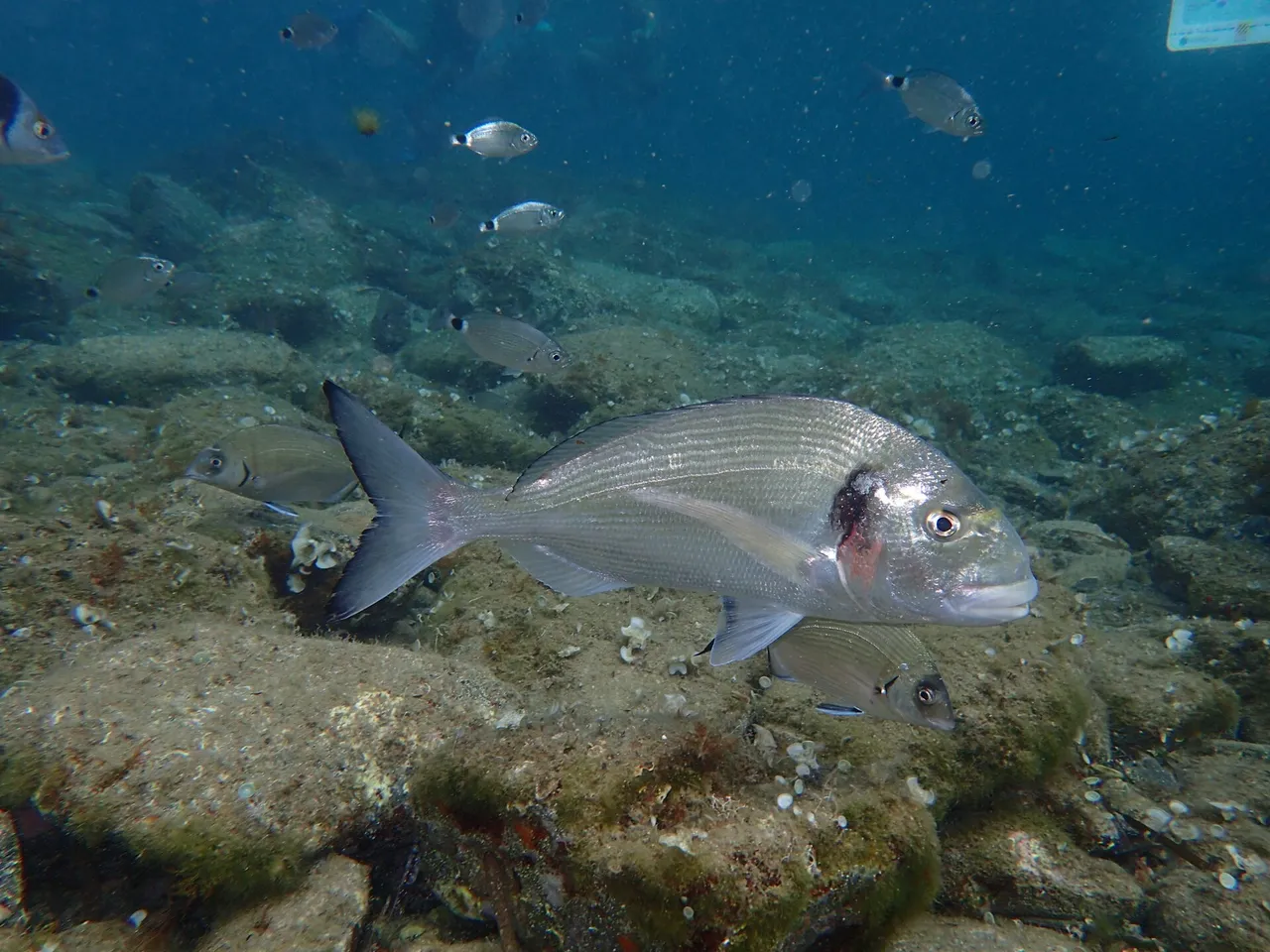
How this was identified, and who took it
Identified by: Identified on the dark blotch at the origin of the lateral line, running onto the upper operculum and bordered below by a red-orange smudge on the opercular margin — a combination no other European sparid carries. Deep body, steep head and faint flank lines are consistent. THE GOLDEN INTERORBITAL BAND IS NOT VISIBLE in this pose and the identification does not rest on it, which is recorded rather than glossed.jujurenoult — CC BY 4.0, via Wikimedia Commons — source, licence
Catching Gilthead bream
Everything here on fishing for it. Each entry opens the page behind it.
- When
- May–Nov — months recorded at the places that document it, not a season for the whole range.
- Where
- 21 places FishingHQ documents — strongest claim anywhere: characteristic of this water · From the shore, From a kayak, From a boat
The gilthead bream is the sparid that everything else in the family is compared with. It is named for the golden band across the forehead between the eyes, which is unmistakable in fresh fish, and it is among the most highly regarded table fish in the Mediterranean.
Biologically it is built around crushing. The jaws carry rows of molar-like teeth capable of breaking open mussels, clams and crabs, and the diet reflects that — this is a fish that eats armoured prey and has the equipment for it. Anglers who understand that fish crab, shellfish and hard-shelled baits rather than soft ones, and use hooks strong enough to survive the same jaws.
It is a protandrous hermaphrodite: individuals mature as males and change sex to female with age and size. That places it in the same category as barramundi and means, again, that the largest fish in a population are the breeding females — a fact with obvious consequences for size-selective fishing.
Its range has been expanding northward along the Atlantic coast of Europe in recent decades, and it is now caught with some regularity in waters where it was formerly a rarity. It is also one of the most important marine aquaculture species in the Mediterranean.
Gear for this fish
- Peeler crabThe statutory guide gives crab as the best bait in the Clonakilty estuary, where it names gilthead bream alongside bass, flounder and three mullet species on the same tide.
- Prawns and shrimpCrushing jaws built for crustaceans, and a prawn is exactly that — fished whole with the shell on so it survives the cast and the fish.
Where Gilthead bream is documented
Places where public sources describe this species as fished, with how it is fished and how strongly the evidence supports it. This is not a range map and it is not a recommendation — it is what has been written down about a fishery rather than a record of any individual catch, and being listed is never permission to fish.
The Bay of Biscay
1 documented place
Bay
Characteristic of this water
From the shore · From a boat
Around May, Jun, Jul, Aug, Sept, Oct, Nov
The Soča and Slovenia's Adriatic rivers
1 documented place
Headland
Characteristic of this water
From the shore
West Cork
3 documented places
Estuary
Regular local target
From the shore
Around Jun, Jul, Aug, Sept
Estuary mark
Regular local target
From the shore
Around Jun, Jul, Aug, Sept
Estuary
Regular local target
From the shore
Around Jun, Jul, Aug, Sept
The Cornish and Devon coasts
6 documented places
Beach section
Recorded here
From the shore
Estuary mark
Occasional
From a kayak
Beach section
Repeatedly reported
From a kayak
Estuary
Occasional
From a kayak
Estuary
Recorded here
From the shore
Estuary
Seasonal
From the shore
Around Jun, Jul, Aug, Sept
Portugal
8 documented places
Estuary
Repeatedly reported
From the shore
Beach
Repeatedly reported
From the shore
Estuary
Repeatedly reported
From the shore
Beach
Recorded here
From the shore
Armação de Pêra
Beach
Recorded here
From the shore
Praia de Faro
Surf beach
Recorded here
From the shore
Tidal channel
Repeatedly reported
From the shore
Ilha de Tavira
Surf beach
Recorded here
From the shore
What these strengths mean
- Recorded here
- At least one credible public account of this species being caught here. That is all it means.
- Occasional
- Caught here, and described as unusual rather than normal. Do not plan a session around it.
- Repeatedly reported
- Several independent public accounts. Enough to say it happens more than once; not enough to call it a fishery.
- Characteristic of this water
- This water is strongly identified with this species by the sources that cover it.
- Regular local target
- Fishing sources describe this as a normal local target here, not merely as caught.
- Seasonal
- Well supported, and concentrated in part of the year rather than spread through it.
When to fish for gilthead bream
Where the places here state a season for gilthead bream, it clusters in Jun–Sep. This is a count of how many documented places name each month — evidence about when people fish for it, not a prediction of what any particular day will produce.
| Jan | Feb | Mar | Apr | May | Jun | Jul | Aug | Sep | Oct | Nov | Dec |
|---|---|---|---|---|---|---|---|---|---|---|---|
| January: no place here names this month — no place names it. | February: no place here names this month — no place names it. | March: no place here names this month — no place names it. | April: no place here names this month — no place names it. | May: 1 place names this month — few places. | June: 6 places name this month — most places. | July: 6 places name this month — most places. | August: 6 places name this month — most places. | September: 6 places name this month — most places. | October: 1 place names this month — few places. | November: 1 place names this month — few places. | December: no place here names this month — no place names it. |
6 of the 21 places that record catches of gilthead bream state which months. The other 15 name no season, so they are counted in neither direction: the shape above is what the dated records say, not the whole picture. The dated records span 4 separate areas.
Identification
- Scientific name
- Sparus aurata
- Family
- Sparidae
- Water
- Saltwater, Brackish
- Conservation status
- Least Concern
- Regions
- Mediterranean, Western Europe, Britain & Ireland, North Africa, West Africa
- A distinct golden band across the forehead between the eyes — the character the name refers to, vivid in fresh fish and fading after death.
- A dark, often blackish blotch at the origin of the lateral line on the gill cover edge, frequently with a red-orange smudge beneath it.
- Deep, compressed, oval sparid body with a steep head profile.
- Silvery-grey with a slight golden sheen along the flanks; longitudinal darker lines may be visible.
- Powerful jaws with rows of molar-like crushing teeth visible in the mouth — a family character but strongly developed here.
Size
- Typical
- 0.4–1 kg (0.9–2.2 lb)
- Large
- 2–3 kg (4.4–6.6 lb)
Exceptional: Over 4 kg (8.8 lb); maximum published weight 17.2 kg
Crushing teeth at one end and sharp spines at the other
Gilthead bream have a mouth built to crush shellfish — heavy molariform teeth in rows on strong jaws — and a stiff spiny dorsal, and the two produce entirely different injuries at opposite ends of the fish.
THE TEETH ARE NOT SHARP AND THAT IS THE PROBLEM. A gilthead does not cut a finger; it crushes it. The jaws close on shellfish with enough force to break them, and a finger placed inside the mouth of a decent fish is bruised badly and may be broken. Anglers who have handled toothy predators expect a cut and are surprised. Keep fingers out of the mouth and use pliers.
THE DORSAL SPINES are stiff and sharp and are met by a hand gripping across the back. Slide the hand from the tail so the fin folds flat, or hold the fish across the body low, below the fin line.
THE GILL COVER EDGE is sharp on this species as it is on most sparids.
THE FISH'S SIDE. Gilthead are frequently caught on light tackle in warm shallow water in summer, which is the combination that produces poor release survival. They also fight hard for their size. In warm water, minimise the fight where possible, keep the fish wet, and hold it upright in the water until it leaves under its own power.
AND WHERE THE FISHING IS FROM ROCK, the handling problem is secondary to the ground: this species is fished from platforms where a distracted angler bending over a fish is the mechanism behind most serious incidents.
What experienced anglers do — why, and the sources (2)
Widely and independently recommended by experienced anglers and specialist sources. This is real angling knowledge, not proof: controlled evidence for it is limited, and FishingHQ records it as convention rather than as a demonstrated effect.
- FishBase: a global information system on fishes — Froese, R. and D. Pauly, eds. — FishBase Consortium (Scientific institute)Relied on for: Dentition, fin and spine morphology, body form, air-breathing capability and distribution for the species, which are the anatomical facts the handling practice below follows from.States this directlyPassage read and verified
- General angling website restatements of established technique — Various (Credible secondary source)Relied on for: Widely restated angling practice for handling this species, recorded as practitioner consensus rather than as tested fact.Background and mechanism onlyCitation checked — the work exists and is described correctly
Male first, female later: the opposite sex change, and why it matters differently
Gilthead bream run the sex change in the opposite direction from wrasse and grouper, and the difference in direction changes the consequences in a way worth understanding.
GILTHEAD ARE PROTANDROUS: individuals mature as males and become female later, with age and size. That is the reverse of protogyny, and it is the same pattern found in barramundi and in snook — three unrelated species that arrived at the same solution independently, which is a reasonable indication that it works.
SO THE LARGE FISH ARE THE FEMALES, and size-selective fishing is female-selective fishing. The consequence differs from the protogynous case in an important respect. Removing males from a protogynous population is dangerous because a small number of males fertilise many females, so losing them can leave eggs unfertilised. Removing females from a protandrous population is dangerous for a different reason: fecundity scales steeply with body size, so the largest females produce disproportionately many eggs, and taking them removes an outsized share of total reproductive output. Both are size-selective problems; the mechanism is not the same.
THE SPAWNING IS COOL-SEASON AND COASTAL, with pelagic eggs and larvae drifting in the water column — a broadcast strategy with no parental investment after release.
AND THE JUVENILE STAGE IS THE PART ANGLERS ACTUALLY MEET. Young gilthead move into brackish lagoons, estuaries and coastal salinas to feed and grow before returning to more saline coastal water as adults. They tolerate a wide salinity range and they exploit the high productivity of those systems, which is why small gilthead turn up in places that seem improbable for a marine bream — and why lagoon and estuary habitat matters to a population whose adults live offshore of it.
THE MOUTH EXPLAINS WHERE THEY FEED IN BOTH STAGES. Gilthead carry powerful jaws with molariform crushing teeth built for shellfish, which is why they are found over mussel beds, oyster ground and shellfish farms, and why they are regarded as a pest by shellfish growers in parts of the Mediterranean — the same equipment that makes them a valued sport fish makes them an expensive neighbour.
Backed by research — why, and the sources (2)
Supported by peer-reviewed research or fisheries science. The sources are listed and can be checked.
- FishBase: a global information system on fishes — Froese, R. and D. Pauly, eds. — FishBase Consortium (Scientific institute)Relied on for: Reproductive mode, spawning season, fecundity, parental care, sex-change pattern and larval development recorded for the species.States this directlyPassage read and verified
- The IUCN Red List of Threatened Species — International Union for Conservation of Nature (Conservation authority)Relied on for: Assessment, population trend, and the life-history traits — age at maturity, longevity, reproductive strategy — that determine sensitivity to exploitation.States this directlyCitation checked — the work exists and is described correctly
Between the sea and the lagoon, and a fish that moves with the salinity
Gilthead bream have one of the most instructive habitat patterns in the Mediterranean and eastern Atlantic, because the fish moves deliberately between two very different environments and the movement is the fishery.
THE ADULT SEA HABITAT IS SHALLOW COASTAL GROUND, MIXED AND VARIED. Gilthead occupy sandy bottoms, seagrass meadows, rocky and mixed ground, harbour and breakwater structure, and the margins of reef, generally in shallow water over the shelf. What ties those together is food: gilthead are powerful molluscivores with crushing pharyngeal teeth, and they go where shellfish are. A mussel-covered wall, a clam bed, an oyster lease and a seagrass meadow full of small bivalves are all gilthead habitat for the same reason.
THE SECOND HABITAT IS BRACKISH AND IT IS SEASONAL. Gilthead move into coastal lagoons, saltmarsh channels, estuaries and salinas in spring and summer, exploiting the exceptional productivity of warm, shallow, sheltered brackish water, and return to the sea as it cools. This is a euryhaline fish that handles a wide salinity range comfortably, and the lagoon phase is where much of its growth happens.
WHICH MAKES THE LAGOON A NURSERY AS WELL AS A FEEDING GROUND. Juveniles use these shallow brackish systems heavily, and the classic Mediterranean lagoon fisheries — the *vallicoltura* traditions of the northern Adriatic among them — are built precisely on intercepting fish moving between lagoon and sea on a seasonal schedule.
TEMPERATURE SETS THE LIMIT AND IS MOVING. Gilthead are a warm-water fish; they are sensitive to cold and can suffer mortality in shallow lagoons during severe winters, which is why the seasonal retreat to the sea happens. The species' northward extension along the Atlantic coast of Europe in recent decades is a temperature story, and gilthead are now caught in places that had no tradition of them.
SUBSTRATE DECIDES WHERE THEY FEED WITHIN A GROUND. Look for the shellfish: mussel-encrusted structure, cockle and clam beds on sand, seagrass with a rich infauna. Gilthead work the interface between sand and structure rather than open sand or bare rock.
AND AQUACULTURE COMPLICATES ANY LOCAL ACCOUNT. This is one of the most farmed fish in the Mediterranean, escapees are common, and the distribution of the animal near cage sites reflects the farms as much as the ecology.
Backed by research — why, and the sources (2)
Supported by peer-reviewed research or fisheries science. The sources are listed and can be checked.
- NOAA National Ocean Service education on estuaries and the National Estuarine Research Reserve System — National Oceanic and Atmospheric Administration, United States (Government fisheries body)Relied on for: Estuarine structure and function, the salinity gradient, turbidity maxima, and the nursery role of estuarine habitat.States this directlyCitation checked — the work exists and is described correctly
- FishBase: a global information system on fishes — Froese, R. and D. Pauly, eds. — FishBase Consortium (Scientific institute)Relied on for: Salinity tolerance, habitat association and life-stage distribution for the species.States this directlyPassage read and verified
Into the lagoon in spring, back to the sea before the cold: a fish with two seasons a year
Gilthead bream have an unusually explicit seasonal pattern because they physically relocate between two environments twice a year, and both movements are temperature-driven.
SPRING TAKES THEM INTO BRACKISH WATER. As lagoons, estuaries, saltmarsh channels and salinas warm faster than the open sea, gilthead move into them to exploit an exceptionally productive shallow environment. Growth through that phase is rapid; these are warm, food-rich, sheltered waters and the fish are there to feed.
AUTUMN TAKES THEM BACK OUT, AND THE TIMING IS A SURVIVAL MATTER. Shallow brackish water cools faster and further than the sea, and gilthead are cold-sensitive. The autumn exodus is a retreat from lethal winter temperature, and fish that fail to leave a lagoon before a hard winter can suffer mass mortality. So the outward migration is a sharper, more urgent event than the inward one, and it can be triggered abruptly by a cold snap.
WHICH GIVES A COASTAL ANGLER TWO DISTINCT WINDOWS. The inward and outward movements concentrate fish at the channels, mouths and gates between the lagoon and the sea, and those are the periods when the species is most predictably encountered. The classic Mediterranean lagoon fisheries are built on exactly that, and the traditional trapping systems are placed to intercept it.
SPAWNING HAPPENS IN THE SEA IN THE COLDER MONTHS, which is the reverse of the intuitive pattern and worth stating. Gilthead spawn offshore in autumn and winter; the lagoon phase is feeding and growth, not reproduction. The species is protandrous — maturing male and changing to female — so the sex composition of a population shifts with size and, indirectly, with the seasonal size structure of the fish present.
THE NORTHERN EDGE HAS A COMPRESSED YEAR. On the Atlantic coast of Europe, where gilthead have extended their range as waters have warmed, the fish are a summer and autumn proposition only, and the season varies considerably between years. In the warm heart of the range the fish are present year-round and the seasonality is a matter of where they are rather than whether they are there.
AND NOTHING ABOVE STATES A RULE. Closed periods, size limits and permitted methods for gilthead differ between jurisdictions and are not derivable from the migration pattern.
Backed by research — why, and the sources (2)
Supported by peer-reviewed research or fisheries science. The sources are listed and can be checked.
- FishBase: a global information system on fishes — Froese, R. and D. Pauly, eds. — FishBase Consortium (Scientific institute)Relied on for: Spawning season, migratory behaviour, temperature preference and seasonal distribution recorded for the species.States this directlyPassage read and verified
- The IUCN Red List of Threatened Species — International Union for Conservation of Nature (Conservation authority)Relied on for: Assessment and life-history account, including reproductive timing and the seasonal pressures on the population.Background and mechanism onlyCitation checked — the work exists and is described correctly
Lifecycle and reproduction
A protandrous hermaphrodite: individuals mature as males at one to two years and change sex to female at around two to three years and above a certain size. Growth is moderate and the species lives to around eleven years. The sex-change pattern means that the largest individuals in a population are overwhelmingly female, and that size-selective removal takes the breeding stock specifically.
Spawns in the cooler months in coastal waters, with pelagic eggs and larvae. The protandrous life history — male first, female later — is the biologically important feature and is the same pattern seen in barramundi, though the two are unrelated. Juveniles frequently enter brackish lagoons and estuaries to feed and grow before returning to more saline coastal water.
Feeding and senses
Feeds principally on shellfish, crustaceans and other hard-bodied invertebrates, crushing them with molar-like pharyngeal and jaw teeth, and takes worms and small fish opportunistically. The crushing dentition is the defining feature: this is a fish equipped for armoured prey, and the traditional baits — crab, mussel, razorfish, prawn — reflect exactly that.
Sight and taste both contribute in the clear inshore water it favours. Gilthead are notably cautious and become markedly harder to catch on heavily fished ground, which is consistent with a fish that inspects food closely before crushing it. Light traces and well-presented natural baits consistently outperform heavier tackle for this reason.
Through the year
Moves inshore into shallow coastal water, lagoons and estuaries in the warmer months to feed and offshore into deeper water in the coldest part of the year, when spawning occurs. In the northern part of the expanding range the species is a summer visitor. Tidal state governs the daily fishing over the shellfish beds and sandy ground it feeds on.
Distribution
Eastern Atlantic from the British Isles south to Cape Verde, and throughout the Mediterranean; less common in the Black Sea. Occurs over sand, seagrass and mixed ground in shallow coastal water, entering brackish lagoons and estuaries, generally shallower than 30 m.
This is a biological range — where the species occurs, not a prediction that you will catch one. To browse the fishing geography FishingHQ holds, start at fishing places.
Why anglers care
The most prized sea bream in Mediterranean recreational fishing, taken on crab, shellfish, prawn and worm baits with light tackle from shore and small boats, and increasingly on lures and soft plastics. A major aquaculture species. Its northward expansion has made it a growing target on the Atlantic coasts of France, Spain and Portugal and an occasional prize further north.
Handling and returning
Sharp dorsal spines and firm gill covers, and jaws powerful enough to injure a finger placed inside them. Wet hands, support the body, keep fingers clear of the mouth and gill plates, and use a disgorger or pliers. Where an upper size limit or a slot applies, the large fish are the breeding females and returning them properly is the purpose of the rule.
Going further
- What does gilthead bream eat? — feeding biology, kept separate from what anglers infer from it.
- Gilthead bream vs Common dentex — how to tell them apart.
Safety
Venomous and spined species — Can cause injury needing treatment
Sharp dorsal spines and firm gill covers on a deep-bodied fish that is awkward to grip, plus crushing jaws that will injure a finger placed in the mouth.
What reduces it: Wet hands, support the body from beneath, keep fingers clear of the mouth and gill plates, and use a disgorger or long pliers.
Tides and being cut off — Can cause injury needing treatment
Much of the shore fishery is over shallow sand, lagoon edges and shellfish ground fished on a rising tide, which is classic cut-off ground.
What reduces it: Check tide times and heights before going out, identify the exit, and leave on a set clock time rather than on the fishing.
Precautions that always apply here
- Handle spined and venomous species with the spines controlled. Know which local species have them before you fish, not afterwards.
- Wet your hands before touching a fish. Dry hands strip the protective mucus layer that keeps infection out.
- Check the tide before you go and know your exit route. Being cut off is the commonest way a shore session becomes a rescue.
- Support the fish's weight along its body, keep it out of the water for as short a time as possible, and hold it over something soft.
Check the rules before you fish
Fishing laws, bylaws, access rules, seasons, bait restrictions and permitted methods vary by location and can change. Check the current rules from the relevant authority and the water you intend to fish before fishing.
Check with:
- Current national or regional law for where you are fishing
- Current local bylaws
- The relevant fisheries authority
- The landowner, club or fishery whose water it is
- Any restrictions specific to the species or the method you intend to use
Where to go next
Similar and related fish
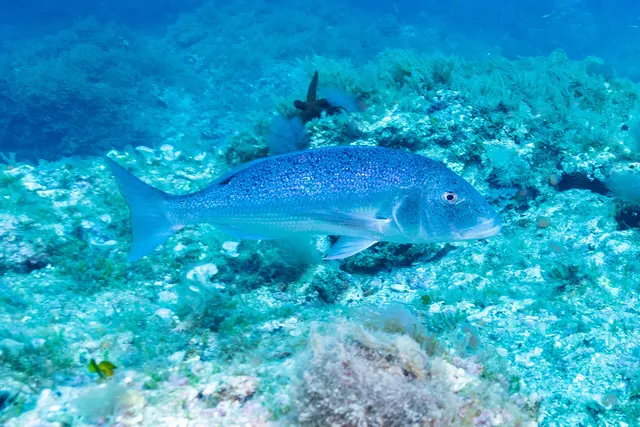 Common dentexBoth are Sparidae and neither is what its market name suggests. The dentex hunts fish with canines; the gilthead crushes shellfish with molars. Same family, opposite equipment.
- White seabreamSparids of the same mediterranean ground separated by flank barring and by the gilthead's gold brow band.
Where you will find it
- Balearic IslandsPresent around the islands over sand, seagrass and shellfish ground, where its crushing dentition suits the bottom it feeds on.
- CyprusThe most sought-after of the shore breams and the clearest case of why a market name is a poor identification: gilthead is the mainstay of Mediterranean aquaculture, so a fish on a plate here is far more often farmed than caught.
- FrancePresent on both the Atlantic and Mediterranean coasts, with juveniles using the coastal lagoons and estuaries of the Mediterranean shore.
- PortugalPresent along the coast with juveniles using the Ria Formosa and other lagoon systems as nursery habitat before moving to more saline water.
- SpainOne of the defining inshore fish of the Spanish Mediterranean and present on the Atlantic side as well, and the species most likely to be the answer to what somebody has caught off a Spanish rock.
- The Bay of BiscayPresent along both coasts with juveniles using the estuaries and coastal lagoons of the bay before returning to more saline water as adults.
- The Croatian AdriaticOver the sand and seagrass margins and around the few brackish transitions, in a coast that otherwise offers almost no soft or estuarine ground.
- The Moroccan Atlantic coastOccupies the sandy and mixed inshore ground and the lagoon systems, and is a mainstay of the shore fishery.
2 more
- The Moroccan Mediterranean coast Fishing regions
- West Cork Fishing regions
Understanding this fish
- Bivalve and gastropod molluscs as preyGilthead bream crush shellfish with heavy molariform teeth, to the extent that they are a recognised problem on commercial shellfish beds.
- Decapod crustaceans as preyCrabs and shrimps are taken alongside molluscs on shallow sand and mixed ground, particularly in estuarine water.
Told apart from
Sources and evidence
- FishBase: a global information system on fishes — Froese, R. and D. Pauly, eds. — FishBase Consortium (Scientific institute)Relied on for: Scientific name, family placement in the Sparidae, a maximum length of 70.0 cm TL, a maximum published weight of 17.2 kg, a maximum reported age of 14 years.States this directlyPassage read and verified
- FishBase: a global information system on fishes — Froese, R. and D. Pauly, eds. — FishBase Consortium (Scientific institute)Relied on for: Environment, climate zone and depth range as recorded: Marine; brackish; demersal; depth range 1 - 150 m , usually 1 - 30 m . Subtropical; 62°N - 15°N, 17°W - 43°EStates this directlyPassage read and verified
- FishBase: a global information system on fishes — Froese, R. and D. Pauly, eds. — FishBase Consortium (Scientific institute)Relied on for: The IUCN Red List category for Sparus aurata — Least Concern, assessed 19 August 2009 — as republished by FishBase, the Red List itself being unreachable during review.States this directlyPassage read and verified
- ICES Advice on fishing opportunities, catch and effort — International Council for the Exploration of the Sea (Scientific institute)Relied on for: That eastern Atlantic and Mediterranean stocks are assessed through scientific advice processes feeding management.Background and mechanism onlyCitation checked — the work exists and is described correctly
- Good Fish Guide — Marine Conservation Society (Conservation authority)Relied on for: That sequential hermaphroditism and size structure are material to whether a stock can sustain harvest.FishingHQ's interpretation of what it saysCitation checked — the work exists and is described correctly
Why the 18 connections on this page are here, and the sources
Similar and related fish
Backed by research — 2 connections
Supported by peer-reviewed research or fisheries science. The sources are listed and can be checked.
Common dentex
A comparison resting on shared family and contrasting feeding morphology, naming both binomials.
- FishBase: a global information system on fishes — Froese, R. and D. Pauly, eds. — FishBase Consortium (Scientific institute)Relied on for: That Sparus aurata and Dentex dentex are both Sparidae of the eastern Atlantic and Mediterranean with differing dentition and feeding ecology.States this directlyPassage read and verified
White seabream
An identification comparison naming both binomials: Diplodus sargus and Sparus aurata.
- FishBase: a global information system on fishes — Froese, R. and D. Pauly, eds. — FishBase Consortium (Scientific institute)Relied on for: Morphological and distributional data for Diplodus sargus and for Sparus aurata.States this directlyPassage read and verified
- The IUCN Red List of Threatened Species — International Union for Conservation of Nature (Conservation authority)Relied on for: Separate assessments treating Diplodus sargus and Sparus aurata as distinct species.States this directlyCitation checked — the work exists and is described correctly
How it is caught
What experienced anglers do — 1 connection
Widely and independently recommended by experienced anglers and specialist sources. This is real angling knowledge, not proof: controlled evidence for it is limited, and FishingHQ records it as convention rather than as a demonstrated effect.
Ledgering
A practitioner claim following from the species' verified crushing dentition.
- Sea Angler — Bauer Media (Specialist angling publication)Relied on for: Practitioner treatment of crab and shellfish baits for sea bream and of the tackle required for crushing-jawed species.Citation checked — the work exists and is described correctly
- General angling website restatements of established technique — Various (Credible secondary source)Relied on for: Widely restated practitioner guidance on bait selection for gilthead bream.Citation checked — the work exists and is described correctly
Gear for this fish
Reported, not established — 1 connection
Reported, but without independent support. Recorded because it is in circulation, not because it has been shown to hold.
Peeler crab
One publisher, but a statutory one, naming the bait at four separate marks in the same estuary system where it names the species. Recorded as practice on that coast rather than as a general claim, and graded as a claim resting on a single independent original.
- Inland Fisheries Ireland: South West Sea Angling Guide — the west and south Cork angling marks — Inland Fisheries Ireland, 2020 (Government fisheries body)Relied on for: The statutory body naming crab as the best bait at the estuary marks where it gives gilthead bream as an ordinary catch.Passage read and verified
What experienced anglers do — 1 connection
Widely and independently recommended by experienced anglers and specialist sources. This is real angling knowledge, not proof: controlled evidence for it is limited, and FishingHQ records it as convention rather than as a demonstrated effect.
Prawns and shrimp
A practitioner claim following from the species' verified crushing dentition.
- Sea Angler — Bauer Media (Specialist angling publication)Relied on for: Practitioner treatment of prawn and shellfish baits for sea bream.Citation checked — the work exists and is described correctly
- General angling website restatements of established technique — Various (Credible secondary source)Relied on for: Widely restated practitioner guidance on shell-on prawn presentation.Citation checked — the work exists and is described correctly
Where you will find it
Backed by research — 10 connections
Supported by peer-reviewed research or fisheries science. The sources are listed and can be checked.
Balearic Islands
Occurrence of the species in these waters: a statement about the animal's distribution, not a venue recommendation.
- The Fishes of the British Isles and North-West Europe — Macmillan, 1969 (Reference work)Relied on for: Distribution and habitat association of fishes in north-west European and eastern Atlantic waters.States this directlyCitation checked — the work exists and is described correctly
- FishBase: a global information system on fishes — Froese, R. and D. Pauly, eds. — FishBase Consortium (Scientific institute)Relied on for: Distribution, depth range and habitat association recorded for the species.States this directlyPassage read and verified
Cyprus
A distribution edge resting on published regional identification and distribution references, written where the species is genuinely characteristic of the destination's fishing rather than merely recorded from its waters.
- FAO Species Identification Guides for Fishery Purposes and the FAO Species Catalogues — Food and Agriculture Organization of the United Nations (Scientific institute)Relied on for: Distribution, habitat association and biology of the fishes of the eastern central Atlantic and the Mediterranean, from the regional identification guides prepared for fishery purposes.States this directlyCitation checked — the work exists and is described correctly
- FishBase: a global information system on fishes — Froese, R. and D. Pauly, eds. — FishBase Consortium (Scientific institute)Relied on for: Recorded environment, depth range, distribution and biology of the species named.States this directlyPassage read and verified
France
Occurrence of the species in these waters: a statement about the animal's distribution, not a venue recommendation.
- The Fishes of the British Isles and North-West Europe — Macmillan, 1969 (Reference work)Relied on for: Distribution and habitat association of fishes in north-west European and eastern Atlantic waters.States this directlyCitation checked — the work exists and is described correctly
- FishBase: a global information system on fishes — Froese, R. and D. Pauly, eds. — FishBase Consortium (Scientific institute)Relied on for: Distribution, depth range and habitat association recorded for the species.States this directlyPassage read and verified
Portugal
Occurrence of the species in these waters: a statement about the animal's distribution, not a venue recommendation.
- The Fishes of the British Isles and North-West Europe — Macmillan, 1969 (Reference work)Relied on for: Distribution and habitat association of fishes in north-west European and eastern Atlantic waters.States this directlyCitation checked — the work exists and is described correctly
- FishBase: a global information system on fishes — Froese, R. and D. Pauly, eds. — FishBase Consortium (Scientific institute)Relied on for: Distribution, depth range and habitat association recorded for the species.States this directlyPassage read and verified
Spain
That a species occurs in these waters, drawn from distribution science and stock assessment. It is a statement about where the animal lives and is not a statement that anybody will catch one, still less where.
- FAO Species Identification Guides for Fishery Purposes and the FAO Species Catalogues — Food and Agriculture Organization of the United Nations (Scientific institute)Relied on for: Identification, distribution and habitat association of the fishes and invertebrates of the Mediterranean and Black Sea.States this directlyCitation checked — the work exists and is described correctly
- FishBase: a global information system on fishes — Froese, R. and D. Pauly, eds. — FishBase Consortium (Scientific institute)Relied on for: Recorded distribution, depth range and habitat association of the species named.States this directlyPassage read and verified
The Bay of Biscay
Occurrence of the species in this system or along this coast: a statement about the animal's distribution, not a venue recommendation.
- The Fishes of the British Isles and North-West Europe — Macmillan, 1969 (Reference work)Relied on for: Distribution and habitat association of fishes in British and north-west European waters.States this directlyCitation checked — the work exists and is described correctly
- FishBase: a global information system on fishes — Froese, R. and D. Pauly, eds. — FishBase Consortium (Scientific institute)Relied on for: Distribution, depth range and habitat association recorded for the species.States this directlyPassage read and verified
The Croatian Adriatic
A claim that a place contains the ground, water and seasonal conditions the species is associated with. It is a distributional statement about the world, it rests on the regional reference literature, and it deliberately asserts nothing about access, permission or catch.
- FishBase: a global information system on fishes — Froese, R. and D. Pauly, eds. — FishBase Consortium (Scientific institute)Relied on for: Recorded distribution, depth range and habitat association for the Mediterranean species named.States this directlyPassage read and verified
- FAO Species Identification Guides for Fishery Purposes and the FAO Species Catalogues — Food and Agriculture Organization of the United Nations (Scientific institute)Relied on for: Regional species identification and distribution for the Mediterranean and eastern Atlantic, including habitat association.States this directlyCitation checked — the work exists and is described correctly
The Moroccan Atlantic coast
A distribution association between an animal and a kind of water, rather than a claim about any named mark.
- FAO Species Identification Guides for Fishery Purposes and the FAO Species Catalogues — Food and Agriculture Organization of the United Nations (Scientific institute)Relied on for: Distribution, habitat, depth and fishery accounts for the species of the eastern central Atlantic and Mediterranean in the FAO regional identification guides.States this directlyCitation checked — the work exists and is described correctly
- FishBase: a global information system on fishes — Froese, R. and D. Pauly, eds. — FishBase Consortium (Scientific institute)Relied on for: Distribution, habitat association and depth range recorded for the species.States this directlyPassage read and verified
The Moroccan Mediterranean coast
A distribution claim about the world, so it rests on the reference datasets rather than on angling report. FishingHQ's evidence policy requires it.
- FishBase: a global information system on fishes — Froese, R. and D. Pauly, eds. — FishBase Consortium (Scientific institute)Relied on for: Distribution, habitat association and depth range recorded for the species, including its occurrence in the water body concerned.States this directlyPassage read and verified
- FAO Species Identification Guides for Fishery Purposes and the FAO Species Catalogues — Food and Agriculture Organization of the United Nations (Scientific institute)Relied on for: Distribution, habitat, depth and fishery accounts for the species of the eastern central Atlantic and Mediterranean.States this directlyCitation checked — the work exists and is described correctly
West Cork
A claim that a coast contains the ground and conditions the species is associated with. It is a distributional statement about the world, it rests on the regional reference literature, and it deliberately asserts nothing about access, permission or catch.
- The Fishes of the British Isles and North-West Europe — Macmillan, 1969 (Reference work)Relied on for: Distribution and habitat association of the marine and estuarine fishes of the British Isles and north-west Europe, including which coasts and ground types a species occupies.States this directlyCitation checked — the work exists and is described correctly
- FishBase: a global information system on fishes — Froese, R. and D. Pauly, eds. — FishBase Consortium (Scientific institute)Relied on for: Recorded distribution, depth range and habitat association for the species named.States this directlyPassage read and verified
Understanding this fish
Backed by research — 2 connections
Supported by peer-reviewed research or fisheries science. The sources are listed and can be checked.
Bivalve and gastropod molluscs as prey
Recorded diet evidence identifies bivalve and gastropod molluscs as a food item of this predator at group level rather than to species. The edge points at the taxon record for that reason, and encoding it as a species-level claim would assert something the source does not.
- FishBase: a global information system on fishes — Froese, R. and D. Pauly, eds. — FishBase Consortium (Scientific institute)Relied on for: Food items recorded for this predator, given as bivalve and gastropod molluscs.States this directlyPassage read and verified
- FAO Species Identification Guides for Fishery Purposes and the FAO Species Catalogues — Food and Agriculture Organization of the United Nations (Scientific institute)Relied on for: Species account describing this predator's diet, recorded at the level of bivalve and gastropod molluscs.Background and mechanism onlyCitation checked — the work exists and is described correctly
Decapod crustaceans as prey
Recorded diet evidence identifies decapod crustaceans as a food item of this predator at group level rather than to species. The edge points at the taxon record for that reason, and encoding it as a species-level claim would assert something the source does not.
- FishBase: a global information system on fishes — Froese, R. and D. Pauly, eds. — FishBase Consortium (Scientific institute)Relied on for: Food items recorded for this predator, given as decapod crustaceans.States this directlyPassage read and verified
- FAO Species Identification Guides for Fishery Purposes and the FAO Species Catalogues — Food and Agriculture Organization of the United Nations (Scientific institute)Relied on for: Species account describing this predator's diet, recorded at the level of decapod crustaceans.Background and mechanism onlyCitation checked — the work exists and is described correctly
Told apart from
What experienced anglers do — 1 connection
Widely and independently recommended by experienced anglers and specialist sources. This is real angling knowledge, not proof: controlled evidence for it is limited, and FishingHQ records it as convention rather than as a demonstrated effect.
Black seabream
Two records a reader will hold together — here because the fish are confused with one another in the hand, which is an identification problem rather than a preference.
- The Fishes of the British Isles and North-West Europe — Macmillan, 1969 (Reference work)Relied on for: Distribution, habitat association, identification and biology of the fishes of the British Isles and north-west Europe.States this directlyCitation checked — the work exists and is described correctly
- FAO Species Identification Guides for Fishery Purposes and the FAO Species Catalogues — Food and Agriculture Organization of the United Nations (Scientific institute)Relied on for: Diagnostic characters, habitat and depth range as set out in the FAO species identification sheets for the eastern Atlantic and Mediterranean.States this directlyCitation checked — the work exists and is described correctly
How FishingHQ labels evidence is explained in the evidence policy.