What does gilthead bream eat?
What is established about how gilthead bream feeds, kept separate from what anglers infer from it.
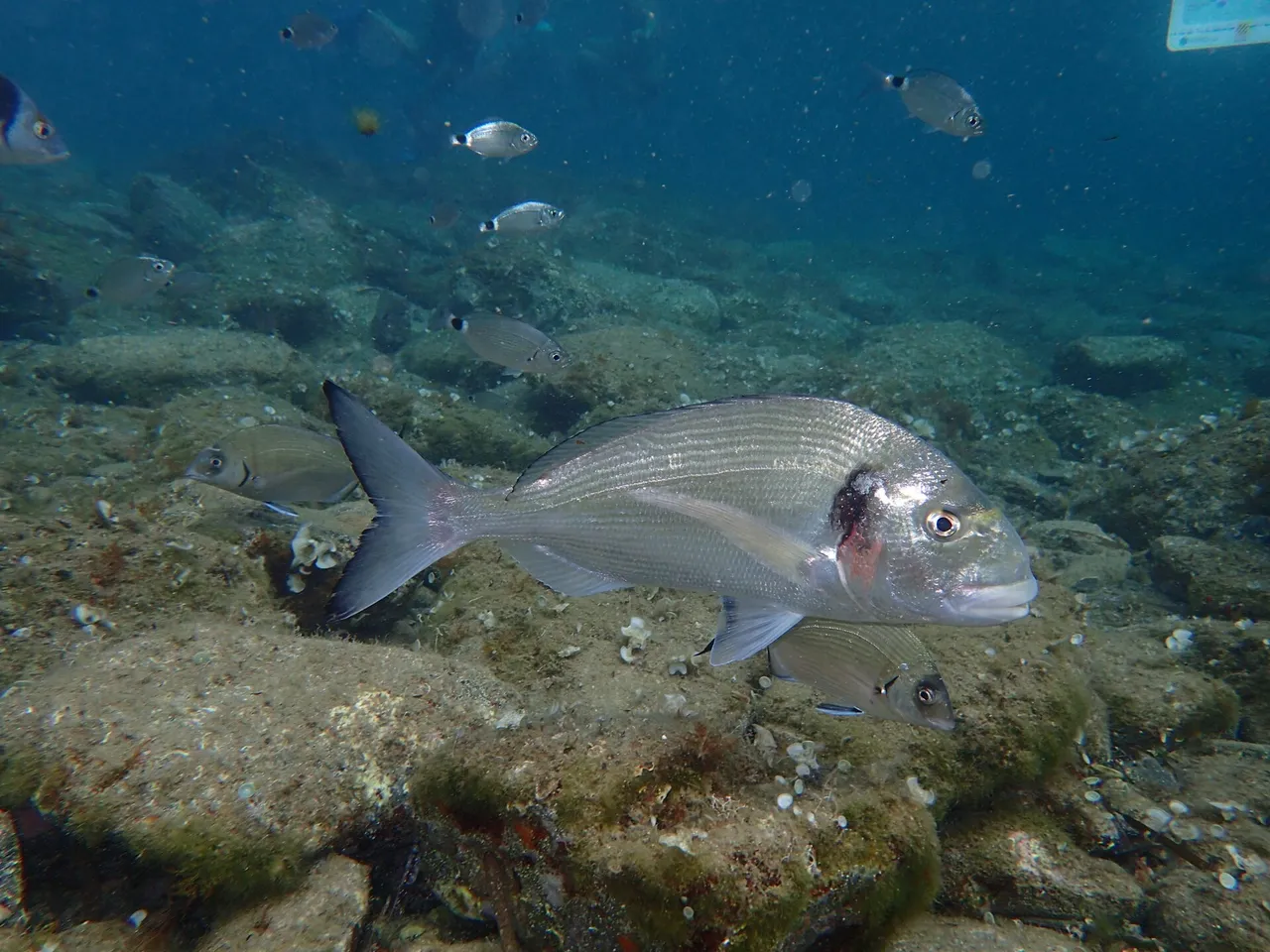
How this was identified, and who took it
Identified by: Identified on the dark blotch at the origin of the lateral line, running onto the upper operculum and bordered below by a red-orange smudge on the opercular margin — a combination no other European sparid carries. Deep body, steep head and faint flank lines are consistent. THE GOLDEN INTERORBITAL BAND IS NOT VISIBLE in this pose and the identification does not rest on it, which is recorded rather than glossed.jujurenoult — CC BY 4.0, via Wikimedia Commons — source, licenceWhat is known about how it feeds
A gilthead bream can crush an oyster, and the fishery consequences of that are more serious than they sound.
The jaws carry rows of rounded molariform teeth backed by a heavy skull, and the resulting bite force is sufficient to break the shells of bivalves and gastropods outright. This is not the pharyngeal mill a wrasse uses; the crushing happens at the front, in the mouth. The species is a recognised problem on commercial shellfish beds across the Mediterranean and eastern Atlantic for exactly this reason, and that is a stronger piece of evidence about diet than most stomach-content studies.
The second verified relationship is decapod crustaceans, taken on shallow sand, mixed ground and in estuarine water, and crushed the same way.
The species is protandrous — individuals typically function as males first and as females later — so large fish are usually female and are usually old. Feeding does not change with the sex change, but the population consequence of removing large fish does.
Giltheads are warm-water fish that move into shallow coastal and lagoon water as it warms and out again as it cools, and they are strongly associated with brackish conditions during the feeding season. The seasonal pattern is the reverse of the northern gadoids on FishingHQ.
The food
Prey with a verified dietary link to this fish. Each entry carries its own evidence, and each is written at the precision the source actually used: a named species where the source named one, a group or food category where it said “polychaetes”, “crustaceans” or “detritus” and meant it. That is why this list is shorter than the animal’s real diet rather than longer.
- Bivalve and gastropod molluscs as prey — a group rather than a species: the evidence names the group
Gilthead bream crush shellfish with heavy molariform teeth, to the extent that they are a recognised problem on commercial shellfish beds.
- Decapod crustaceans as prey — a group rather than a species: the evidence names the group
Crabs and shrimps are taken alongside molluscs on shallow sand and mixed ground, particularly in estuarine water.
Food with no page of its own here yet
These are real components of the diet, listed as plain text because FishingHQ has no page for them yet. Inventing pages to make the list look fuller would be the fabrication this whole approach exists to prevent.
- mussels and clams
- razorfish
- small crabs
- polychaete worms
- sea urchins
What anglers do with this
Everything below is interpretation, not finding. It is what experienced anglers conclude from the biology above, and the reasoning is usually sound and almost never tested. It is separated from the biology deliberately.
The crushing dentition is the basis of the standard use of hard-shelled natural baits, and the reasoning is mechanical and explicit in the practitioner literature around the Mediterranean and the Atlantic coast of Iberia. It is convention rather than a tested comparison.
The same dentition is a handling consideration that is not interpretation: a gilthead can injure a hand, and the fish should be controlled rather than gripped near the mouth.
The warm-season pattern converts into a straightforward expectation about when the fishery works, and it is one of the clearer seasonal relationships in the European sea angling catalogue.
What this does not establish
Both relationships are group-level. Diet composition varies between lagoon, estuarine and open coastal ground and with the size of the fish, and the account describes wild fish — a very large number of gilthead bream in the region are of aquaculture origin and their diet history is entirely different. Nothing here establishes proportions.
Where this connects
These are the baits, lures, methods and explainers FishingHQ already joins to this fish — which is why the list is sometimes short. They are not chosen for this page, and a link here means an evidenced relationship exists, not that it follows from the diet.
Baits recorded for this species
Methods used for it
This page covers feeding. The Gilthead bream record covers identification, lifecycle, seasonal behaviour, handling and the sources behind all of it.
Reviewed 2026-08-12.