Gilthead bream vs Common dentex
How to tell them apart, and what follows from getting it right.
Why they get confused
Two large Sparidae of the same Mediterranean and eastern Atlantic ground, both deep-bodied, both silver-grey, and both taken on the same baits over the same rough bottom.
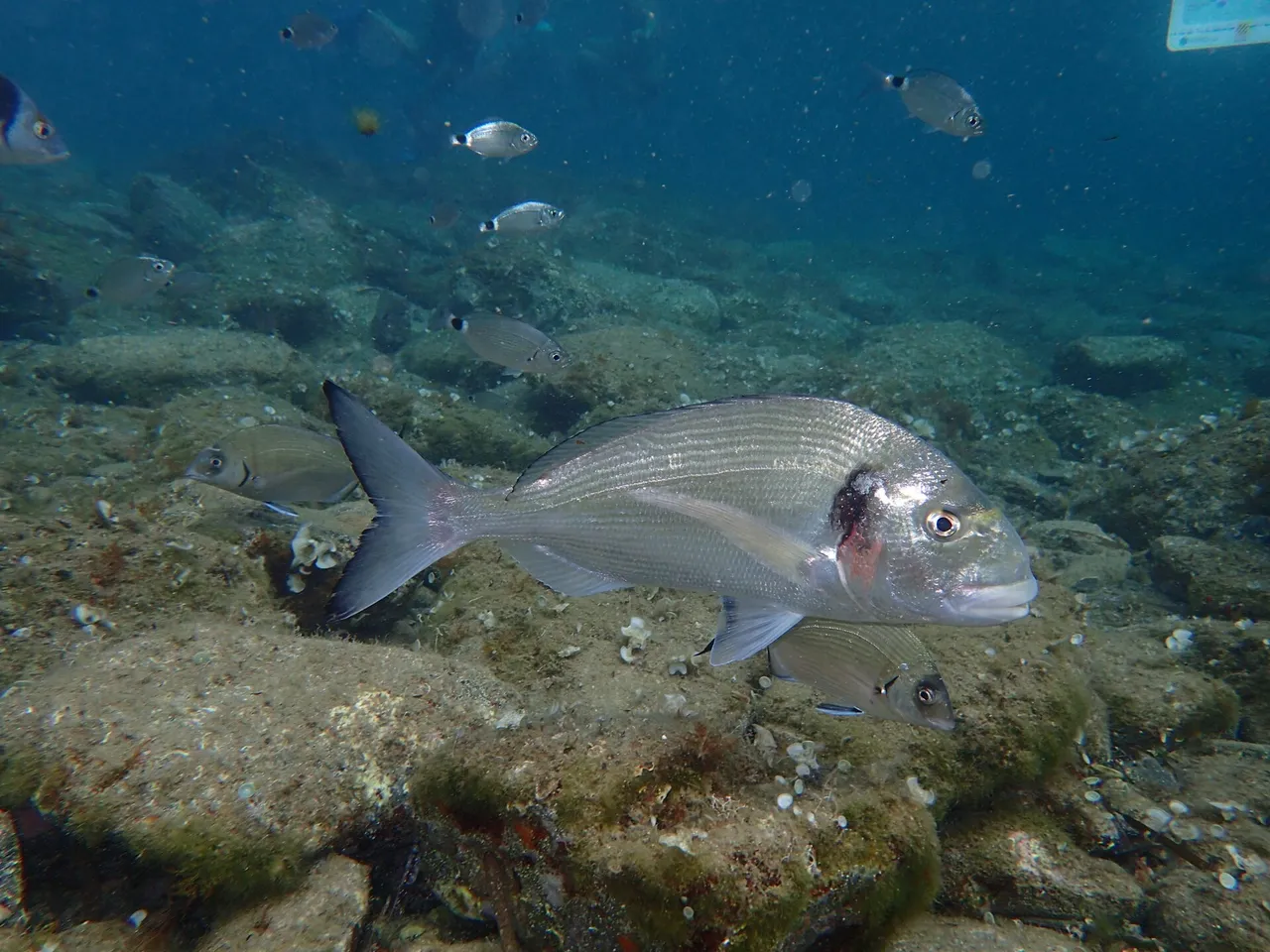
Gilthead bream
Sparus aurata — Sparidae

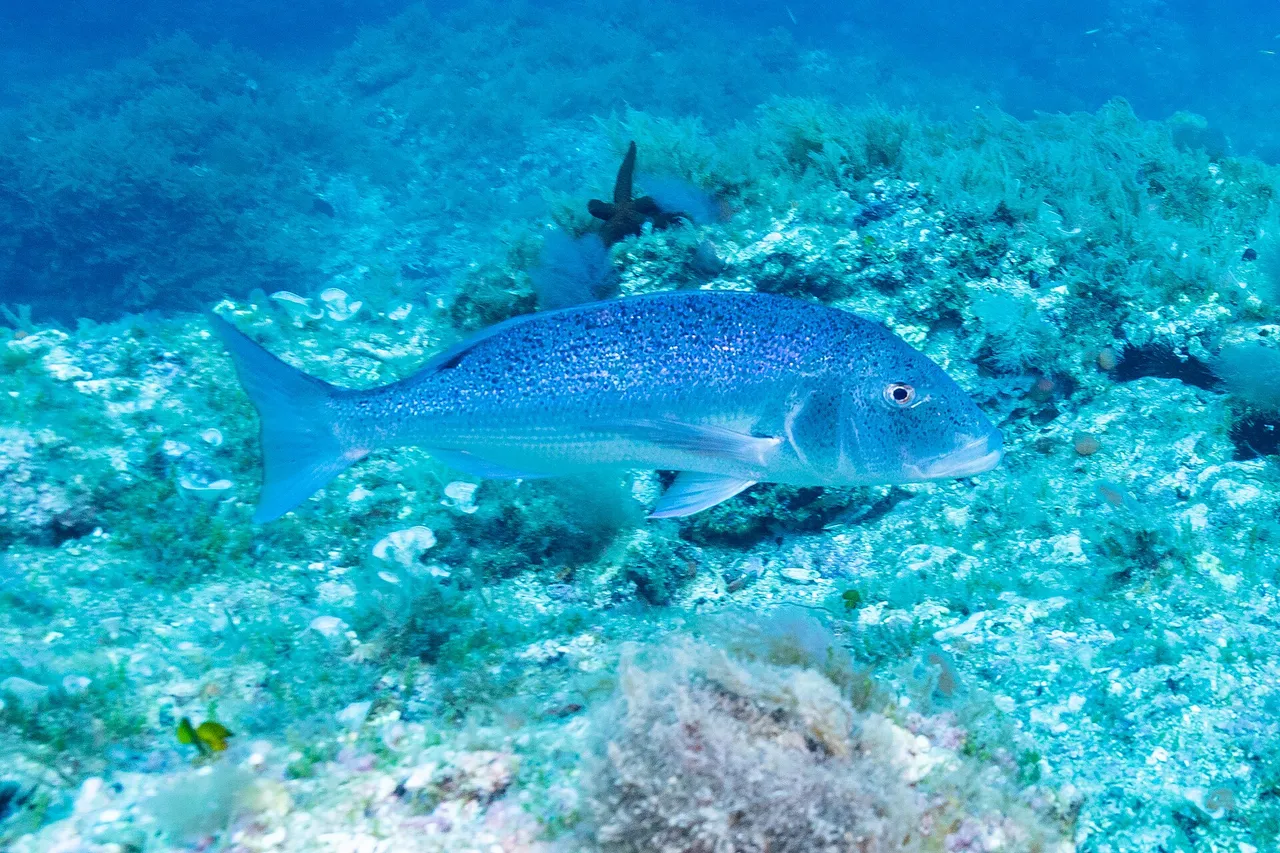
Common dentex
Dentex dentex — Sparidae
,_Cabo_de_Palos,_Espa%C3%B1a,_2022-07-15,_DD_59.jpg)
The differences
Each difference is marked with how far it can be trusted on its own. A single diagnostic character settles the identification; suggestive ones only narrow it.
| Character | Gilthead bream | Common dentex | Reliability |
|---|---|---|---|
| Mark between the eyesIdentification | A golden band between the eyes — the mark the common name refers to. | No golden band; the forehead is plain, steeper and heavier in old fish. | Diagnostic on its own |
| TeethIdentification | Rounded crushing molars at the back of the jaw, suited to shellfish. | Prominent canine teeth at the front of the jaw, suited to fish prey. | Diagnostic on its own |
| FeedingFeeding | A hard-shelled-prey specialist whose whole jaw is built for crushing. | An active predator of fish and cephalopods, hunting in mid-water as well as on the bottom. | Supporting — use with others |
| Dark shoulder markIdentification | A dark blotch at the origin of the lateral line, above the gill cover. | No comparable shoulder blotch; older fish are speckled over the whole upper flank. | Supporting — use with others |
Why it matters
The two feed completely differently, so the identification is also the explanation of why one took a shellfish bait and the other took a fish bait. Minimum sizes also differ in most Mediterranean jurisdictions.
The full records
This page compares two species. Each of them has a complete record covering biology, behaviour, handling and the evidence behind all of it.
More about gilthead bream
Where it lives, how it is caught, and what else it is confused with.
Similar and related fish
 Common dentexBoth are Sparidae and neither is what its market name suggests. The dentex hunts fish with canines; the gilthead crushes shellfish with molars. Same family, opposite equipment.
- White seabreamSparids of the same mediterranean ground separated by flank barring and by the gilthead's gold brow band.
How it is caught
Gear for this fish
- Peeler crabThe statutory guide gives crab as the best bait in the Clonakilty estuary, where it names gilthead bream alongside bass, flounder and three mullet species on the same tide.
- Prawns and shrimpCrushing jaws built for crustaceans, and a prawn is exactly that — fished whole with the shell on so it survives the cast and the fish.
Why the 5 connections on this page are here, and the sources
Similar and related fish
Backed by research — 2 connections
Supported by peer-reviewed research or fisheries science. The sources are listed and can be checked.
Common dentex
A comparison resting on shared family and contrasting feeding morphology, naming both binomials.
- FishBase: a global information system on fishes — Froese, R. and D. Pauly, eds. — FishBase Consortium (Scientific institute)Relied on for: That Sparus aurata and Dentex dentex are both Sparidae of the eastern Atlantic and Mediterranean with differing dentition and feeding ecology.States this directlyPassage read and verified
White seabream
An identification comparison naming both binomials: Diplodus sargus and Sparus aurata.
- FishBase: a global information system on fishes — Froese, R. and D. Pauly, eds. — FishBase Consortium (Scientific institute)Relied on for: Morphological and distributional data for Diplodus sargus and for Sparus aurata.States this directlyPassage read and verified
- The IUCN Red List of Threatened Species — International Union for Conservation of Nature (Conservation authority)Relied on for: Separate assessments treating Diplodus sargus and Sparus aurata as distinct species.States this directlyCitation checked — the work exists and is described correctly
How it is caught
What experienced anglers do — 1 connection
Widely and independently recommended by experienced anglers and specialist sources. This is real angling knowledge, not proof: controlled evidence for it is limited, and FishingHQ records it as convention rather than as a demonstrated effect.
Ledgering
A practitioner claim following from the species' verified crushing dentition.
- Sea Angler — Bauer Media (Specialist angling publication)Relied on for: Practitioner treatment of crab and shellfish baits for sea bream and of the tackle required for crushing-jawed species.Citation checked — the work exists and is described correctly
- General angling website restatements of established technique — Various (Credible secondary source)Relied on for: Widely restated practitioner guidance on bait selection for gilthead bream.Citation checked — the work exists and is described correctly
Gear for this fish
Reported, not established — 1 connection
Reported, but without independent support. Recorded because it is in circulation, not because it has been shown to hold.
Peeler crab
One publisher, but a statutory one, naming the bait at four separate marks in the same estuary system where it names the species. Recorded as practice on that coast rather than as a general claim, and graded as a claim resting on a single independent original.
- Inland Fisheries Ireland: South West Sea Angling Guide — the west and south Cork angling marks — Inland Fisheries Ireland, 2020 (Government fisheries body)Relied on for: The statutory body naming crab as the best bait at the estuary marks where it gives gilthead bream as an ordinary catch.Passage read and verified
What experienced anglers do — 1 connection
Widely and independently recommended by experienced anglers and specialist sources. This is real angling knowledge, not proof: controlled evidence for it is limited, and FishingHQ records it as convention rather than as a demonstrated effect.
Prawns and shrimp
A practitioner claim following from the species' verified crushing dentition.
- Sea Angler — Bauer Media (Specialist angling publication)Relied on for: Practitioner treatment of prawn and shellfish baits for sea bream.Citation checked — the work exists and is described correctly
- General angling website restatements of established technique — Various (Credible secondary source)Relied on for: Widely restated practitioner guidance on shell-on prawn presentation.Citation checked — the work exists and is described correctly
Reviewed 2026-08-10. FishingHQ does not state what any rule is or where any rule applies. Where this page says the two species are managed differently, that is a reason to check the authority for the water you are on — not a statement of what it requires.