Common dentex
Fish · Last reviewed 2026-08-10
The Mediterranean's fastest and warriest inshore predator — a sea bream that hunts like a jack, and the fish spearfishers there rate above all others.
Safety: injury while handling fish — can cause injury needing treatment. 3 more points apply here.
How this was identified, and who took it
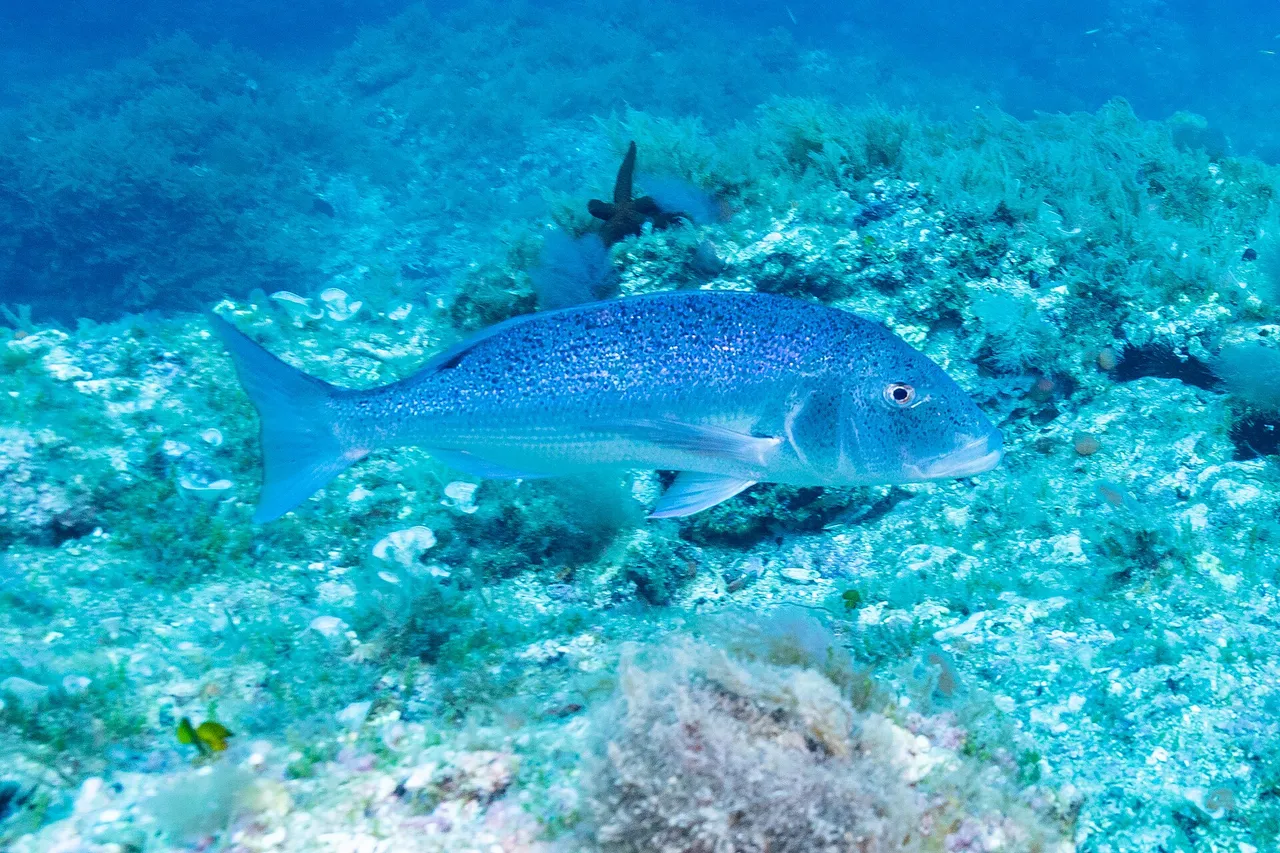
Identified by: Full lateral view over a Mediterranean reef. Robust deep body, steep blunt head, fine dark speckling over blue-grey and the pointed caudal lobes are all clear. Colour is depth-shifted towards blue.Diego Delso — CC BY-SA 4.0, via Wikimedia Commons — source, licence,_Cabo_de_Palos,_Espa%C3%B1a,_2022-07-15,_DD_59.jpg)
Catching Common dentex
Everything here on fishing for it. Each entry opens the page behind it.
- When
- Mar–Nov — months recorded at the places that document it, not a season for the whole range.
- Where
- 11 places FishingHQ documents — strongest claim anywhere: regular local target · From the shore, From a boat, Spearfishing
The common dentex is a sea bream that decided to become a predator, and it is very good at it. Where most sparids graze and root, the dentex hunts fish and cephalopods over hard bottom at speed, with a mouth full of prominent canine teeth that gives the genus and the species its name twice over.
Among Mediterranean spearfishers it has a status the dusky grouper does not, and for the opposite reason. A grouper stays put and can be found; a dentex is mobile, extremely wary, and appears for a few seconds at the edge of visibility before deciding you are not worth investigating. Taking one is a matter of stillness, patience and a shot at the limit of range, and that difficulty is the whole appeal.
It is assessed as Vulnerable, which for a fish this heavily targeted across a heavily fished sea is not surprising. Its reproductive biology is unusual and worth noting precisely: the species is generally gonochoristic — separate sexes — but some individuals are hermaphroditic, particularly in early life. That is a genuinely different pattern from the clean protogyny of the groupers and wrasses, and the distinction matters because the conservation argument that applies to those does not transfer directly here.
Where Common dentex is documented
Places where public sources describe this species as fished, with how it is fished and how strongly the evidence supports it. This is not a range map and it is not a recommendation — it is what has been written down about a fishery rather than a record of any individual catch, and being listed is never permission to fish.
Balearic Islands
2 documented places
Sound or strait
Regular local target
From a boat
Around Jun, Jul, Aug, Sept
Rock mark
Seasonal
From a boat
Around Jun, Jul, Aug, Sept
The Aegean and Crete
2 documented places
Beach section
Recorded here
From a boat
Rock mark
Regular local target
From the shore · From a boat
Malta and Gozo
1 documented place
Headland
Seasonal
From the shore · From a boat
Around Mar, Apr, May, Sept, Oct, Nov
Also documented on 1 more coast
Fewer places each, or less strongly supported. Each one names its own marks.
Portugal (1)
What these strengths mean
- Recorded here
- At least one credible public account of this species being caught here. That is all it means.
- Repeatedly reported
- Several independent public accounts. Enough to say it happens more than once; not enough to call it a fishery.
- Regular local target
- Fishing sources describe this as a normal local target here, not merely as caught.
- Seasonal
- Well supported, and concentrated in part of the year rather than spread through it.
Identification
- Scientific name
- Dentex dentex
- Family
- Sparidae
- Water
- Saltwater
- Conservation status
- Vulnerable
- Regions
- Mediterranean, Western Europe, North Africa, Britain & Ireland
- Prominent, widely spaced canine teeth at the front of both jaws — visible, distinctive, and the origin of the name.
- Steep forehead profile becoming markedly humped in large males; the outline of a big dentex is unmistakable.
- Silvery-blue to grey with a scattering of small dark spots on the upper flank of younger fish, fading with age.
- A single continuous dorsal fin; body deep-bodied but powerfully built rather than disc-shaped.
- Separated from other large sparids by the canines and the head profile rather than by colour, which shifts considerably underwater.
Size
- Typical
- 1.5–4 kg (3–9 lb)
- Large
- 6–9 kg (13–20 lb)
Exceptional: Over 11 kg (24 lb); maximum published weight 14.3 kg
Rock, drop-offs and clear water: a Mediterranean sight hunter
Common dentex occupy hard ground in clear warm-temperate water, and they are among the most structure-associated large predators in the Mediterranean.
ROCKY BOTTOM AND DROP-OFFS ARE THE HABITAT. Dentex hold on reef, rocky slopes, offshore pinnacles and the edges where hard ground meets sand, generally from shallow water down to around a hundred metres, with larger fish deeper.
CLEAR WATER IS REQUIRED. They are visual pursuit predators with acute eyesight, hunting fast in open water above and around structure, and they are scarce in turbid conditions.
SEAGRASS MARGINS AND SAND PATCHES MATTER as hunting ground rather than as cover — dentex work the boundaries, taking fish and cephalopods flushed from them.
JUVENILES ARE SHALLOWER AND MORE GREGARIOUS, occupying inshore rock and seagrass in small groups; large adults are solitary, deeper and notably wary.
THE WARINESS IS ITSELF A HABITAT FACT. Dentex respond strongly to boats, divers and noise, and their distribution within a reef reflects disturbance as much as physical structure — which is why they recover conspicuously inside well-enforced marine reserves and why reserve studies use them as an indicator.
AND THE SPECIES IS AN INDICATOR OF REEF CONDITION more broadly: a rocky Mediterranean coast with large dentex present is a lightly fished one.
Backed by research — why, and the sources (2)
Supported by peer-reviewed research or fisheries science. The sources are listed and can be checked.
- FAO Species Identification Guides for Fishery Purposes and the FAO Species Catalogues — Food and Agriculture Organization of the United Nations (Scientific institute)Relied on for: Distribution, habitat, depth and fishery accounts for the species in the FAO regional identification guides for the ocean area concerned.States this directlyCitation checked — the work exists and is described correctly
- The IUCN Red List of Threatened Species — International Union for Conservation of Nature (Conservation authority)Relied on for: Assessment and range account for the species, including the habitats it depends on, its life history and the pressures acting on it.States this directlyCitation checked — the work exists and is described correctly
Spring spawning on the rock, and a sex change on the way
Dentex reproduction involves a hermaphroditic pattern that is common in the seabreams and is worth stating plainly because it changes what a size limit does.
THE SPECIES IS HERMAPHRODITIC, with individuals functioning as one sex and changing to the other as they grow. The pattern in dentex is documented but not simple, and both protogynous elements and simultaneous function have been reported, which means the sex ratio of a population is a function of its size structure.
SO REMOVING THE LARGE FISH ALTERS THE BREEDING STRUCTURE, not just the numbers, and heavily fished populations can lose the size classes that carry one sex.
SPAWNING IS IN SPRING AND EARLY SUMMER in most of the range, triggered by rising water temperature, and occurs over rocky ground in the adults' normal habitat rather than at a distant aggregation site.
EGGS AND LARVAE ARE PELAGIC, drifting before juveniles settle onto inshore rocky and seagrass habitat.
SPAWNING IS BATCH, with females releasing repeatedly over a season.
MATURITY IS AT A MODERATE SIZE and the fish is long-lived and slow-growing at size, so large dentex are old dentex.
AND THE COMBINATION — hermaphroditism, site attachment, wariness and slow growth at size — is why this species responds so visibly to protection and so quickly to pressure.
Backed by research — why, and the sources (2)
Supported by peer-reviewed research or fisheries science. The sources are listed and can be checked.
- FAO Species Identification Guides for Fishery Purposes and the FAO Species Catalogues — Food and Agriculture Organization of the United Nations (Scientific institute)Relied on for: Distribution, habitat, depth and fishery accounts for the species in the FAO regional identification guides for the ocean area concerned.States this directlyCitation checked — the work exists and is described correctly
- The IUCN Red List of Threatened Species — International Union for Conservation of Nature (Conservation authority)Relied on for: Assessment and range account for the species, including the habitats it depends on, its life history and the pressures acting on it.States this directlyCitation checked — the work exists and is described correctly
A serious set of canines, and a decision that is made before the shot
Dentex are handled in two entirely different fisheries with two entirely different failure modes, and the species is one of the clearest illustrations of why FishingHQ treats spearfishing and rod fishing as separate disciplines rather than as variants.
ON ROD AND LINE the hazards are conventional and substantial. The canines are large, conical and set at the front of powerful jaws — this is an active piscivore that seizes and holds prey — and they puncture deeply. The gill covers are firm with hard edges. A dentex is a strong fish that thrashes at the boat, and the standard answer applies: control the fish before unhooking rather than during, keep fingers out of the mouth entirely, use long pliers, and support a heavy fish horizontally. Fish taken from depth arrive with swim-bladder expansion and cannot swim down unaided, which makes a descending device the difference between a release and a discard.
UNDERWATER, THERE IS NO RELEASE, and that changes the whole shape of the problem. A speared fish is a killed fish, and every decision about whether this individual should be taken — its size, whether the population can carry it, whether the shot can be placed properly at that range and angle — is made in the water before the trigger, with a breath running down and a fish that will not wait. There is no equivalent of unhooking a fish and changing your mind.
WHICH IS WHY, FOR THIS SPECIES, RESTRAINT IS THE HANDLING TECHNIQUE. Dentex are slow-growing, long-lived, curious, and inclined to approach a diver — a combination that makes them unusually vulnerable to a fishery that selects by sight and takes the largest fish available. The species' assessment reflects exactly that pressure. A diver's own limits on size and number are doing more work here than any grip, and they are the part that transfers to every other large, slow-growing, approachable reef predator.
Backed by research — why, and the sources (2)
Supported by peer-reviewed research or fisheries science. The sources are listed and can be checked.
- FishBase: a global information system on fishes — Froese, R. and D. Pauly, eds. — FishBase Consortium (Scientific institute)Relied on for: Morphology, dentition, spination, thermal tolerance, reproductive strategy and depth range recorded for the species.States this directlyPassage read and verified
- The IUCN Red List of Threatened Species — International Union for Conservation of Nature (Conservation authority)Relied on for: Assessment, population trend and the life-history traits — longevity, growth rate, sex structure — that determine a population's sensitivity to the removal of large individuals.Background and mechanism onlyCitation checked — the work exists and is described correctly
A Mediterranean predator that comes shallow to breed and goes deep to survive summer
Dentex seasonality is a story of two constraints — spawning and temperature — pulling in opposite directions, and the fish resolves them by changing depth through the year.
SPRING AND EARLY SUMMER BRING THEM SHALLOW TO SPAWN. Dentex move onto shallower rocky and mixed ground as water warms in spring, and spawning takes place through late spring and early summer. That is the period when large fish are most accessible from the shore and in shallow water, and it is also the period when they are most concentrated and most vulnerable to targeted fishing — the standard reef-predator problem.
HIGH SUMMER PUSHES THEM DOWN. As surface water warms beyond their preference, dentex move deeper and become far less available in shallow water, particularly in daylight. The fish have not left; they have descended, and the same ground fishes at a different depth.
AUTUMN IS FREQUENTLY THE BEST FEEDING PERIOD. As the surface cools and the thermocline breaks down, dentex return to intermediate depths and feed hard, and the abundance of small pelagic prey in autumn Mediterranean water supports it. Autumn dentex are typically in good condition and actively hunting rather than spawning.
WINTER IS DEEP AND SLOW. Dentex remain on deeper ground through the cold months with reduced feeding activity, and shallow-water encounters become uncommon.
LIGHT AND TIME OF DAY MODULATE ALL OF IT. Dentex are highly visual daylight hunters that are most active around dawn and dusk, and the seasonal depth pattern combines with that so that the productive window shifts through the year: early-morning shallow water in spring, deeper water in the middle of the day in summer, and longer active periods in autumn.
THE MEDITERRANEAN'S WEAK TIDES MEAN THE CUES ARE THERMAL RATHER THAN TIDAL, which is a genuine difference from Atlantic predators of similar habit and worth holding onto: what moves a bass on an Atlantic coast is largely tide, and what moves a dentex is largely temperature and light.
AND THE SPECIES IS UNDER PRESSURE ACROSS MUCH OF ITS RANGE, with the spawning concentration being the point of greatest vulnerability. What may be taken, when and by what method — including whether spearfishing is permitted on that ground at that time — is a matter for the local competent authority, and it varies sharply between Mediterranean jurisdictions.
Backed by research — why, and the sources (2)
Supported by peer-reviewed research or fisheries science. The sources are listed and can be checked.
- FishBase: a global information system on fishes — Froese, R. and D. Pauly, eds. — FishBase Consortium (Scientific institute)Relied on for: Spawning season, migratory behaviour, temperature preference and seasonal distribution recorded for the species.States this directlyPassage read and verified
- The IUCN Red List of Threatened Species — International Union for Conservation of Nature (Conservation authority)Relied on for: Assessment and life-history account, including reproductive timing and the seasonal pressures on the population.Background and mechanism onlyCitation checked — the work exists and is described correctly
Lifecycle and reproduction
Grows to about a metre and is long-lived, with the largest fish being old. Juveniles use shallower, more sheltered ground and move onto harder, deeper bottom as they grow. Because the species is both heavily targeted and slow to replace large individuals, the size structure of local populations is a reasonable indicator of how heavily a piece of coast is fished.
Generally gonochoristic — separate sexes — though some individuals are recorded as hermaphroditic, particularly during young life stages. That is a different and less tidy pattern than the strict protogyny of many groupers and wrasses, and it should not be described as though it were the same thing. Spawning occurs in spring and early summer on hard bottom.
Feeding and senses
Feeds on fish, molluscs and cephalopods, hunting actively over hard bottom rather than ambushing from cover. The canine dentition suits seizing and holding active prey. Large dentex hunt at speed and cover ground, which is why they turn up unpredictably rather than being resident on a known spot the way a grouper is.
Sight-dominant in the clear water of its range, and acutely so — the species' reputation for wariness is a direct consequence. A dentex sees a diver or a boat at a distance and evaluates it, which is why the technique that works is stillness and why the shot, when it comes, is at the edge of what is possible.
Through the year
Moves shallower in the warmer months and deeper in winter, within a depth range of about 15 to 50 m and recorded to 200 m. Mobile rather than resident, following prey over hard ground. In the northern part of the range it is more strongly seasonal; in the southern Mediterranean and off North Africa it is available across more of the year.
Distribution
Eastern Atlantic from the British Isles to Cape Blanc in Mauritania, including the Canary Islands and Madeira, and throughout the Mediterranean where it is common south of 40 degrees north. Occurs on hard bottoms of rock or rubble, typically between 15 and 50 m and recorded to 200 m.
This is a biological range — where the species occurs, not a prediction that you will catch one. To browse the fishing geography FishingHQ holds, start at fishing places.
Why anglers care
The most prized spearfishing target across much of the Mediterranean, and an important rod-and-line and commercial species. Its wariness makes it the benchmark by which divers there measure a session. Its Vulnerable assessment, in a sea with a long history of heavy exploitation, means that where local rules restrict its capture the reason is not arbitrary.
Handling and returning
The canine teeth are large and the gill covers are firm; keep fingers clear of both. Where the fish is taken on rod and line from depth, barotrauma is a genuine consideration for release. Where it is speared, the decision is made before the shot — and given the species' assessment, a diver's own restraint about size and number is doing more work here than any handling technique.
Going further
- What does common dentex eat? — feeding biology, kept separate from what anglers infer from it.
- Common dentex vs Common pandora — how to tell them apart.
- Common dentex vs Gilthead bream — how to tell them apart.
Safety
Injury while handling fish — Can cause injury needing treatment
Prominent canine teeth and firm gill covers on a strong fish handled at close quarters.
What reduces it: Keep fingers clear of the mouth and gill plates, wet hands, and use a tool rather than fingers for unhooking or for removing a shaft.
Precautions that always apply here
- Wet your hands before touching a fish. Dry hands strip the protective mucus layer that keeps infection out.
- Keep fingers out of the gills and clear of the teeth. Gill damage is usually fatal to the fish, and several species will remove skin from a finger.
- Support the fish's weight along its body, keep it out of the water for as short a time as possible, and hold it over something soft.
Check the rules before you fish
Fishing laws, bylaws, access rules, seasons, bait restrictions and permitted methods vary by location and can change. Check the current rules from the relevant authority and the water you intend to fish before fishing.
Check with:
- Current national or regional law for where you are fishing
- Current local bylaws
- The relevant fisheries authority
- The landowner, club or fishery whose water it is
- Any restrictions specific to the species or the method you intend to use
Where to go next
Similar and related fish
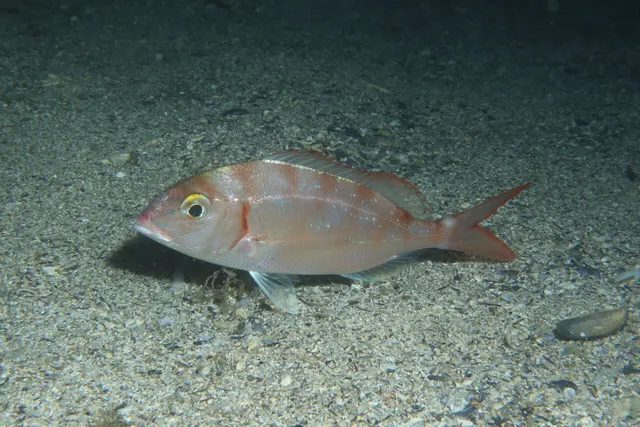 Common pandoraSparids of the same waters separated by dentition, body depth and colour.
- European anchovySmall shoaling clupeids and anchovies are taken in open water, which is when dentex move off the structure they otherwise hold to.
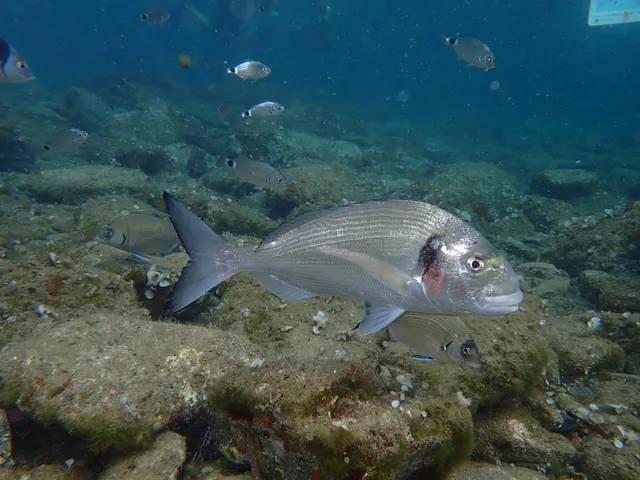 Gilthead breamBoth are Sparidae and neither is what its market name suggests. The dentex hunts fish with canines; the gilthead crushes shellfish with molars. Same family, opposite equipment.
- Pink dentexThe pair whose overlapping Spanish names kept both of them out of Canary records for two programmes.
Where you will find it
- Balearic IslandsPresent over rocky ground and drop-offs, and one of the large predators the Mediterranean spearfishing tradition here is built around.
- ItalyA fast, wary open-water sparid of Italian rock and reef ground, and one of the fish the country's ambush breath-hold technique was developed to approach.
- MediterraneanThe most prized spearfishing target across much of the sea, and the benchmark by which divers there judge a session — mobile, extremely wary, and seen for a few seconds at the edge of visibility.
- The Croatian AdriaticOver the karst walls, drop-offs and rubble where it hunts actively rather than holding a spot. It is the species Adriatic spearfishers rate above all others, and its vulnerable assessment is exactly why the local conversation about restraint is more advanced than the regulation.
- The Strait of GibraltarOccupies the rocky margins on both sides, hunting in clear water over current-swept hard ground.
Understanding this fish
Told apart from
- Australasian snapperBoth are Sparidae — sea bream — and neither is what its common name suggests. Setting them together is the quickest way to show that the family, not the market name, is what predicts the fish.
- Dusky grouperThe Mediterranean's two great spearfishing targets and complete opposites: one resident and findable, the other mobile and wary. The techniques that take them have nothing in common.
- Red porgyThe two big sparids of the same ground, and the pair the Spanish names blur.
Environment and conservation
Sources and evidence
- FishBase: a global information system on fishes — Froese, R. and D. Pauly, eds. — FishBase Consortium (Scientific institute)Relied on for: Scientific name, family placement in the Sparidae, maximum length of 100 cm and maximum published weight of 14.3 kg, eastern Atlantic distribution from the British Isles to Cape Blanc in Mauritania including the Canaries and Madeira and commonness in the Mediterranean south of 40 degrees north, habitat on hard bottoms of rock or rubble typically at 15 to 50 m and ranging to 200 m.States this directlyPassage read and verified
- FishBase: a global information system on fishes — Froese, R. and D. Pauly, eds. — FishBase Consortium (Scientific institute)Relied on for: The IUCN Red List category — Vulnerable, assessed 17 August 2009 — is taken from FishBase's republication.States this directlyPassage read and verified
Why the 16 connections on this page are here, and the sources
Similar and related fish
Backed by research — 4 connections
Supported by peer-reviewed research or fisheries science. The sources are listed and can be checked.
Common pandora
An identification comparison naming both binomials: Pagellus erythrinus and Dentex dentex.
- FishBase: a global information system on fishes — Froese, R. and D. Pauly, eds. — FishBase Consortium (Scientific institute)Relied on for: Morphological and distributional data for Pagellus erythrinus and for Dentex dentex.States this directlyPassage read and verified
- The IUCN Red List of Threatened Species — International Union for Conservation of Nature (Conservation authority)Relied on for: Separate assessments treating Pagellus erythrinus and Dentex dentex as distinct species.States this directlyCitation checked — the work exists and is described correctly
European anchovy
Recorded diet evidence identifies Engraulis encrasicolus as a food item of this predator at species level. The edge is written at that granularity and no further.
- FishBase: a global information system on fishes — Froese, R. and D. Pauly, eds. — FishBase Consortium (Scientific institute)Relied on for: Food items recorded for this predator, including Engraulis encrasicolus.States this directlyPassage read and verified
- FAO Species Identification Guides for Fishery Purposes and the FAO Species Catalogues — Food and Agriculture Organization of the United Nations (Scientific institute)Relied on for: Species account describing the diet of this predator in the region where Engraulis encrasicolus occurs.Background and mechanism onlyCitation checked — the work exists and is described correctly
Gilthead bream
A comparison resting on shared family and contrasting feeding morphology, naming both binomials.
- FishBase: a global information system on fishes — Froese, R. and D. Pauly, eds. — FishBase Consortium (Scientific institute)Relied on for: That Sparus aurata and Dentex dentex are both Sparidae of the eastern Atlantic and Mediterranean with differing dentition and feeding ecology.States this directlyPassage read and verified
Pink dentex
Dentex gibbosus develops a pronounced forehead bulge on old fish and reaches 106 cm and 16.4 kg; Dentex dentex does not and is smaller. Spanish sources use overlapping common names for the two, which is why the Canary directorate's `sama, serruda, pargo macho` against D. gibbosus was the thing that finally resolved it.
- FishBase: a global information system on fishes — Froese, R. and D. Pauly, eds. — FishBase Consortium (Scientific institute)Relied on for: The morphology, size, depth range and distribution that separate these two species from one another.States this directlyPassage read and verified
How it is caught
Official guidance — 1 connection
Stated by a fisheries authority, scientific institute or recognised angling body. Authoritative, but summarising rather than demonstrating.
Reef spearfishing
A scientific institute reporting what its own survey of the fishery recorded: a two-year catch-recording programme across the Canary archipelago counted and weighed every specimen, and this species appears in its published catch table. That is what Canary spearfishers were measured taking, rather than an inference from where the species lives or an assertion about what people do.
- Spearfishing in the Canary Islands: is the devil as black as it seems to be? — Pablo Martín-Sosa, Instituto Español de Oceanografía — Revista Scientia Insularum, 2019 (Scientific literature)Relied on for: The Canary spearfishing catch table, in which this species appears with a specimen count and a landed weight over the study's two-year recording period.States this directlyPassage read and verified
Gear for this fish
What experienced anglers do — 1 connection
Widely and independently recommended by experienced anglers and specialist sources. This is real angling knowledge, not proof: controlled evidence for it is limited, and FishingHQ records it as convention rather than as a demonstrated effect.
Soft plastics
A practitioner claim about which lure family answers this species' feeding or holding behaviour.
- Sea Angler — Bauer Media (Specialist angling publication)Relied on for: Established shore and boat lure practice for the species in north-west European seas.States this directlyCitation checked — the work exists and is described correctly
- General angling website restatements of established technique — Various (Credible secondary source)Relied on for: Widely restated lure selection for this species, recorded as practitioner consensus rather than as tested fact.Background and mechanism onlyCitation checked — the work exists and is described correctly
Where you will find it
Backed by research — 5 connections
Supported by peer-reviewed research or fisheries science. The sources are listed and can be checked.
Balearic Islands
Occurrence of the species in these waters: a statement about the animal's distribution, not a venue recommendation.
- The Fishes of the British Isles and North-West Europe — Macmillan, 1969 (Reference work)Relied on for: Distribution and habitat association of fishes in north-west European and eastern Atlantic waters.States this directlyCitation checked — the work exists and is described correctly
- FishBase: a global information system on fishes — Froese, R. and D. Pauly, eds. — FishBase Consortium (Scientific institute)Relied on for: Distribution, depth range and habitat association recorded for the species.States this directlyPassage read and verified
Italy
That a species occurs in these waters, drawn from distribution science and stock assessment. It is a statement about where the animal lives and is not a statement that anybody will catch one, still less where.
- FAO Species Identification Guides for Fishery Purposes and the FAO Species Catalogues — Food and Agriculture Organization of the United Nations (Scientific institute)Relied on for: Identification, distribution and habitat association of the fishes and invertebrates of the Mediterranean and Black Sea.States this directlyCitation checked — the work exists and is described correctly
- FishBase: a global information system on fishes — Froese, R. and D. Pauly, eds. — FishBase Consortium (Scientific institute)Relied on for: Recorded distribution, depth range and habitat association of the species named.States this directlyPassage read and verified
Mediterranean
A distribution claim held to a scientific standard.
- FishBase: a global information system on fishes — Froese, R. and D. Pauly, eds. — FishBase Consortium (Scientific institute)Relied on for: That Dentex dentex is common in the Mediterranean south of 40 degrees north and occurs on hard bottoms of rock or rubble typically at 15 to 50 m.States this directlyPassage read and verified
The Croatian Adriatic
A claim that a place contains the ground, water and seasonal conditions the species is associated with. It is a distributional statement about the world, it rests on the regional reference literature, and it deliberately asserts nothing about access, permission or catch.
- FishBase: a global information system on fishes — Froese, R. and D. Pauly, eds. — FishBase Consortium (Scientific institute)Relied on for: Recorded distribution, depth range and habitat association for the Mediterranean species named.States this directlyPassage read and verified
- FAO Species Identification Guides for Fishery Purposes and the FAO Species Catalogues — Food and Agriculture Organization of the United Nations (Scientific institute)Relied on for: Regional species identification and distribution for the Mediterranean and eastern Atlantic, including habitat association.States this directlyCitation checked — the work exists and is described correctly
The Strait of Gibraltar
A distribution association between an animal and a kind of water, rather than a claim about any named mark.
- FAO Species Identification Guides for Fishery Purposes and the FAO Species Catalogues — Food and Agriculture Organization of the United Nations (Scientific institute)Relied on for: Distribution, habitat, depth and fishery accounts for the species of the eastern central Atlantic and Mediterranean in the FAO regional identification guides.States this directlyCitation checked — the work exists and is described correctly
- FishBase: a global information system on fishes — Froese, R. and D. Pauly, eds. — FishBase Consortium (Scientific institute)Relied on for: Distribution, habitat association and depth range recorded for the species.States this directlyPassage read and verified
Understanding this fish
Backed by research — 1 connection
Supported by peer-reviewed research or fisheries science. The sources are listed and can be checked.
Cephalopods as prey
Recorded diet evidence identifies cephalopods as a food item of this predator at group level rather than to species. The edge points at the taxon record for that reason, and encoding it as a species-level claim would assert something the source does not.
- FishBase: a global information system on fishes — Froese, R. and D. Pauly, eds. — FishBase Consortium (Scientific institute)Relied on for: Food items recorded for this predator, given as cephalopods.States this directlyPassage read and verified
- FAO Species Identification Guides for Fishery Purposes and the FAO Species Catalogues — Food and Agriculture Organization of the United Nations (Scientific institute)Relied on for: Species account describing this predator's diet, recorded at the level of cephalopods.Background and mechanism onlyCitation checked — the work exists and is described correctly
Told apart from
Backed by research — 2 connections
Supported by peer-reviewed research or fisheries science. The sources are listed and can be checked.
Australasian snapper
A taxonomic comparison that does real work: it corrects a common-name error on one record using a verified family placement on both.
- FishBase: a global information system on fishes — Froese, R. and D. Pauly, eds. — FishBase Consortium (Scientific institute)Relied on for: That both Pagrus auratus and Dentex dentex are placed in the Sparidae, and that Pagrus auratus has a nomenclatural history of confusion with other names.States this directlyPassage read and verified
Dusky grouper
A comparison resting on documented habits — territorial and solitary against mobile over hard ground — rather than on reputation.
- FishBase: a global information system on fishes — Froese, R. and D. Pauly, eds. — FishBase Consortium (Scientific institute)Relied on for: That Epinephelus marginatus adults are solitary and territorial on rocky bottoms, while Dentex dentex occurs on hard bottoms of rock or rubble and feeds on fish, molluscs and cephalopods.States this directlyPassage read and verified
What experienced anglers do — 1 connection
Widely and independently recommended by experienced anglers and specialist sources. This is real angling knowledge, not proof: controlled evidence for it is limited, and FishingHQ records it as convention rather than as a demonstrated effect.
Red porgy
Canarian sources use overlapping vernacular for the large sparids, which is exactly why they are kept apart here: a bocinegro is not a dentón, the two are fished on the same marks, and a name that covers both cannot support a claim about either.
- Canary Islands regional angling guidance sites — Various Canary-based angling and island guidance publishers (Credible secondary source)Relied on for: Canary shore angling practice: the techniques and tackle used from rock, mole and beach, and the species each is used for.States this directlyCitation checked — the work exists and is described correctly
- Guías de zonas de pesca en Canarias — Tenerife, Gran Canaria y Lanzarote — GuíaCanarias (Credible secondary source)Relied on for: The techniques named for Canarian shore fishing — rockfishing, jigging, light bottom fishing and squid jigs — and the species attached to them.States this directlyPassage read and verified
Environment and conservation
Backed by research — 1 connection
Supported by peer-reviewed research or fisheries science. The sources are listed and can be checked.
Fish stocks and sustainability
A conservation claim resting on an assessment republished with its date.
- FishBase: a global information system on fishes — Froese, R. and D. Pauly, eds. — FishBase Consortium (Scientific institute)Relied on for: The IUCN Red List category for Dentex dentex — Vulnerable, assessed 17 August 2009 — as republished by FishBase.States this directlyPassage read and verified
- ICES Advice on fishing opportunities, catch and effort — International Council for the Exploration of the Sea (Scientific institute)Relied on for: That stock status is assessed through scientific advice processes feeding management.Background and mechanism onlyCitation checked — the work exists and is described correctly
How FishingHQ labels evidence is explained in the evidence policy.