How to identify common dentex
Dentex dentex · Sparidae
The characters that identify common dentex, ranked by how far each one can be trusted on its own.
Safety: injury while handling fish — can cause injury needing treatment.
How this was identified, and who took it
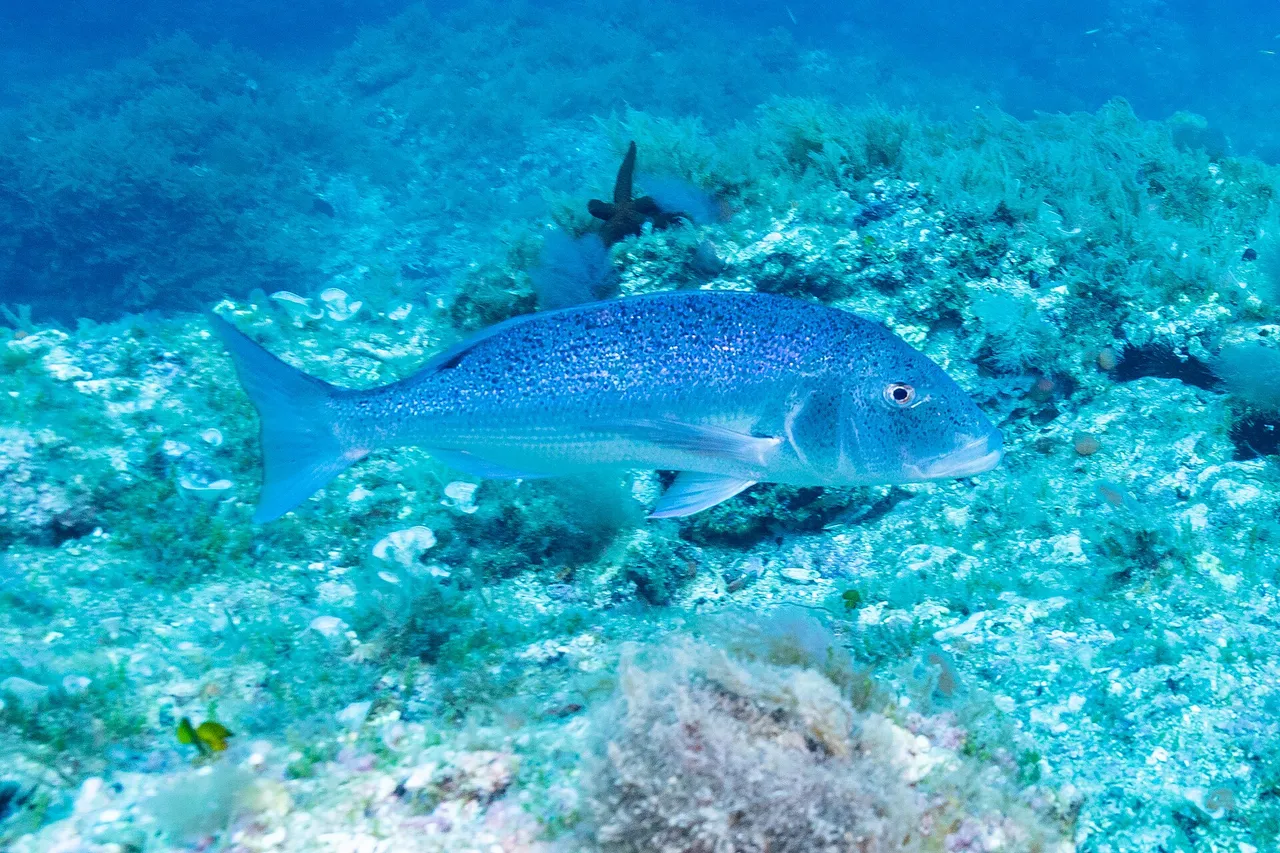
Identified by: Full lateral view over a Mediterranean reef. Robust deep body, steep blunt head, fine dark speckling over blue-grey and the pointed caudal lobes are all clear. Colour is depth-shifted towards blue.Diego Delso — CC BY-SA 4.0, via Wikimedia Commons — source, licenceLook at this first
Open the mouth. Four large widely spaced canines at the front of each jaw, unlike anything else in the Mediterranean sea breams, and the origin of both the common and the scientific name. On a big fish the domed forehead confirms it before you get that far.
Diagnostic — settles it on its own
Each of these settles the identification on its own. If one is clear, you have your answer.
Large widely spaced canines in both jaws
Prominent conical teeth at the front of the upper and lower jaws, well separated from one another. The other large sparids in the same water have crushing molars or fine incisors instead, so this settles the genus immediately.
Supporting — use with other characters
Real characters that are not conclusive by themselves. Use two or three together.
A steep forehead that becomes a hump
The profile rises sharply from the snout, and in large males the forehead builds into a pronounced bulge that makes the fish unmistakable in silhouette. Age and sex dependent, which is why it sits below the teeth.
A single unbroken dorsal fin on a powerful body
The dorsal runs the length of the back without a notch, over a body that is deep but built like a predator rather than a disc. It separates dentex from the deeper, rounder breams at a glance underwater.
Suggestive only — varies with condition
Hints only. These vary with condition, season, water and how long the fish has been out of it, and a fish that contradicts them is still the same species.
Fine dark speckling on the upper flank
Small dark spots scattered above the lateral line on younger fish, fading with age until a large adult has none. Useful on a small fish and misleading on a big one.
What it gets confused with
- Other Dentex species in the eastern Atlantic and around the Canaries, which share the dentition.
- Large gilthead bream and other big sparids at a distance, until the head profile or the teeth are visible.
- Meagre in Mediterranean water, separated by body depth and the entirely different mouth.
Side by side: Common dentex vs Common pandora, Common dentex vs Gilthead bream.
Where this stops working
Colour is unusable: dentex photographed at twenty metres are blue-grey because the water has removed the warmer wavelengths, and the same fish on a boat is a different animal to look at. Several congeners overlap at the southern end of the range. Where the fish is taken by spearfishing the identification and the size judgement both have to be made before the shot, which is a stronger requirement than any rod fishery imposes.
The full record
This page covers identification only. The Common dentex record covers behaviour, lifecycle, distribution, handling and the sources behind all of it.
Reviewed 2026-08-14.
More about this fish
Telling it apart is one question. Here are the others.
Similar and related fish
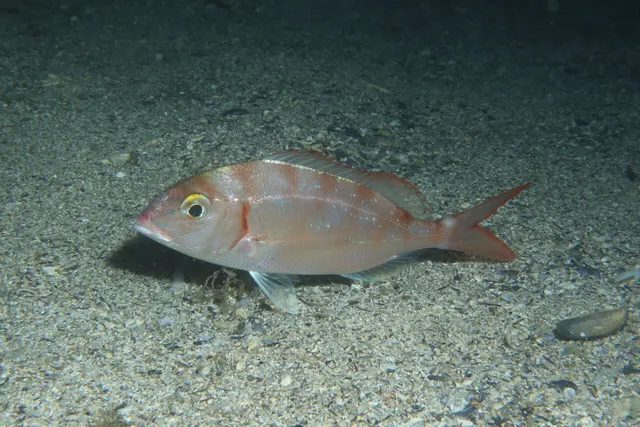 Common pandoraSparids of the same waters separated by dentition, body depth and colour.
- European anchovySmall shoaling clupeids and anchovies are taken in open water, which is when dentex move off the structure they otherwise hold to.
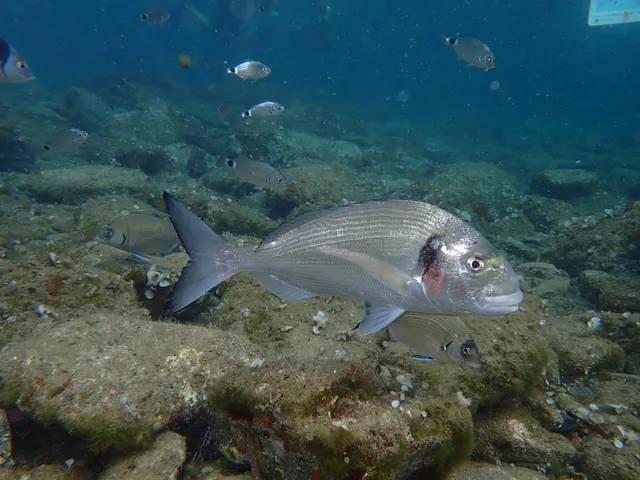 Gilthead breamBoth are Sparidae and neither is what its market name suggests. The dentex hunts fish with canines; the gilthead crushes shellfish with molars. Same family, opposite equipment.
- Pink dentexThe pair whose overlapping Spanish names kept both of them out of Canary records for two programmes.
How it is caught
Where you will find it
- Balearic IslandsPresent over rocky ground and drop-offs, and one of the large predators the Mediterranean spearfishing tradition here is built around.
- ItalyA fast, wary open-water sparid of Italian rock and reef ground, and one of the fish the country's ambush breath-hold technique was developed to approach.
- MediterraneanThe most prized spearfishing target across much of the sea, and the benchmark by which divers there judge a session — mobile, extremely wary, and seen for a few seconds at the edge of visibility.
- The Croatian AdriaticOver the karst walls, drop-offs and rubble where it hunts actively rather than holding a spot. It is the species Adriatic spearfishers rate above all others, and its vulnerable assessment is exactly why the local conversation about restraint is more advanced than the regulation.
- The Strait of GibraltarOccupies the rocky margins on both sides, hunting in clear water over current-swept hard ground.
Why the 10 connections on this page are here, and the sources
Similar and related fish
Backed by research — 4 connections
Supported by peer-reviewed research or fisheries science. The sources are listed and can be checked.
Common pandora
An identification comparison naming both binomials: Pagellus erythrinus and Dentex dentex.
- FishBase: a global information system on fishes — Froese, R. and D. Pauly, eds. — FishBase Consortium (Scientific institute)Relied on for: Morphological and distributional data for Pagellus erythrinus and for Dentex dentex.States this directlyPassage read and verified
- The IUCN Red List of Threatened Species — International Union for Conservation of Nature (Conservation authority)Relied on for: Separate assessments treating Pagellus erythrinus and Dentex dentex as distinct species.States this directlyCitation checked — the work exists and is described correctly
European anchovy
Recorded diet evidence identifies Engraulis encrasicolus as a food item of this predator at species level. The edge is written at that granularity and no further.
- FishBase: a global information system on fishes — Froese, R. and D. Pauly, eds. — FishBase Consortium (Scientific institute)Relied on for: Food items recorded for this predator, including Engraulis encrasicolus.States this directlyPassage read and verified
- FAO Species Identification Guides for Fishery Purposes and the FAO Species Catalogues — Food and Agriculture Organization of the United Nations (Scientific institute)Relied on for: Species account describing the diet of this predator in the region where Engraulis encrasicolus occurs.Background and mechanism onlyCitation checked — the work exists and is described correctly
Gilthead bream
A comparison resting on shared family and contrasting feeding morphology, naming both binomials.
- FishBase: a global information system on fishes — Froese, R. and D. Pauly, eds. — FishBase Consortium (Scientific institute)Relied on for: That Sparus aurata and Dentex dentex are both Sparidae of the eastern Atlantic and Mediterranean with differing dentition and feeding ecology.States this directlyPassage read and verified
Pink dentex
Dentex gibbosus develops a pronounced forehead bulge on old fish and reaches 106 cm and 16.4 kg; Dentex dentex does not and is smaller. Spanish sources use overlapping common names for the two, which is why the Canary directorate's `sama, serruda, pargo macho` against D. gibbosus was the thing that finally resolved it.
- FishBase: a global information system on fishes — Froese, R. and D. Pauly, eds. — FishBase Consortium (Scientific institute)Relied on for: The morphology, size, depth range and distribution that separate these two species from one another.States this directlyPassage read and verified
How it is caught
Official guidance — 1 connection
Stated by a fisheries authority, scientific institute or recognised angling body. Authoritative, but summarising rather than demonstrating.
Reef spearfishing
A scientific institute reporting what its own survey of the fishery recorded: a two-year catch-recording programme across the Canary archipelago counted and weighed every specimen, and this species appears in its published catch table. That is what Canary spearfishers were measured taking, rather than an inference from where the species lives or an assertion about what people do.
- Spearfishing in the Canary Islands: is the devil as black as it seems to be? — Pablo Martín-Sosa, Instituto Español de Oceanografía — Revista Scientia Insularum, 2019 (Scientific literature)Relied on for: The Canary spearfishing catch table, in which this species appears with a specimen count and a landed weight over the study's two-year recording period.States this directlyPassage read and verified
Where you will find it
Backed by research — 5 connections
Supported by peer-reviewed research or fisheries science. The sources are listed and can be checked.
Balearic Islands
Occurrence of the species in these waters: a statement about the animal's distribution, not a venue recommendation.
- The Fishes of the British Isles and North-West Europe — Macmillan, 1969 (Reference work)Relied on for: Distribution and habitat association of fishes in north-west European and eastern Atlantic waters.States this directlyCitation checked — the work exists and is described correctly
- FishBase: a global information system on fishes — Froese, R. and D. Pauly, eds. — FishBase Consortium (Scientific institute)Relied on for: Distribution, depth range and habitat association recorded for the species.States this directlyPassage read and verified
Italy
That a species occurs in these waters, drawn from distribution science and stock assessment. It is a statement about where the animal lives and is not a statement that anybody will catch one, still less where.
- FAO Species Identification Guides for Fishery Purposes and the FAO Species Catalogues — Food and Agriculture Organization of the United Nations (Scientific institute)Relied on for: Identification, distribution and habitat association of the fishes and invertebrates of the Mediterranean and Black Sea.States this directlyCitation checked — the work exists and is described correctly
- FishBase: a global information system on fishes — Froese, R. and D. Pauly, eds. — FishBase Consortium (Scientific institute)Relied on for: Recorded distribution, depth range and habitat association of the species named.States this directlyPassage read and verified
Mediterranean
A distribution claim held to a scientific standard.
- FishBase: a global information system on fishes — Froese, R. and D. Pauly, eds. — FishBase Consortium (Scientific institute)Relied on for: That Dentex dentex is common in the Mediterranean south of 40 degrees north and occurs on hard bottoms of rock or rubble typically at 15 to 50 m.States this directlyPassage read and verified
The Croatian Adriatic
A claim that a place contains the ground, water and seasonal conditions the species is associated with. It is a distributional statement about the world, it rests on the regional reference literature, and it deliberately asserts nothing about access, permission or catch.
- FishBase: a global information system on fishes — Froese, R. and D. Pauly, eds. — FishBase Consortium (Scientific institute)Relied on for: Recorded distribution, depth range and habitat association for the Mediterranean species named.States this directlyPassage read and verified
- FAO Species Identification Guides for Fishery Purposes and the FAO Species Catalogues — Food and Agriculture Organization of the United Nations (Scientific institute)Relied on for: Regional species identification and distribution for the Mediterranean and eastern Atlantic, including habitat association.States this directlyCitation checked — the work exists and is described correctly
The Strait of Gibraltar
A distribution association between an animal and a kind of water, rather than a claim about any named mark.
- FAO Species Identification Guides for Fishery Purposes and the FAO Species Catalogues — Food and Agriculture Organization of the United Nations (Scientific institute)Relied on for: Distribution, habitat, depth and fishery accounts for the species of the eastern central Atlantic and Mediterranean in the FAO regional identification guides.States this directlyCitation checked — the work exists and is described correctly
- FishBase: a global information system on fishes — Froese, R. and D. Pauly, eds. — FishBase Consortium (Scientific institute)Relied on for: Distribution, habitat association and depth range recorded for the species.States this directlyPassage read and verified
Safety
Injury while handling fish — Can cause injury needing treatment
Prominent canine teeth and firm gill covers on a strong fish handled at close quarters.
What reduces it: Keep fingers clear of the mouth and gill plates, wet hands, and use a tool rather than fingers for unhooking or for removing a shaft.