The Croatian Adriatic
Fishing regions · Last reviewed 2026-08-16
A thousand islands on drowned limestone, the clearest coastal water in the Mediterranean, almost no tide and a fierce local wind — and the densest spearfishing culture in Europe.
Safety: shallow water blackout and breath-hold loss of consciousness — can cause serious injury or death. 3 more points apply here.
Shallow water blackout and breath-hold loss of consciousness — Can cause serious injury or death
Warm, clear, comfortable water lengthens dives, and hypoxic blackout gives no warning symptoms at all. Hyperventilation suppresses the urge to breathe without adding oxygen, and the diver loses consciousness with no signal that would prompt them to surface.
What reduces it: One up, one down on every dive without exception, with the buddy watching the ascent and the first thirty seconds after it from close enough to reach the diver. Take proper surface intervals, and never dive after hyperventilating.
Worse when:
- In exceptional visibility over a wall with a fish in sight, which is precisely when a diver stays down longer than intended.
- Diving alone, which is the common factor in freediving fatalities.
Being listed here is not permission to fish. What that meansClose
Access, fishing rights, seasons, licences, local bylaws and permitted methods vary and can change. Check current access, permission, local regulations, closures and restrictions before you travel or fish. FishingHQ describes what the ground is and names who holds the answer; it does not hold the answer itself.
Find the authority for a jurisdiction · What FishingHQ does and does not cover
The eastern Adriatic is a coast-tier record because a single geological history explains the whole of it: this is a drowned karst landscape, and everything about the fishing follows from limestone that dissolved before the sea arrived.
WHAT DROWNED KARST MEANS. Limestone dissolves in rain, so a limestone landscape develops sinkholes, caves, dry valleys and steep ridges rather than the smooth slopes of softer rock. When sea level rose after the last glaciation, the sea flooded that landscape. The ridges became long narrow islands lying parallel to the coast, the valleys between them became channels, and the underwater topography is the same dissolved landscape continuing down — walls, caves, overhangs and near-vertical drops within metres of the shore.
THE RESULT IS DEEP WATER IMMEDIATELY OFF THE ROCK over enormous stretches, more than a thousand islands and islets, and a coastline whose length is many times the straight-line distance it covers.
THE WATER IS THE CLEAREST IN THE MEDITERRANEAN. Limestone catchments deliver almost no silt, there are few large rivers, and the sea is oligotrophic — nutrient-poor. That produces exceptional visibility, which is beautiful and is also the reason the fish are hard: everything here can see a diver or a line a very long way off.
THERE IS ALMOST NO TIDE, which removes the mechanism that organises fishing on every Atlantic coast, and replaces it with wind. The local winds are named, they are strong, they arrive fast, and they blow from opposite directions with opposite effects — a cold dry katabatic wind off the mountains, and a warm humid southerly that raises a sea.
AND IT IS THE DENSEST SPEARFISHING CULTURE IN EUROPE. Clear water, deep rock close to shore, an accessible island archipelago and a long tradition of taking fish for the table have produced a spearfishing community with its own competition history, its own equipment industry and its own conservation arguments. That is a genuine regional fact rather than a tourist claim.
THE THE SPECIES LIST IS MEDITERRANEAN AND HEAVILY WORKED. Dentex, seabream of several species, grouper, wrasse, mullet, and the pelagics that come through in season. Several of the headline species are under real pressure, and the local argument about restraint is more advanced than in many places.
What fishing here is like
A drowned karst coast: limestone ridges flooded by rising sea level, producing more than a thousand long narrow islands and islets lying parallel to the mainland, with channels between them and an underwater topography of walls, caves, overhangs and near-vertical drops within metres of the shore. Water is exceptionally clear and nutrient-poor with very little river silt, the tidal range is negligible, and the organising physical variable is wind rather than tide. Ground is hard limestone with sparse posidonia meadow on the sand between, and there is almost no soft estuarine habitat anywhere.
How people fish here
5 methods are recorded on the places documented here, counted from the records themselves rather than from what is practised in the country. Each opens a full guide to the technique.
Float fishing
Recorded at 2 places here, over headland, island.
Suspending a bait at a controlled depth beneath a buoyant indicator — the most visual, most controllable and most widely applicable method in angling.
Shore diving
Recorded at 2 places here, over headland, island.
Entering and leaving the water from land under your own power — the most accessible spearfishing and the one where the entry and exit are the dangerous part.
Aspetto (waiting)
Recorded at 1 place here, over island.
Descending, settling on the bottom and waiting for fish to come to you — the technique that produces most of the large fish taken by shore divers.
Eging
Recorded at 1 place here, over headland.
Jigging for squid and cuttlefish with a barbed, weighted lure worked in lifts and pauses — a Japanese discipline with its own tackle, vocabulary and competitive scene.
Kayak fishing
Recorded at 1 place here, over island.
A platform rather than a technique: quiet, shallow-draught access to water no other craft reaches, bought at the price of exposure, and a discipline where the decision not to launch is part of the skill.
These are the methods documented at the places FishingHQ holds here. A species listed beside a method is documented on the same ground, which is not the same as being taken that way — where a source establishes the method a fish was caught on, it is stated on that place’s own page. All fishing methods.
What dominates
Spearfishing and freediving, which this coast supports at a density and with a competitive and technical culture unmatched in Europe. Shore fishing from rock over deep water, for seabream, wrasse and pelagic species, with fine tackle and long leaders because of the clarity. Boat fishing among the islands and over the offshore banks. Lure and popper fishing for pelagic species in season. Squid and cuttlefish fishing, which is a substantial and traditional local practice from shore and boat. Bottom fishing over the rock and sand margins. Small-scale traditional net and trap fishing, which persists alongside the recreational fishery and shapes local expectations about what is normal.
The water available
Drowned karst limestone with walls, caves, overhangs and vertical drops close inshore; more than a thousand islands and islets with channels between them; posidonia seagrass meadow on sand between the rock; exceptionally clear oligotrophic water; a small number of submarine freshwater springs where karst groundwater discharges into the sea; almost no estuary or soft ground; and offshore banks and deeper channels in the open Adriatic.
How the rules are structured
Croatia's framework is its own and it is more prescriptive than visitors expect. Recreational sea fishing requires a licence purchased for a defined period, and there are separate licence categories for angling and for spearfishing, with different conditions attached. Spearfishing in particular is subject to specific restrictions on equipment, on the use of breathing apparatus, on night activity, on areas, and on age, and those restrictions are enforced. Daily catch limits by weight and by species apply to recreational fishing, and certain species are prohibited or restricted. National parks and nature parks cover several of the most attractive island groups and prohibit or heavily restrict fishing within them, independently of any licence. Shellfish gathering is separately regulated. FishingHQ does not state what any current rule is, and here in particular the licence categories, the limits and the protected areas change and are checked.
Who to ask
- The Croatian ministry responsible for agriculture and fisheries, which issues recreational and sport fishing licences and sets catch limits and species restrictions.
- The national park or nature park authority for the island group concerned, where fishing is prohibited or restricted independently of any licence.
- The harbour master's office, for navigation, anchoring and the rules applying to small craft.
- The local licence vendor or tourist office, which issues the time-limited recreational licences and is where the current categories can be established.
Words you will meet
- Bura
- A cold, dry, gusty katabatic wind falling off the coastal mountains, sometimes reaching extreme strength with very little warning. It flattens the sea against the mainland shore and makes the channels dangerous, and it is the single most important weather phenomenon on this coast.
- Jugo
- A warm, humid southerly wind that builds over time rather than arriving suddenly, raising a substantial sea along the length of the Adriatic. Unlike the bura it is announced by falling pressure and building cloud, and it closes the outer islands for days at a time.
- Vrulja
- A submarine freshwater spring where karst groundwater discharges directly into the sea, sometimes in quantity. Vrulje create cold, low-salinity plumes that fish avoid or exploit, and they are a genuine local feature of a limestone coast rather than a curiosity.
Conditions and hazards
The absence of tide removes the cut-off mechanism that dominates Atlantic coasts and it removes the habits that go with it, which is worth naming because visitors carry those habits in both directions. The live hazards here are wind, depth and traffic. The bura arrives as a cold katabatic fall off the mountains, sometimes at extreme strength and with very little warning, and it makes the channels between islands genuinely dangerous for small craft while leaving the mainland shore deceptively flat. The jugo builds a substantial sea over hours. Depth is the second: the karst drops vertically close inshore, so a shore angler is beside deep water and a freediver is over it immediately, and the clarity encourages longer and deeper dives than the diver intends. Hypoxic blackout gives no warning symptoms and is not made less likely by warm comfortable water — it is made more likely, because comfort lengthens dives. Summer boat traffic is heavy and a diver is close to invisible from a moving vessel. Sun exposure over reflective water is severe, and the rock is sharp limestone that lacerates.
A landscape that dissolved before the sea flooded it
The eastern Adriatic looks the way it does because of chemistry rather than tectonics, and understanding that explains both the shape of the coast and the shape of the fishing.
LIMESTONE DISSOLVES. Rainwater is very slightly acidic, and over long periods it dissolves calcium carbonate rather than merely abrading it. A limestone landscape therefore develops from the inside out: water works down joints and bedding planes, opening caves, shafts, sinkholes and underground drainage, until the surface is a landscape of steep ridges, closed depressions and dry valleys with the water all underground. That is karst.
THEN THE SEA CAME UP. After the last glaciation sea level rose and flooded that landscape. The ridges, which ran parallel to the coast, became the long narrow islands that characterise this coast. The valleys between them became channels. And critically, the caves, shafts and vertical walls that the dissolution had produced are still there — under water, continuing down from the shoreline.
WHICH IS WHY THE WATER IS DEEP IMMEDIATELY OFF THE ROCK. There is no shelf, no gradual shelving beach and no soft margin over enormous stretches of this coast. A person standing on a rock is standing beside water that may be twenty or thirty metres deep a short swim out, with a vertical wall beneath them and caves and overhangs in it.
THAT PRODUCES AN EXCEPTIONAL SPEARFISHING PROPOSITION and it is why the culture developed here. Depth, structure, caves for grouper and conger, walls for dentex and amberjack to patrol, and all of it reachable from the shore or from a small boat with a short run.
THE CLARITY IS THE SECOND CONSEQUENCE OF THE LIMESTONE. Karst catchments deliver almost no suspended sediment — the drainage is underground and the rock does not produce mud — and there are few significant rivers. Combined with nutrient-poor Adriatic water, that gives visibility that is exceptional by any European standard.
AND THE CLARITY IS A DIFFICULTY RATHER THAN A GIFT. Fish that can see thirty metres can see an angler, a line, a leader and a diver at that distance, and they behave accordingly. Fine tackle, long fluorocarbon leaders, distance and stealth matter here far more than on a turbid Atlantic coast, and technique carried over from coloured water simply does not work.
THE VRULJE ARE THE LAST KARST FEATURE WORTH KNOWING. Submarine freshwater springs where groundwater discharges directly into the sea, producing cold low-salinity plumes. They are a real local feature, they affect where fish are, and they exist because the whole landscape's drainage is underground and has to come out somewhere.
Backed by research — why, and the sources (4)
Supported by peer-reviewed research or fisheries science. The sources are listed and can be checked.
- ICES Advice on fishing opportunities, catch and effort — International Council for the Exploration of the Sea (Scientific institute)Relied on for: Ecoregion description, stock distribution, nursery function and the hydrography of the European sea areas assessed.States this directlyCitation checked — the work exists and is described correctly
- Cefas science, advice and data on marine and freshwater environments — Centre for Environment, Fisheries and Aquaculture Science (Government fisheries body)Relied on for: Marine environmental science for north-west European shelf seas, including tidal range and stream, sediment characterisation, estuarine and intertidal process.States this directlyCitation checked — the work exists and is described correctly
- JNCC species and habitat conservation advice — Joint Nature Conservation Committee (Conservation authority)Relied on for: Designation, habitat description and conservation status of the marine, coastal and freshwater habitats named, and the species characteristically associated with them.States this directlyCitation checked — the work exists and is described correctly
- FishBase: a global information system on fishes — Froese, R. and D. Pauly, eds. — FishBase Consortium (Scientific institute)Relied on for: Recorded distribution, depth range, habitat association and biology of the species named.States this directlyPassage read and verified
The densest spearfishing culture in Europe, and the argument inside it
This coast supports spearfishing at a density, a technical level and a cultural depth that has no European equal, and both halves of that — the practice and the argument about it — are worth recording.
WHY IT CONCENTRATED HERE. Warm clear water with exceptional visibility. Vertical structure and caves within metres of the shore. More than a thousand islands giving an effectively unlimited supply of accessible ground. A long tradition of taking fish for the household rather than for sport. And a climate that makes the activity comfortable for much of the year.
WHAT THAT PRODUCED. A serious competitive scene with its own history. An equipment industry — several of the recognised European speargun and wetsuit makers are from this region or the adjacent Italian coast. A body of technique around aspetto and hole hunting adapted to karst structure specifically. And a transmission of knowledge through families and clubs rather than through commercial instruction.
AND THE ARGUMENT INSIDE IT IS MORE ADVANCED THAN IN MOST PLACES. Several of the headline species — dentex above all, and the larger groupers — are slow-growing, site-attached, easily targeted and under real pressure. A spearfisher selects a specific fish rather than presenting a bait and accepting what takes it, which is the discipline's great strength for selectivity and its great danger for a species whose largest individuals are the reproductive engine of the population.
SO THE LOCAL CONVERSATION IS ABOUT RESTRAINT RATHER THAN ABOUT LIMITS. What size to leave. Whether to take a fish from a hole that clearly holds a resident. How often to work the same ground. Those are questions the regulation cannot fully answer and that the community argues about openly, and the fact that it does is a better indicator of a healthy fishery culture than any bag limit.
THE REGULATION IS NEVERTHELESS PRESCRIPTIVE, and visitors underestimate it. Croatia licenses recreational fishing for a defined period, with separate categories for angling and for spearfishing carrying different conditions. Spearfishing specifically is restricted on equipment, on the use of breathing apparatus, on night activity, on areas and on age. Daily limits by weight and by species apply. Several of the most attractive island groups are national or nature parks in which fishing is prohibited or heavily restricted independently of any licence.
WHICH MAKES THE PRACTICAL ADVICE SIMPLE AND UNUSUALLY IMPORTANT HERE. Establish the current licence category, the current limits and the current park boundaries before going, from the issuing authority. FishingHQ does not state any of them, they change, and enforcement is real.
AND THE SAFETY CULTURE IS THE OTHER HALF. Clear warm comfortable water lengthens dives, hypoxic blackout gives no warning, and the only measure that works is one up and one down — a buddy on the surface watching the ascent and the first thirty seconds after it, every dive, with no exception for a shallow one.
What experienced anglers do — why, and the sources (4)
Widely and independently recommended by experienced anglers and specialist sources. This is real angling knowledge, not proof: controlled evidence for it is limited, and FishingHQ records it as convention rather than as a demonstrated effect.
- Fishers' Craft and Lettered Art: Tracts on Fishing from the End of the Middle Ages — University of Toronto Press, 1997 (Scientific literature)Relied on for: That fishing traditions develop around the water and fish available to them, and the historical method of reading such traditions.Background and mechanism onlyCitation checked — the work exists and is described correctly
- General angling website restatements of established technique — Various (Credible secondary source)Relied on for: Widely restated descriptions of regional angling practice, recorded as practitioner consensus rather than as scholarship.Background and mechanism onlyCitation checked — the work exists and is described correctly
- DAN guidance on freediving safety, hypoxia and shallow-water blackout — Divers Alert Network (Water-safety or diver-training authority)Relied on for: Hypoxic blackout in breath-hold diving, its absence of warning symptoms, and the direct supervision practice that addresses it.States this directlyPassage read and verified
- AIDA International freediving education and safety standards — AIDA International (Water-safety or diver-training authority)Relied on for: Freediving training and safety standards including one-up-one-down direct supervision and surface interval practice.States this directlyCitation checked — the work exists and is described correctly
No tide, a wind that falls off a mountain, and water that is deep at your feet
This coast removes the hazard that organises safety thinking on every Atlantic coast and replaces it with three that are easy to underrate.
THE TIDE IS ESSENTIALLY ABSENT and that is genuinely good news — no cut-off, no race, no ground that covers, no session planned around a table. It also exports a problem: anglers who learn here and then fish an Atlantic coast carry the resulting habits with them, and those habits are dangerous somewhere with a ten-metre range.
THE FIRST LIVE HAZARD IS THE BURA. A cold dry wind falling off the coastal mountains, sometimes at extreme strength, arriving fast and gusting violently. Its behaviour is the trap: it is a katabatic wind, so it comes off the land, which means the mainland shore can look flat and sheltered while the channel a kilometre out is unworkable. A small craft that left a calm harbour can be in a serious situation within a short distance. It is strongly associated with particular pressure patterns and it is forecast, and the local practice of taking bura warnings seriously is not caution but experience.
THE JUGO IS THE OPPOSITE AND EASIER. A warm humid southerly that builds over hours with falling pressure and thickening cloud, raising a substantial sea along the Adriatic. It is announced, and it closes the outer islands for days rather than surprising anybody.
THE SECOND HAZARD IS DEPTH AT THE SHORELINE. The karst drops vertically, so a shore angler stands beside deep water with nothing to climb back onto and a freediver is over serious depth immediately. The limestone lacerates rather than grazes, and cuts in warm water infect readily.
WHICH LEADS TO THE HAZARD THIS COAST SPECIFICALLY DISGUISES. Hypoxic blackout gives no warning symptoms — that is its defining feature rather than bad luck. The urge to breathe comes from carbon dioxide rather than oxygen, so hyperventilating suppresses the alarm without adding oxygen, which is why it is specifically warned against. And warm, clear, comfortable water makes blackout MORE likely rather than less, because comfort lengthens dives and length is the variable that matters. Thirty metres of visibility over a wall with a fish in sight is exactly the situation in which a diver stays down longer than they meant to.
SO THE ONE RULE THAT WORKS IS NOT A TECHNIQUE. One up, one down: a buddy on the surface watching the ascent and the first thirty seconds after it, close enough to reach the diver, every dive. Solo freediving is the common factor in freediving fatalities.
THE THIRD HAZARD IS TRAFFIC. Summer boat traffic here is heavy, fast and largely recreational, and a diver's head in a chop is close to invisible. Use a surface marker with a flag that is genuinely visible, stay with it rather than ranging away, and surface beside the float when an engine is approaching.
AND THE SUN DOES ITS QUIET WORK on judgement across a long day over reflective water.
Official guidance — why, and the sources (4)
Stated by a fisheries authority, scientific institute or recognised angling body. Authoritative, but summarising rather than demonstrating.
- DAN guidance on freediving safety, hypoxia and shallow-water blackout — Divers Alert Network (Water-safety or diver-training authority)Relied on for: Hypoxic blackout in breath-hold diving, its absence of warning symptoms, and the direct supervision practice that addresses it.States this directlyPassage read and verified
- AIDA International freediving education and safety standards — AIDA International (Water-safety or diver-training authority)Relied on for: Freediving training and safety standards including one-up-one-down direct supervision and surface interval practice.States this directlyCitation checked — the work exists and is described correctly
- RNLI water safety guidance: cold water shock and Float to Live — Royal National Lifeboat Institution (Water-safety or diver-training authority)Relied on for: Cold water shock and the immersion response, tidal cut-off, and water-safety guidance for shore anglers and small-craft users.States this directlyPassage read and verified
- Met Office shipping forecast, inshore waters forecast and marine warnings — Met Office, United Kingdom (Government fisheries body)Relied on for: That inshore waters forecasts, sea state and swell are the operative inputs for shore and small-craft decisions in north-west European waters.States this directlyCitation checked — the work exists and is described correctly
Some of what lives here
Fish recorded here that FishingHQ holds a reviewed photograph of. It is not a complete list of what The Croatian Adriatic holds, and it is not a prediction that you will catch any of them — it is a way in to the ones we can show you.
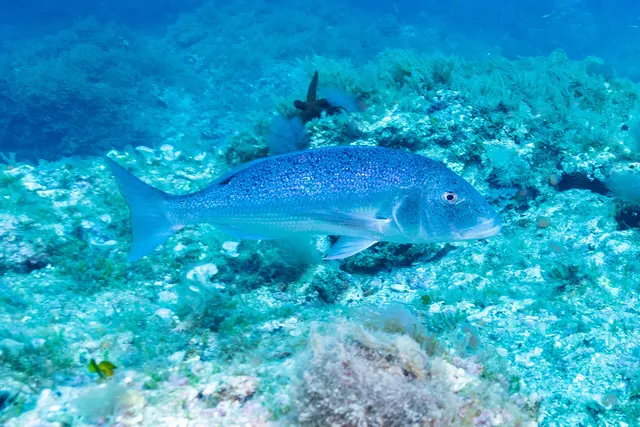 Common dentexThe Mediterranean's fastest and warriest inshore predator — a sea bream that hunts like a jack, and the fish spearfishers there rate above all others.
Diego Delso — CC BY-SA 4.0, via Wikimedia Commons
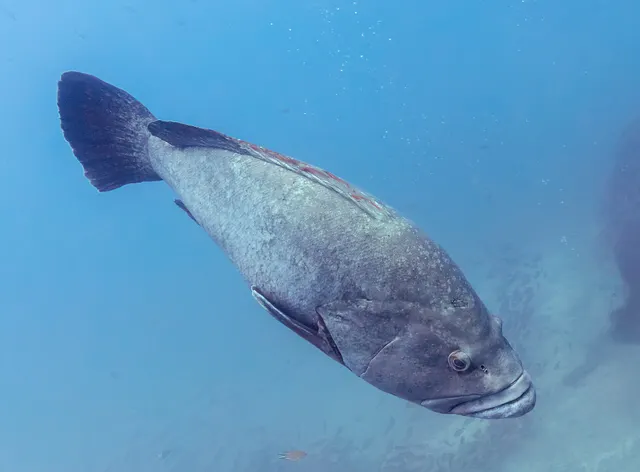 Dusky grouperThe Mediterranean's iconic reef predator: territorial, slow to mature, sex-changing, and the species whose decline made the case for marine protected areas there.
Diego Delso — CC BY-SA 4.0, via Wikimedia Commons
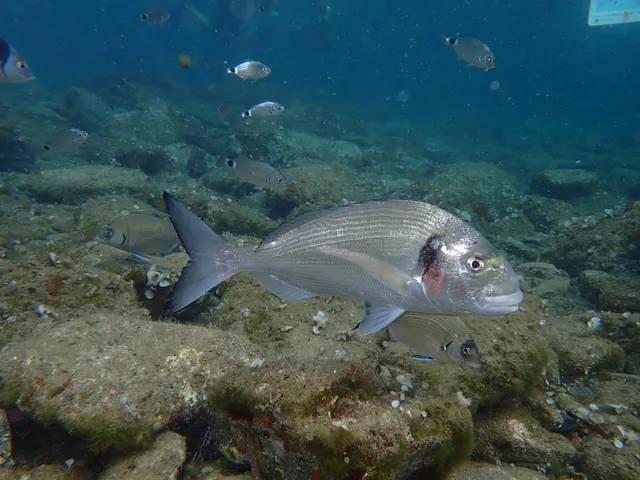 Gilthead breamThe Mediterranean's most prized sea bream, marked by a golden band between the eyes, with a jaw powerful enough to crush shellfish and a range now expanding northward.
jujurenoult — CC BY 4.0, via Wikimedia Commons
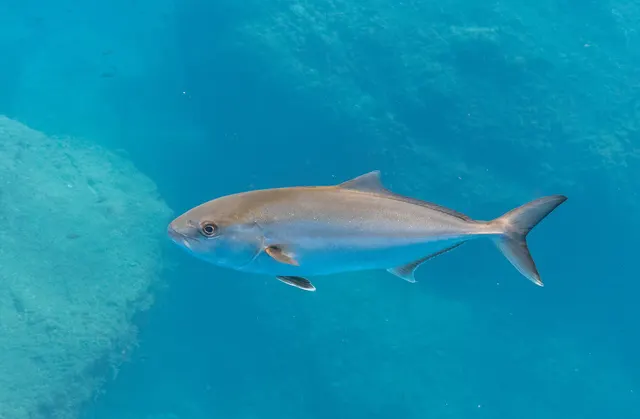 Greater amberjackThe largest amberjack — a circumglobal reef and wreck predator that fights downward with more raw power per kilogram than almost anything, and carries a genuine ciguatera caveat.
Diego Delso — CC BY-SA 4.0, via Wikimedia Commons
Places within this area
Publicly documented fishing geography. FishingHQ describes what the ground is; it does not say whether you may fish it, and every one of these sends that question to the body that holds the answer. Browse every place in this part of the world.
Who to ask before fishing any of these
FishingHQ does not know the current access position here. Croatia sells recreational sea fishing licences for fixed periods — a day, several days, a year — and treats underwater fishing as a separate category with its own licence, its own minimum age and its own prohibitions, including on the use of breathing apparatus. Protected areas, national parks and species measures apply on top and change. Check the current position with the ministry responsible for fisheries before going.
The Kornati islands
Island · Salt water
Some 140 bare karst islands, islets and reefs in the central Croatian Adriatic, almost without soil or fresh water, with white limestone above the surface and vertical cliffs on the seaward side dropping into deep clear water.
The seaward crowns take the open Adriatic and the bora — a violent cold downslope wind from the north-east that arrives with very little warning — while the inner channels are sheltered.
Particular to this ground: drowning and immersion, weather and lightning.
Severe hazards of The Croatian Adriatic apply here: shallow water blackout and breath-hold loss of consciousness, boat traffic and being seen.
Particular to this water: This ground lies in or beside a marine protected area whose zoning constrains fishing, diving, anchoring and collection independently of any licence, with rules that differ between zones and boundaries that are not visible from the water. Underwater fishing is licensed and regulated separately from rod fishing throughout this jurisdiction, with its own age, equipment and distance requirements, and holding a rod licence is not permission to spearfish.
Cape Kamenjak
Headland · Salt water
The southernmost point of Istria: a low limestone peninsula worn into shelves, small coves and islets, with clear shallow water over rock inshore and deeper ground off the point.
Exposed on three sides, with the bora from the north-east and the jugo from the south-east producing quite different seas.
Particular to this ground: drowning and immersion, sun, dehydration and fatigue.
Severe hazards of The Croatian Adriatic apply here: shallow water blackout and breath-hold loss of consciousness, weather and lightning, boat traffic and being seen.
Particular to this water: This ground lies in or beside a marine protected area whose zoning constrains fishing, diving, anchoring and collection independently of any licence, with rules that differ between zones and boundaries that are not visible from the water. Underwater fishing is licensed and regulated separately from rod fishing throughout this jurisdiction, with its own age, equipment and distance requirements, and holding a rod licence is not permission to spearfish.
Safety
Shallow water blackout and breath-hold loss of consciousness is set out at the top of this page, where it cannot be missed.
Weather and lightning — Can cause serious injury or death
The bura falls off the coastal mountains as a cold gusting katabatic wind, sometimes at extreme strength and with little warning. Because it comes off the land, the mainland shore can look flat while the channel a kilometre out is unworkable for a small craft.
What reduces it: Take bura warnings seriously and check the forecast before any crossing, do not judge the channel by the look of the water at the shore, and treat a decision not to go as ordinary.
Boat traffic and being seen — Can cause serious injury or death
Summer boat traffic is heavy, fast and largely recreational, and a diver's head in a chop is close to invisible from a moving vessel. Propeller injuries are catastrophic.
What reduces it: Use a surface marker buoy with a flag that is genuinely visible, stay with it rather than ranging away from it, and surface beside the float when an engine is approaching.
Slips, trips and falls — Can cause injury needing treatment
The karst shoreline is sharp limestone dropping vertically into deep water with no shallow margin, and cuts on it lacerate rather than graze and infect readily in warm water.
What reduces it: Wear footwear with real grip, plan an entry and an exit before getting into the water, keep cuts clean and covered, and do not assume a shore entry can be reversed at the same point in a sea.
Further safety reading
- Breath-hold blackout — Hypoxic blackout gives no warning symptoms, and warm clear comfortable water makes it more likely rather than less because comfort lengthens dives. One up, one down on every dive is the only measure that works.
Check the rules before you fish
Fishing laws, bylaws, access rules, seasons, bait restrictions and permitted methods vary by location and can change. Check the current rules from the relevant authority and the water you intend to fish before fishing.
Check with:
- Current national or regional law for where you are fishing
- Current local bylaws
- The relevant fisheries authority
- The landowner, club or fishery whose water it is
- Any restrictions specific to the species or the method you intend to use
Where to go next
What swims here
- Common dentexOver the karst walls, drop-offs and rubble where it hunts actively rather than holding a spot. It is the species Adriatic spearfishers rate above all others, and its vulnerable assessment is exactly why the local conversation about restraint is more advanced than the regulation.
- Dusky grouperIn the caves, overhangs and vertical structure that dissolved limestone produces in quantity. A site-attached, slow-growing, easily targeted fish in habitat that is easy to find is the clearest case for restraint on this coast.
- European squidMoving inshore seasonally over the sand and seagrass margins, supporting a shore and small-boat jigging fishery that is culturally and gastronomically central here rather than incidental.
- Gilthead breamOver the sand and seagrass margins and around the few brackish transitions, in a coast that otherwise offers almost no soft or estuarine ground.
- Greater amberjackPatrolling the karst walls and offshore banks in season, which is the pelagic component of a fishery otherwise dominated by resident rock species.
- White seabreamOn the rock and the posidonia edges throughout, and one of the ordinary shore and spearfishing catches of the whole eastern Adriatic.
How this compares
- Balearic IslandsThe two ends of the Mediterranean spearfishing world, both on limestone and both in clear water, with opposite tourism pressures and different regulatory temperaments. Reading them together shows how much of a fishery's character is set by how many people can reach it.
- Malta and GozoThe two Mediterranean destinations where a visiting spearfisher is most likely to assume the rules travel with them. They do not, and the difference between these two is the clearest illustration.
Environment and conservation
Sources and evidence
- ICES Advice on fishing opportunities, catch and effort — International Council for the Exploration of the Sea (Scientific institute)Relied on for: Ecoregion description, stock distribution, nursery function and the hydrography of the European sea areas assessed.States this directlyCitation checked — the work exists and is described correctly
- Cefas science, advice and data on marine and freshwater environments — Centre for Environment, Fisheries and Aquaculture Science (Government fisheries body)Relied on for: Marine environmental science for north-west European shelf seas, including tidal range and stream, sediment characterisation, estuarine and intertidal process.States this directlyCitation checked — the work exists and is described correctly
- JNCC species and habitat conservation advice — Joint Nature Conservation Committee (Conservation authority)Relied on for: Designation, habitat description and conservation status of the marine, coastal and freshwater habitats named, and the species characteristically associated with them.States this directlyCitation checked — the work exists and is described correctly
- FishBase: a global information system on fishes — Froese, R. and D. Pauly, eds. — FishBase Consortium (Scientific institute)Relied on for: Recorded distribution, depth range, habitat association and biology of the species named.States this directlyPassage read and verified
- DAN guidance on freediving safety, hypoxia and shallow-water blackout — Divers Alert Network (Water-safety or diver-training authority)Relied on for: Hypoxic blackout in breath-hold diving, its absence of warning symptoms, and the direct supervision practice that addresses it.States this directlyPassage read and verified
- AIDA International freediving education and safety standards — AIDA International (Water-safety or diver-training authority)Relied on for: Freediving training and safety standards including one-up-one-down direct supervision and surface interval practice.States this directlyCitation checked — the work exists and is described correctly
Why the 12 connections on this page are here, and the sources
What swims here
Backed by research — 6 connections
Supported by peer-reviewed research or fisheries science. The sources are listed and can be checked.
Common dentex
A claim that a place contains the ground, water and seasonal conditions the species is associated with. It is a distributional statement about the world, it rests on the regional reference literature, and it deliberately asserts nothing about access, permission or catch.
- FishBase: a global information system on fishes — Froese, R. and D. Pauly, eds. — FishBase Consortium (Scientific institute)Relied on for: Recorded distribution, depth range and habitat association for the Mediterranean species named.States this directlyPassage read and verified
- FAO Species Identification Guides for Fishery Purposes and the FAO Species Catalogues — Food and Agriculture Organization of the United Nations (Scientific institute)Relied on for: Regional species identification and distribution for the Mediterranean and eastern Atlantic, including habitat association.States this directlyCitation checked — the work exists and is described correctly
Dusky grouper
A claim that a place contains the ground, water and seasonal conditions the species is associated with. It is a distributional statement about the world, it rests on the regional reference literature, and it deliberately asserts nothing about access, permission or catch.
- FishBase: a global information system on fishes — Froese, R. and D. Pauly, eds. — FishBase Consortium (Scientific institute)Relied on for: Recorded distribution, depth range and habitat association for the Mediterranean species named.States this directlyPassage read and verified
- FAO Species Identification Guides for Fishery Purposes and the FAO Species Catalogues — Food and Agriculture Organization of the United Nations (Scientific institute)Relied on for: Regional species identification and distribution for the Mediterranean and eastern Atlantic, including habitat association.States this directlyCitation checked — the work exists and is described correctly
European squid
A claim that a place contains the ground, water and seasonal conditions the species is associated with. It is a distributional statement about the world, it rests on the regional reference literature, and it deliberately asserts nothing about access, permission or catch.
- FishBase: a global information system on fishes — Froese, R. and D. Pauly, eds. — FishBase Consortium (Scientific institute)Relied on for: Recorded distribution, depth range and habitat association for the Mediterranean species named.States this directlyPassage read and verified
- FAO Species Identification Guides for Fishery Purposes and the FAO Species Catalogues — Food and Agriculture Organization of the United Nations (Scientific institute)Relied on for: Regional species identification and distribution for the Mediterranean and eastern Atlantic, including habitat association.States this directlyCitation checked — the work exists and is described correctly
Gilthead bream
A claim that a place contains the ground, water and seasonal conditions the species is associated with. It is a distributional statement about the world, it rests on the regional reference literature, and it deliberately asserts nothing about access, permission or catch.
- FishBase: a global information system on fishes — Froese, R. and D. Pauly, eds. — FishBase Consortium (Scientific institute)Relied on for: Recorded distribution, depth range and habitat association for the Mediterranean species named.States this directlyPassage read and verified
- FAO Species Identification Guides for Fishery Purposes and the FAO Species Catalogues — Food and Agriculture Organization of the United Nations (Scientific institute)Relied on for: Regional species identification and distribution for the Mediterranean and eastern Atlantic, including habitat association.States this directlyCitation checked — the work exists and is described correctly
Greater amberjack
A claim that a place contains the ground, water and seasonal conditions the species is associated with. It is a distributional statement about the world, it rests on the regional reference literature, and it deliberately asserts nothing about access, permission or catch.
- FishBase: a global information system on fishes — Froese, R. and D. Pauly, eds. — FishBase Consortium (Scientific institute)Relied on for: Recorded distribution, depth range and habitat association for the Mediterranean species named.States this directlyPassage read and verified
- FAO Species Identification Guides for Fishery Purposes and the FAO Species Catalogues — Food and Agriculture Organization of the United Nations (Scientific institute)Relied on for: Regional species identification and distribution for the Mediterranean and eastern Atlantic, including habitat association.States this directlyCitation checked — the work exists and is described correctly
White seabream
A claim that a place contains the ground, water and seasonal conditions the species is associated with. It is a distributional statement about the world, it rests on the regional reference literature, and it deliberately asserts nothing about access, permission or catch.
- FishBase: a global information system on fishes — Froese, R. and D. Pauly, eds. — FishBase Consortium (Scientific institute)Relied on for: Recorded distribution, depth range and habitat association for the Mediterranean species named.States this directlyPassage read and verified
- FAO Species Identification Guides for Fishery Purposes and the FAO Species Catalogues — Food and Agriculture Organization of the United Nations (Scientific institute)Relied on for: Regional species identification and distribution for the Mediterranean and eastern Atlantic, including habitat association.States this directlyCitation checked — the work exists and is described correctly
How people fish here
What experienced anglers do — 2 connections
Widely and independently recommended by experienced anglers and specialist sources. This is real angling knowledge, not proof: controlled evidence for it is limited, and FishingHQ records it as convention rather than as a demonstrated effect.
Freediving for spearfishing
A claim about angling convention rather than about the world: that this place sits within this branch of fishing, which drives the information architecture as well as the page. It rests on independent practitioner description.
- General angling website restatements of established technique — Various (Credible secondary source)Relied on for: Widely restated descriptions of which practices are conventionally used in the waters named, recorded as practitioner consensus rather than as scholarship.Background and mechanism onlyCitation checked — the work exists and is described correctly
- Sea Angler — Bauer Media (Specialist angling publication)Relied on for: Long-running published description of European sea angling practice by region and by ground type.FishingHQ's interpretation of what it saysCitation checked — the work exists and is described correctly
Spearfishing
A claim about angling convention rather than about the world: that this place sits within this branch of fishing, which drives the information architecture as well as the page. It rests on independent practitioner description.
- General angling website restatements of established technique — Various (Credible secondary source)Relied on for: Widely restated descriptions of which practices are conventionally used in the waters named, recorded as practitioner consensus rather than as scholarship.Background and mechanism onlyCitation checked — the work exists and is described correctly
- Sea Angler — Bauer Media (Specialist angling publication)Relied on for: Long-running published description of European sea angling practice by region and by ground type.FishingHQ's interpretation of what it saysCitation checked — the work exists and is described correctly
How this compares
What experienced anglers do — 2 connections
Widely and independently recommended by experienced anglers and specialist sources. This is real angling knowledge, not proof: controlled evidence for it is limited, and FishingHQ records it as convention rather than as a demonstrated effect.
Balearic Islands
A claim that two places are worth reading against one another, because a reader choosing between them or generalising from one to the other needs to know how the underlying process differs.
- General angling website restatements of established technique — Various (Credible secondary source)Relied on for: Widely restated descriptions of which practices are conventionally used in the waters named, recorded as practitioner consensus rather than as scholarship.Background and mechanism onlyCitation checked — the work exists and is described correctly
- Sea Angler — Bauer Media (Specialist angling publication)Relied on for: Long-running published description of European sea angling practice by region and by ground type.FishingHQ's interpretation of what it saysCitation checked — the work exists and is described correctly
Malta and Gozo
A comparison a traveller choosing between two destinations genuinely needs.
- General angling website restatements of established technique — Various (Credible secondary source)Relied on for: Widely restated descriptions of regional practice, ground and species, recorded as consensus rather than as scholarship.Background and mechanism onlyCitation checked — the work exists and is described correctly
- Code of Conduct for Responsible Fisheries — Food and Agriculture Organization of the United Nations, Rome, 1995 (Standards body)Relied on for: International principles for responsible fisheries, including the management of small-scale and artisanal fisheries.Background and mechanism onlyCitation checked — the work exists and is described correctly
Safety reading
Official guidance — 1 connection
Stated by a fisheries authority, scientific institute or recognised angling body. Authoritative, but summarising rather than demonstrating.
Breath-hold blackout
A claim that a place presents a particular hazard strongly enough that the reader should be sent to the page dealing with it in full, rather than left with the short warning on the place itself.
- RNLI water safety guidance: cold water shock and Float to Live — Royal National Lifeboat Institution (Water-safety or diver-training authority)Relied on for: Cold water shock and the immersion response, tidal cut-off, and water-safety guidance for shore anglers and small-craft users.States this directlyPassage read and verified
Environment and conservation
Backed by research — 1 connection
Supported by peer-reviewed research or fisheries science. The sources are listed and can be checked.
Selectivity and what it is used for
A claim that a place raises a particular environmental question, resting on the scientific and conservation literature for the system rather than on angling practice.
- JNCC species and habitat conservation advice — Joint Nature Conservation Committee (Conservation authority)Relied on for: Habitat classification and description for the intertidal, coastal and freshwater habitats named, and the species characteristically associated with them.States this directlyCitation checked — the work exists and is described correctly
- ICES Advice on fishing opportunities, catch and effort — International Council for the Exploration of the Sea (Scientific institute)Relied on for: Ecoregion description, nursery function and the hydrography of the European sea areas assessed.States this directlyCitation checked — the work exists and is described correctly
How FishingHQ labels evidence is explained in the evidence policy.