Common pandora
Fish · Last reviewed 2026-08-10
A pink-silver Mediterranean sparid of sand and mixed ground, changing sex from female to male with age, and a staple of light bottom fishing.
Safety: injury while handling fish — minor injury.
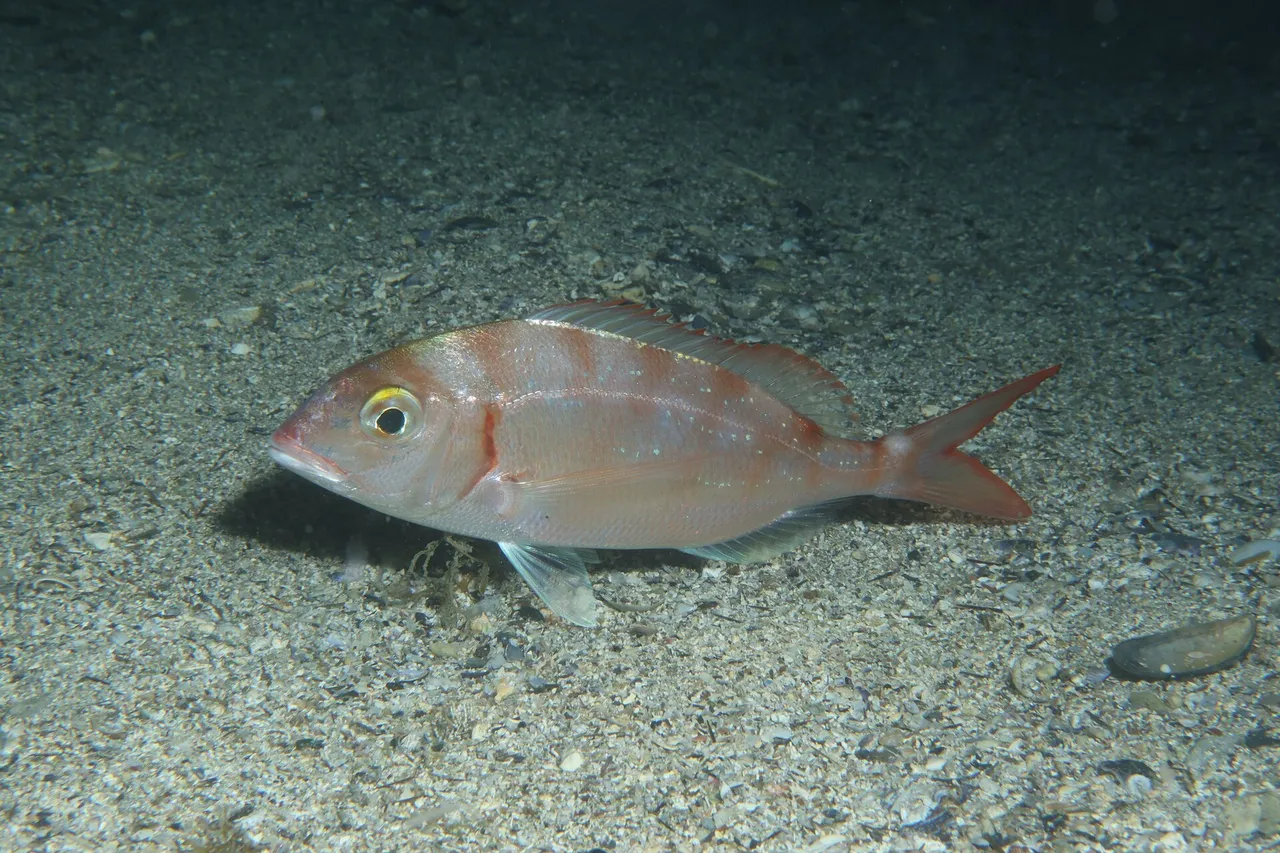
How this was identified, and who took it
Identified by: Identified partly on an absence, which is why the whole fish had to be in frame: there is NO dark blotch at the origin of the lateral line, and that blotch is what makes a blackspot seabream, Pagellus bogaraveo — the fish most likely to be confused with this one. Supporting: uniform pink-red body, small pale blue spots on the upper flank, and a red mark on the upper opercular margin.jujurenoult — CC BY 4.0, via Wikimedia Commons — source, licence
Catching Common pandora
Everything here on fishing for it. Each entry opens the page behind it.
- Ground
- When
- Feb — months recorded at the places that document it, not a season for the whole range.
- Where
- 1 place FishingHQ documents — strongest claim anywhere: recorded here · From the shore
Common pandora is one of the everyday sparids of the Mediterranean and eastern Atlantic — a slim, rose-pink fish with a silvery sheen and blue speckling along the back, taken over sand, mud and mixed ground rather than tight on rock.
It is protogynous: individuals mature first as females and change to male as they grow older and larger. That life history is common in sparids and matters for management, because the largest fish in a population are disproportionately male.
For anglers it is a light-tackle bottom species, taken on small baited hooks over open ground, and it is a staple of Mediterranean boat and shore fishing rather than a trophy.
How it is caught
Where Common pandora is documented
Places where public sources describe this species as fished, with how it is fished and how strongly the evidence supports it. This is not a range map and it is not a recommendation — it is what has been written down about a fishery rather than a record of any individual catch, and being listed is never permission to fish.
What these strengths mean
- Recorded here
- At least one credible public account of this species being caught here. That is all it means.
Identification
- Scientific name
- Pagellus erythrinus
- Family
- Sparidae
- Water
- Saltwater
- Conservation status
- Least Concern
- Regions
- Mediterranean, Western Europe, West Africa
- Slim, moderately deep body with a distinctly rose-pink cast over silver, brightest along the back.
- Small blue spots or speckles scattered along the upper flank in fresh fish.
- A reddish mark at the upper edge of the gill cover, and a pointed snout with a small mouth.
- No dark spot on the shoulder or caudal peduncle, which separates it from several similar sparids.
Size
- Typical
- 150–400 g (5–14 oz)
- Large
- 600 g–1.2 kg (1.3–2.6 lb)
Exceptional: FishBase records a maximum of 60 cm and 3.2 kg
A seabream that starts female and a spawning tied to warm water
Common pandora reproduction follows the seabream pattern of sequential hermaphroditism, and getting the direction right matters.
THE SPECIES IS PROTOGYNOUS: individuals function first as females and a proportion change to male as they grow older and larger. So the larger fish in a population skew male, and the sex ratio of a stock is a function of its size structure.
WHICH MEANS HEAVY FISHING ALTERS THE BREEDING STRUCTURE, not merely the numbers. Removing the larger size classes removes males, and populations fished down can develop skewed ratios that catch data alone will not reveal.
SPAWNING IS IN THE WARMER MONTHS, generally spring through summer in the Mediterranean and eastern Atlantic, triggered by rising water temperature, and it is protracted rather than a single event.
EGGS AND LARVAE ARE PELAGIC, drifting before juveniles settle onto inshore ground.
JUVENILES OCCUPY SHALLOWER INSHORE HABITAT than adults, including seagrass and sand, moving deeper as they grow.
MATURITY COMES AT A SMALL SIZE AND A YOUNG AGE relative to the maximum, which gives the species reasonable resilience — but it is a heavily exploited component of Mediterranean and eastern Atlantic mixed fisheries and is taken in quantity as a small fish.
AND THE MINIMUM SIZE QUESTION IS THEREFORE A REAL ONE for this species, because the sizes commonly landed sit close to the size at first maturity.
Backed by research — why, and the sources (2)
Supported by peer-reviewed research or fisheries science. The sources are listed and can be checked.
- FAO Species Identification Guides for Fishery Purposes and the FAO Species Catalogues — Food and Agriculture Organization of the United Nations (Scientific institute)Relied on for: Distribution, habitat, depth and fishery accounts for the species in the FAO regional identification guides for the ocean area concerned.States this directlyCitation checked — the work exists and is described correctly
- The IUCN Red List of Threatened Species — International Union for Conservation of Nature (Conservation authority)Relied on for: Assessment and range account for the species, including the habitats it depends on, its life history and the pressures acting on it.States this directlyCitation checked — the work exists and is described correctly
Small, spiny, deep-caught, and mostly undersized — the hardest combination to do well
Common pandora bring together four properties that individually are trivial and together produce the worst release outcomes of any small fish in the Mediterranean.
SMALL AND SPINY. The dorsal spines are fine and sharp and go into a fingertip easily, and the fish is small enough that people handle it with fingers rather than with a tool. Grip across the body with the spines folded, and use a disgorger — the hooks are small and frequently well inside a small mouth, and fingers cannot reach them without doing damage.
DEEP-CAUGHT. Pandora come off ground deep enough that swim-bladder expansion is common, and a small fish with an expanded bladder is completely unable to return. It floats, visibly, and it does not recover on the surface.
MOSTLY UNDERSIZED. On most ground the majority of pandora caught are below any retention size, which means most of the fish in this fishery are fish that need to be returned successfully — and the ones being returned are precisely the ones least able to deal with the depth.
AND CAUGHT IN NUMBERS, quickly, often on multi-hook rigs, by somebody who is fishing for something else. That is the condition under which care lapses.
SO THE HONEST GUIDANCE IS UNCOMFORTABLE AND WORTH STATING. If small pandora are coming up from deep water in numbers and going back unable to swim down, the release is not working, and no technique on deck will make it work. The available responses are to move — to shallower ground, or off the mark entirely — or to reduce the hook count, or to retain within the local rules what is legally retainable rather than returning fish that will not survive. What does not help is doing the same thing more gently.
Where fish are returned: fast, wet hands, a disgorger rather than fingers, and back over the side within seconds rather than after the rest of the rig is dealt with.
What experienced anglers do — why, and the sources (4)
Widely and independently recommended by experienced anglers and specialist sources. This is real angling knowledge, not proof: controlled evidence for it is limited, and FishingHQ records it as convention rather than as a demonstrated effect.
- Do we need species-specific guidelines for catch-and-release recreational angling? — Biodiversity and Conservation 14:1195–1209, 2005 (Scientific literature)Relied on for: That post-release mortality varies with species, capture depth, water temperature, air exposure and handling duration, and that species-specific guidance outperforms general guidance.States this directlyCitation checked — the work exists and is described correctly
- A review of catch-and-release angling mortality with implications for no-take reserves — Reviews in Fish Biology and Fisheries 15:129–154, 2005 (Scientific literature)Relied on for: Review of hooking and release mortality across fisheries, including the contribution of capture depth, handling and anatomical hooking location.States this directlyCitation checked — the work exists and is described correctly
- Sea Angler — Bauer Media (Specialist angling publication)Relied on for: Established boat and shore practice for handling and returning the species.States this directlyCitation checked — the work exists and is described correctly
- IGFA International Angling Rules and World Record Requirements — International Game Fish Association (Angling or fisheries organisation)Relied on for: Handling, release and tackle conventions in recognised sport fisheries for the species.Background and mechanism onlyPassage read and verified
Lifecycle and reproduction
Protogynous hermaphrodite — most fish mature as female and transition to male with age and size. Moderately short-lived compared with the larger sparids, and fast to mature.
Spawns in spring and summer over open ground in coastal waters, broadcasting eggs with no parental care. Because the species changes sex from female to male with age, the sex ratio of a population is set by its age structure, and heavy removal of the largest fish removes the males.
Feeding and senses
Takes small crustaceans, worms and molluscs from sand and mud, feeding close to the bottom over open ground rather than around structure.
A daylight bottom feeder locating prey by sight and by close-range detection over sediment, which is why small natural baits presented on or near the bottom work best.
Through the year
Moves into shallower coastal water in the warmer months and deeper in winter, following temperature rather than making long migrations.
Distribution
Eastern Atlantic: Norway and the Mediterranean to Guinea-Bissau , including Cape Verde, Madeira and the Canary Islands. Rarely recorded in Scandinavia
This is a biological range — where the species occurs, not a prediction that you will catch one. To browse the fishing geography FishingHQ holds, start at fishing places.
Why anglers care
A common light-tackle target across the Mediterranean and eastern Atlantic, taken on small hooks baited with worm, shrimp and shellfish over sand and mixed ground from boat and shore. Its significance is as a reliable everyday species that supports a great deal of ordinary fishing, and as good eating at modest size. It is not a specimen fish and is not fished for as one.
Handling and returning
Small and spiny; the dorsal spines puncture easily. Grip across the body with the spines folded and unhook with a disgorger or pliers. Fish taken from deeper water may show barotrauma and should be returned promptly or retained.
Going further
- Common pandora vs Common dentex — how to tell them apart.
Safety
Injury while handling fish — Minor injury
The spiny dorsal causes punctures when the fish is gripped carelessly, and puncture wounds from fish spines readily become infected.
What reduces it: Grip across the body with the spines folded and use a disgorger or pliers.
Where to go next
Similar and related fish
Where it lives
Where you will find it
Sources and evidence
- FishBase: a global information system on fishes — Froese, R. and D. Pauly, eds. — FishBase Consortium (Scientific institute)Relied on for: Family, maximum size, depth and environment, distribution and the IUCN assessment for Pagellus erythrinus.States this directlyPassage read and verified
- The IUCN Red List of Threatened Species — International Union for Conservation of Nature (Conservation authority)Relied on for: The Least Concern assessment for Pagellus erythrinus, assessed 17 August 2009.States this directlyCitation checked — the work exists and is described correctly
Why the 8 connections on this page are here, and the sources
Similar and related fish
Backed by research — 3 connections
Supported by peer-reviewed research or fisheries science. The sources are listed and can be checked.
Axillary seabream
Pagellus acarne carries a dark blotch in the axil of the pectoral fin; Pagellus erythrinus is more strongly red and lacks it. The Canary directorate calls the first besugo and the second breca, which is not what either word means on the Spanish mainland.
- FishBase: a global information system on fishes — Froese, R. and D. Pauly, eds. — FishBase Consortium (Scientific institute)Relied on for: The morphology, size, depth range and distribution that separate these two species from one another.States this directlyPassage read and verified
Blackspot seabream
Pagellus erythrinus is the smallest and reddest of the three, without either the axillary blotch of Pagellus acarne or the shoulder blotch of Pagellus bogaraveo. The Azores checklist and the Canary directorate both give it a name of its own — breca — which is the one Pagellus name that does not move between regions.
- FishBase: a global information system on fishes — Froese, R. and D. Pauly, eds. — FishBase Consortium (Scientific institute)Relied on for: The morphology, size, depth range and distribution that separate these two species from one another.States this directlyPassage read and verified
Common dentex
An identification comparison naming both binomials: Pagellus erythrinus and Dentex dentex.
- FishBase: a global information system on fishes — Froese, R. and D. Pauly, eds. — FishBase Consortium (Scientific institute)Relied on for: Morphological and distributional data for Pagellus erythrinus and for Dentex dentex.States this directlyPassage read and verified
- The IUCN Red List of Threatened Species — International Union for Conservation of Nature (Conservation authority)Relied on for: Separate assessments treating Pagellus erythrinus and Dentex dentex as distinct species.States this directlyCitation checked — the work exists and is described correctly
How it is caught
What experienced anglers do — 2 connections
Widely and independently recommended by experienced anglers and specialist sources. This is real angling knowledge, not proof: controlled evidence for it is limited, and FishingHQ records it as convention rather than as a demonstrated effect.
Drift fishing
A practitioner claim about how Pagellus erythrinus is commonly fished, following from where and how it feeds.
- General angling website restatements of established technique — Various (Credible secondary source)Relied on for: Widely restated practitioner accounts of fishing for common pandora.Citation checked — the work exists and is described correctly
- Sea Angler — Bauer Media (Specialist angling publication)Relied on for: Practitioner treatment of the methods used for common pandora and comparable species.Citation checked — the work exists and is described correctly
Ledgering
A practitioner claim about how Pagellus erythrinus is commonly fished, following from where and how it feeds.
- General angling website restatements of established technique — Various (Credible secondary source)Relied on for: Widely restated practitioner accounts of fishing for common pandora.Citation checked — the work exists and is described correctly
- Sea Angler — Bauer Media (Specialist angling publication)Relied on for: Practitioner treatment of the methods used for common pandora and comparable species.Citation checked — the work exists and is described correctly
Where it lives
Backed by research — 1 connection
Supported by peer-reviewed research or fisheries science. The sources are listed and can be checked.
Inshore ground
A habitat association for Pagellus erythrinus taken from the environment and distribution data on its FishBase summary.
- FishBase: a global information system on fishes — Froese, R. and D. Pauly, eds. — FishBase Consortium (Scientific institute)Relied on for: The environment, depth range and habitat description recorded for Pagellus erythrinus.States this directlyPassage read and verified
Where you will find it
Backed by research — 2 connections
Supported by peer-reviewed research or fisheries science. The sources are listed and can be checked.
The Aegean and Crete
A claim that a place contains the ground, water and seasonal conditions the species is associated with. It is a distributional statement about the world, it rests on the regional reference literature, and it deliberately asserts nothing about access, permission or catch.
- FishBase: a global information system on fishes — Froese, R. and D. Pauly, eds. — FishBase Consortium (Scientific institute)Relied on for: Recorded distribution, depth range and habitat association for the Mediterranean species named.States this directlyPassage read and verified
- FAO Species Identification Guides for Fishery Purposes and the FAO Species Catalogues — Food and Agriculture Organization of the United Nations (Scientific institute)Relied on for: Regional species identification and distribution for the Mediterranean and eastern Atlantic, including habitat association.States this directlyCitation checked — the work exists and is described correctly
The Strait of Messina
A distribution association between an animal and a kind of water, rather than a claim about any named mark.
- FishBase: a global information system on fishes — Froese, R. and D. Pauly, eds. — FishBase Consortium (Scientific institute)Relied on for: Distribution, habitat association and depth range recorded for the species, including its occurrence in the water body concerned.States this directlyPassage read and verified
- The IUCN Red List of Threatened Species — International Union for Conservation of Nature (Conservation authority)Relied on for: Assessment and range account for the species, including the systems and coasts it occupies.Background and mechanism onlyCitation checked — the work exists and is described correctly
How FishingHQ labels evidence is explained in the evidence policy.