Common dentex vs Common pandora
How to tell them apart, and what follows from getting it right.
Why they get confused
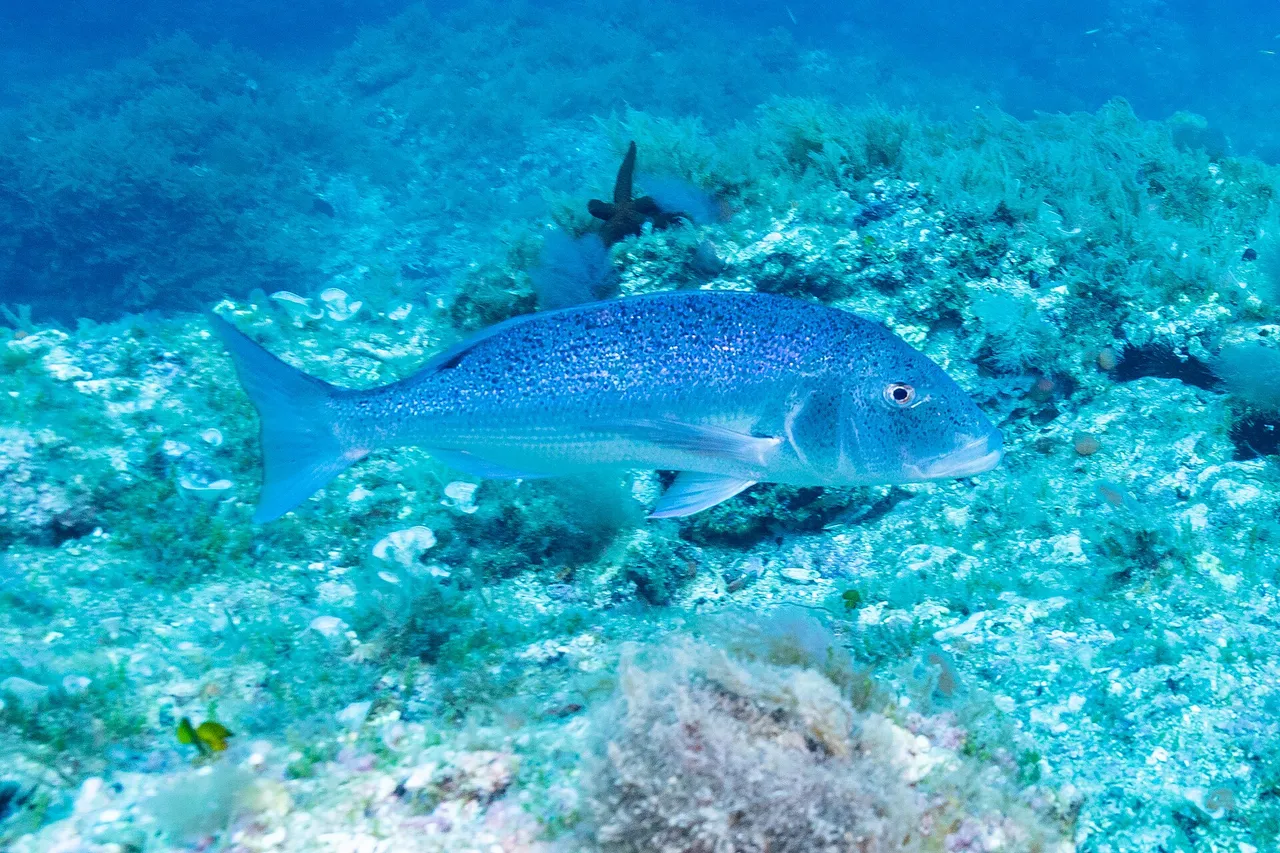
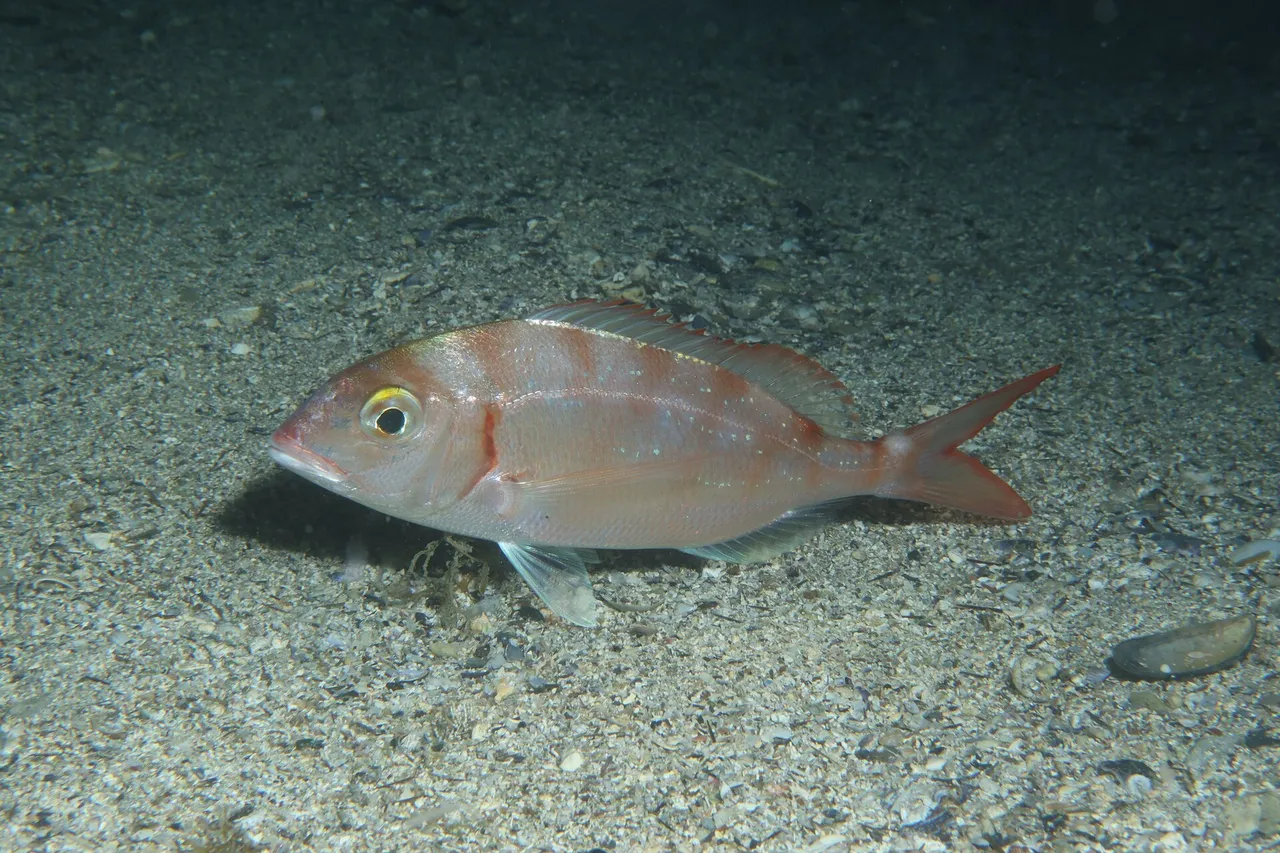
Two Mediterranean sparids of similar build taken over the same mixed ground, both silver with a coloured cast, both spotted on the upper flank, and both sold under names that shade into each other on a market slab. A juvenile dentex of a few hundred grammes is the same size and shape as an adult pandora, which is precisely the size at which the identification matters most, because one of the two is vulnerable and the other is not.
Common dentex
Dentex dentex — Sparidae
,_Cabo_de_Palos,_Espa%C3%B1a,_2022-07-15,_DD_59.jpg)
Common pandora
Pagellus erythrinus — Sparidae

The differences
Each difference is marked with how far it can be trusted on its own. A single diagnostic character settles the identification; suggestive ones only narrow it.
| Character | Common dentex | Common pandora | Reliability |
|---|---|---|---|
| Canine teeth at the front of the jawIdentification | Prominent, widely spaced canines at the front of both jaws — visible without opening the mouth wide, and the origin of the name. A hunting dentition. | None. A small mouth at the end of a pointed snout, built for picking crustaceans and worms off sand. There is no version of this fish with canines. | Diagnostic on its own |
| The profile of the headIdentification | A steep forehead that becomes markedly humped in large males, so the outline of a big fish is unmistakable even in poor underwater light. | A clean pointed snout with no hump at any age, on a slimmer and only moderately deep body. | Diagnostic on its own |
| The colour cast, and the spots in itIdentification | Silvery-blue to grey, with small DARK spots scattered on the upper flank of younger fish that fade with age. | A distinct rose-pink cast over silver, brightest along the back, with small BLUE speckles along the upper flank on a fresh fish and a reddish mark at the top of the gill cover. | Supporting — use with others |
| The size the fish reachesSize | Ordinary fish run 1.5–4 kg, a good one six to nine, and the maximum published weight is 14.3 kg. | Ordinary fish run 150–400 g, a good one under one and a quarter kilos, and FishBase records a maximum of 60 cm and 3.2 kg. A five-kilo fish is not a pandora. | Supporting — use with others |
| Where on the ground each one isFeeding | Hunting fish, molluscs and cephalopods actively over hard bottom of rock and rubble, covering ground at speed rather than holding a spot. | Working small crustaceans, worms and molluscs off sand and mud close to the bottom, over open ground rather than around structure. | Supporting — use with others |
| How each one handles sexSpawning | Generally separate sexes, with some individuals recorded as hermaphroditic in young life stages — a looser pattern than the strict protogyny of many groupers, and not the same thing. | Changes sex from female to male with age, so the sex ratio of a population is set by its age structure and removing the largest fish removes the males. | Suggestive only — varies |
| Where each one standsConservation status | Vulnerable. A slow, mobile, heavily targeted predator that spearfishers across the Mediterranean rate above everything else, which is part of the problem. | Least concern, and a staple of light bottom fishing throughout its range. | Supporting — use with others |
Why it matters
The two carry different obligations and the difference runs the wrong way from the difficulty: the fish that needs restraint is the one that is harder to recognise when small. Common dentex is assessed as vulnerable, and a diver or angler who has decided the fish in front of them is a dentex has decided that their own restraint about size and number is doing more work than any handling technique can. Pandora is a least-concern sand-ground fish taken in numbers on light gear, frequently from enough depth that barotrauma decides whether a return is meaningful. Minimum sizes for both are set locally, they differ between jurisdictions, and they change — FishingHQ does not state them.
The full records
This page compares two species. Each of them has a complete record covering biology, behaviour, handling and the evidence behind all of it.
More about common dentex
Where it lives, how it is caught, and what else it is confused with.
Similar and related fish
 Common pandoraSparids of the same waters separated by dentition, body depth and colour.
- European anchovySmall shoaling clupeids and anchovies are taken in open water, which is when dentex move off the structure they otherwise hold to.
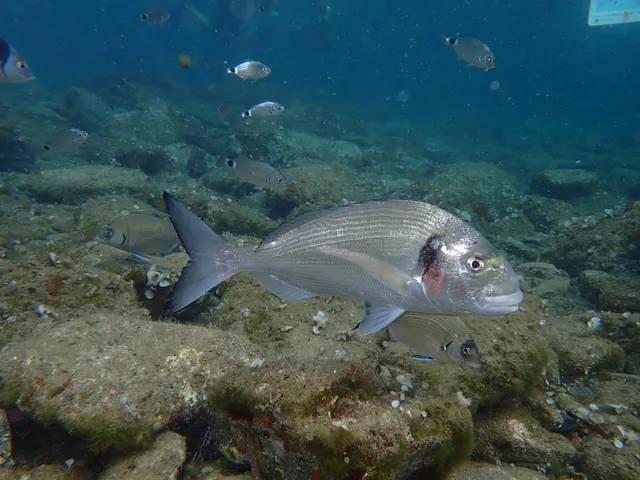 Gilthead breamBoth are Sparidae and neither is what its market name suggests. The dentex hunts fish with canines; the gilthead crushes shellfish with molars. Same family, opposite equipment.
- Pink dentexThe pair whose overlapping Spanish names kept both of them out of Canary records for two programmes.
How it is caught
Gear for this fish
Why the 6 connections on this page are here, and the sources
Similar and related fish
Backed by research — 4 connections
Supported by peer-reviewed research or fisheries science. The sources are listed and can be checked.
Common pandora
An identification comparison naming both binomials: Pagellus erythrinus and Dentex dentex.
- FishBase: a global information system on fishes — Froese, R. and D. Pauly, eds. — FishBase Consortium (Scientific institute)Relied on for: Morphological and distributional data for Pagellus erythrinus and for Dentex dentex.States this directlyPassage read and verified
- The IUCN Red List of Threatened Species — International Union for Conservation of Nature (Conservation authority)Relied on for: Separate assessments treating Pagellus erythrinus and Dentex dentex as distinct species.States this directlyCitation checked — the work exists and is described correctly
European anchovy
Recorded diet evidence identifies Engraulis encrasicolus as a food item of this predator at species level. The edge is written at that granularity and no further.
- FishBase: a global information system on fishes — Froese, R. and D. Pauly, eds. — FishBase Consortium (Scientific institute)Relied on for: Food items recorded for this predator, including Engraulis encrasicolus.States this directlyPassage read and verified
- FAO Species Identification Guides for Fishery Purposes and the FAO Species Catalogues — Food and Agriculture Organization of the United Nations (Scientific institute)Relied on for: Species account describing the diet of this predator in the region where Engraulis encrasicolus occurs.Background and mechanism onlyCitation checked — the work exists and is described correctly
Gilthead bream
A comparison resting on shared family and contrasting feeding morphology, naming both binomials.
- FishBase: a global information system on fishes — Froese, R. and D. Pauly, eds. — FishBase Consortium (Scientific institute)Relied on for: That Sparus aurata and Dentex dentex are both Sparidae of the eastern Atlantic and Mediterranean with differing dentition and feeding ecology.States this directlyPassage read and verified
Pink dentex
Dentex gibbosus develops a pronounced forehead bulge on old fish and reaches 106 cm and 16.4 kg; Dentex dentex does not and is smaller. Spanish sources use overlapping common names for the two, which is why the Canary directorate's `sama, serruda, pargo macho` against D. gibbosus was the thing that finally resolved it.
- FishBase: a global information system on fishes — Froese, R. and D. Pauly, eds. — FishBase Consortium (Scientific institute)Relied on for: The morphology, size, depth range and distribution that separate these two species from one another.States this directlyPassage read and verified
How it is caught
Official guidance — 1 connection
Stated by a fisheries authority, scientific institute or recognised angling body. Authoritative, but summarising rather than demonstrating.
Reef spearfishing
A scientific institute reporting what its own survey of the fishery recorded: a two-year catch-recording programme across the Canary archipelago counted and weighed every specimen, and this species appears in its published catch table. That is what Canary spearfishers were measured taking, rather than an inference from where the species lives or an assertion about what people do.
- Spearfishing in the Canary Islands: is the devil as black as it seems to be? — Pablo Martín-Sosa, Instituto Español de Oceanografía — Revista Scientia Insularum, 2019 (Scientific literature)Relied on for: The Canary spearfishing catch table, in which this species appears with a specimen count and a landed weight over the study's two-year recording period.States this directlyPassage read and verified
Gear for this fish
What experienced anglers do — 1 connection
Widely and independently recommended by experienced anglers and specialist sources. This is real angling knowledge, not proof: controlled evidence for it is limited, and FishingHQ records it as convention rather than as a demonstrated effect.
Soft plastics
A practitioner claim about which lure family answers this species' feeding or holding behaviour.
- Sea Angler — Bauer Media (Specialist angling publication)Relied on for: Established shore and boat lure practice for the species in north-west European seas.States this directlyCitation checked — the work exists and is described correctly
- General angling website restatements of established technique — Various (Credible secondary source)Relied on for: Widely restated lure selection for this species, recorded as practitioner consensus rather than as tested fact.Background and mechanism onlyCitation checked — the work exists and is described correctly
Reviewed 2026-08-16. FishingHQ does not state what any rule is or where any rule applies. Where this page says the two species are managed differently, that is a reason to check the authority for the water you are on — not a statement of what it requires.