How to identify common pandora
Pagellus erythrinus · Sparidae
The characters that identify common pandora, ranked by how far each one can be trusted on its own.
Safety: injury while handling fish — minor injury.
How this was identified, and who took it
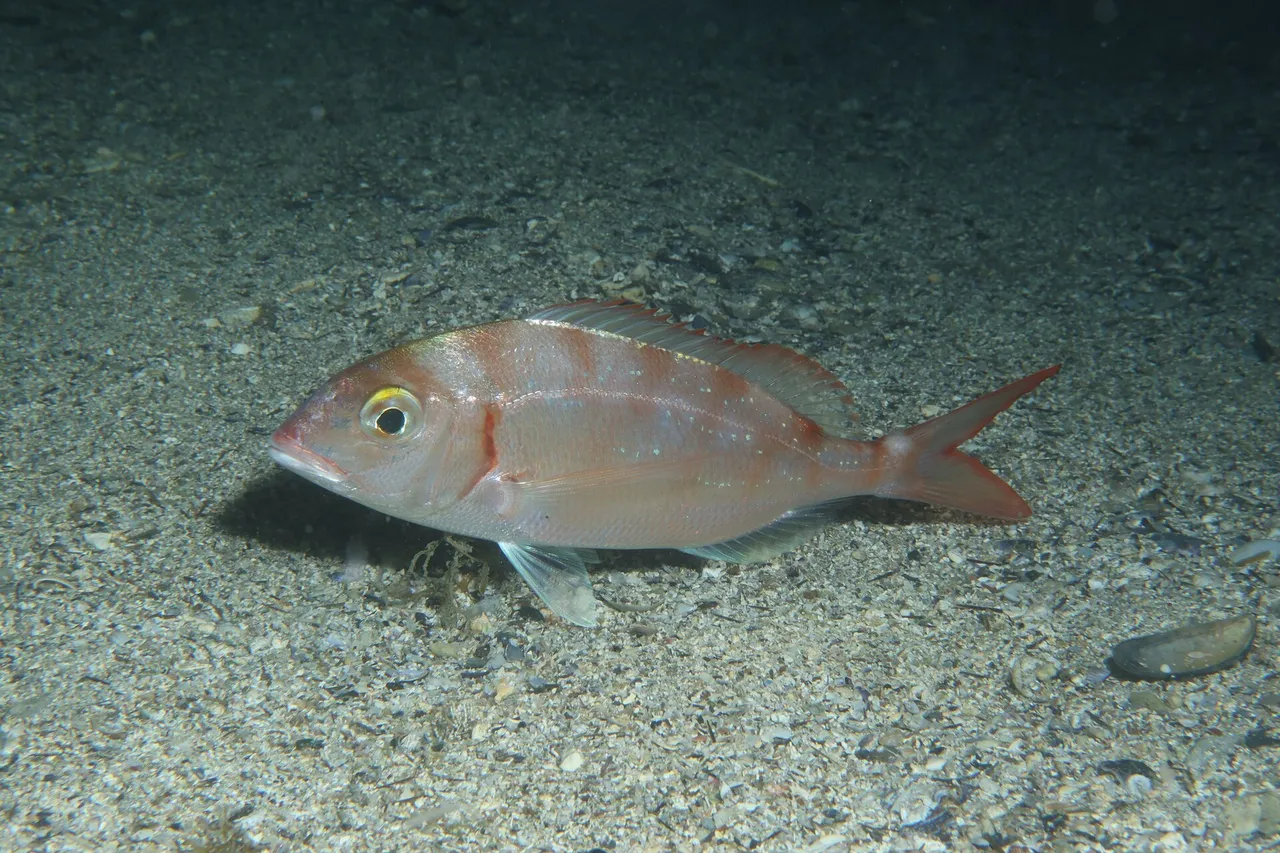
Identified by: Identified partly on an absence, which is why the whole fish had to be in frame: there is NO dark blotch at the origin of the lateral line, and that blotch is what makes a blackspot seabream, Pagellus bogaraveo — the fish most likely to be confused with this one. Supporting: uniform pink-red body, small pale blue spots on the upper flank, and a red mark on the upper opercular margin.jujurenoult — CC BY 4.0, via Wikimedia Commons — source, licenceLook at this first
Look at the shoulder and expect to find nothing. A common pandora is a plain pink-red seabream with NO dark blotch where the lateral line begins. The presence of that blotch is what makes a blackspot seabream, which is the fish this is confused with.
Diagnostic — settles it on its own
Each of these settles the identification on its own. If one is clear, you have your answer.
No dark blotch at the start of the lateral line
The shoulder is clean. Pagellus bogaraveo, the blackspot seabream, carries a conspicuous dark spot at the origin of the lateral line just behind the gill cover, and it is the first thing to look for. Its absence, on an otherwise pink Pagellus, is the identification — which is why the whole fish has to be visible rather than a head shot.
Supporting — use with other characters
Real characters that are not conclusive by themselves. Use two or three together.
Small pale blue spots along the upper flank
Scattered small blue or blue-white spots are often visible on the back and upper flank of a fresh fish. They fade quickly after death, which is why they are supporting rather than diagnostic, and they are absent or much weaker in the confusable species.
A red mark on the upper edge of the gill cover
The upper margin of the operculum carries a reddish tinge or mark. Consistent in fresh fish and among the first things to fade, so it confirms rather than decides.
A moderate, evenly-sloping head profile
The head slopes evenly rather than rising steeply as in a gilthead, and the eye is moderate rather than large — blackspot seabream is notably large-eyed. Proportional characters that read well when the two are side by side and less well in isolation.
What it gets confused with
- Blackspot seabream, the principal confusion. Look for the shoulder spot: present means blackspot, absent means pandora.
- Axillary seabream, which carries a dark blotch in the pectoral axil rather than on the shoulder and is generally smaller.
- Small gilthead bream, which have a much steeper head profile and a silver rather than pink ground colour.
Side by side: Common pandora vs Common dentex.
Where this stops working
This page turns on an absence, which is a harder thing to see reliably than a presence — a faded or damaged fish, a photograph at the wrong angle, or a fish partly obscured can all hide a blotch that is there. The safe reading is that a clearly visible shoulder spot rules pandora OUT, while its apparent absence should be checked against the head profile and eye size before it is trusted. Juvenile Pagellus of all three species are difficult and this page does not attempt them.
The full record
This page covers identification only. The Common pandora record covers behaviour, lifecycle, distribution, handling and the sources behind all of it.
Reviewed 2026-08-15.
More about this fish
Telling it apart is one question. Here are the others.
Similar and related fish
How it is caught
Where it lives
Where you will find it
Why the 8 connections on this page are here, and the sources
Similar and related fish
Backed by research — 3 connections
Supported by peer-reviewed research or fisheries science. The sources are listed and can be checked.
Axillary seabream
Pagellus acarne carries a dark blotch in the axil of the pectoral fin; Pagellus erythrinus is more strongly red and lacks it. The Canary directorate calls the first besugo and the second breca, which is not what either word means on the Spanish mainland.
- FishBase: a global information system on fishes — Froese, R. and D. Pauly, eds. — FishBase Consortium (Scientific institute)Relied on for: The morphology, size, depth range and distribution that separate these two species from one another.States this directlyPassage read and verified
Blackspot seabream
Pagellus erythrinus is the smallest and reddest of the three, without either the axillary blotch of Pagellus acarne or the shoulder blotch of Pagellus bogaraveo. The Azores checklist and the Canary directorate both give it a name of its own — breca — which is the one Pagellus name that does not move between regions.
- FishBase: a global information system on fishes — Froese, R. and D. Pauly, eds. — FishBase Consortium (Scientific institute)Relied on for: The morphology, size, depth range and distribution that separate these two species from one another.States this directlyPassage read and verified
Common dentex
An identification comparison naming both binomials: Pagellus erythrinus and Dentex dentex.
- FishBase: a global information system on fishes — Froese, R. and D. Pauly, eds. — FishBase Consortium (Scientific institute)Relied on for: Morphological and distributional data for Pagellus erythrinus and for Dentex dentex.States this directlyPassage read and verified
- The IUCN Red List of Threatened Species — International Union for Conservation of Nature (Conservation authority)Relied on for: Separate assessments treating Pagellus erythrinus and Dentex dentex as distinct species.States this directlyCitation checked — the work exists and is described correctly
How it is caught
What experienced anglers do — 2 connections
Widely and independently recommended by experienced anglers and specialist sources. This is real angling knowledge, not proof: controlled evidence for it is limited, and FishingHQ records it as convention rather than as a demonstrated effect.
Drift fishing
A practitioner claim about how Pagellus erythrinus is commonly fished, following from where and how it feeds.
- General angling website restatements of established technique — Various (Credible secondary source)Relied on for: Widely restated practitioner accounts of fishing for common pandora.Citation checked — the work exists and is described correctly
- Sea Angler — Bauer Media (Specialist angling publication)Relied on for: Practitioner treatment of the methods used for common pandora and comparable species.Citation checked — the work exists and is described correctly
Ledgering
A practitioner claim about how Pagellus erythrinus is commonly fished, following from where and how it feeds.
- General angling website restatements of established technique — Various (Credible secondary source)Relied on for: Widely restated practitioner accounts of fishing for common pandora.Citation checked — the work exists and is described correctly
- Sea Angler — Bauer Media (Specialist angling publication)Relied on for: Practitioner treatment of the methods used for common pandora and comparable species.Citation checked — the work exists and is described correctly
Where it lives
Backed by research — 1 connection
Supported by peer-reviewed research or fisheries science. The sources are listed and can be checked.
Inshore ground
A habitat association for Pagellus erythrinus taken from the environment and distribution data on its FishBase summary.
- FishBase: a global information system on fishes — Froese, R. and D. Pauly, eds. — FishBase Consortium (Scientific institute)Relied on for: The environment, depth range and habitat description recorded for Pagellus erythrinus.States this directlyPassage read and verified
Where you will find it
Backed by research — 2 connections
Supported by peer-reviewed research or fisheries science. The sources are listed and can be checked.
The Aegean and Crete
A claim that a place contains the ground, water and seasonal conditions the species is associated with. It is a distributional statement about the world, it rests on the regional reference literature, and it deliberately asserts nothing about access, permission or catch.
- FishBase: a global information system on fishes — Froese, R. and D. Pauly, eds. — FishBase Consortium (Scientific institute)Relied on for: Recorded distribution, depth range and habitat association for the Mediterranean species named.States this directlyPassage read and verified
- FAO Species Identification Guides for Fishery Purposes and the FAO Species Catalogues — Food and Agriculture Organization of the United Nations (Scientific institute)Relied on for: Regional species identification and distribution for the Mediterranean and eastern Atlantic, including habitat association.States this directlyCitation checked — the work exists and is described correctly
The Strait of Messina
A distribution association between an animal and a kind of water, rather than a claim about any named mark.
- FishBase: a global information system on fishes — Froese, R. and D. Pauly, eds. — FishBase Consortium (Scientific institute)Relied on for: Distribution, habitat association and depth range recorded for the species, including its occurrence in the water body concerned.States this directlyPassage read and verified
- The IUCN Red List of Threatened Species — International Union for Conservation of Nature (Conservation authority)Relied on for: Assessment and range account for the species, including the systems and coasts it occupies.Background and mechanism onlyCitation checked — the work exists and is described correctly
Safety
Injury while handling fish — Minor injury
The spiny dorsal causes punctures when the fish is gripped carelessly, and puncture wounds from fish spines readily become infected.
What reduces it: Grip across the body with the spines folded and use a disgorger or pliers.