What does common dentex eat?
What is established about how common dentex feeds, kept separate from what anglers infer from it.
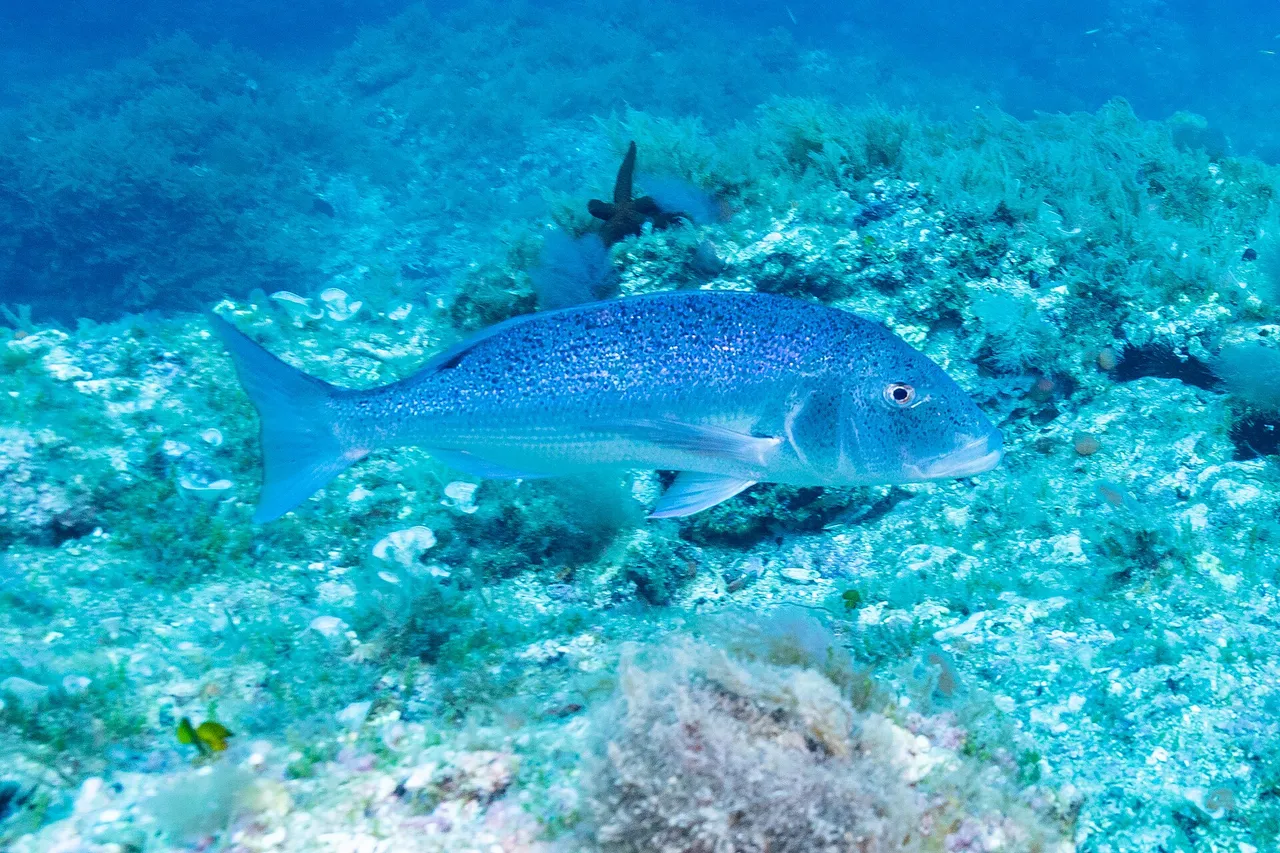
How this was identified, and who took it
Identified by: Full lateral view over a Mediterranean reef. Robust deep body, steep blunt head, fine dark speckling over blue-grey and the pointed caudal lobes are all clear. Colour is depth-shifted towards blue.Diego Delso — CC BY-SA 4.0, via Wikimedia Commons — source, licenceWhat is known about how it feeds
The dentex is the Mediterranean's answer to a reef predator that hunts like an open-water one, and the diet reflects the double life.
It holds over rocky ground and drop-offs, which is where the cephalopod component of the diet comes from — squid, cuttlefish and octopus taken around structure. Then it leaves, moving into open water to hunt shoaling fish, and the anchovy relationship FishingHQ records belongs to that phase.
The teeth are the clue to both. Dentex carry prominent canines at the front of the jaws suited to seizing and holding rather than crushing, which separates them decisively from the sea breams they are related to and frequently caught alongside. A gilthead bream crushes; a dentex grips.
Size changes the balance. Small dentex take more crustaceans and small benthic prey; large fish are substantially piscivorous and take cephalopods heavily. The largest are solitary, wary and hold in deeper water, which is a behavioural change as much as a dietary one.
The species is a warm-water fish whose feeding is temperature-linked, and its activity peaks in the warmer half of the year — the opposite seasonal pattern to the northern gadoids on FishingHQ, and a useful reminder that "when do they feed" has no general answer.
The food
Prey with a verified dietary link to this fish. Each entry carries its own evidence, and each is written at the precision the source actually used: a named species where the source named one, a group or food category where it said “polychaetes”, “crustaceans” or “detritus” and meant it. That is why this list is shorter than the animal’s real diet rather than longer.
- Cephalopods as prey — a group rather than a species: the evidence names the group
Dentex are cephalopod and fish hunters over Mediterranean rocky ground, and squid and cuttlefish are a recurring item.
- European anchovy — Engraulis encrasicolus
Small shoaling clupeids and anchovies are taken in open water, which is when dentex move off the structure they otherwise hold to.
Food with no page of its own here yet
These are real components of the diet, listed as plain text because FishingHQ has no page for them yet. Inventing pages to make the list look fuller would be the fabrication this whole approach exists to prevent.
- sardine and other small clupeids
- bogue and picarel
- crabs and shrimps
- small sea breams
What anglers do with this
Everything below is interpretation, not finding. It is what experienced anglers conclude from the biology above, and the reasoning is usually sound and almost never tested. It is separated from the biology deliberately.
The cephalopod component is the basis of the traditional Mediterranean approach of using squid and cuttlefish as bait, and the reasoning from diet to bait is explicit in the practitioner literature. It is still an inference: that a fish eats squid does not establish that squid is the productive offering on a given day, and the same fisheries use small live fish equally.
The wariness of large dentex is reported consistently enough across the northern Mediterranean to be worth recording, and it is practitioner observation rather than a studied behaviour.
The seasonal pattern — better fishing as water warms — follows from the temperature relationship above and is convention.
What this does not establish
The cephalopod relationship is recorded at group level. Two relationships describe a broad opportunistic diet that shifts substantially with fish size, and the account here is of the Mediterranean population rather than the eastern Atlantic one. Nothing establishes proportions or seasonal composition.
Where this connects
These are the baits, lures, methods and explainers FishingHQ already joins to this fish — which is why the list is sometimes short. They are not chosen for this page, and a link here means an evidenced relationship exists, not that it follows from the diet.
Lures recorded for this species
Methods used for it
This page covers feeding. The Common dentex record covers identification, lifecycle, seasonal behaviour, handling and the sources behind all of it.
Reviewed 2026-08-12.