How to identify gilthead bream
Sparus aurata · Sparidae
The characters that identify gilthead bream, ranked by how far each one can be trusted on its own.
Safety: venomous and spined species — can cause injury needing treatment. One more point applies here.
How this was identified, and who took it
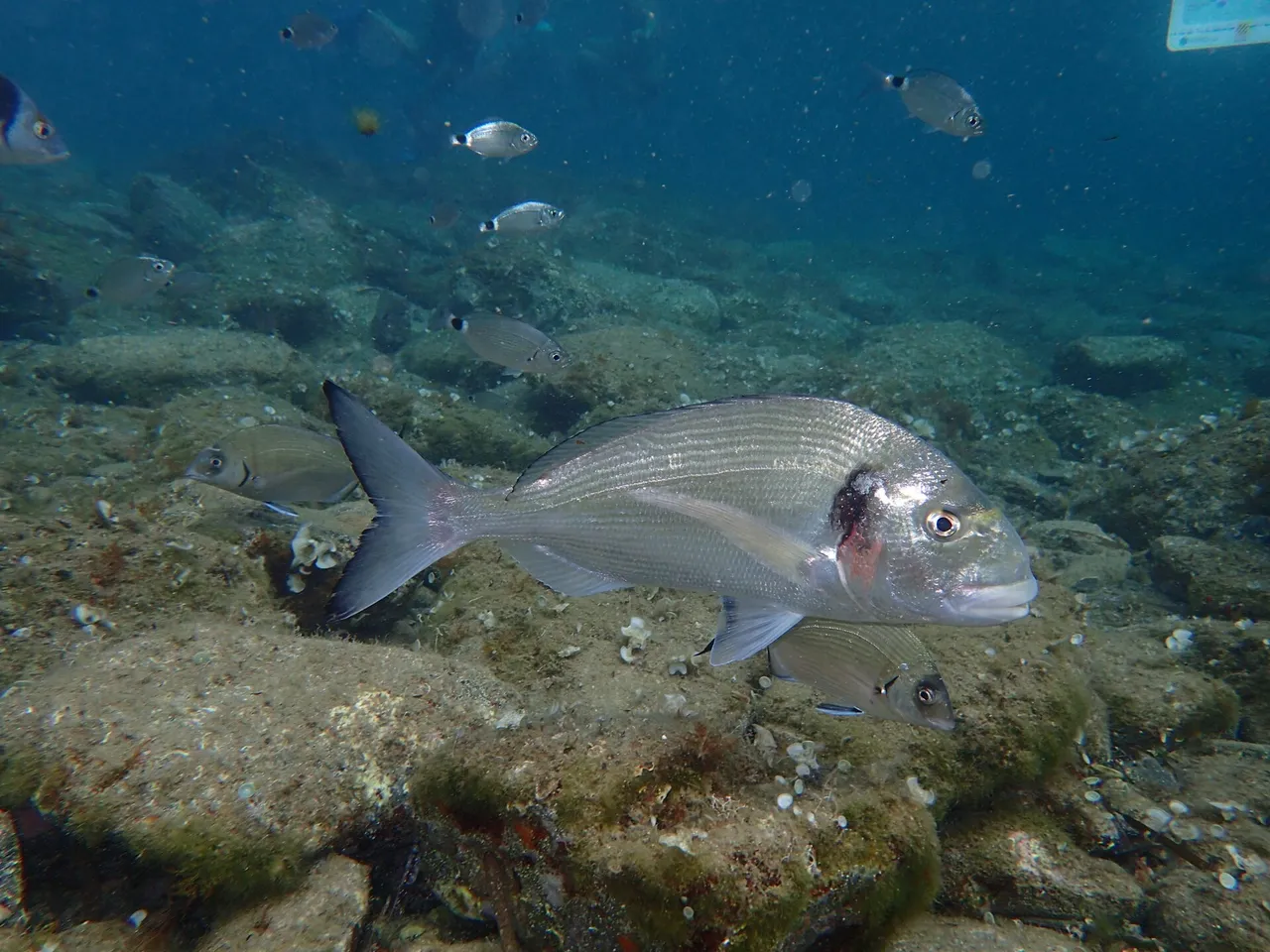
Identified by: Identified on the dark blotch at the origin of the lateral line, running onto the upper operculum and bordered below by a red-orange smudge on the opercular margin — a combination no other European sparid carries. Deep body, steep head and faint flank lines are consistent. THE GOLDEN INTERORBITAL BAND IS NOT VISIBLE in this pose and the identification does not rest on it, which is recorded rather than glossed.jujurenoult — CC BY 4.0, via Wikimedia Commons — source, licenceLook at this first
Look at the shoulder, not the brow. A gilthead has a dark blotch where the lateral line begins, running onto the top edge of the gill cover, with a red-orange smudge on the gill-cover margin below it. The golden band between the eyes that names the fish is frequently invisible in the water, and leading with it is why people get this wrong.
Diagnostic — settles it on its own
Each of these settles the identification on its own. If one is clear, you have your answer.
A dark blotch at the start of the lateral line, with red below it
A distinct dark mark sits at the origin of the lateral line and extends onto the upper rear edge of the operculum; immediately below it the gill-cover margin carries a red-orange smudge. No other European sparid carries that pair together, and both survive in the water where colour characters generally do not.
Supporting — use with other characters
Real characters that are not conclusive by themselves. Use two or three together.
A steep, blunt head profile
The forehead rises steeply from the mouth, giving the deep-bodied, high-shouldered profile that separates gilthead from the slimmer Diplodus seabreams sharing the same ground. It reads at a distance and it is a proportion rather than a measurement.
Suggestive only — varies with condition
Hints only. These vary with condition, season, water and how long the fish has been out of it, and a fish that contradicts them is still the same species.
The golden band between the eyes
A gold or yellow bar crosses the head between the eyes in a fresh fish, and it is the character every guide leads with. It is REAL and it is UNRELIABLE in the water: it fades with light, angle and the fish's condition, and it is frequently not visible at all in an underwater photograph or in a fish that has been handled. Use it to confirm, never to decide.
Faint longitudinal lines along a silver flank
The flank is silver-grey with faint darker longitudinal lines and, in some fish, a dark band along the base of the dorsal. Variable, condition-dependent, and useful mainly for excluding the strongly barred Diplodus species.
What it gets confused with
- White seabream and other Diplodus species, which are slimmer, more strongly barred, and carry a dark saddle at the tail rather than a shoulder blotch.
- Common pandora and other Pagellus species, which are pink rather than silver and have a much less steep head.
- Farmed escapees, which are the same species and frequently in poorer condition with faded colour — the shoulder blotch persists where the golden band does not.
Side by side: Gilthead bream vs Common dentex.
Where this stops working
Colour is doing more of the work on this page than is comfortable, and every colour character on a fish underwater is at the mercy of depth, angle and light. The shoulder blotch is the most robust of them and is still a pigment mark rather than a structure. Juveniles are much harder: the shoulder blotch is weaker and the head profile has not yet developed, and small sparids of several genera in shallow Mediterranean water are a genuinely difficult group that this page does not claim to resolve. One practical note about the photograph beside this page: the golden band between the eyes is not visible in it, which is normal for a gilthead photographed in the water and is exactly why the page leads with the shoulder blotch instead.
The full record
This page covers identification only. The Gilthead bream record covers behaviour, lifecycle, distribution, handling and the sources behind all of it.
Reviewed 2026-08-15.
More about this fish
Telling it apart is one question. Here are the others.
Similar and related fish
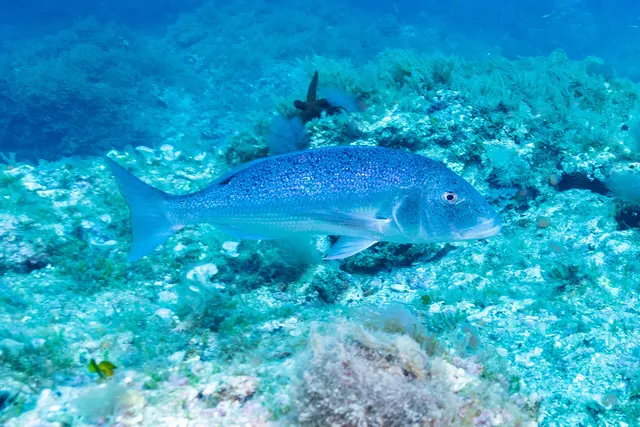 Common dentexBoth are Sparidae and neither is what its market name suggests. The dentex hunts fish with canines; the gilthead crushes shellfish with molars. Same family, opposite equipment.
- White seabreamSparids of the same mediterranean ground separated by flank barring and by the gilthead's gold brow band.
How it is caught
Where you will find it
- Balearic IslandsPresent around the islands over sand, seagrass and shellfish ground, where its crushing dentition suits the bottom it feeds on.
- CyprusThe most sought-after of the shore breams and the clearest case of why a market name is a poor identification: gilthead is the mainstay of Mediterranean aquaculture, so a fish on a plate here is far more often farmed than caught.
- FrancePresent on both the Atlantic and Mediterranean coasts, with juveniles using the coastal lagoons and estuaries of the Mediterranean shore.
- PortugalPresent along the coast with juveniles using the Ria Formosa and other lagoon systems as nursery habitat before moving to more saline water.
- SpainOne of the defining inshore fish of the Spanish Mediterranean and present on the Atlantic side as well, and the species most likely to be the answer to what somebody has caught off a Spanish rock.
- The Bay of BiscayPresent along both coasts with juveniles using the estuaries and coastal lagoons of the bay before returning to more saline water as adults.
- The Croatian AdriaticOver the sand and seagrass margins and around the few brackish transitions, in a coast that otherwise offers almost no soft or estuarine ground.
- The Moroccan Atlantic coastOccupies the sandy and mixed inshore ground and the lagoon systems, and is a mainstay of the shore fishery.
2 more
- The Moroccan Mediterranean coast Fishing regions
- West Cork Fishing regions
Why the 13 connections on this page are here, and the sources
Similar and related fish
Backed by research — 2 connections
Supported by peer-reviewed research or fisheries science. The sources are listed and can be checked.
Common dentex
A comparison resting on shared family and contrasting feeding morphology, naming both binomials.
- FishBase: a global information system on fishes — Froese, R. and D. Pauly, eds. — FishBase Consortium (Scientific institute)Relied on for: That Sparus aurata and Dentex dentex are both Sparidae of the eastern Atlantic and Mediterranean with differing dentition and feeding ecology.States this directlyPassage read and verified
White seabream
An identification comparison naming both binomials: Diplodus sargus and Sparus aurata.
- FishBase: a global information system on fishes — Froese, R. and D. Pauly, eds. — FishBase Consortium (Scientific institute)Relied on for: Morphological and distributional data for Diplodus sargus and for Sparus aurata.States this directlyPassage read and verified
- The IUCN Red List of Threatened Species — International Union for Conservation of Nature (Conservation authority)Relied on for: Separate assessments treating Diplodus sargus and Sparus aurata as distinct species.States this directlyCitation checked — the work exists and is described correctly
How it is caught
What experienced anglers do — 1 connection
Widely and independently recommended by experienced anglers and specialist sources. This is real angling knowledge, not proof: controlled evidence for it is limited, and FishingHQ records it as convention rather than as a demonstrated effect.
Ledgering
A practitioner claim following from the species' verified crushing dentition.
- Sea Angler — Bauer Media (Specialist angling publication)Relied on for: Practitioner treatment of crab and shellfish baits for sea bream and of the tackle required for crushing-jawed species.Citation checked — the work exists and is described correctly
- General angling website restatements of established technique — Various (Credible secondary source)Relied on for: Widely restated practitioner guidance on bait selection for gilthead bream.Citation checked — the work exists and is described correctly
Where you will find it
Backed by research — 10 connections
Supported by peer-reviewed research or fisheries science. The sources are listed and can be checked.
Balearic Islands
Occurrence of the species in these waters: a statement about the animal's distribution, not a venue recommendation.
- The Fishes of the British Isles and North-West Europe — Macmillan, 1969 (Reference work)Relied on for: Distribution and habitat association of fishes in north-west European and eastern Atlantic waters.States this directlyCitation checked — the work exists and is described correctly
- FishBase: a global information system on fishes — Froese, R. and D. Pauly, eds. — FishBase Consortium (Scientific institute)Relied on for: Distribution, depth range and habitat association recorded for the species.States this directlyPassage read and verified
Cyprus
A distribution edge resting on published regional identification and distribution references, written where the species is genuinely characteristic of the destination's fishing rather than merely recorded from its waters.
- FAO Species Identification Guides for Fishery Purposes and the FAO Species Catalogues — Food and Agriculture Organization of the United Nations (Scientific institute)Relied on for: Distribution, habitat association and biology of the fishes of the eastern central Atlantic and the Mediterranean, from the regional identification guides prepared for fishery purposes.States this directlyCitation checked — the work exists and is described correctly
- FishBase: a global information system on fishes — Froese, R. and D. Pauly, eds. — FishBase Consortium (Scientific institute)Relied on for: Recorded environment, depth range, distribution and biology of the species named.States this directlyPassage read and verified
France
Occurrence of the species in these waters: a statement about the animal's distribution, not a venue recommendation.
- The Fishes of the British Isles and North-West Europe — Macmillan, 1969 (Reference work)Relied on for: Distribution and habitat association of fishes in north-west European and eastern Atlantic waters.States this directlyCitation checked — the work exists and is described correctly
- FishBase: a global information system on fishes — Froese, R. and D. Pauly, eds. — FishBase Consortium (Scientific institute)Relied on for: Distribution, depth range and habitat association recorded for the species.States this directlyPassage read and verified
Portugal
Occurrence of the species in these waters: a statement about the animal's distribution, not a venue recommendation.
- The Fishes of the British Isles and North-West Europe — Macmillan, 1969 (Reference work)Relied on for: Distribution and habitat association of fishes in north-west European and eastern Atlantic waters.States this directlyCitation checked — the work exists and is described correctly
- FishBase: a global information system on fishes — Froese, R. and D. Pauly, eds. — FishBase Consortium (Scientific institute)Relied on for: Distribution, depth range and habitat association recorded for the species.States this directlyPassage read and verified
Spain
That a species occurs in these waters, drawn from distribution science and stock assessment. It is a statement about where the animal lives and is not a statement that anybody will catch one, still less where.
- FAO Species Identification Guides for Fishery Purposes and the FAO Species Catalogues — Food and Agriculture Organization of the United Nations (Scientific institute)Relied on for: Identification, distribution and habitat association of the fishes and invertebrates of the Mediterranean and Black Sea.States this directlyCitation checked — the work exists and is described correctly
- FishBase: a global information system on fishes — Froese, R. and D. Pauly, eds. — FishBase Consortium (Scientific institute)Relied on for: Recorded distribution, depth range and habitat association of the species named.States this directlyPassage read and verified
The Bay of Biscay
Occurrence of the species in this system or along this coast: a statement about the animal's distribution, not a venue recommendation.
- The Fishes of the British Isles and North-West Europe — Macmillan, 1969 (Reference work)Relied on for: Distribution and habitat association of fishes in British and north-west European waters.States this directlyCitation checked — the work exists and is described correctly
- FishBase: a global information system on fishes — Froese, R. and D. Pauly, eds. — FishBase Consortium (Scientific institute)Relied on for: Distribution, depth range and habitat association recorded for the species.States this directlyPassage read and verified
The Croatian Adriatic
A claim that a place contains the ground, water and seasonal conditions the species is associated with. It is a distributional statement about the world, it rests on the regional reference literature, and it deliberately asserts nothing about access, permission or catch.
- FishBase: a global information system on fishes — Froese, R. and D. Pauly, eds. — FishBase Consortium (Scientific institute)Relied on for: Recorded distribution, depth range and habitat association for the Mediterranean species named.States this directlyPassage read and verified
- FAO Species Identification Guides for Fishery Purposes and the FAO Species Catalogues — Food and Agriculture Organization of the United Nations (Scientific institute)Relied on for: Regional species identification and distribution for the Mediterranean and eastern Atlantic, including habitat association.States this directlyCitation checked — the work exists and is described correctly
The Moroccan Atlantic coast
A distribution association between an animal and a kind of water, rather than a claim about any named mark.
- FAO Species Identification Guides for Fishery Purposes and the FAO Species Catalogues — Food and Agriculture Organization of the United Nations (Scientific institute)Relied on for: Distribution, habitat, depth and fishery accounts for the species of the eastern central Atlantic and Mediterranean in the FAO regional identification guides.States this directlyCitation checked — the work exists and is described correctly
- FishBase: a global information system on fishes — Froese, R. and D. Pauly, eds. — FishBase Consortium (Scientific institute)Relied on for: Distribution, habitat association and depth range recorded for the species.States this directlyPassage read and verified
The Moroccan Mediterranean coast
A distribution claim about the world, so it rests on the reference datasets rather than on angling report. FishingHQ's evidence policy requires it.
- FishBase: a global information system on fishes — Froese, R. and D. Pauly, eds. — FishBase Consortium (Scientific institute)Relied on for: Distribution, habitat association and depth range recorded for the species, including its occurrence in the water body concerned.States this directlyPassage read and verified
- FAO Species Identification Guides for Fishery Purposes and the FAO Species Catalogues — Food and Agriculture Organization of the United Nations (Scientific institute)Relied on for: Distribution, habitat, depth and fishery accounts for the species of the eastern central Atlantic and Mediterranean.States this directlyCitation checked — the work exists and is described correctly
West Cork
A claim that a coast contains the ground and conditions the species is associated with. It is a distributional statement about the world, it rests on the regional reference literature, and it deliberately asserts nothing about access, permission or catch.
- The Fishes of the British Isles and North-West Europe — Macmillan, 1969 (Reference work)Relied on for: Distribution and habitat association of the marine and estuarine fishes of the British Isles and north-west Europe, including which coasts and ground types a species occupies.States this directlyCitation checked — the work exists and is described correctly
- FishBase: a global information system on fishes — Froese, R. and D. Pauly, eds. — FishBase Consortium (Scientific institute)Relied on for: Recorded distribution, depth range and habitat association for the species named.States this directlyPassage read and verified
Safety
Venomous and spined species — Can cause injury needing treatment
Sharp dorsal spines and firm gill covers on a deep-bodied fish that is awkward to grip, plus crushing jaws that will injure a finger placed in the mouth.
What reduces it: Wet hands, support the body from beneath, keep fingers clear of the mouth and gill plates, and use a disgorger or long pliers.
Tides and being cut off — Can cause injury needing treatment
Much of the shore fishery is over shallow sand, lagoon edges and shellfish ground fished on a rising tide, which is classic cut-off ground.
What reduces it: Check tide times and heights before going out, identify the exit, and leave on a set clock time rather than on the fishing.