How to identify atlantic bonito
Sarda sarda · Scombridae
The characters that identify atlantic bonito, ranked by how far each one can be trusted on its own.
Safety: cliffs and rock platforms — can cause serious injury or death. One more point applies here.
How this was identified, and who took it
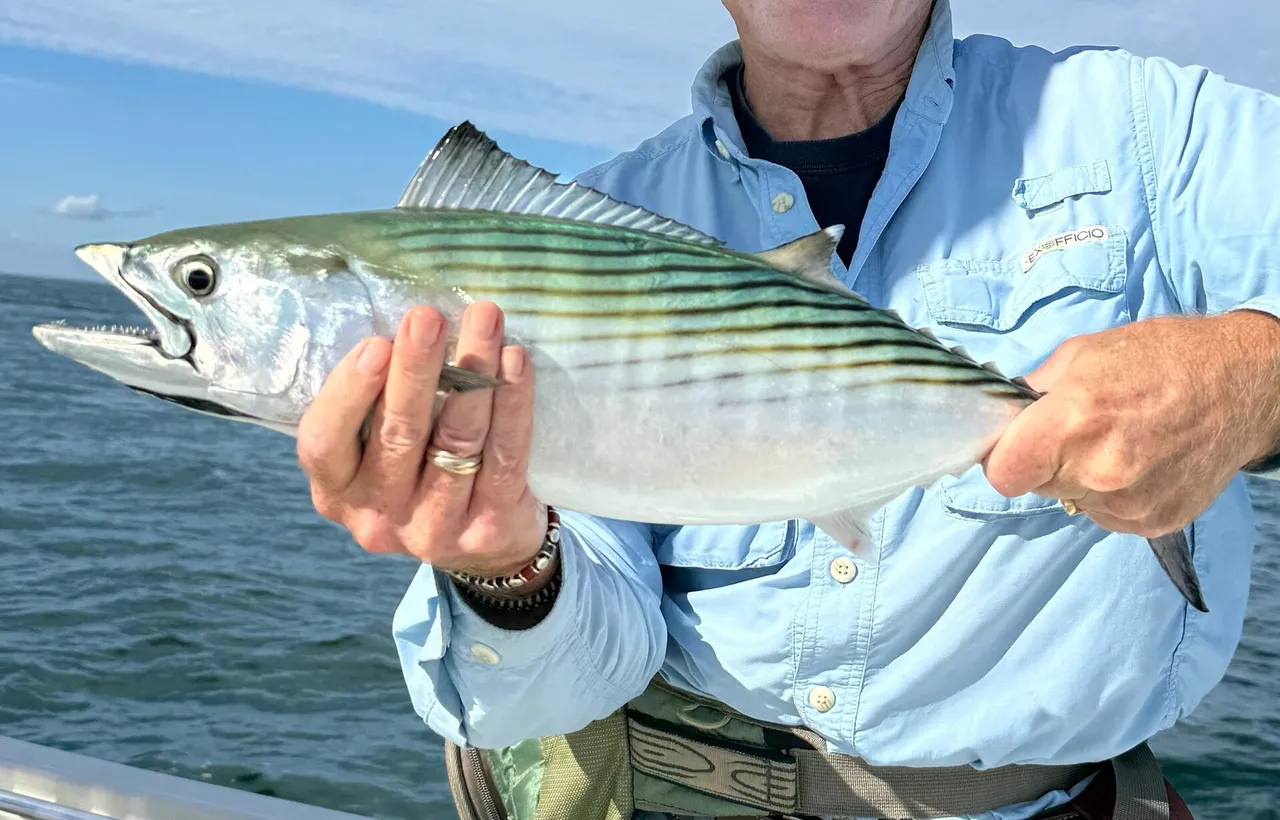
Identified by: The diagnostic is unusually clean. Dark stripes run OBLIQUELY — angled down and forward — across the back and onto the upper flank, which is the character of Sarda and is visible along the whole fish. That separates it from Atlantic mackerel, whose bars are near-vertical and wavy; from little tunny, whose markings stay above the lateral line; and from skipjack, whose stripes run along the belly. The conical teeth are supporting and are inconsistent with Thunnus.ricofish — CC0, via Wikimedia Commons — source, licenceLook at this first
Look at the back and ask which way the stripes run. On an Atlantic bonito several dark lines slant OBLIQUELY — down and forward — across the back and onto the upper flank. Mackerel bars run near-vertically and wave; skipjack stripes run along the belly. Then open the mouth: bonito have real teeth.
Diagnostic — settles it on its own
Each of these settles the identification on its own. If one is clear, you have your answer.
Oblique dark stripes across the back
Several dark stripes run diagonally down and forward across the dorsal surface, continuing onto the upper flank. This is the character of Sarda and it is the one to lead with, because it is a pattern geometry rather than a colour and it survives on a dead fish for as long as the markings last.
Conspicuous conical teeth
The jaws carry a row of well-developed pointed teeth, obvious in an open mouth. Tunas of similar size have far smaller teeth, and mackerel have fine ones. Together with the stripe angle this settles the fish against everything it is likely to be confused with.
Supporting — use with other characters
Real characters that are not conclusive by themselves. Use two or three together.
No markings and no spots below the lateral line
The belly and lower flank are plain silver. Little tunny carries dark spots below the pectoral fin and its wavy markings stay above the lateral line, which is the reciprocal check to the stripes running onto the flank here.
Suggestive only — varies with condition
Hints only. These vary with condition, season, water and how long the fish has been out of it, and a fish that contradicts them is still the same species.
The green-blue back
Vivid in a live fish and gone within an hour of death, when the whole animal goes leaden grey. Never identify a scombrid on the colour of its back, and be particularly careful with photographs taken on a deck in the sun.
What it gets confused with
- Little tunny and other Euthynnus, separated by whether the markings cross the lateral line and by the spots below the pectoral.
- Skipjack tuna, whose stripes run horizontally along the belly rather than obliquely across the back.
- Atlantic mackerel at small sizes, separated by the near-vertical wavy bars and the absence of real teeth.
- Other Sarda species outside the Atlantic, which this page does not attempt to separate.
Side by side: Atlantic bonito vs Narrow-barred Spanish mackerel.
Where this stops working
The stripe geometry is reliable while the markings are visible and they fade as a fish deteriorates, so a bonito that has been dead and warm for some hours can lose the character the page depends on. Small fish are harder, because the stripes are less developed and the teeth are less obvious. Where the fish is going to be eaten, the identification matters for a reason beyond naming: scombrid flesh forms histamine rapidly and the handling that prevents it is the same whichever scombrid this is, so an uncertain identification is not a reason to delay bleeding and chilling.
The full record
This page covers identification only. The Atlantic bonito record covers behaviour, lifecycle, distribution, handling and the sources behind all of it.
Reviewed 2026-08-13.
More about this fish
Telling it apart is one question. Here are the others.
Similar and related fish
- European anchovyBonito are anchovy specialists through much of their range, and bonito runs along Mediterranean and Black Sea coasts follow anchovy movements directly.
- European spratSprat and other small clupeids make up the rest of the diet where anchovy are scarce, which is why bonito appear in northern waters in some years and not others.
- Narrow-barred Spanish mackerelBoth are scombrids with teeth, which separates them from the true tunas, and both cut through monofilament. The Spanish mackerel is much the larger and faster of the two.
How it is caught
Where you will find it
- CyprusPart of the same seasonal pelagic run, taken from rock marks and small boats when the fish are inshore. Timing a trip for that window changes what the island offers more than choosing a different coast does.
- Malta and GozoA warm-season pelagic visitor to deep-water shore marks and to the small-boat fishery.
- PortugalPresent seasonally on the shelf and taken on trolled and spun lures when water temperature and bait bring them within reach.
- The Agulhas CurrentWorks the frontal zone between the current and the cooler shelf water inshore of it.
- The Black SeaA seasonal visitor rather than a resident, entering from the Mediterranean through the Bosphorus and running along the coast in autumn. That run is the year's main fishing event on much of the southern coast and carries real cultural weight.
- The Moroccan Atlantic coastWorks the productive upwelling-influenced shelf water, following the small pelagic shoals along the coast.
- The Moroccan Mediterranean coastWorks the productive Alboran water and passes through the Strait on migration, following the small pelagic shoals.
- The Strait of GibraltarWorks the shear zones and current lines the exchange flow generates, following the small pelagic shoals concentrated by the mixing.
2 more
- The Strait of Messina Fishing regions
- The West African coast Fishing regions
Why the 14 connections on this page are here, and the sources
Similar and related fish
Backed by research — 3 connections
Supported by peer-reviewed research or fisheries science. The sources are listed and can be checked.
European anchovy
Recorded diet evidence identifies Engraulis encrasicolus as a food item of this predator at species level. The edge is written at that granularity and no further.
- FishBase: a global information system on fishes — Froese, R. and D. Pauly, eds. — FishBase Consortium (Scientific institute)Relied on for: Food items recorded for this predator, including Engraulis encrasicolus.States this directlyPassage read and verified
- FAO Species Identification Guides for Fishery Purposes and the FAO Species Catalogues — Food and Agriculture Organization of the United Nations (Scientific institute)Relied on for: Species account describing the diet of this predator in the region where Engraulis encrasicolus occurs.Background and mechanism onlyCitation checked — the work exists and is described correctly
European sprat
Recorded diet evidence identifies Sprattus sprattus as a food item of this predator at species level. The edge is written at that granularity and no further.
- FishBase: a global information system on fishes — Froese, R. and D. Pauly, eds. — FishBase Consortium (Scientific institute)Relied on for: Food items recorded for this predator, including Sprattus sprattus.States this directlyPassage read and verified
- FAO Species Identification Guides for Fishery Purposes and the FAO Species Catalogues — Food and Agriculture Organization of the United Nations (Scientific institute)Relied on for: Species account describing the diet of this predator in the region where Sprattus sprattus occurs.Background and mechanism onlyCitation checked — the work exists and is described correctly
Narrow-barred Spanish mackerel
A taxonomic and identification comparison naming both binomials.
- FishBase: a global information system on fishes — Froese, R. and D. Pauly, eds. — FishBase Consortium (Scientific institute)Relied on for: That Scomberomorus commerson and Sarda sarda are both Scombridae possessing well-developed teeth, unlike the true tunas of Thunnus.States this directlyPassage read and verified
How it is caught
Official guidance — 1 connection
Stated by a fisheries authority, scientific institute or recognised angling body. Authoritative, but summarising rather than demonstrating.
Reef spearfishing
A scientific institute reporting what its own survey of the fishery recorded: a two-year catch-recording programme across the Canary archipelago counted and weighed every specimen, and this species appears in its published catch table. That is what Canary spearfishers were measured taking, rather than an inference from where the species lives or an assertion about what people do.
- Spearfishing in the Canary Islands: is the devil as black as it seems to be? — Pablo Martín-Sosa, Instituto Español de Oceanografía — Revista Scientia Insularum, 2019 (Scientific literature)Relied on for: The Canary spearfishing catch table, in which this species appears with a specimen count and a landed weight over the study's two-year recording period.States this directlyPassage read and verified
Where you will find it
Backed by research — 10 connections
Supported by peer-reviewed research or fisheries science. The sources are listed and can be checked.
Cyprus
A distribution edge resting on published regional identification and distribution references, written where the species is genuinely characteristic of the destination's fishing rather than merely recorded from its waters.
- FAO Species Identification Guides for Fishery Purposes and the FAO Species Catalogues — Food and Agriculture Organization of the United Nations (Scientific institute)Relied on for: Distribution, habitat association and biology of the fishes of the eastern central Atlantic and the Mediterranean, from the regional identification guides prepared for fishery purposes.States this directlyCitation checked — the work exists and is described correctly
- FishBase: a global information system on fishes — Froese, R. and D. Pauly, eds. — FishBase Consortium (Scientific institute)Relied on for: Recorded environment, depth range, distribution and biology of the species named.States this directlyPassage read and verified
Malta and Gozo
A distributional claim about where a species occurs, resting on the regional identification literature rather than on angling report. It says nothing about where a reader should fish.
- FAO Species Identification Guides for Fishery Purposes and the FAO Species Catalogues — Food and Agriculture Organization of the United Nations (Scientific institute)Relied on for: Species composition, habitat association and distribution for the region concerned, as set out in the FAO species identification sheets.States this directlyCitation checked — the work exists and is described correctly
- The IUCN Red List of Threatened Species — International Union for Conservation of Nature (Conservation authority)Relied on for: Global assessment and distribution for the species concerned.States this directlyCitation checked — the work exists and is described correctly
Portugal
Occurrence of the species in these waters: a statement about the animal's distribution, not a venue recommendation.
- The Fishes of the British Isles and North-West Europe — Macmillan, 1969 (Reference work)Relied on for: Distribution and habitat association of fishes in north-west European and eastern Atlantic waters.States this directlyCitation checked — the work exists and is described correctly
- FishBase: a global information system on fishes — Froese, R. and D. Pauly, eds. — FishBase Consortium (Scientific institute)Relied on for: Distribution, depth range and habitat association recorded for the species.States this directlyPassage read and verified
The Agulhas Current
A distribution association between an animal and a kind of water, rather than a claim about any named mark.
- FishBase: a global information system on fishes — Froese, R. and D. Pauly, eds. — FishBase Consortium (Scientific institute)Relied on for: Distribution, habitat association and depth range recorded for the species, including its occurrence in the water body concerned.States this directlyPassage read and verified
- The IUCN Red List of Threatened Species — International Union for Conservation of Nature (Conservation authority)Relied on for: Assessment and range account for the species, including the systems and coasts it occupies.Background and mechanism onlyCitation checked — the work exists and is described correctly
The Black Sea
A distribution edge resting on published identification and distribution references rather than on angling report, written where the species is genuinely characteristic of the system rather than merely recorded in it once.
- FishBase: a global information system on fishes — Froese, R. and D. Pauly, eds. — FishBase Consortium (Scientific institute)Relied on for: Recorded environment, salinity tolerance, depth range, distribution and biology of the species named.States this directlyPassage read and verified
- FAO Species Identification Guides for Fishery Purposes and the FAO Species Catalogues — Food and Agriculture Organization of the United Nations (Scientific institute)Relied on for: Distribution, habitat association and identification of the fishes of the Mediterranean and Black Sea region.States this directlyCitation checked — the work exists and is described correctly
The Moroccan Atlantic coast
A distribution association between an animal and a kind of water, rather than a claim about any named mark.
- FAO Species Identification Guides for Fishery Purposes and the FAO Species Catalogues — Food and Agriculture Organization of the United Nations (Scientific institute)Relied on for: Distribution, habitat, depth and fishery accounts for the species of the eastern central Atlantic and Mediterranean in the FAO regional identification guides.States this directlyCitation checked — the work exists and is described correctly
- FishBase: a global information system on fishes — Froese, R. and D. Pauly, eds. — FishBase Consortium (Scientific institute)Relied on for: Distribution, habitat association and depth range recorded for the species.States this directlyPassage read and verified
The Moroccan Mediterranean coast
A distribution claim about the world, so it rests on the reference datasets rather than on angling report. FishingHQ's evidence policy requires it.
- FishBase: a global information system on fishes — Froese, R. and D. Pauly, eds. — FishBase Consortium (Scientific institute)Relied on for: Distribution, habitat association and depth range recorded for the species, including its occurrence in the water body concerned.States this directlyPassage read and verified
- FAO Species Identification Guides for Fishery Purposes and the FAO Species Catalogues — Food and Agriculture Organization of the United Nations (Scientific institute)Relied on for: Distribution, habitat, depth and fishery accounts for the species of the eastern central Atlantic and Mediterranean.States this directlyCitation checked — the work exists and is described correctly
The Strait of Gibraltar
A distribution association between an animal and a kind of water, rather than a claim about any named mark.
- FAO Species Identification Guides for Fishery Purposes and the FAO Species Catalogues — Food and Agriculture Organization of the United Nations (Scientific institute)Relied on for: Distribution, habitat, depth and fishery accounts for the species of the eastern central Atlantic and Mediterranean in the FAO regional identification guides.States this directlyCitation checked — the work exists and is described correctly
- FishBase: a global information system on fishes — Froese, R. and D. Pauly, eds. — FishBase Consortium (Scientific institute)Relied on for: Distribution, habitat association and depth range recorded for the species.States this directlyPassage read and verified
The Strait of Messina
A distribution association between an animal and a kind of water, rather than a claim about any named mark.
- FishBase: a global information system on fishes — Froese, R. and D. Pauly, eds. — FishBase Consortium (Scientific institute)Relied on for: Distribution, habitat association and depth range recorded for the species, including its occurrence in the water body concerned.States this directlyPassage read and verified
- The IUCN Red List of Threatened Species — International Union for Conservation of Nature (Conservation authority)Relied on for: Assessment and range account for the species, including the systems and coasts it occupies.Background and mechanism onlyCitation checked — the work exists and is described correctly
The West African coast
A distribution association between an animal and a kind of water, rather than a claim about any named mark.
- FishBase: a global information system on fishes — Froese, R. and D. Pauly, eds. — FishBase Consortium (Scientific institute)Relied on for: Distribution, habitat association and depth range recorded for the species, including its occurrence in the water body concerned.States this directlyPassage read and verified
- The IUCN Red List of Threatened Species — International Union for Conservation of Nature (Conservation authority)Relied on for: Assessment and range account for the species, including the systems and coasts it occupies.Background and mechanism onlyCitation checked — the work exists and is described correctly
Safety
Cliffs and rock platforms — Can cause serious injury or death
A great deal of the shore fishery for this species is from ocean rock marks and breakwaters, where swell sweeps anglers off.
What reduces it: Never fish rock marks alone. Watch a mark for a full set cycle before committing. Wear a buoyancy aid and footwear with grip, and plan the escape route first.
Species that bite — Can cause injury needing treatment
Conical teeth in a fast fish that thrashes at the point of landing, frequently on rock or a quay.
What reduces it: Keep fingers clear of the mouth, use pliers or a de-hooking tool, and control the fish before touching it.