What does atlantic mackerel eat?
What is established about how atlantic mackerel feeds, kept separate from what anglers infer from it.
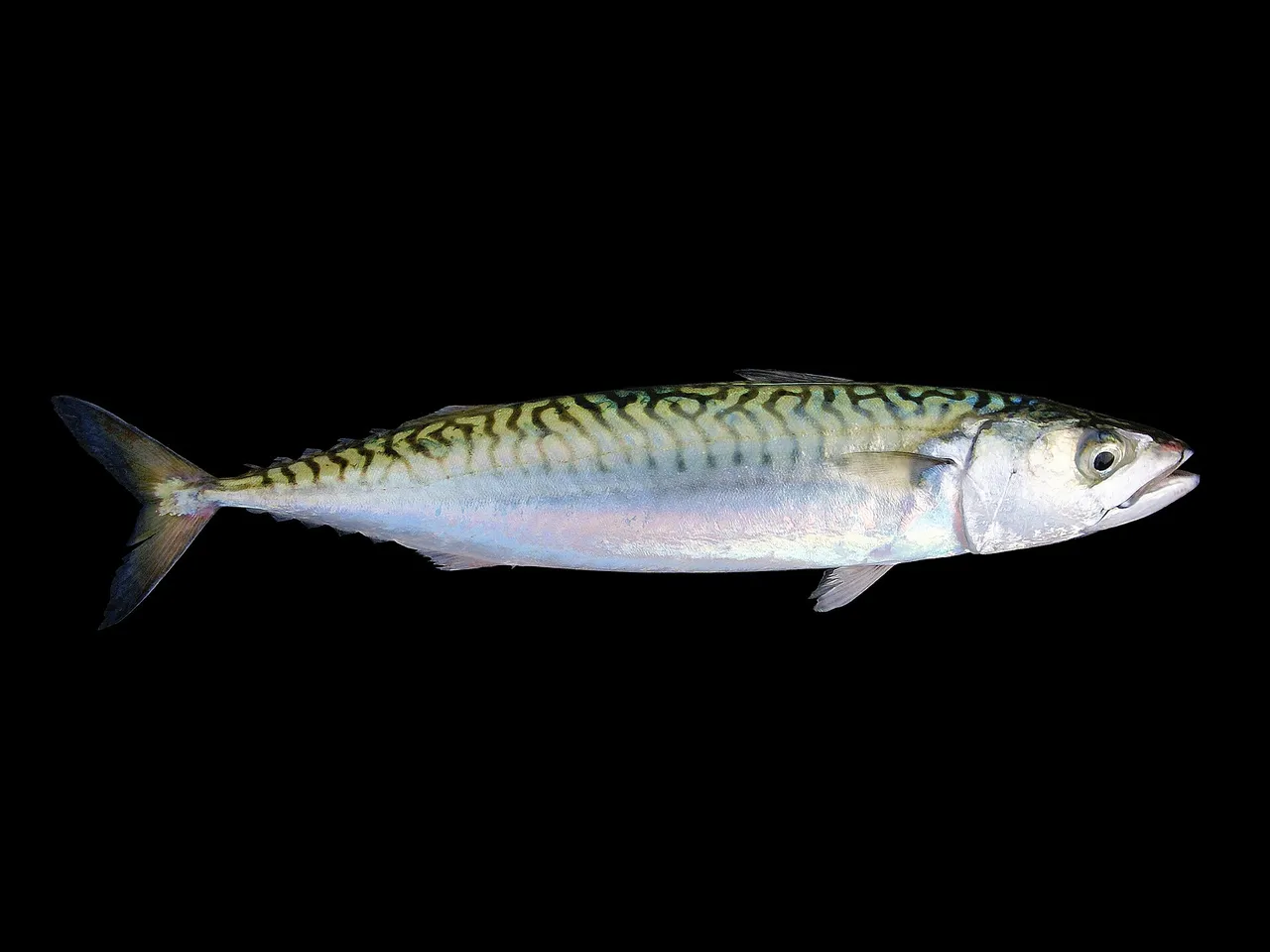
How this was identified, and who took it
Identified by: Specimen photograph on black. The wavy dark bars over the green back, the finlets between second dorsal and tail, and the whole body outline are all clear, and the fish is fresh enough that the back colour has not yet gone.Hans Hillewaert — CC BY-SA 4.0, via Wikimedia Commons — source, licenceWhat is known about how it feeds
A mackerel is a filter feeder and a hunter in the same body, and it switches between the two according to what is in front of it.
When plankton is dense the fish swims with its mouth open and strains copepods and euphausiids from the water with its gill rakers. When fish are available it hunts them visually as a coordinated school, driving prey upwards until it is trapped against the surface — the behaviour that produces the visible boils that gulls work and anglers look for.
Both connections are documented here, and the pairing is the point: the same fish that cannot be interested in anything bait-sized while filtering is, an hour later, the most aggressive visual predator in the water.
The seasonal frame is metabolic. Mackerel are highly active fish with correspondingly high energy demand, feeding hard through the productive part of the year and much less through winter, when the shoals move offshore and deeper. Their arrival inshore in early summer is a feeding migration, not a spawning one, and it tracks the plankton bloom and the forage fish that follow it.
Vision dominates the hunting phase, and the lateral line coordinates the school. Both are the sensory profile of a fast open-water predator rather than of a plankton feeder, which is a reminder that the filtering is opportunism rather than specialisation.
The food
Prey with a verified dietary link to this fish. Each entry carries its own evidence, and each is written at the precision the source actually used: a named species where the source named one, a group or food category where it said “polychaetes”, “crustaceans” or “detritus” and meant it. That is why this list is shorter than the animal’s real diet rather than longer.
- Lesser sandeel — Ammodytes marinus
Mackerel take sandeel as they grow beyond plankton feeding, which is the transition that brings them into range of shore anglers over sandy ground.
- Krill and planktonic crustaceans as prey — a group rather than a species: the evidence names the group
For much of the year mackerel filter-feed on planktonic crustaceans, which is why shoals can be visibly present at the surface and completely uninterested in anything bait-sized.
Food with no page of its own here yet
These are real components of the diet, listed as plain text because FishingHQ has no page for them yet. Inventing pages to make the list look fuller would be the fabrication this whole approach exists to prevent.
- sprat and other small clupeids
- fish larvae and eggs
- copepods
- small squid
What anglers do with this
Everything below is interpretation, not finding. It is what experienced anglers conclude from the biology above, and the reasoning is usually sound and almost never tested. It is separated from the biology deliberately.
The dominance of vision in the hunting phase is the reasoning behind almost all mackerel angling: bare feathers and small bright presentations work as well as bait because the fish is responding to movement and flash rather than to scent. That is practitioner convention with a clear biological rationale, and it is one of the more reliable pieces of convention in sea angling.
The filtering phase is the other half and gets less attention. Anglers report shoals that are visibly present and completely uninterested, and the explanation above is the likely one. It is an inference rather than a demonstrated cause.
One welfare point is not interpretation. Mackerel are frequently caught in numbers far beyond what anybody will use, and a fish taken and discarded is a fish killed for nothing. Taking what will be eaten is the standard that the sea angling bodies set.
What this does not establish
The plankton relationship is recorded at group level. Neither relationship establishes what proportion of the diet it forms, and that balance changes within a single day. Regional and seasonal variation is large, and the temperate North Atlantic pattern described here does not transfer unchanged to the southern part of the range.
Where this connects
These are the baits, lures, methods and explainers FishingHQ already joins to this fish — which is why the list is sometimes short. They are not chosen for this page, and a link here means an evidenced relationship exists, not that it follows from the diet.
Lures recorded for this species
Methods used for it
Where it lives
This page covers feeding. The Atlantic mackerel record covers identification, lifecycle, seasonal behaviour, handling and the sources behind all of it.
Reviewed 2026-08-12.