Atlantic halibut
Fish · Last reviewed 2026-08-10
The largest flatfish in the world, reaching over four metres, and a species whose commercial collapse made it one of the clearest cautionary tales in North Atlantic fisheries.
Safety: injury while handling fish — can cause serious injury or death. 5 more points apply here.
Barotrauma and pressure injury — Can cause injury needing treatment
Fish taken from substantial depth suffer swim bladder expansion and cannot return unaided, which limits the effectiveness of release.
What reduces it: Decide what will be kept before fishing deep. Where release is intended, fish shallower ground and retrieve at a moderate rate. Use a descending device where appropriate.
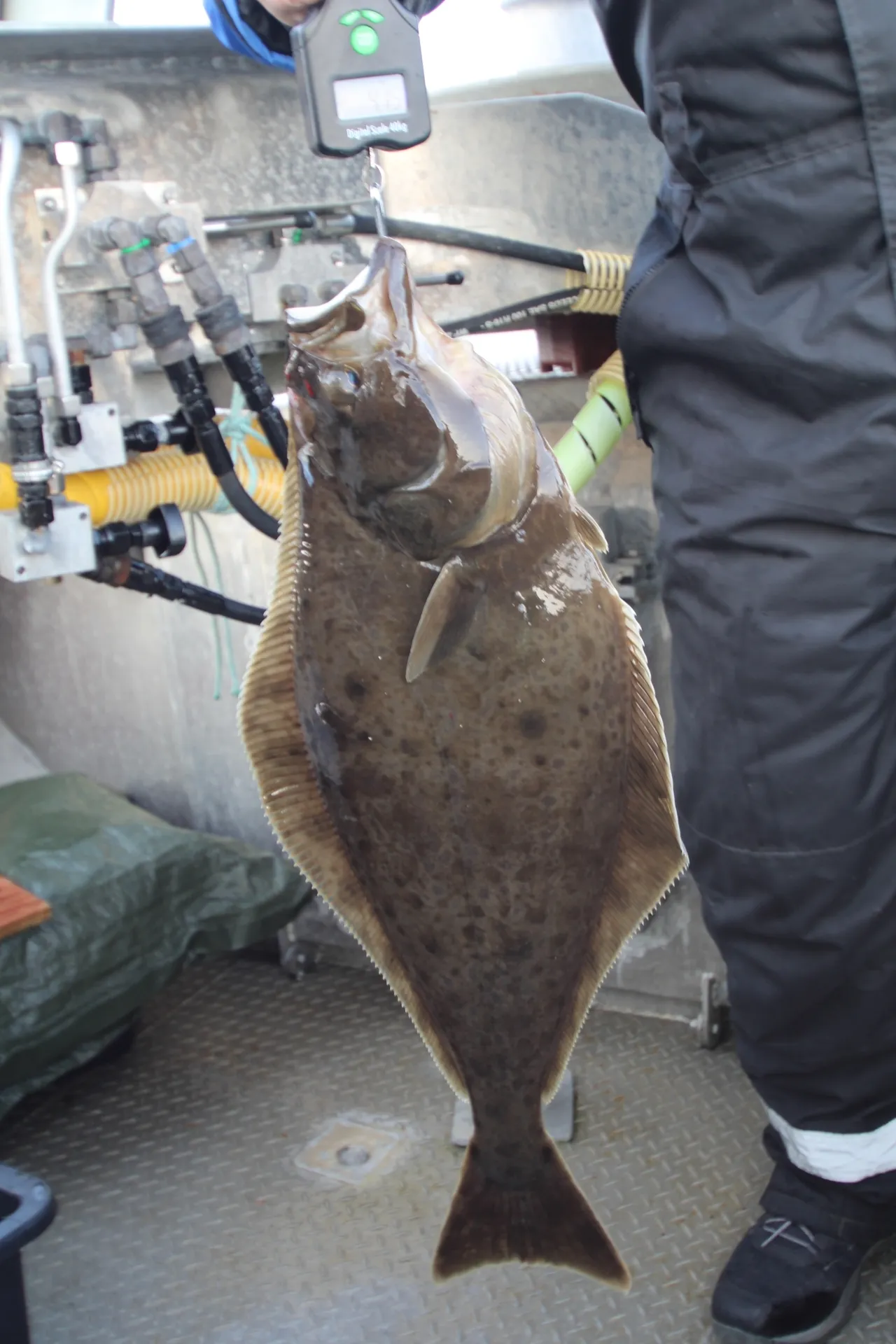
How this was identified, and who took it
Identified by: Four characters, all legible and all in frame. The body is elongate and ovate at roughly a third depth, quite unlike the near-circular outline of turbot or brill. The lateral line arches strongly over the pectoral. The mouth is large and reaches back to below the eye. The caudal fin is concave and crescent-shaped, which neither turbot nor brill carries. Both eyes sit on the pigmented side facing the camera. Four agreeing identifications, none disagreeing.portulaca — CC BY, via iNaturalist — source, licenceCatching Atlantic halibut
Everything here on fishing for it. Each entry opens the page behind it.
- Ground
- When
- Jun–Aug — months recorded at the places that document it, not a season for the whole range.
- Where
- 4 places FishingHQ documents — strongest claim anywhere: seasonal · From a boat, On a charter
The Atlantic halibut is a flatfish that grew into an apex predator. It reaches over four metres and several hundred kilograms, it hunts actively in the water column rather than lying in ambush like most flatfish, and it takes cod and other substantial fish as prey. Nothing else shaped like a flatfish behaves this way.
Its fishery history is the reason it matters beyond angling. Atlantic halibut were heavily fished across the North Atlantic through the nineteenth and twentieth centuries and collapsed severely, and the species is assessed as at risk with recovery slow because the biology is unforgiving: it matures late, grows slowly to enormous size, and a large female represents decades. A stock of very large late-maturing fish is exactly the kind that does not bounce back.
As a recreational target it is a northern boat fishery — Norway, Iceland, Canada and Alaska for the Pacific relative — fished deep with heavy tackle and large baits or lures. The fish are strong, the depths substantial, and the practical difficulties of releasing a very large fish from deep water are real.
It is right-eyed, like most flatfish: lying on its left side with both eyes on the right. That is worth knowing because it separates halibut from turbot and brill, which are left-eyed.
How it is caught
Where Atlantic halibut is documented
Places where public sources describe this species as fished, with how it is fished and how strongly the evidence supports it. This is not a range map and it is not a recommendation — it is what has been written down about a fishery rather than a record of any individual catch, and being listed is never permission to fish.
Norway and the Nordic coast
4 documented places
Sound or strait
Seasonal
From a boat · On a charter
Around Jun, Jul, Aug
Island
Seasonal
From a boat · On a charter
Around Jun, Jul, Aug
Offshore bank
Seasonal
From a boat · On a charter
Around Jun, Jul, Aug
Tidal race
Seasonal
From a boat
Around Jun, Jul, Aug
What these strengths mean
- Seasonal
- Well supported, and concentrated in part of the year rather than spread through it.
When to fish for atlantic halibut
Where the places here state a season for atlantic halibut, it clusters in Jun–Aug. This is a count of how many documented places name each month — evidence about when people fish for it, not a prediction of what any particular day will produce.
| Jan | Feb | Mar | Apr | May | Jun | Jul | Aug | Sep | Oct | Nov | Dec |
|---|---|---|---|---|---|---|---|---|---|---|---|
| January: no place here names this month — no place names it. | February: no place here names this month — no place names it. | March: no place here names this month — no place names it. | April: no place here names this month — no place names it. | May: no place here names this month — no place names it. | June: 4 places name this month — most places. | July: 4 places name this month — most places. | August: 4 places name this month — most places. | September: no place here names this month — no place names it. | October: no place here names this month — no place names it. | November: no place here names this month — no place names it. | December: no place here names this month — no place names it. |
4 of the 4 places that record catches of atlantic halibut state which months. The dated records come from a single area, so this is a local season rather than a general one.
Identification
- Scientific name
- Hippoglossus hippoglossus
- Family
- Pleuronectidae
- Water
- Saltwater
- Conservation status
- Near Threatened
- Regions
- Northern Europe, Arctic & Subarctic, Britain & Ireland, North America, Western Europe
- Right-eyed: lies on its left side with both eyes on the right-hand side of the head. Turbot and brill are left-eyed, which is the quickest family separation.
- Body much more elongate than most flatfish — long and powerful rather than disc-shaped.
- Uniform dark brown to greenish-black on the eyed side, clean white on the blind side, without the strong mottling of smaller flatfish.
- Large mouth extending to below the eye, with strong teeth — this is a predator rather than a bottom-picker.
- Slightly concave tail rather than the rounded tail of plaice and flounder.
Size
- Typical
- 5–20 kg (11–44 lb)
- Large
- 50–100 kg (110–220 lb)
Exceptional: Over 150 kg (330 lb); maximum published weight 320 kg
Cold, deep, and a flatfish that does not behave like one
Atlantic halibut occupy cold deep water on the continental shelf and slope, and they use it more actively than the word flatfish suggests.
DEPTH AND COLD ARE THE REQUIREMENTS. Adults occupy water from a few tens of metres down to several hundred, on sand, gravel and mixed ground, in consistently cold northern water. They are a boreal species and are scarce at the southern edge of the range.
THEY ARE NOT PASSIVE AMBUSHERS. Unlike plaice or sole, large halibut hunt actively, leaving the bottom to pursue fish in the water column, and their diet is dominated by fish and cephalopods rather than by benthic invertebrates. That is why a halibut is caught on a moving bait as often as on a static one.
JUVENILES OCCUPY SHALLOWER INSHORE GROUND before moving progressively deeper, so the depth distribution is size-structured.
THEY ASSOCIATE WITH STRUCTURE AND RELIEF more than other large flatfish, holding around banks, edges and areas of varied bottom rather than on featureless plain.
THEY MOVE SUBSTANTIAL DISTANCES, with tagging showing individual movements of hundreds of kilometres, so a local population is not a closed one.
AND THE STOCK POSITION IS PART OF THE HABITAT PICTURE. Atlantic halibut are slow-growing, late-maturing and long-lived, and populations across much of the range were heavily depleted historically; the species is now taken largely as bycatch and is subject to substantial restriction in many areas.
Backed by research — why, and the sources (2)
Supported by peer-reviewed research or fisheries science. The sources are listed and can be checked.
- The Fishes of the British Isles and North-West Europe — Macmillan, 1969 (Reference work)Relied on for: Distribution, habitat association, depth, ground preference and biology of fishes in British and north-west European waters.States this directlyCitation checked — the work exists and is described correctly
- The IUCN Red List of Threatened Species — International Union for Conservation of Nature (Conservation authority)Relied on for: Assessment and range account for the species, including the habitats it depends on, its life history and the pressures acting on it.States this directlyCitation checked — the work exists and is described correctly
A very large flatfish is not a large plaice
Atlantic halibut handling is dominated by power and mass in a confined space, and the species is genuinely dangerous on a small boat in a way that its flatfish shape disguises.
WHAT A LARGE HALIBUT DOES ON A DECK. It thrashes with the whole body, it does so with enormous force, and it does so after periods of stillness. People have been badly injured — broken limbs, crushed hands, injuries from tackle sent flying — by halibut that appeared subdued. A large one should not come aboard a small boat at all unless the crew have a plan and the space to execute it.
THE MOUTH HAS REAL TEETH. Halibut are predators with sharp conical teeth in strong jaws, and a hand in the mouth of a live one is a serious injury.
SO THE DECISION IS MADE AT THE BOAT SIDE. Fish that are being released are best released in the water with a long dehooker or by cutting the trace, without lifting. Fish being kept should be dispatched promptly and properly rather than left to thrash.
THE CONSERVATION SIDE IS SUBSTANTIAL. Atlantic halibut are slow-growing, late-maturing and were severely depleted across much of their range; the species is of conservation concern and large fish are old females contributing disproportionately to reproduction. Several fisheries operate maximum-size rules or release conventions for that reason, and a large halibut released properly is worth more than one killed.
BAROTRAUMA is a lesser but real factor: halibut are taken from depth and fish from deep marks may show swim bladder effects, though the species suffers less than physoclistous round fish of comparable depth.
Official guidance — why, and the sources (1)
Stated by a fisheries authority, scientific institute or recognised angling body. Authoritative, but summarising rather than demonstrating.
- The IUCN Red List of Threatened Species — International Union for Conservation of Nature (Conservation authority)Relied on for: Conservation status of Atlantic halibut and the life-history characteristics — slow growth, late maturity — underlying it.States this directlyCitation checked — the work exists and is described correctly
A slow-growing giant on a shallow–deep cycle, and why the season is the least of it
Atlantic halibut have a seasonal pattern worth stating briefly and a conservation position that dominates any discussion of when to fish for them.
THE PATTERN. Halibut move between deeper spawning grounds in the colder part of the year and shallower feeding areas in the warmer months, and the recreational fishery in northern waters is concentrated on that summer feeding period. Tidal flow governs the daily fishing exactly as it does for every deep bottom species, and the northern-hemisphere calendar applies throughout the range.
AND THE LIFE HISTORY IS WHY THAT MATTERS MORE THAN IT WOULD FOR ANOTHER FISH. Atlantic halibut are extremely large, extremely slow-growing, very late-maturing and very long-lived — a combination that produces a population with almost no capacity to absorb exploitation. Females mature at an age at which most fish on FishingHQ are dead. Fecundity scales steeply with size, so the largest individuals contribute disproportionately to reproduction, and those are precisely the fish a fishery selects for.
THE CONSEQUENCE IS DOCUMENTED RATHER THAN THEORETICAL. Atlantic halibut were commercially fished to a fraction of their historical abundance across much of the North Atlantic, and recovery has been slow to absent in many areas. This is not a stock that rebuilds within a human career.
WHICH REFRAMES THE SEASONAL QUESTION ENTIRELY. The summer feeding period is when a recreational angler in northern Norway, Iceland or eastern Canada is most likely to encounter one, and the operative decisions are about what happens then rather than about timing: whether a large fish is released, how it is handled given its size, and whether the fishery is targeting the size class that the population can least afford to lose.
A fish this large, taken from depth, is also a fish with a serious barotrauma problem, which makes release a technical matter rather than a matter of intent. What may be retained is a current local matter and varies substantially across the range; this page does not state it.
Backed by research — why, and the sources (4)
Supported by peer-reviewed research or fisheries science. The sources are listed and can be checked.
- FishBase: a global information system on fishes — Froese, R. and D. Pauly, eds. — FishBase Consortium (Scientific institute)Relied on for: Depth range, migration, spawning season and temperature association recorded for the species.States this directlyPassage read and verified
- ICES Advice on fishing opportunities, catch and effort — International Council for the Exploration of the Sea (Scientific institute)Relied on for: Stock distribution, seasonal movement between spawning and feeding grounds, and the assessment basis for the stock.States this directlyCitation checked — the work exists and is described correctly
- The IUCN Red List of Threatened Species — International Union for Conservation of Nature (Conservation authority)Relied on for: Assessment, population trend and the life-history traits that determine sensitivity to seasonal exploitation.States this directlyCitation checked — the work exists and is described correctly
- FishBase: a global information system on fishes — Froese, R. and D. Pauly, eds. — FishBase Consortium (Scientific institute)Relied on for: Spawning season, migration and life-history data recorded for the species.States this directlyPassage read and verified
The slowest reproducer in the North Atlantic, and why the stock has not come back
Atlantic halibut reproduction is the clearest demonstration on FishingHQ of why some fish cannot be fished hard, and the numbers behind it are stark.
MATURITY IS EXTREMELY LATE. Atlantic halibut take many years to reach breeding condition — considerably longer than the gadoids they share ground with — and females mature later than males. A fish that has not yet spawned may already be large enough to have been caught many times over, which is the fundamental problem with fishing this species at all.
SPAWNING IS DEEP, WINTER AND CONCENTRATED. Mature fish move to deep water, often in specific basins and along the shelf edge, and spawn in the cold months. Eggs are large and released into deep water where they are near-neutrally buoyant, developing at depth before the larvae rise and drift. The requirement for particular depth and density conditions means suitable spawning locations are limited and known.
FECUNDITY IS HIGH FOR AN INDIVIDUAL AND IRRELEVANT AGAINST THE ARITHMETIC OF LATE MATURITY. A large female produces a great many eggs, but a population in which few fish live long enough to become large females has lost most of its reproductive capacity regardless.
GROWTH IS SLOW AND LONGEVITY IS EXTREME. This is a fish that can live for decades, and the largest individuals are very old. Every one of those is an accumulation the stock cannot replace within a fishing lifetime.
WHICH IS WHY THE STOCK COLLAPSE HAS BEEN SO PERSISTENT. Atlantic halibut were heavily fished, declined severely, and have recovered slowly or not at all across much of the range despite reduced pressure — the standard signature of a species whose life history cannot support the mortality it received. The species is assessed accordingly.
JUVENILE HABITAT IS SHALLOWER AND SEPARATE, with young fish using shallower shelf ground before moving deeper, so recruitment depends on ground distinct from the adult and spawning areas.
AND THE MANAGEMENT POSITION IS RESTRICTIVE AND VARIABLE. Retention of Atlantic halibut is prohibited or tightly limited in several jurisdictions and permitted in others under quota. What applies anywhere is a matter for the competent authority, and it is not derivable from the biology.
Backed by research — why, and the sources (2)
Supported by peer-reviewed research or fisheries science. The sources are listed and can be checked.
- FishBase: a global information system on fishes — Froese, R. and D. Pauly, eds. — FishBase Consortium (Scientific institute)Relied on for: Reproductive mode, spawning season, fecundity, size and age at maturity, and larval development recorded for the species.States this directlyPassage read and verified
- The IUCN Red List of Threatened Species — International Union for Conservation of Nature (Conservation authority)Relied on for: Assessment and life-history account, including reproductive biology and the pressures acting on recruitment.Background and mechanism onlyCitation checked — the work exists and is described correctly
Lifecycle and reproduction
Very slow-growing, late-maturing and long-lived, with maturity delayed well into the second decade for females and a maximum reported age of around fifty years. Spawns in deep water in winter and early spring. The combination of late maturity, extreme size and long life makes the species exceptionally vulnerable to fishing pressure and exceptionally slow to recover from it — which is precisely what the North Atlantic history shows.
Deep-water spawning in winter and early spring, with pelagic eggs and larvae that undergo the flatfish metamorphosis, one eye migrating across the head as the fish settles to the bottom. Large females produce disproportionately more eggs, so the removal of the largest fish reduces reproductive output far more than the equivalent weight of small fish would.
Feeding and senses
An active predator taking fish — cod, haddock, sand eels, herring — along with cephalopods and crustaceans, and hunting in the water column as well as on the bottom. This is the behaviour that separates it from every other flatfish: a halibut will rise well off the seabed to take prey, which is why baits and lures fished above the bottom work and why the fishery is not simply bottom fishing.
Sight matters more than for most flatfish given the active hunting, and both eyes being on the upper surface gives a wide upward field of view — consistent with a fish that attacks prey above it. The lateral line supports detection in the low light of deep northern water. The upward-oriented predation is the key practical fact.
Through the year
Moves between deeper spawning grounds in winter and shallower feeding areas in the warmer months, with the recreational fishery concentrated on the summer feeding period in northern waters. Tidal flow governs the daily fishing as it does for all deep bottom species. Northern-hemisphere calendar throughout the range.
Distribution
North Atlantic: from the Barents Sea and Iceland south along the European coast to the Bay of Biscay, and on the western side from Greenland and Labrador south to New England. A cold-water species of the continental shelf and slope.
This is a biological range — where the species occurs, not a prediction that you will catch one. To browse the fishing geography FishingHQ holds, start at fishing places.
Why anglers care
A headline northern boat fishery, particularly in Norway, Iceland and Atlantic Canada, fished deep with heavy tackle, large baits and jigs. The scale of the fish and the depths involved make it a serious undertaking rather than a casual one, and the conservation position means that a great deal of the modern recreational fishery operates on a release basis for large fish where that is practical.
Handling and returning
A very large and extremely powerful fish that is dangerous to bring aboard alive — a large halibut thrashing on a deck causes serious injuries. Where a fish is to be released, do it in the water without lifting it. Where one is retained, secure it properly before it comes aboard. Fish from significant depth suffer barotrauma, which complicates release, and this is a species where the decision about what to keep should be made before fishing rather than at the surface.
Going further
- What does atlantic halibut eat? — feeding biology, kept separate from what anglers infer from it.
Safety
Barotrauma and pressure injury is set out at the top of this page, where it cannot be missed.
Injury while handling fish — Can cause serious injury or death
A very large, heavy, powerful fish. A halibut brought aboard alive thrashes with enough force to break bones and has caused serious injuries in commercial and recreational fisheries alike.
What reduces it: Do not bring a large fish aboard alive. Release in the water without lifting. Where a fish is retained, secure and dispatch it properly at the side before it comes over. Keep the deck clear and everybody briefed before the fish arrives.
Precautions that always apply here
- Wear a buoyancy aid or lifejacket. Cold water incapacitates strong swimmers within a minute, long before swimming ability matters.
- Tell somebody where you are going and when you expect to be back.
- Carry a charged phone in a waterproof case, or another means of calling for help.
- Support the fish's weight along its body, keep it out of the water for as short a time as possible, and hold it over something soft.
Check the rules before you fish
Fishing laws, bylaws, access rules, seasons, bait restrictions and permitted methods vary by location and can change. Check the current rules from the relevant authority and the water you intend to fish before fishing.
Check with:
- Current national or regional law for where you are fishing
- Current local bylaws
- The relevant fisheries authority
- The landowner, club or fishery whose water it is
- Any restrictions specific to the species or the method you intend to use
Where to go next
Similar and related fish
Where it lives
Where you will find it
- AlaskaNot the Pacific species that dominates the state's groundfish fishery; recorded here only where FishingHQ's halibut material describes the shared biology of very slow-maturing flatfish on a wide shelf.
- CanadaOccupies the deep shelf and basin waters off the Atlantic provinces, where it is severely reduced and slow to recover.
- Greenland and the high ArcticOccurs on the deeper ground of the coast alongside the deep-water Greenland halibut that dominates the commercial fishery.
- Norway and the Nordic coastHalibut on the deeper mixed ground, a fish that is rare and heavily protected across much of its former range and is a headline species here.
- ShetlandOccurs on the deeper ground around the islands, at a northern latitude that suits the species, and carries its depleted status here as everywhere.
Understanding this fish
- Contaminants, and what accumulates in a fishA very large, very slow-growing, long-lived marine predator, and the clearest case in the north-east Atlantic of a fish whose age rather than its habitat is the reason the mechanism applies.
- Handling a large fish for the tableThe largest flatfish in the north Atlantic and the clearest British case of a fish whose handling problem is its mass: a body deep enough that ice on the surface never reaches the centre, on an animal slow-growing enough that keeping one is a conservation decision as much as a food one.
Environment and conservation
Sources and evidence
- FishBase: a global information system on fishes — Froese, R. and D. Pauly, eds. — FishBase Consortium (Scientific institute)Relied on for: Scientific name, family placement in the Pleuronectidae, a maximum length of 470 cm TL, a maximum published weight of 320.0 kg, a maximum reported age of 50 years.States this directlyPassage read and verified
- FishBase: a global information system on fishes — Froese, R. and D. Pauly, eds. — FishBase Consortium (Scientific institute)Relied on for: Environment, climate zone and depth range as recorded: Marine; demersal; oceanodromous ; depth range 50 - 2000 m . Temperate; 79°N - 36°N, 77°W - 55°EStates this directlyPassage read and verified
- FishBase: a global information system on fishes — Froese, R. and D. Pauly, eds. — FishBase Consortium (Scientific institute)Relied on for: The IUCN Red List category for Hippoglossus hippoglossus — Near Threatened, assessed 12 February 2021 — as republished by FishBase, the Red List itself being unreachable during review.States this directlyPassage read and verified
- ICES Advice on fishing opportunities, catch and effort — International Council for the Exploration of the Sea (Scientific institute)Relied on for: That North Atlantic stocks including halibut are assessed through international scientific advice feeding management measures.States this directlyCitation checked — the work exists and is described correctly
- Good Fish Guide — Marine Conservation Society (Conservation authority)Relied on for: That longevity, late maturity and large maximum size are material to whether a stock can sustain harvest.States this directlyCitation checked — the work exists and is described correctly
Why the 14 connections on this page are here, and the sources
Similar and related fish
Backed by research — 2 connections
Supported by peer-reviewed research or fisheries science. The sources are listed and can be checked.
Atlantic herring
Recorded diet evidence identifies Clupea harengus as a food item of this predator at species level. The edge is written at that granularity and no further.
- FishBase: a global information system on fishes — Froese, R. and D. Pauly, eds. — FishBase Consortium (Scientific institute)Relied on for: Food items recorded for this predator, including Clupea harengus.States this directlyPassage read and verified
- FAO Species Identification Guides for Fishery Purposes and the FAO Species Catalogues — Food and Agriculture Organization of the United Nations (Scientific institute)Relied on for: Species account describing the diet of this predator in the region where Clupea harengus occurs.Background and mechanism onlyCitation checked — the work exists and is described correctly
Capelin
Recorded diet evidence identifies Mallotus villosus as a food item of this predator at species level. The edge is written at that granularity and no further.
- FishBase: a global information system on fishes — Froese, R. and D. Pauly, eds. — FishBase Consortium (Scientific institute)Relied on for: Food items recorded for this predator, including Mallotus villosus.States this directlyPassage read and verified
- FAO Species Identification Guides for Fishery Purposes and the FAO Species Catalogues — Food and Agriculture Organization of the United Nations (Scientific institute)Relied on for: Species account describing the diet of this predator in the region where Mallotus villosus occurs.Background and mechanism onlyCitation checked — the work exists and is described correctly
How it is caught
What experienced anglers do — 3 connections
Widely and independently recommended by experienced anglers and specialist sources. This is real angling knowledge, not proof: controlled evidence for it is limited, and FishingHQ records it as convention rather than as a demonstrated effect.
Deep-drop fishing
The page names the depths and the tackle and says the scale of both makes this a serious undertaking. Deep-drop fishing is the technique those constraints produce, and the release-based conservation position applies to it specifically.
- Sea Angler — Bauer Media (Specialist angling publication)Relied on for: Documents which fishery and which technique takes this species.States this directlyCitation checked — the work exists and is described correctly
- FishBase: a global information system on fishes — Froese, R. and D. Pauly, eds. — FishBase Consortium (Scientific institute)Relied on for: Independently corroborates the species' recreational capture and range.Background and mechanism onlyPassage read and verified
Drift fishing
Halibut lie on specific bottom features and are located by drifting across them rather than by anchoring on them, which is what makes the drift part of the technique rather than a way of positioning.
- Sea Angler — Bauer Media (Specialist angling publication)Relied on for: Documents which fishery and which technique takes this species.States this directlyCitation checked — the work exists and is described correctly
- FishBase: a global information system on fishes — Froese, R. and D. Pauly, eds. — FishBase Consortium (Scientific institute)Relied on for: Independently corroborates the species' recreational capture and range.Background and mechanism onlyPassage read and verified
Jigging
The page names jigs beside large baits. On Norwegian and Icelandic ground the jigged fishery is distinct enough to be run as its own trip.
- Sea Angler — Bauer Media (Specialist angling publication)Relied on for: Documents which fishery and which technique takes this species.States this directlyCitation checked — the work exists and is described correctly
- FishBase: a global information system on fishes — Froese, R. and D. Pauly, eds. — FishBase Consortium (Scientific institute)Relied on for: Independently corroborates the species' recreational capture and range.Background and mechanism onlyPassage read and verified
Where it lives
Backed by research — 1 connection
Supported by peer-reviewed research or fisheries science. The sources are listed and can be checked.
Open ocean
A habitat and behavioural claim held to a scientific standard.
- FishBase: a global information system on fishes — Froese, R. and D. Pauly, eds. — FishBase Consortium (Scientific institute)Relied on for: That Hippoglossus hippoglossus is a marine demersal species of the North Atlantic continental shelf and slope.States this directlyPassage read and verified
Where you will find it
Backed by research — 5 connections
Supported by peer-reviewed research or fisheries science. The sources are listed and can be checked.
Alaska
A distribution association between an animal and a kind of water, rather than a claim about any named mark.
- FishBase: a global information system on fishes — Froese, R. and D. Pauly, eds. — FishBase Consortium (Scientific institute)Relied on for: Distribution, habitat association and depth range recorded for the species, including its occurrence in the water body concerned.States this directlyPassage read and verified
- The IUCN Red List of Threatened Species — International Union for Conservation of Nature (Conservation authority)Relied on for: Assessment and range account for the species, including the systems and coasts it occupies.Background and mechanism onlyCitation checked — the work exists and is described correctly
Canada
A distribution association between an animal and a kind of water, rather than a claim about any named mark.
- FishBase: a global information system on fishes — Froese, R. and D. Pauly, eds. — FishBase Consortium (Scientific institute)Relied on for: Distribution, habitat association and depth range recorded for the species, including its occurrence in the water body concerned.States this directlyPassage read and verified
- The IUCN Red List of Threatened Species — International Union for Conservation of Nature (Conservation authority)Relied on for: Assessment and range account for the species, including the systems and coasts it occupies.Background and mechanism onlyCitation checked — the work exists and is described correctly
Greenland and the high Arctic
A distribution association between an animal and a kind of water, rather than a claim about any named mark.
- FishBase: a global information system on fishes — Froese, R. and D. Pauly, eds. — FishBase Consortium (Scientific institute)Relied on for: Distribution, habitat association and depth range recorded for the species, including its occurrence in the water body concerned.States this directlyPassage read and verified
- The IUCN Red List of Threatened Species — International Union for Conservation of Nature (Conservation authority)Relied on for: Assessment and range account for the species, including the systems and coasts it occupies.Background and mechanism onlyCitation checked — the work exists and is described correctly
Norway and the Nordic coast
A distributional claim taken from reference works on the fishes of the region rather than from angling report. It states presence and asserts nothing about a fishery.
- FishBase: a global information system on fishes — Froese, R. and D. Pauly, eds. — FishBase Consortium (Scientific institute)Relied on for: Distribution, habitat association, depth range and feeding behaviour recorded for the species concerned.States this directlyPassage read and verified
- The Fishes of the British Isles and North-West Europe — Macmillan, 1969 (Reference work)Relied on for: Distribution, habitat and biology of the fishes of the British Isles and north-west Europe.States this directlyCitation checked — the work exists and is described correctly
Shetland
A distribution association between an animal and a kind of water, rather than a claim about any named mark.
- The Fishes of the British Isles and North-West Europe — Macmillan, 1969 (Reference work)Relied on for: Distribution, habitat association, depth and ground preference of fishes in British and north-west European waters.States this directlyCitation checked — the work exists and is described correctly
- FishBase: a global information system on fishes — Froese, R. and D. Pauly, eds. — FishBase Consortium (Scientific institute)Relied on for: Distribution, habitat association and depth range recorded for the species.Background and mechanism onlyPassage read and verified
Understanding this fish
Backed by research — 1 connection
Supported by peer-reviewed research or fisheries science. The sources are listed and can be checked.
Contaminants, and what accumulates in a fish
That bioaccumulation is relevant to this species, because it is large, long-lived and high in a food web. It states no consumption limit and no frequency — those are issued by authorities, differ by water body and by who is eating, and the record it points at says so.
- Fish and Fishery Products Hazards and Controls Guidance — US Food and Drug Administration, Center for Food Safety and Applied Nutrition, 2022 (Standards body)Relied on for: Chemical contaminants in fishery products, the accumulation of methylmercury with age and trophic position, and the basis on which consumption advice is issued.States this directlyPassage read and verified
- FishBase: a global information system on fishes — Froese, R. and D. Pauly, eds. — FishBase Consortium (Scientific institute)Relied on for: Trophic level, maximum size, maximum reported age and feeding biology of the species named.States this directlyPassage read and verified
Official guidance — 1 connection
Stated by a fisheries authority, scientific institute or recognised angling body. Authoritative, but summarising rather than demonstrating.
Handling a large fish for the table
A link from a species that reaches sizes at which surface chilling fails to the record covering why mass changes the handling problem, resting on the guidance's treatment of internal temperature in large fish.
- Fish and Fishery Products Hazards and Controls Guidance — US Food and Drug Administration, Center for Food Safety and Applied Nutrition, 2022 (Standards body)Relied on for: Hazards and controls for fish and fishery products: scombrotoxin formation and the species groups associated with it, seafood parasites, and natural toxins.States this directlyPassage read and verified
Environment and conservation
Official guidance — 1 connection
Stated by a fisheries authority, scientific institute or recognised angling body. Authoritative, but summarising rather than demonstrating.
Fish stocks and sustainability
A conservation claim held to an authoritative standard, resting on documented life history and assessment.
- ICES Advice on fishing opportunities, catch and effort — International Council for the Exploration of the Sea (Scientific institute)Relied on for: That North Atlantic stocks are assessed through international scientific advice and that depleted stocks with late maturity recover slowly.States this directlyCitation checked — the work exists and is described correctly
- Good Fish Guide — Marine Conservation Society (Conservation authority)Relied on for: That longevity, late maturity and large maximum size are material to whether a stock can sustain harvest.States this directlyCitation checked — the work exists and is described correctly
How FishingHQ labels evidence is explained in the evidence policy.