What does atlantic halibut eat?
What is established about how atlantic halibut feeds, kept separate from what anglers infer from it.
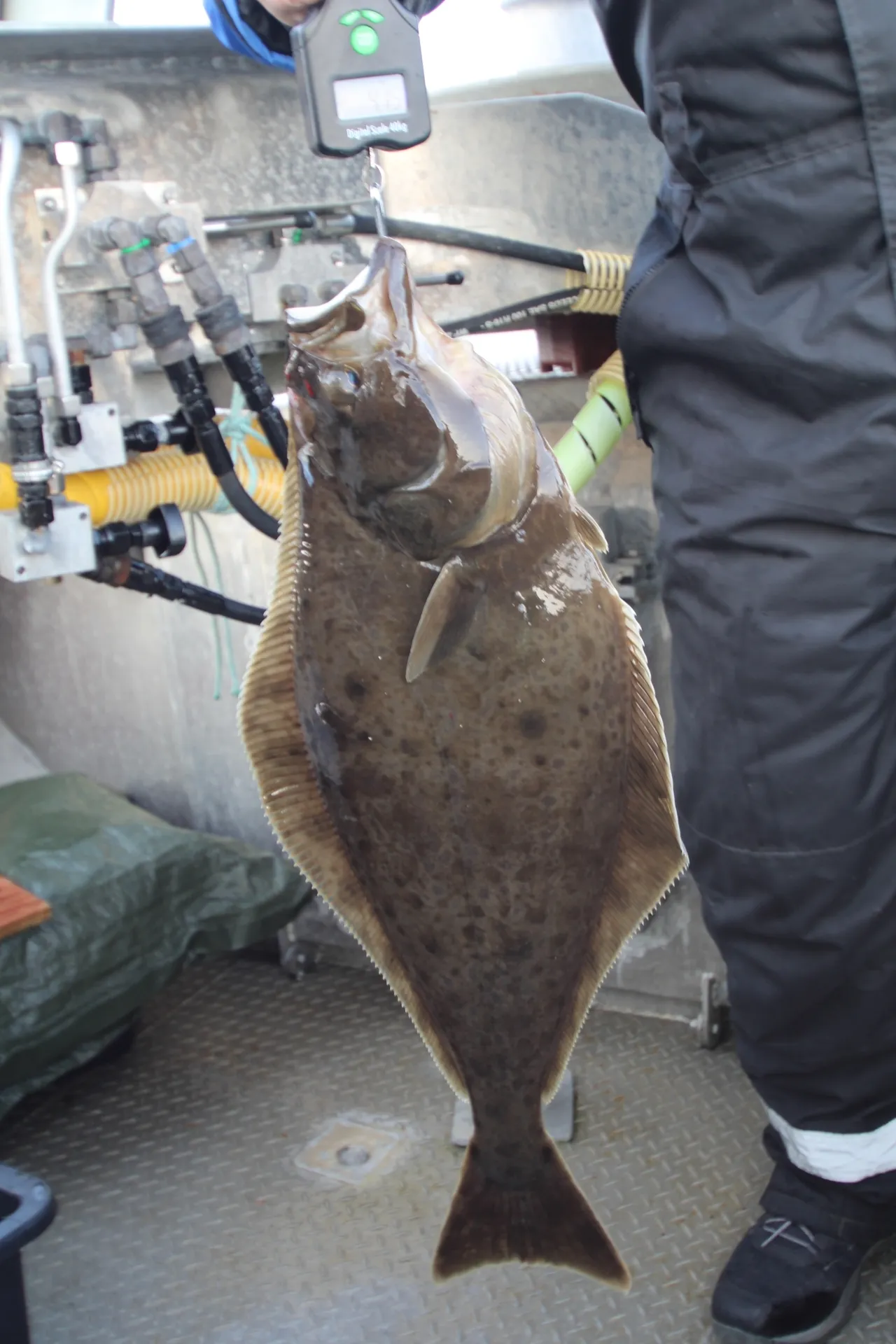
How this was identified, and who took it
Identified by: Four characters, all legible and all in frame. The body is elongate and ovate at roughly a third depth, quite unlike the near-circular outline of turbot or brill. The lateral line arches strongly over the pectoral. The mouth is large and reaches back to below the eye. The caudal fin is concave and crescent-shaped, which neither turbot nor brill carries. Both eyes sit on the pigmented side facing the camera. Four agreeing identifications, none disagreeing.portulaca — CC BY, via iNaturalist — source, licenceWhat is known about how it feeds
The halibut is the flatfish that refuses to behave like one. Both eyes sit on the upper surface giving a wide upward field of view, and the fish uses it: halibut rise well off the seabed to take prey in the water column, which is not something plaice, sole or turbot do.
That single behavioural fact reorganises the whole diet. A bottom-restricted flatfish is limited to what lives in or on the sediment; a flatfish that hunts upwards has access to the shoaling fish above it, and FishingHQ's two verified prey relationships — herring and capelin — are both mid-water shoaling species rather than benthic ones.
Size compounds it. The halibut is the largest flatfish in the world and a mature fish is a serious predator by any standard, taking cod, haddock and other substantial fish alongside cephalopods and large crustaceans. Prey size scales with predator size in the usual way, and at the top of the range there is very little in the northern demersal community that is out of reach.
The sensory arrangement supports the behaviour rather than the other way round. Sight matters more than it does for most flatfish, and the lateral line does the work in the low light of deep northern water where the species spends most of its time.
The food
Prey with a verified dietary link to this fish. Each entry carries its own evidence, and each is written at the precision the source actually used: a named species where the source named one, a group or food category where it said “polychaetes”, “crustaceans” or “detritus” and meant it. That is why this list is shorter than the animal’s real diet rather than longer.
- Atlantic herring — Clupea harengus
Halibut are active pursuit predators despite being flatfish, and herring and other shoaling fish are taken in mid water rather than from the bottom.
- Capelin — Mallotus villosus
In northern waters capelin is a principal prey, and halibut concentrate where capelin do.
Food with no page of its own here yet
These are real components of the diet, listed as plain text because FishingHQ has no page for them yet. Inventing pages to make the list look fuller would be the fabrication this whole approach exists to prevent.
- cod and haddock
- redfish
- squid
- large crustaceans
- octopus
What anglers do with this
Everything below is interpretation, not finding. It is what experienced anglers conclude from the biology above, and the reasoning is usually sound and almost never tested. It is separated from the biology deliberately.
The upward-hunting habit is the fact anglers build the fishery on, and the inference is direct: presentations worked above the seabed are fished deliberately rather than as a mistake, and a halibut fishery is not simply bottom fishing conducted with heavier tackle.
The size of the prey recorded is used to argue for large baits, and the reasoning is sound as far as it goes. It remains practitioner convention: a large halibut taking a cod does not establish that a bait of that size is the productive choice on any particular day.
The conservation dimension belongs here rather than in the biology. Atlantic halibut are slow-growing, late-maturing and depleted across much of the range, and several fisheries operate under strict retention rules or as catch-and-release only. What applies where you are fishing is a question for the relevant fisheries authority.
What this does not establish
Two verified prey relationships for a fish with a broad, opportunistic and largely piscivorous diet. Composition varies with depth, region and the size of the individual, and the northern and western Atlantic populations differ. Nothing here supports a claim about proportions, and the upward-hunting behaviour is a documented tendency rather than a description of what every halibut does at every moment.
Where this connects
These are the baits, lures, methods and explainers FishingHQ already joins to this fish — which is why the list is sometimes short. They are not chosen for this page, and a link here means an evidenced relationship exists, not that it follows from the diet.
Methods used for it
Where it lives
The science behind the feeding
This page covers feeding. The Atlantic halibut record covers identification, lifecycle, seasonal behaviour, handling and the sources behind all of it.
Reviewed 2026-08-12.