Grey gurnard
Fish · Last reviewed 2026-08-15
A small, abundant, bony-headed gurnard that walks the seabed on three free finger-rays per side, grunts when handled, and is caught far more often than it is recognised.
Safety: venomous and spined species — can cause injury needing treatment. 3 more points apply here.
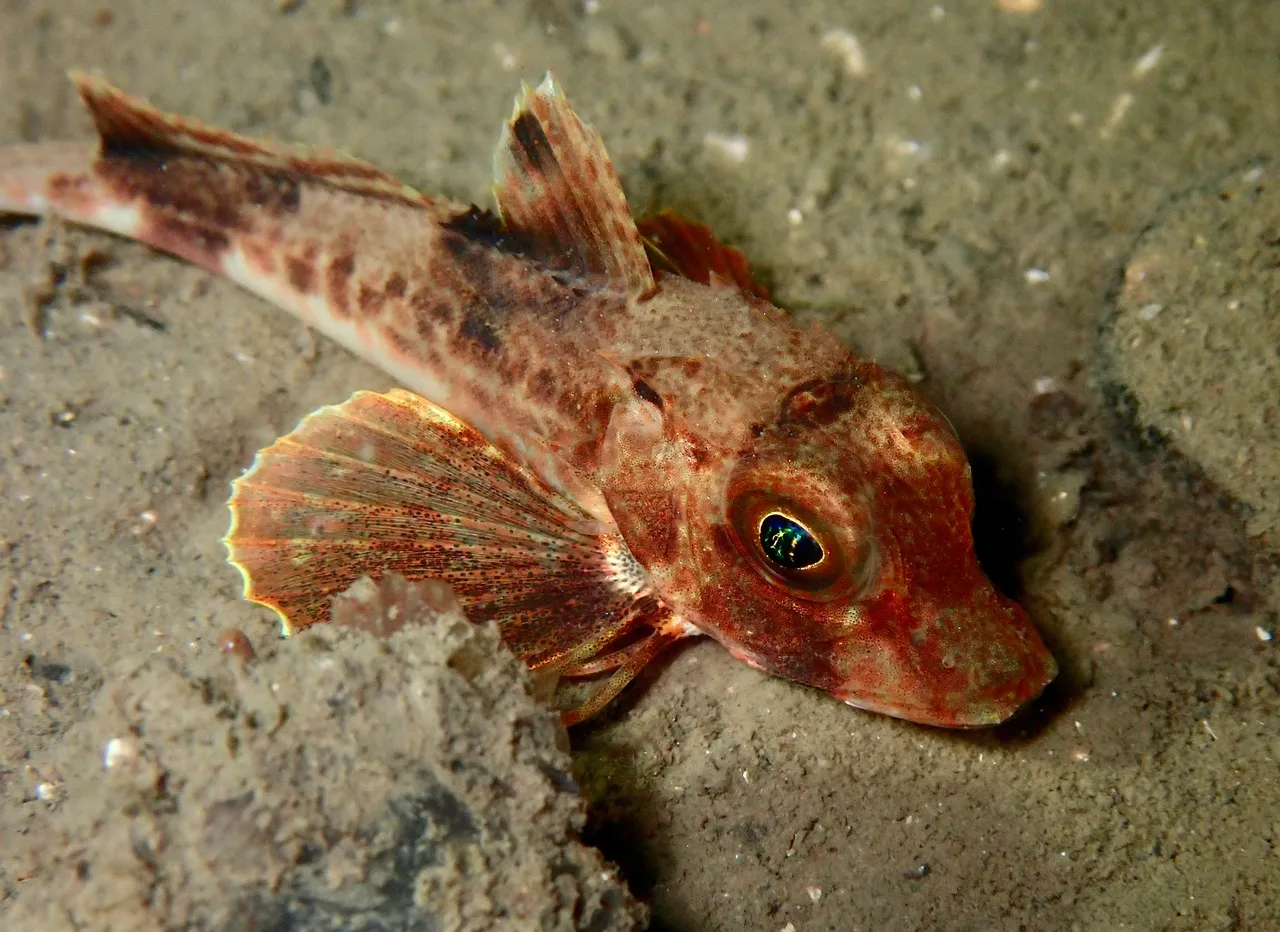
How this was identified, and who took it
Identified by: Two characters. The family character the record leads on is fully shown: three free finger-like rays are held clear of the pectoral fin and rest separately on the sand. The species character is the dark blotch on the short spinous first dorsal fin, which grey gurnard carries and red gurnard does not, together with a mottled brown pectoral rather than the brilliant blue-edged fin of a tub gurnard. Research-grade observation with agreeing identifications and none disagreeing.Libby Keatley — CC BY, via iNaturalist — source, licenceCatching Grey gurnard
Everything here on fishing for it. Each entry opens the page behind it.
- Ground
- Where
- 8 places FishingHQ documents — strongest claim anywhere: regular local target · From a boat, From the shore
A gurnard is built around a problem: how to find buried invertebrates on open sand without being able to smell them out of the sediment. The answer is to walk over the bottom and taste it.
THE THREE LOWEST RAYS OF EACH PECTORAL FIN ARE FREE OF THE WEBBING and work as separate, mobile, finger-like feelers. They carry chemosensory and touch receptors, and the fish uses them to prop itself on the seabed and probe the sediment ahead of it. A gurnard genuinely walks and genuinely tastes what it walks on.
THE HEAD IS ARMOURED AND SO IS THE ANGLER'S PROBLEM. Gurnards have a boxy, bony skull covered in plates and carrying sharp spines at the gill cover and shoulder, plus a spiny first dorsal. None of it is venomous, all of it is sharp, and a gurnard handled like a mackerel will draw blood.
AND THEY MAKE NOISE. Gurnards drum with muscles against the swim bladder and produce audible grunts and croaks, in the water and in the boat. The sound is real communication rather than distress, and a bucket of gurnards is a noisy bucket.
GREY GURNARD IS THE SMALL, ABUNDANT, WIDESPREAD ONE — the gurnard most British anglers catch and the one most often written off as a nuisance while another species is waited for.
How it is caught
- Drift fishingDrifting baited traces over clean ground is how most gurnards reach a boat.
- JiggingA small jig worked slowly along the bottom takes gurnards readily: something moving across their ground is worth investigating whether or not it looks like food.
- LedgeringA static baited hook on the seabed matches exactly how a gurnard hunts, which is why they are so easily caught and so often caught by accident.
Gear for this fish
Where Grey gurnard is documented
Places where public sources describe this species as fished, with how it is fished and how strongly the evidence supports it. This is not a range map and it is not a recommendation — it is what has been written down about a fishery rather than a record of any individual catch, and being listed is never permission to fish.
The Donegal coast and its sea loughs
2 documented places
Headland
Regular local target
From the shore
Beach
Regular local target
From the shore
Scottish sea lochs
3 documented places
Sea loch
Recorded here
From a boat
Sea loch
Recorded here
From a boat
Sea loch
Recorded here
From a boat
What these strengths mean
- Recorded here
- At least one credible public account of this species being caught here. That is all it means.
- Regular local target
- Fishing sources describe this as a normal local target here, not merely as caught.
Identification
- Scientific name
- Eutrigla gurnardus
- Family
- Triglidae
- Water
- Saltwater
- Conservation status
- Least Concern
- Regions
- Britain & Ireland, Northern Europe, Western Europe, Mediterranean, North Africa, Arctic & Subarctic
- THREE FREE FINGER-LIKE RAYS below each pectoral fin, held clear of the fin and used to walk and probe. Every gurnard has these; nothing else in British seas does.
- Greyish or greyish-brown back, often with scattered small white spots along and just below the lateral line — the white speckling is the quickest separator from tub and red gurnards.
- PECTORAL FINS ARE SHORT AND DRAB. In tub gurnard they are large and brilliantly coloured; in grey gurnard they are small and unremarkable, and this is the single most reliable distinction between the two.
- A large, boxy, bony head with visible plates and sharp spines at the gill cover and shoulder.
- A rough, strongly toothed bony ridge along the lateral line, felt easily with a finger.
- Small — usually well under 40 cm — where a tub gurnard of the same age would be noticeably larger.
Size
- Typical
- 20–30 cm and 150–350 g for rod-caught fish.
- Large
- Over 35 cm and 500 g.
Exceptional: Around 45 cm is the reported maximum for the species. Any gurnard much beyond that is almost certainly a tub gurnard rather than a large grey.
Clean ground, moderate depth, and a fish that is always there
Grey gurnards are among the most abundant demersal fish in the North Sea, and where you find them follows entirely from how they feed.
THE GROUND MUST BE PROBEABLE. A gurnard hunts by walking on three free finger-rays per pectoral fin and testing the sediment with them. That requires a surface it can prop on and push into: sand, muddy sand and fine gravel. Heavy reef, thick kelp and boulder ground are all poor gurnard habitat, which is why the gurnards and the wrasse come from different parts of the same drift.
DEPTH IS MODERATE RATHER THAN SHALLOW. The species occurs from about ten metres down to three hundred, with the useful range for anglers between roughly twenty and a hundred and fifty. This is a boat fish rather than a shore fish in most of Britain, and shore-caught grey gurnards are an occasional bonus rather than a target.
THE SEASONAL PATTERN IS A DEPTH SHIFT, NOT AN ARRIVAL. Grey gurnards are present around Britain all year. They move inshore and shallower through summer and early autumn and back offshore into deeper water through winter, so inshore catches peak in the warmer half of the year while the fish themselves have gone nowhere in particular.
WHICH MAKES THEM THE RELIABLE OPTION. On a summer inshore boat trip over clean ground, gurnards are what is reliably there when the bream have moved, the mackerel have not arrived and the bass are not feeding. For a beginner that reliability is worth more than any glamour species, and a day spent catching gurnards teaches ground reading, bite detection and — emphatically — fish handling.
THEY ARE ALSO A BYCATCH SPECIES AT SCALE. Grey gurnard is taken in quantity in mixed demersal trawl fisheries and has historically been discarded in large volumes. That is a fisheries-management matter rather than an angling one, but it is part of why the species is worth understanding rather than dismissing.
NOTHING HERE STATES WHAT MAY BE RETAINED, WHERE, OR WHEN. Retention rules, minimum sizes and protected-area conditions vary between administrations and inshore authorities and are revised; ask the relevant fisheries authority before deciding.
What experienced anglers do — why, and the sources (3)
Widely and independently recommended by experienced anglers and specialist sources. This is real angling knowledge, not proof: controlled evidence for it is limited, and FishingHQ records it as convention rather than as a demonstrated effect.
- The Fishes of the British Isles and North-West Europe — Macmillan, 1969 (Reference work)Relied on for: Distribution, habitat, identification characters and biology of the fishes of the British Isles and north-west Europe.States this directlyCitation checked — the work exists and is described correctly
- Sea Angler — Bauer Media (Specialist angling publication)Relied on for: Contemporary UK and European sea angling practice as reported by practitioners, including regional ground, seasonal timing and species behaviour.States this directlyCitation checked — the work exists and is described correctly
- ICES Advice on fishing opportunities, catch and effort — International Council for the Exploration of the Sea (Scientific institute)Relied on for: Scientific advice on north-east Atlantic stocks, including stock state, recruitment and the basis for management advice.States this directlyCitation checked — the work exists and is described correctly
Walking on fingers: how a gurnard actually finds food, and how big it gets
The gurnard's feeding apparatus is the most unusual thing about it and it explains almost everything else.
THE THREE LOWEST PECTORAL RAYS ARE FREE. On each side, the bottom three rays of the pectoral fin are separated from the webbing and act as independent, mobile, finger-like appendages. They carry both touch and chemical receptors. The fish props itself on them, moves them ahead of it over the sediment, and detects buried prey by feel and by taste before it can see anything at all.
SO IT HUNTS BY CONTACT, NOT BY SIGHT. This is a genuinely different strategy from every other fish an angler is likely to catch on the same drift, and the practical consequences are direct: gurnards feed as well at night as by day, they feed as well in coloured water as in clear, and lure colour is close to irrelevant to them. What matters is that the bait is on the bottom, where the fingers are.
THE DIET IS SMALL AND MOSTLY BURIED — shrimps, prawns, small crabs, polychaete worms — with small fish including sandeels and gobies taken opportunistically. A static baited hook on the seabed matches that exactly, which is why gurnards are so easy to catch and so often caught by accident.
BUT THEY WILL CHASE. A small jig or lure worked slowly along the bottom takes gurnards readily, because something moving across their ground is worth investigating whether or not it looks like food.
SIZE: SMALL, AND THAT IS DIAGNOSTIC. Most rod-caught grey gurnards are 20 to 30 centimetres and 150 to 350 grams. Over 35 centimetres and half a kilogram is a good one, and the reported maximum is around 45 centimetres. If you are holding a gurnard much bigger than that, you are almost certainly holding a tub gurnard rather than an exceptional grey — and the pectoral fins will tell you immediately, because a tub's are large and vividly coloured while a grey's are short and drab.
AND THEY MAKE NOISE. Gurnards drum specialised muscles against the swim bladder to produce audible grunts and croaks. It is communication rather than distress, it happens in the water as well as in the boat, and it is the origin of both the name and a great deal of confusion on charter boats.
Backed by research — why, and the sources (3)
Supported by peer-reviewed research or fisheries science. The sources are listed and can be checked.
- The Fishes of the British Isles and North-West Europe — Macmillan, 1969 (Reference work)Relied on for: Distribution, habitat, identification characters and biology of the fishes of the British Isles and north-west Europe.States this directlyCitation checked — the work exists and is described correctly
- FAO Species Identification Guides for Fishery Purposes and the FAO Species Catalogues — Food and Agriculture Organization of the United Nations (Scientific institute)Relied on for: Diagnostic identification characters, family placement and distribution as set out in the FAO species identification sheets for the eastern Atlantic and Mediterranean.States this directlyCitation checked — the work exists and is described correctly
- Cefas science, advice and data on marine and freshwater environments — Centre for Environment, Fisheries and Aquaculture Science (Government fisheries body)Relied on for: UK marine fisheries science: stock monitoring, survey data and the biological basis of management advice for the species concerned.States this directlyCitation checked — the work exists and is described correctly
Spawning, growing up, and the right way to hold a fish covered in spines
The gurnard's life history is unremarkable, which is itself worth stating, and its handling is not.
SPAWNING IS SIMPLE BROADCAST SPAWNING. Eggs are released into the water in spring and summer over inshore and offshore grounds, they float, and the larvae drift in the plankton before settling to the bottom as tiny juveniles on shallow sandy ground. There is no nest, no guarding, no spawning migration of consequence and no aggregation an angler could damage — the exact opposite of black bream, and a useful contrast to hold in mind.
MATURITY IS EARLY, at two to three years, and the species is abundant. Together those are why grey gurnard has never been a conservation concern even though it is taken in very large quantities as trawl bycatch: it breeds young, breeds often and scatters its eggs widely.
IT IS NOT A LONG-LIVED FISH. A large grey gurnard represents several years of growth rather than several decades, which is a different proposition from a large plaice or a large bream and should inform what an angler decides to keep.
NOW THE PART THAT MATTERS MOST. A GURNARD IS SHARP EXACTLY WHERE YOUR HAND WANTS TO GO. The gill covers carry backward-pointing spines, there is another at the shoulder, and the first dorsal fin is spiny. None of it is venomous. All of it punctures, and puncture wounds from marine fish infect readily and out of proportion to how minor they look.
THE GRIP THAT WORKS: take the fish across the body BEHIND the pectoral fins, with the first dorsal folded flat under your palm rather than standing up against it. Alternatively hold it by the lower jaw, well clear of the head plates. Do not grip it around the head, and do not slide a hand forward from the tail, which is exactly how the gill-cover spines catch you.
USE PLIERS, NOT FINGERS, to unhook, and a cloth or gloves if you are handling several. Wash and cover any puncture and watch it.
BAROTRAUMA APPLIES. Gurnards have a swim bladder — the same one that makes the noise — and fish brought up quickly from deep marks suffer expansion damage and may not survive release. On deep ground, decide what you are going to keep before you start rather than after.
Backed by research — why, and the sources (3)
Supported by peer-reviewed research or fisheries science. The sources are listed and can be checked.
- The Fishes of the British Isles and North-West Europe — Macmillan, 1969 (Reference work)Relied on for: Distribution, habitat, identification characters and biology of the fishes of the British Isles and north-west Europe.States this directlyCitation checked — the work exists and is described correctly
- Cefas science, advice and data on marine and freshwater environments — Centre for Environment, Fisheries and Aquaculture Science (Government fisheries body)Relied on for: UK marine fisheries science: stock monitoring, survey data and the biological basis of management advice for the species concerned.States this directlyCitation checked — the work exists and is described correctly
- FAO Species Identification Guides for Fishery Purposes and the FAO Species Catalogues — Food and Agriculture Organization of the United Nations (Scientific institute)Relied on for: Diagnostic identification characters, family placement and distribution as set out in the FAO species identification sheets for the eastern Atlantic and Mediterranean.States this directlyCitation checked — the work exists and is described correctly
How grey gurnard are caught
Grey gurnard have moved in twenty years from bycatch nobody wanted to a fish a good many anglers set out for, and the methods reflect that transition.
THEY ARE CAUGHT OVER CLEAN AND MIXED GROUND, ON THE BOTTOM. Gurnards walk on the free rays of their pectoral fins, feeling the substrate for crustaceans and small fish, so they are on and against the seabed rather than above it. A bait fished hard on the bottom is what they find.
DRIFTING BEATS ANCHORING for a fish that is spread over ground rather than concentrated on a feature. A boat drifting across clean and mixed bottom, with baits or small lures working near the seabed, covers the water gurnards actually occupy.
SMALL BAITS ON SMALL HOOKS. Strips of mackerel, squid or ragworm on sizes 1 to 4. Grey gurnard have large heads and modest mouths, and they are aggressive rather than delicate — the limit is what fits, not what tempts.
THEY TAKE LURES FREELY, which surprises people. Small jigs, feathers and soft plastics worked close to the bottom catch them consistently, and light lure tackle turns a fish that fights modestly into one worth catching.
FROM THE SHORE THEY ARE A GENUINE IF LOCAL TARGET, on deep-water marks and over clean ground where the fish come close, particularly at night in summer and autumn.
AND THE HANDLING IS PART OF THE METHOD. Gurnards are spined along the dorsal and around the gill covers, they are frequently caught by people who were not expecting one, and the sharp spines are the reason many are still thrown up the beach rather than unhooked. A gloved hand or a wet cloth over the back, and pliers, make the fish straightforward — and a gurnard returned properly is a fish that survives well.
What experienced anglers do — why, and the sources (2)
Widely and independently recommended by experienced anglers and specialist sources. This is real angling knowledge, not proof: controlled evidence for it is limited, and FishingHQ records it as convention rather than as a demonstrated effect.
- Sea Angler — Bauer Media (Specialist angling publication)Relied on for: Contemporary UK and European sea angling practice as reported by practitioners, including ground, seasonal timing, bait and method convention.States this directlyCitation checked — the work exists and is described correctly
- General angling website restatements of established technique — Various (Credible secondary source)Relied on for: Widely restated descriptions of species behaviour and regional angling practice, recorded as consensus rather than as scholarship.Background and mechanism onlyCitation checked — the work exists and is described correctly
Lifecycle and reproduction
Grey gurnards hatch from pelagic eggs, pass through a planktonic larval stage, and settle to the bottom as small juveniles on shallow sandy ground. Growth is moderate and maturity comes at two to three years, which is early enough to make the species resilient. They are not long-lived by the standards of the flatfish they share ground with, and a large grey gurnard is a fish of several years rather than several decades.
Spawning takes place in spring and summer over offshore and inshore grounds, releasing pelagic eggs. There is no nest, no parental care and no migration of consequence — a straightforward broadcast spawner, which combined with early maturity and abundance is why the species has never been a conservation concern even where it is taken in quantity as bycatch.
Feeding and senses
A bottom feeder taking small crustaceans — shrimps, prawns, small crabs — along with polychaete worms and small fish including sandeels and gobies. The three free pectoral rays are the hunting apparatus: the fish props on them, probes the sediment, and detects buried prey by chemical and tactile cues rather than by sight. That is why gurnards feed as effectively at night and in coloured water as in clear daylight, and why they take a static baited hook so readily.
Touch and taste through the free pectoral rays lead, with vision secondary and hearing genuinely developed — the drumming muscles that produce the grunt imply a fish that listens as well as calls. For an angler the practical point is that gurnards are not a visual catch: they find a bait by contact and chemistry, so scent and position on the bottom matter and lure colour barely does. A gurnard will still hit a jig or a small lure worked slowly along the seabed, because a thing moving across its ground is worth investigating.
Through the year
Present around Britain year-round, moving into shallower inshore water through summer and autumn and offshore into deeper water through winter. Catches from inshore boat marks peak in summer and early autumn. There is no dramatic migration; the seasonal pattern is a depth shift rather than an arrival and departure.
Distribution
North-east Atlantic from Iceland, Norway and the Baltic approaches south to Morocco and into the western Mediterranean, and abundant throughout the North Sea and around the whole of the British Isles. Occupies sand, muddy sand and fine gravel from around 10 m to 300 m, commonly 20 to 150 m. One of the most numerous demersal fish in the North Sea; the global assessment is Least Concern.
This is a biological range — where the species occurs, not a prediction that you will catch one. To browse the fishing geography FishingHQ holds, start at fishing places.
Why anglers care
Caught constantly from inshore boats over clean ground and long treated as a nuisance species by anglers waiting for something else. That reputation is undeserved: gurnards take baits and small lures freely, they are excellent eating, and for a beginner on a boat they provide reliable action on ground where nothing else is biting. They are also the species most likely to injure a careless hand on a British charter boat, which makes knowing how to hold one genuinely useful rather than academic.
Handling and returning
The critical point is that a gurnard is sharp everywhere a hand naturally goes. The gill covers carry backward-pointing spines, the shoulder carries another, and the first dorsal is spiny. None of it is venomous but all of it punctures, and marine puncture wounds infect readily. Grip the fish across the body BEHIND the pectoral fins with the dorsal folded flat, or hold it by the lower jaw clear of the head plates, and use a cloth or gloves if in any doubt. Unhook with pliers rather than fingers. Gurnards suffer barotrauma from depth like other swim-bladdered fish, so fish brought up quickly from deep marks may not survive release.
Going further
- What does grey gurnard eat? — feeding biology, kept separate from what anglers infer from it.
Safety
Venomous and spined species — Can cause injury needing treatment
The gill covers and shoulder carry sharp backward-pointing bony spines and the first dorsal fin is spiny. A hand sliding forward along the body, or gripping the fish around the head, is punctured. There is no venom, but marine puncture wounds seed bacteria deep into tissue and infect far more readily than their size suggests — a small gurnard prick can become a hand that needs antibiotics.
What reduces it: Hold the fish across the body behind the pectoral fins with the dorsal folded flat, or by the lower jaw clear of the head plates. Never slide a hand forward from the tail. Unhook with pliers rather than fingers, use a cloth or gloves when handling several, and wash, disinfect and cover any puncture. Seek medical advice if a puncture becomes red, swollen or painful over the following days.
Worse when:
- Handling fish in the dark or in a moving boat, where the grip is taken by feel rather than by sight.
- Handling several fish quickly, when attention drops and the grip becomes casual.
- Handling with cold, wet hands that have lost sensation and grip strength.
Precautions that always apply here
- Handle spined and venomous species with the spines controlled. Know which local species have them before you fish, not afterwards.
- Wet your hands before touching a fish. Dry hands strip the protective mucus layer that keeps infection out.
- Keep fingers out of the gills and clear of the teeth. Gill damage is usually fatal to the fish, and several species will remove skin from a finger.
Further safety reading
- Venomous and spined fish — Gill-cover and shoulder spines plus a spiny first dorsal, none venomous and all capable of a puncture that infects readily. The species most likely to injure a hand on a British charter boat.
Check the rules before you fish
Fishing laws, bylaws, access rules, seasons, bait restrictions and permitted methods vary by location and can change. Check the current rules from the relevant authority and the water you intend to fish before fishing.
Check with:
- Current national or regional law for where you are fishing
- Current local bylaws
- The relevant fisheries authority
- The landowner, club or fishery whose water it is
- Any restrictions specific to the species or the method you intend to use
Where to go next
Where it lives
Understanding this fish
- Decapod crustaceans as preyShrimps, prawns and small crabs located by probing the sediment with the three free pectoral rays, which carry both touch and chemical receptors.
- How fish hearGurnards drum specialised muscles against the swim bladder to produce audible grunts and croaks. A fish that calls is a fish that listens.
- How fish smell and tasteThe three free pectoral rays carry chemical and touch receptors, so a gurnard genuinely tastes the seabed it walks on — which is why it feeds as well at night and in coloured water as in clear daylight.
- Polychaete worms as preyPolychaetes taken from clean sand and fine gravel, detected by contact and chemistry rather than by sight.
Told apart from
- Red gurnardThe third of the set. A grey gurnard is speckled with pale spots and has a spiny lateral line, and — despite the name — is very often reddish, which is why colour cannot decide any of this.
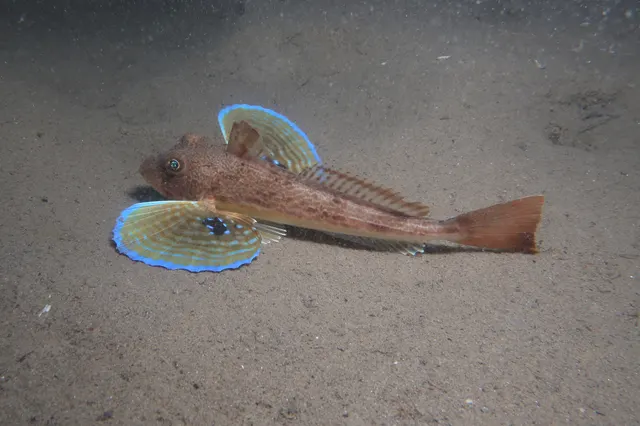 Tub gurnardThe two British gurnards an angler will meet. Look at the pectoral fins: a tub's are enormous and peacock blue, a grey's are short and drab. Size settles it too — a gurnard much over 45 cm is a tub.
Sources and evidence
- The Fishes of the British Isles and North-West Europe — Macmillan, 1969 (Reference work)Relied on for: Distribution, habitat, identification characters and biology of the fishes of the British Isles and north-west Europe.States this directlyCitation checked — the work exists and is described correctly
- FAO Species Identification Guides for Fishery Purposes and the FAO Species Catalogues — Food and Agriculture Organization of the United Nations (Scientific institute)Relied on for: Diagnostic identification characters, family placement and distribution as set out in the FAO species identification sheets for the eastern Atlantic and Mediterranean.States this directlyCitation checked — the work exists and is described correctly
- Cefas science, advice and data on marine and freshwater environments — Centre for Environment, Fisheries and Aquaculture Science (Government fisheries body)Relied on for: UK marine fisheries science: stock monitoring, survey data and the biological basis of management advice for the species concerned.States this directlyCitation checked — the work exists and is described correctly
- Sea Angler — Bauer Media (Specialist angling publication)Relied on for: Contemporary UK and European sea angling practice as reported by practitioners, including regional ground, seasonal timing and species behaviour.States this directlyCitation checked — the work exists and is described correctly
- ICES Advice on fishing opportunities, catch and effort — International Council for the Exploration of the Sea (Scientific institute)Relied on for: Scientific advice on north-east Atlantic stocks, including stock state, recruitment and the basis for management advice.States this directlyCitation checked — the work exists and is described correctly
Why the 14 connections on this page are here, and the sources
How it is caught
What experienced anglers do — 3 connections
Widely and independently recommended by experienced anglers and specialist sources. This is real angling knowledge, not proof: controlled evidence for it is limited, and FishingHQ records it as convention rather than as a demonstrated effect.
Drift fishing
A statement about how a species is fished, which is angling convention rather than biology and is labelled as such.
- Sea Angler — Bauer Media (Specialist angling publication)Relied on for: Contemporary UK and European sea angling practice as reported by practitioners, including ground, seasonal timing, bait and method convention.States this directlyCitation checked — the work exists and is described correctly
- General angling website restatements of established technique — Various (Credible secondary source)Relied on for: Widely restated descriptions of species behaviour and regional angling practice, recorded as consensus rather than as scholarship.Background and mechanism onlyCitation checked — the work exists and is described correctly
Jigging
A statement about how a species is fished, which is angling convention rather than biology and is labelled as such.
- Sea Angler — Bauer Media (Specialist angling publication)Relied on for: Contemporary UK and European sea angling practice as reported by practitioners, including ground, seasonal timing, bait and method convention.States this directlyCitation checked — the work exists and is described correctly
- General angling website restatements of established technique — Various (Credible secondary source)Relied on for: Widely restated descriptions of species behaviour and regional angling practice, recorded as consensus rather than as scholarship.Background and mechanism onlyCitation checked — the work exists and is described correctly
Ledgering
A statement about how a species is fished, which is angling convention rather than biology and is labelled as such.
- Sea Angler — Bauer Media (Specialist angling publication)Relied on for: Contemporary UK and European sea angling practice as reported by practitioners, including ground, seasonal timing, bait and method convention.States this directlyCitation checked — the work exists and is described correctly
- General angling website restatements of established technique — Various (Credible secondary source)Relied on for: Widely restated descriptions of species behaviour and regional angling practice, recorded as consensus rather than as scholarship.Background and mechanism onlyCitation checked — the work exists and is described correctly
Gear for this fish
What experienced anglers do — 2 connections
Widely and independently recommended by experienced anglers and specialist sources. This is real angling knowledge, not proof: controlled evidence for it is limited, and FishingHQ records it as convention rather than as a demonstrated effect.
Fish strip and cut bait
A bait joined to the fish it is conventionally used for. Convention, recorded as convention.
- Sea Angler — Bauer Media (Specialist angling publication)Relied on for: Contemporary UK and European sea angling practice as reported by practitioners, including ground, seasonal timing, bait and method convention.States this directlyCitation checked — the work exists and is described correctly
- General angling website restatements of established technique — Various (Credible secondary source)Relied on for: Widely restated descriptions of species behaviour and regional angling practice, recorded as consensus rather than as scholarship.Background and mechanism onlyCitation checked — the work exists and is described correctly
Lugworm
A bait joined to the fish it is conventionally used for. Convention, recorded as convention.
- Sea Angler — Bauer Media (Specialist angling publication)Relied on for: Contemporary UK and European sea angling practice as reported by practitioners, including ground, seasonal timing, bait and method convention.States this directlyCitation checked — the work exists and is described correctly
- General angling website restatements of established technique — Various (Credible secondary source)Relied on for: Widely restated descriptions of species behaviour and regional angling practice, recorded as consensus rather than as scholarship.Background and mechanism onlyCitation checked — the work exists and is described correctly
Where it lives
Backed by research — 2 connections
Supported by peer-reviewed research or fisheries science. The sources are listed and can be checked.
Inshore ground
A distributional claim about where a species is found, which is a claim about the world and rests on the standard regional reference works rather than on angling report.
- The Fishes of the British Isles and North-West Europe — Macmillan, 1969 (Reference work)Relied on for: Distribution, habitat association, identification and biology of the fishes of the British Isles and north-west Europe.States this directlyCitation checked — the work exists and is described correctly
- FAO Species Identification Guides for Fishery Purposes and the FAO Species Catalogues — Food and Agriculture Organization of the United Nations (Scientific institute)Relied on for: Diagnostic characters, habitat and depth range as set out in the FAO species identification sheets for the eastern Atlantic and Mediterranean.States this directlyCitation checked — the work exists and is described correctly
Open ocean
A distributional claim about where a species is found, which is a claim about the world and rests on the standard regional reference works rather than on angling report.
- The Fishes of the British Isles and North-West Europe — Macmillan, 1969 (Reference work)Relied on for: Distribution, habitat association, identification and biology of the fishes of the British Isles and north-west Europe.States this directlyCitation checked — the work exists and is described correctly
- FAO Species Identification Guides for Fishery Purposes and the FAO Species Catalogues — Food and Agriculture Organization of the United Nations (Scientific institute)Relied on for: Diagnostic characters, habitat and depth range as set out in the FAO species identification sheets for the eastern Atlantic and Mediterranean.States this directlyCitation checked — the work exists and is described correctly
Understanding this fish
Backed by research — 2 connections
Supported by peer-reviewed research or fisheries science. The sources are listed and can be checked.
Decapod crustaceans as prey
A dietary claim recorded at GROUP level against a modelled prey concept, because the sources describe the prey as a group and inventing a species to point at would be the fabrication the precision audit exists to prevent.
- Cefas science, advice and data on marine and freshwater environments — Centre for Environment, Fisheries and Aquaculture Science (Government fisheries body)Relied on for: UK marine fisheries science: survey data, distribution and the biological basis of management advice for the species concerned.States this directlyCitation checked — the work exists and is described correctly
- The Fishes of the British Isles and North-West Europe — Macmillan, 1969 (Reference work)Relied on for: Distribution, habitat and biology of the fishes of the British Isles and north-west Europe.States this directlyCitation checked — the work exists and is described correctly
Polychaete worms as prey
A dietary claim recorded at GROUP level against a modelled prey concept, because the sources describe the prey as a group and inventing a species to point at would be the fabrication the precision audit exists to prevent.
- Cefas science, advice and data on marine and freshwater environments — Centre for Environment, Fisheries and Aquaculture Science (Government fisheries body)Relied on for: UK marine fisheries science: survey data, distribution and the biological basis of management advice for the species concerned.States this directlyCitation checked — the work exists and is described correctly
- The Fishes of the British Isles and North-West Europe — Macmillan, 1969 (Reference work)Relied on for: Distribution, habitat and biology of the fishes of the British Isles and north-west Europe.States this directlyCitation checked — the work exists and is described correctly
What experienced anglers do — 2 connections
Widely and independently recommended by experienced anglers and specialist sources. This is real angling knowledge, not proof: controlled evidence for it is limited, and FishingHQ records it as convention rather than as a demonstrated effect.
How fish hear
A record joined to the mechanism that explains it, which is what makes a species page transferable rather than a list of facts.
- Sea Angler — Bauer Media (Specialist angling publication)Relied on for: Contemporary UK and European sea angling practice as reported by practitioners, including ground, seasonal timing, bait and method convention.States this directlyCitation checked — the work exists and is described correctly
- General angling website restatements of established technique — Various (Credible secondary source)Relied on for: Widely restated descriptions of species behaviour and regional angling practice, recorded as consensus rather than as scholarship.Background and mechanism onlyCitation checked — the work exists and is described correctly
How fish smell and taste
A record joined to the mechanism that explains it, which is what makes a species page transferable rather than a list of facts.
- Sea Angler — Bauer Media (Specialist angling publication)Relied on for: Contemporary UK and European sea angling practice as reported by practitioners, including ground, seasonal timing, bait and method convention.States this directlyCitation checked — the work exists and is described correctly
- General angling website restatements of established technique — Various (Credible secondary source)Relied on for: Widely restated descriptions of species behaviour and regional angling practice, recorded as consensus rather than as scholarship.Background and mechanism onlyCitation checked — the work exists and is described correctly
Told apart from
What experienced anglers do — 2 connections
Widely and independently recommended by experienced anglers and specialist sources. This is real angling knowledge, not proof: controlled evidence for it is limited, and FishingHQ records it as convention rather than as a demonstrated effect.
Red gurnard
A comparison a reader with the animal or the decision in front of them actually needs, joining two records that resolve one another.
- The Fishes of the British Isles and North-West Europe — Macmillan, 1969 (Reference work)Relied on for: Distribution, habitat association, identification and biology of the fishes and inshore fauna of the British Isles and north-west Europe.States this directlyCitation checked — the work exists and is described correctly
- FAO Species Identification Guides for Fishery Purposes and the FAO Species Catalogues — Food and Agriculture Organization of the United Nations (Scientific institute)Relied on for: Diagnostic characters, family placement, habitat and depth range as set out in the FAO species identification sheets for the eastern Atlantic and Mediterranean.States this directlyCitation checked — the work exists and is described correctly
Tub gurnard
Two records a reader will hold together — here because the fish are confused with one another in the hand, which is an identification problem rather than a preference.
- The Fishes of the British Isles and North-West Europe — Macmillan, 1969 (Reference work)Relied on for: Distribution, habitat association, identification and biology of the fishes of the British Isles and north-west Europe.States this directlyCitation checked — the work exists and is described correctly
- FAO Species Identification Guides for Fishery Purposes and the FAO Species Catalogues — Food and Agriculture Organization of the United Nations (Scientific institute)Relied on for: Diagnostic characters, habitat and depth range as set out in the FAO species identification sheets for the eastern Atlantic and Mediterranean.States this directlyCitation checked — the work exists and is described correctly
Safety reading
Official guidance — 1 connection
Stated by a fisheries authority, scientific institute or recognised angling body. Authoritative, but summarising rather than demonstrating.
Venomous and spined fish
A hazard carried by this page joined to the topic that explains it in full, so that the warning on the page has somewhere to lead.
- The Fishes of the British Isles and North-West Europe — Macmillan, 1969 (Reference work)Relied on for: Distribution, habitat association, identification and biology of the fishes of the British Isles and north-west Europe.States this directlyCitation checked — the work exists and is described correctly
- FAO Species Identification Guides for Fishery Purposes and the FAO Species Catalogues — Food and Agriculture Organization of the United Nations (Scientific institute)Relied on for: Diagnostic characters, habitat and depth range as set out in the FAO species identification sheets for the eastern Atlantic and Mediterranean.States this directlyCitation checked — the work exists and is described correctly
How FishingHQ labels evidence is explained in the evidence policy.