What does grey gurnard eat?
What is established about how grey gurnard feeds, kept separate from what anglers infer from it.
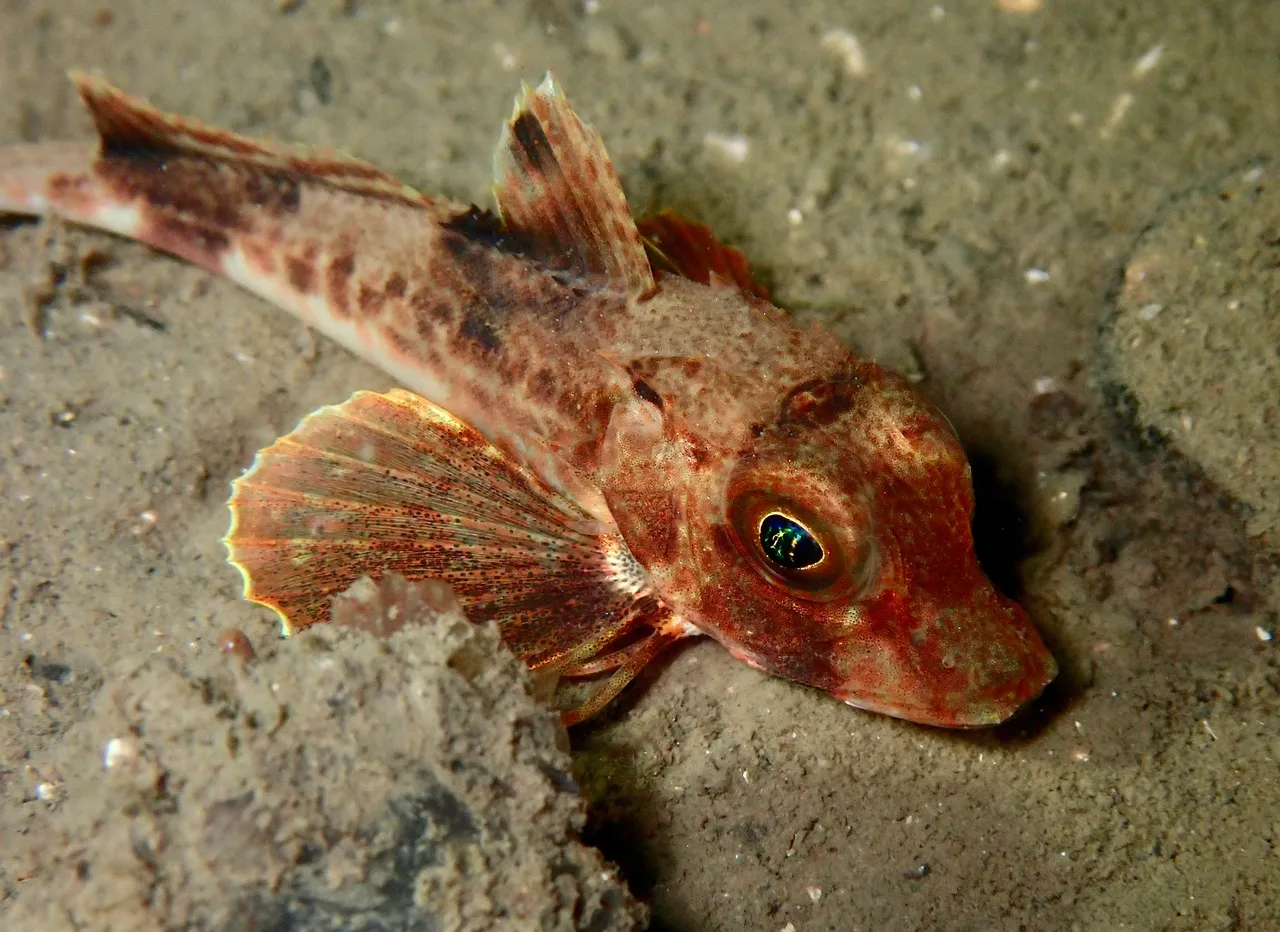
How this was identified, and who took it
Identified by: Two characters. The family character the record leads on is fully shown: three free finger-like rays are held clear of the pectoral fin and rest separately on the sand. The species character is the dark blotch on the short spinous first dorsal fin, which grey gurnard carries and red gurnard does not, together with a mottled brown pectoral rather than the brilliant blue-edged fin of a tub gurnard. Research-grade observation with agreeing identifications and none disagreeing.Libby Keatley — CC BY, via iNaturalist — source, licenceWhat is known about how it feeds
The grey gurnard has a feeding apparatus that nothing else on its ground possesses, and it is worth describing before the diet itself.
The three lowest rays of each pectoral fin are free of the webbing and act as independent, mobile, finger-like appendages carrying both touch and chemical receptors. The fish props on them, moves them ahead of itself over the seabed, and detects buried prey by feel and by taste before it can see anything. A gurnard genuinely walks over the bottom and genuinely tastes what it walks on.
The diet follows directly. The two verified relationships are decapod crustaceans — shrimps, prawns and small crabs — and polychaete worms, all taken from and just under the surface of clean sand and fine gravel. Small fish including sandeels and gobies are taken opportunistically, and the fish component rises with size.
Because detection is by contact and chemistry rather than by sight, a grey gurnard feeds as effectively at night and in coloured water as in clear daylight. That is a real advantage over the visual bottom feeders sharing the same ground, and it is why gurnards are caught at every state of light and water.
Hearing is developed too. Gurnards drum specialised muscles against the swim bladder to produce audible grunts and croaks, and a fish that calls is a fish that listens — though what role sound plays in feeding rather than in communication is not established.
The seasonal pattern is a depth shift rather than a change in diet: fish move shallower through summer and autumn and offshore in winter, feeding throughout.
The food
Prey with a verified dietary link to this fish. Each entry carries its own evidence, and each is written at the precision the source actually used: a named species where the source named one, a group or food category where it said “polychaetes”, “crustaceans” or “detritus” and meant it. That is why this list is shorter than the animal’s real diet rather than longer.
- Decapod crustaceans as prey — a group rather than a species: the evidence names the group
Shrimps, prawns and small crabs located by probing the sediment with the three free pectoral rays, which carry both touch and chemical receptors.
- Polychaete worms as prey — a group rather than a species: the evidence names the group
Polychaetes taken from clean sand and fine gravel, detected by contact and chemistry rather than by sight.
Food with no page of its own here yet
These are real components of the diet, listed as plain text because FishingHQ has no page for them yet. Inventing pages to make the list look fuller would be the fabrication this whole approach exists to prevent.
- sandeels
- gobies
- small flatfish
- amphipods
- juvenile fish of other species
What anglers do with this
Everything below is interpretation, not finding. It is what experienced anglers conclude from the biology above, and the reasoning is usually sound and almost never tested. It is separated from the biology deliberately.
Gurnards are mostly caught by accident, and the interpretation below is about turning that into something deliberate.
A STATIC BAIT ON THE SEABED matches the hunting method exactly, and that is the whole reason gurnards are so easy to catch: the fish walks over the bottom testing it, and a bait lying on the bottom is what it is testing for. Worm and fish strip are both conventional.
LURE COLOUR IS WIDELY HELD TO MATTER LITTLE, and the reasoning is the sensory profile: a fish that finds food by contact and chemistry is not making a colour judgement. This is practitioner inference from biology rather than a tested claim, and it is a good example of the kind that sounds like a fact.
MOVEMENT STILL WORKS. A small jig worked slowly along the bottom takes gurnards readily, which is usually explained as investigation rather than as feeding — something crossing the fish's ground is worth examining whether or not it resembles food. Also inference.
The handling consequence is not interpretation and is the most important thing on this page for anybody who has just caught one. The gill covers and shoulder carry sharp backward-pointing spines and the first dorsal is spiny; none is venomous and all of it punctures, and marine puncture wounds infect out of proportion to their size. Grip the fish across the body behind the pectorals with the dorsal folded flat, never sliding a hand forward from the tail.
What this does not establish
Both relationships are group-level and neither establishes proportions. The fish component of the diet is substantial in larger individuals and is represented by no modelled relationship, because the sources describe it at a level of generality the precision rule will not accept as a species claim. Nothing here quantifies the shift in diet with size, and the role of hearing in feeding as distinct from communication is not established.
Where this connects
These are the baits, lures, methods and explainers FishingHQ already joins to this fish — which is why the list is sometimes short. They are not chosen for this page, and a link here means an evidenced relationship exists, not that it follows from the diet.
Baits recorded for this species
Methods used for it
Where it lives
The science behind the feeding
This page covers feeding. The Grey gurnard record covers identification, lifecycle, seasonal behaviour, handling and the sources behind all of it.
Reviewed 2026-08-15.