Red gurnard
Fish · Last reviewed 2026-08-17
The smallest and best-eating of the three British gurnards, and the one that proves colour cannot be used to tell gurnards apart — because all three of them can be red.
Safety: injury while handling fish — can cause injury needing treatment.
Catching Red gurnard
Everything here on fishing for it. Each entry opens the page behind it.
- Ground
- Where
- 1 place FishingHQ documents — strongest claim anywhere: regular local target · From the shore
A gurnard is unmistakable as a gurnard: a big armoured head, a tapering body, and three free rays on each pectoral fin that the fish walks along the seabed on and tastes with. Telling one gurnard from another is a different problem, and the red gurnard is where most people get it wrong.
THE NAME IS A TRAP. A tub gurnard is frequently red. A grey gurnard is frequently reddish. The red gurnard is red. Colour separates none of them, and an identification built on it will be wrong roughly a third of the time.
WHAT ACTUALLY SEPARATES THEM IS THE LATERAL LINE AND THE PECTORAL FIN. On a red gurnard the lateral line is a series of broad, conspicuous, plate-like scales — like a row of tiles down the flank — and the pectoral fins are short and reddish. On a tub gurnard the lateral line is smooth and unremarkable and the pectorals are enormous, reaching well past the vent, with a brilliant blue and green edge on the inner surface. On a grey gurnard the flanks are speckled with pale spots and the lateral line is spiny.
AND IT MAKES A NOISE. All gurnards produce sound with muscles against the swim bladder, and a boated one grunts and croaks audibly. It is the origin of the name and it is the first thing anybody notices.
How it is caught
- Drift fishingDrifted baits and small lures over clean and mixed ground take gurnards readily, and increasingly on purpose.
- Feathering and multi-lure tracesSmall feathers and multi-hook traces worked near the bottom take gurnards regularly.
- LedgeringAlmost every red gurnard is taken on a small baited hook fished hard on the bottom, usually by somebody fishing for flatfish.
Where Red gurnard is documented
Places where public sources describe this species as fished, with how it is fished and how strongly the evidence supports it. This is not a range map and it is not a recommendation — it is what has been written down about a fishery rather than a record of any individual catch, and being listed is never permission to fish.
What these strengths mean
- Regular local target
- Fishing sources describe this as a normal local target here, not merely as caught.
Identification
No photograph of Red gurnard has passed identity review yet, so none is shown. A photograph is published only once somebody has checked the animal in it against the diagnostic features described on this page.
- Scientific name
- Chelidonichthys cuculus
- Family
- Triglidae
- Water
- Saltwater
- Conservation status
- Least Concern
- Regions
- Britain & Ireland, Western Europe, Northern Europe, Mediterranean, North Africa
- THE LATERAL LINE IS A ROW OF BROAD PLATE-LIKE SCALES, conspicuous as a line of tiles running the length of the flank. This is the diagnostic character and it is visible at arm's length.
- PECTORAL FINS ARE SHORT — reaching to about the level of the vent, not past it — and reddish rather than blue-edged. A tub gurnard's pectorals are huge and have a vivid blue and green inner margin.
- SMALLEST OF THE THREE. Usually 25–35 cm; a red gurnard over 40 cm is a big one, whereas a tub gurnard commonly exceeds 45 cm.
- THREE FREE RAYS ON EACH PECTORAL FIN, used as legs and as chemosensory feelers on the seabed. Common to all gurnards and the family's signature.
- COLOUR IS NOT A CHARACTER. Tub gurnards are often red, grey gurnards are often reddish, and this species is red. Anybody identifying a British gurnard by colour is guessing.
- GREY GURNARD IS SPECKLED. Pale spots scattered over the flanks and a spiny lateral line separate it from both of the others.
Size
- Typical
- 25–35 cm and 250–500 g.
- Large
- Over 40 cm is a very good red gurnard.
Exceptional: Around 50 cm is the widely reported maximum for the species and is exceptional; the tub gurnard grows considerably larger.
The three British gurnards, and the character that actually works
This is a three-way identification and it fails for one reason: everybody starts with colour.
RED GURNARD — the lateral line is a row of broad, plate-like scales running the length of the flank, like tiles. Pectoral fins short, reaching about to the vent, and reddish. Usually the smallest of the three.
TUB GURNARD — enormous pectoral fins reaching well past the vent, with a vivid blue and green margin on the inner surface that is unmistakable when the fin is spread. Lateral line smooth. The largest of the three, commonly over 45 cm.
GREY GURNARD — pale spots scattered over the flanks, a spiny lateral line, and a generally drabber look, though it is very often reddish rather than grey. The one most likely to be caught in the North Sea.
SO THE ORDER OF CHECKS IS: spread a pectoral fin. Blue and green edge, huge — tub. Then look at the lateral line. Broad plates like tiles — red. Spiny, with pale spots on the flank — grey.
WHY THIS IS WORTH THE TROUBLE. Not because anything hangs on it legally in most places, but because a person who identifies fish by colour will go on being wrong about everything with variable colour, which in British seas is most things. Gurnards are the clearest available lesson that the character has to be structural.
AND THE FOURTH ONE. The streaked gurnard occurs in the south-west and is genuinely uncommon; it has a strongly marked, wavy lateral line and shorter body. Anybody who has confidently identified the three above will notice it as not fitting.
What experienced anglers do — why, and the sources (4)
Widely and independently recommended by experienced anglers and specialist sources. This is real angling knowledge, not proof: controlled evidence for it is limited, and FishingHQ records it as convention rather than as a demonstrated effect.
- The Fishes of the British Isles and North-West Europe — Macmillan, 1969 (Reference work)Relied on for: Distribution, habitat, identification characters and biology of the fishes of the British Isles and north-west Europe.States this directlyCitation checked — the work exists and is described correctly
- FAO Species Identification Guides for Fishery Purposes and the FAO Species Catalogues — Food and Agriculture Organization of the United Nations (Scientific institute)Relied on for: Diagnostic identification characters, family placement, depth range and distribution as set out in the FAO species identification sheets for the eastern Atlantic and Mediterranean.States this directlyCitation checked — the work exists and is described correctly
- Sea Angler — Bauer Media (Specialist angling publication)Relied on for: Contemporary UK sea angling practice as reported by practitioners: ground, seasonal timing, bait and method convention.States this directlyCitation checked — the work exists and is described correctly
- General angling website restatements of established technique — Various (Credible secondary source)Relied on for: Widely restated descriptions of species behaviour and regional angling practice, recorded as consensus rather than as scholarship.Background and mechanism onlyCitation checked — the work exists and is described correctly
Walking on its fins, tasting the seabed, and making a noise about it
The gurnards do three things no other fish on FishingHQ does, and all three come from the same body plan.
THEY WALK. The lowest three rays of each pectoral fin are free of the fin membrane, stiffened, and used as legs. A gurnard on the seabed moves in short deliberate steps, and divers who have watched one describe it as an insect rather than a fish.
THEY TASTE WITH THEM. Those rays carry chemoreceptors, so the fish is sampling the sediment chemically as it walks. It is not hunting by sight over sand; it is feeling and tasting for buried crustaceans. That is why a bait fished hard on the bottom, even one partly buried, is found — and why gurnards are caught so relentlessly by people fishing for flatfish.
THEY MAKE A NOISE. Muscles drum against the swim bladder to produce grunts and croaks loud enough to hear across a boat deck. It is where the name comes from — French grognard, a grunter — and the sound is thought to have a social function, though what exactly is not settled.
AND THE ARMOURED HEAD IS THE PRACTICAL CONSEQUENCE. A bottom-walking fish that spends its life in contact with gravel has a heavily ossified, spined head, and that head is what a person has to hold. Take a gurnard across the back behind the pectorals, or with a cloth. The spines are not venomous and they still put people in a minor injuries unit every summer.
Backed by research — why, and the sources (3)
Supported by peer-reviewed research or fisheries science. The sources are listed and can be checked.
- The Fishes of the British Isles and North-West Europe — Macmillan, 1969 (Reference work)Relied on for: Distribution, habitat, identification characters and biology of the fishes of the British Isles and north-west Europe.States this directlyCitation checked — the work exists and is described correctly
- FAO Species Identification Guides for Fishery Purposes and the FAO Species Catalogues — Food and Agriculture Organization of the United Nations (Scientific institute)Relied on for: Diagnostic identification characters, family placement, depth range and distribution as set out in the FAO species identification sheets for the eastern Atlantic and Mediterranean.States this directlyCitation checked — the work exists and is described correctly
- Cefas science, advice and data on marine and freshwater environments — Centre for Environment, Fisheries and Aquaculture Science (Government fisheries body)Relied on for: UK marine fisheries science: survey data, distribution and the biological basis of management advice.States this directlyCitation checked — the work exists and is described correctly
Lifecycle and reproduction
Red gurnards mature at around three years and live to perhaps twenty. Spawning occurs in spring and summer over the continental shelf, with pelagic eggs and larvae; juveniles settle to the bottom at small size and are found in shallower water than adults. Growth is slow after the first few years, and the species is bottom-associated throughout its life on sand, gravel and mixed ground from shallow water down to a few hundred metres. It is taken in quantity as a by-catch of demersal trawling and has been a species whose commercial value rose sharply once cooking interest in it did.
Spawning runs from spring into summer, later further north, with eggs released into the water column over shelf ground. There is no nest, no parental care and no inshore spawning migration of the kind salmon or shad make: this is a broadcast spawner whose eggs and larvae drift. The practical consequence for an angler is that gurnard availability inshore is governed by feeding and temperature rather than by a spawning run, and that the summer inshore fishery is fish following food into shallow water.
Feeding and senses
A bottom feeder that finds its food by touch and taste as much as by sight. The three free pectoral rays on each side are used to walk across the seabed and to probe sediment, and they carry chemoreceptors — the fish is, in effect, tasting the ground as it moves over it. Diet is crustaceans above all, with small fish and worms. That is why a gurnard takes a small bait fished hard on the bottom, why it is caught constantly by people fishing for something else, and why a bait that is buried is still findable.
The free pectoral rays are the distinctive sense, combining touch and chemoreception in an organ no other British fish group has. Gurnards also produce sound with drumming muscles against the swim bladder — grunts and croaks clearly audible from a boated fish — and are believed to use it socially. Eyesight is good but secondary to the seabed-probing.
Through the year
Moves inshore into shallower water through summer and out into deeper water in winter, following temperature and food. Summer and autumn are the inshore season, which is when they turn up on boat and occasionally shore gear over clean and mixed ground.
Distribution
Eastern Atlantic from Norway to Mauritania, including the Mediterranean, on sand, gravel and mixed ground from about twenty metres to several hundred. Common around the south and west of Britain and Ireland, less abundant in the northern North Sea.
This is a biological range — where the species occurs, not a prediction that you will catch one. To browse the fishing geography FishingHQ holds, start at fishing places.
Why anglers care
Overwhelmingly a by-catch of boat fishing over clean and mixed ground, taken on small baited hooks meant for something else, and increasingly a deliberate light-tackle target because it is willing, abundant in season and excellent to eat. The red gurnard is the best of the three on the table by general agreement — firm, white, sweet, and traditionally dismissed in Britain as trash long after French and Mediterranean cooks were paying for it. Its importance on FishingHQ, though, is the identification: it is the third of a set, and the other two cannot be reliably separated without it.
Handling and returning
The head is armoured and spined and the gill covers carry sharp points, so a gurnard is picked up across the back behind the head, or with a cloth, and never grabbed round the head. The spines are not venomous — this is not a weever or a scorpionfish — but they will drive into a hand and the wounds go septic readily. Fish brought up from any depth may show barotrauma; return unwanted fish promptly and support them. If the fish is being kept for the table it should be dispatched, bled and chilled immediately, which is the difference between a very good fish and an ordinary one.
Safety
Injury while handling fish — Can cause injury needing treatment
The head is armoured and carries sharp spines, and the gill covers end in points. A hand closed around a gurnard's head takes a deep puncture, and marine puncture wounds become infected easily.
What reduces it: Hold the fish across the back behind the pectoral fins, or use a cloth. Unhook with forceps. Wash and dress any puncture properly and seek advice if it inflames — marine wound infections are not ordinary cuts.
Worse when:
- Wet or cold hands
- A lively fish on a moving deck
- Working by torchlight
Further safety reading
- Handling fish safely — An armoured, spined head on a fish that has to be picked up. Not venomous, and the punctures infect readily.
Where to go next
Similar and related fish
Where it lives
Understanding this fish
Told apart from
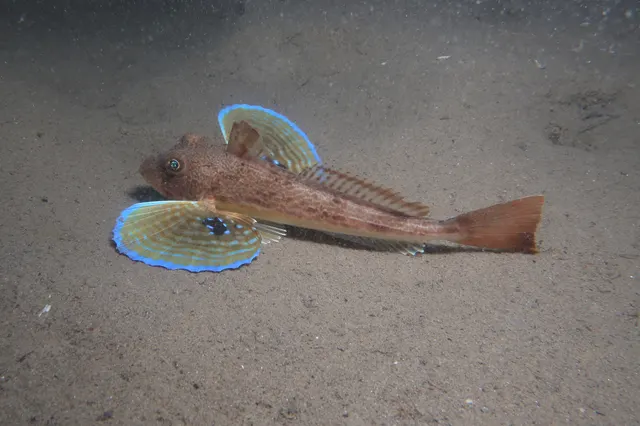 Tub gurnardThe identification FishingHQ could not previously make: a tub gurnard has enormous blue-and-green-edged pectorals and a smooth lateral line; a red gurnard has short reddish pectorals and a lateral line of broad plate-like scales.
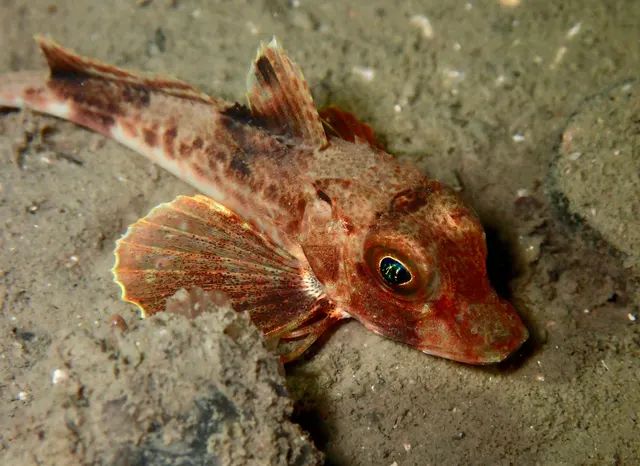 Grey gurnardThe third of the set. A grey gurnard is speckled with pale spots and has a spiny lateral line, and — despite the name — is very often reddish, which is why colour cannot decide any of this.
Sources and evidence
- The Fishes of the British Isles and North-West Europe — Macmillan, 1969 (Reference work)Relied on for: Distribution, habitat, identification characters and biology of the fishes of the British Isles and north-west Europe.States this directlyCitation checked — the work exists and is described correctly
- FAO Species Identification Guides for Fishery Purposes and the FAO Species Catalogues — Food and Agriculture Organization of the United Nations (Scientific institute)Relied on for: Diagnostic identification characters, family placement, depth range and distribution as set out in the FAO species identification sheets for the eastern Atlantic and Mediterranean.States this directlyCitation checked — the work exists and is described correctly
- The IUCN Red List of Threatened Species — International Union for Conservation of Nature (Conservation authority)Relied on for: The global Red List category and the assessment behind it, assessed 11 January 2014. A statement about the species across its range and not about any managed stock.States this directlyCitation checked — the work exists and is described correctly
- Sea Angler — Bauer Media (Specialist angling publication)Relied on for: Contemporary UK sea angling practice as reported by practitioners: ground, seasonal timing, bait and method convention.States this directlyCitation checked — the work exists and is described correctly
- ICES Advice on fishing opportunities, catch and effort — International Council for the Exploration of the Sea (Scientific institute)Relied on for: Stock assessment and scientific advice for north-east Atlantic fisheries, including the distribution and status of the stocks concerned.States this directlyCitation checked — the work exists and is described correctly
Why the 9 connections on this page are here, and the sources
Similar and related fish
Backed by research — 1 connection
Supported by peer-reviewed research or fisheries science. The sources are listed and can be checked.
Bluefin gurnard
Chelidonichthys kumu reaches 60 cm and 1.5 kg in the Indo-West Pacific with brilliant blue-marked pectoral fins; Chelidonichthys cuculus is the smaller northern European red gurnard. Both walk on three free pectoral rays carrying chemosensory cells and both grunt audibly when landed.
- FishBase: a global information system on fishes — Froese, R. and D. Pauly, eds. — FishBase Consortium (Scientific institute)Relied on for: The morphology, size, depth range and distribution that separate these two species from one another.States this directlyPassage read and verified
How it is caught
What experienced anglers do — 3 connections
Widely and independently recommended by experienced anglers and specialist sources. This is real angling knowledge, not proof: controlled evidence for it is limited, and FishingHQ records it as convention rather than as a demonstrated effect.
Drift fishing
A statement about how a species is fished, which is angling convention rather than biology and is labelled as such.
- Sea Angler — Bauer Media (Specialist angling publication)Relied on for: Contemporary UK sea angling and shore gathering practice as reported by practitioners: ground, seasonal timing, tackle, bait and method convention.States this directlyCitation checked — the work exists and is described correctly
- General angling website restatements of established technique — Various (Credible secondary source)Relied on for: Widely restated descriptions of technique, fish behaviour and regional practice, recorded as consensus rather than as scholarship.Background and mechanism onlyCitation checked — the work exists and is described correctly
Feathering and multi-lure traces
A statement about how a species is fished, which is angling convention rather than biology and is labelled as such.
- Sea Angler — Bauer Media (Specialist angling publication)Relied on for: Contemporary UK sea angling and shore gathering practice as reported by practitioners: ground, seasonal timing, tackle, bait and method convention.States this directlyCitation checked — the work exists and is described correctly
- General angling website restatements of established technique — Various (Credible secondary source)Relied on for: Widely restated descriptions of technique, fish behaviour and regional practice, recorded as consensus rather than as scholarship.Background and mechanism onlyCitation checked — the work exists and is described correctly
Ledgering
A statement about how a species is fished, which is angling convention rather than biology and is labelled as such.
- Sea Angler — Bauer Media (Specialist angling publication)Relied on for: Contemporary UK sea angling and shore gathering practice as reported by practitioners: ground, seasonal timing, tackle, bait and method convention.States this directlyCitation checked — the work exists and is described correctly
- General angling website restatements of established technique — Various (Credible secondary source)Relied on for: Widely restated descriptions of technique, fish behaviour and regional practice, recorded as consensus rather than as scholarship.Background and mechanism onlyCitation checked — the work exists and is described correctly
Where it lives
Backed by research — 1 connection
Supported by peer-reviewed research or fisheries science. The sources are listed and can be checked.
Inshore ground
A distributional claim about where a species is found, resting on the standard regional reference works rather than on angling report.
- The Fishes of the British Isles and North-West Europe — Macmillan, 1969 (Reference work)Relied on for: Distribution, habitat association, identification and biology of the fishes and inshore fauna of the British Isles and north-west Europe.States this directlyCitation checked — the work exists and is described correctly
- FAO Species Identification Guides for Fishery Purposes and the FAO Species Catalogues — Food and Agriculture Organization of the United Nations (Scientific institute)Relied on for: Diagnostic characters, family placement, habitat and depth range as set out in the FAO species identification sheets for the eastern Atlantic and Mediterranean.States this directlyCitation checked — the work exists and is described correctly
Understanding this fish
Backed by research — 1 connection
Supported by peer-reviewed research or fisheries science. The sources are listed and can be checked.
Decapod crustaceans as prey
A diet claim recorded at group level, pointed at a modelled prey CATEGORY, because the reference works describe the diet as a group rather than by species. Naming a particular species FishingHQ happens to hold would invent a precision the evidence never had.
- The Fishes of the British Isles and North-West Europe — Macmillan, 1969 (Reference work)Relied on for: Distribution, habitat association, identification and biology of the fishes and inshore fauna of the British Isles and north-west Europe.States this directlyCitation checked — the work exists and is described correctly
- FAO Species Identification Guides for Fishery Purposes and the FAO Species Catalogues — Food and Agriculture Organization of the United Nations (Scientific institute)Relied on for: Diagnostic characters, family placement, habitat and depth range as set out in the FAO species identification sheets for the eastern Atlantic and Mediterranean.States this directlyCitation checked — the work exists and is described correctly
Told apart from
What experienced anglers do — 2 connections
Widely and independently recommended by experienced anglers and specialist sources. This is real angling knowledge, not proof: controlled evidence for it is limited, and FishingHQ records it as convention rather than as a demonstrated effect.
Tub gurnard
A comparison a reader with the animal or the decision in front of them actually needs, joining two records that resolve one another.
- The Fishes of the British Isles and North-West Europe — Macmillan, 1969 (Reference work)Relied on for: Distribution, habitat association, identification and biology of the fishes and inshore fauna of the British Isles and north-west Europe.States this directlyCitation checked — the work exists and is described correctly
- FAO Species Identification Guides for Fishery Purposes and the FAO Species Catalogues — Food and Agriculture Organization of the United Nations (Scientific institute)Relied on for: Diagnostic characters, family placement, habitat and depth range as set out in the FAO species identification sheets for the eastern Atlantic and Mediterranean.States this directlyCitation checked — the work exists and is described correctly
Grey gurnard
A comparison a reader with the animal or the decision in front of them actually needs, joining two records that resolve one another.
- The Fishes of the British Isles and North-West Europe — Macmillan, 1969 (Reference work)Relied on for: Distribution, habitat association, identification and biology of the fishes and inshore fauna of the British Isles and north-west Europe.States this directlyCitation checked — the work exists and is described correctly
- FAO Species Identification Guides for Fishery Purposes and the FAO Species Catalogues — Food and Agriculture Organization of the United Nations (Scientific institute)Relied on for: Diagnostic characters, family placement, habitat and depth range as set out in the FAO species identification sheets for the eastern Atlantic and Mediterranean.States this directlyCitation checked — the work exists and is described correctly
Backed by research — 1 connection
Supported by peer-reviewed research or fisheries science. The sources are listed and can be checked.
Tub gurnard
Taxonomic and practical relatedness recorded because confusable species matter more to a reader than a shared family does, with the evidence naming the species the edge is about.
- The Fishes of the British Isles and North-West Europe — Macmillan, 1969 (Reference work)Relied on for: Identification characters, family placement and biology of Chelidonichthys lucerna and of the species it is confused with, as set out for the fauna of the British Isles and north-west Europe.States this directlyCitation checked — the work exists and is described correctly
- FAO Species Identification Guides for Fishery Purposes and the FAO Species Catalogues — Food and Agriculture Organization of the United Nations (Scientific institute)Relied on for: Diagnostic characters and family placement of Chelidonichthys lucerna as set out in the FAO species identification sheets for the region concerned.States this directlyCitation checked — the work exists and is described correctly
Safety reading
Official guidance — 1 connection
Stated by a fisheries authority, scientific institute or recognised angling body. Authoritative, but summarising rather than demonstrating.
Handling fish safely
A link to a safety topic substantial enough to be read in full.
- RNLI water safety guidance: cold water shock and Float to Live — Royal National Lifeboat Institution (Water-safety or diver-training authority)Relied on for: Water safety guidance for coastal and inland users.States this directlyPassage read and verified
How FishingHQ labels evidence is explained in the evidence policy.