Tub gurnard
Fish · Last reviewed 2026-08-15
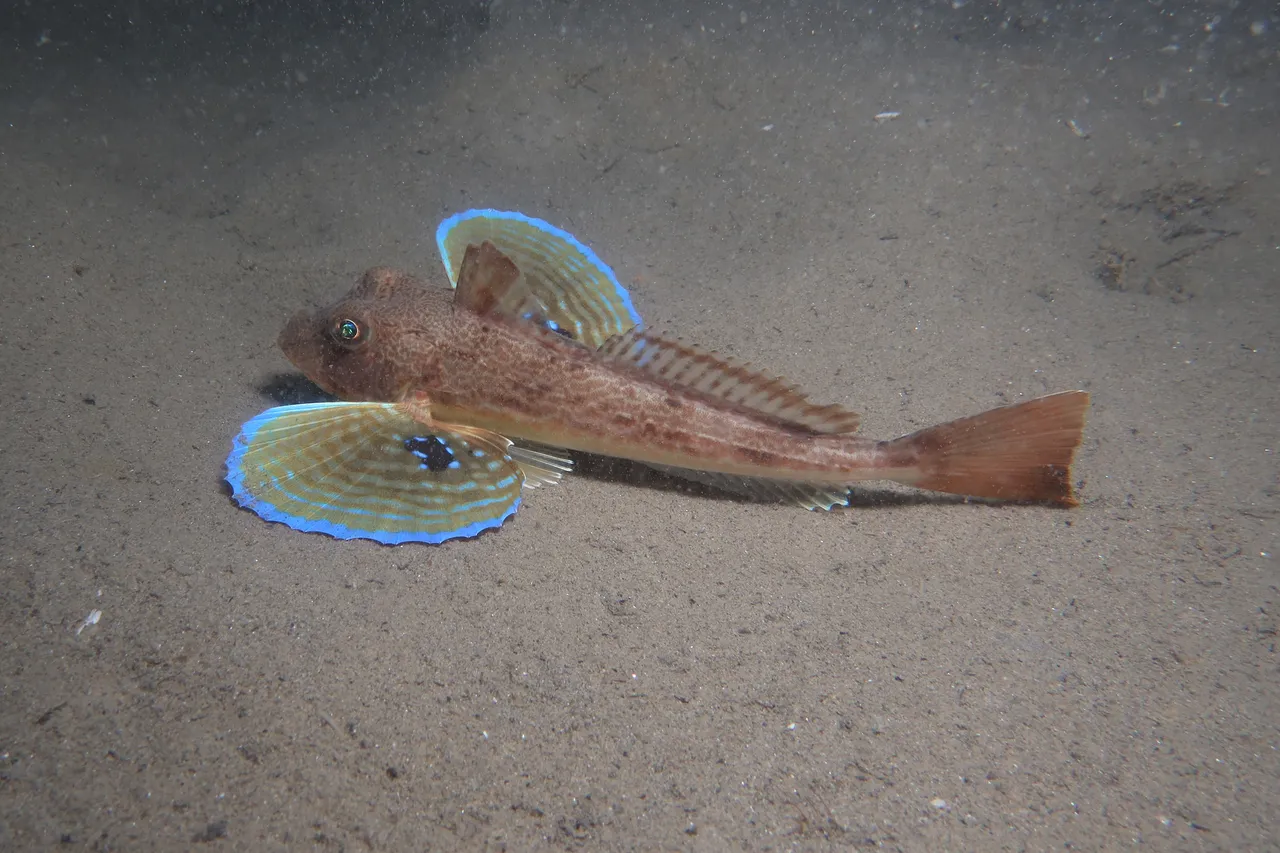
The big, brilliantly coloured gurnard — vivid blue-edged pectoral fins spread like wings, a red body, and the largest of the British gurnards by a clear margin.
Safety: venomous and spined species — can cause injury needing treatment. 3 more points apply here.
How this was identified, and who took it
Identified by: Both pectoral fins fully spread, showing the great fan area, the bright blue outer margin and the green-yellow inner surface that place this in Chelidonichthys lucerna rather than in the red or grey gurnard, together with the three free finger-like pectoral rays, the armoured head and the spiny first dorsal. Two agreeing identifications on the source, none disagreeing.Julien Renoult — CC BY, via iNaturalist — source, licenceCatching Tub gurnard
Everything here on fishing for it. Each entry opens the page behind it.
- When
- Jun–Sept — months recorded at the places that document it, not a season for the whole range.
- Where
- 9 places FishingHQ documents — strongest claim anywhere: seasonal · From a kayak, From the shore
The tub gurnard is the one that makes people put the camera down and stare. It is the largest gurnard in British and Irish waters, its body is red or orange-red, and its pectoral fins are enormous, rounded, and coloured a startling peacock blue-green with a brilliant blue margin. Spread, they look like wings.
THEY ARE NOT FOR SWIMMING. The huge pectorals are display and startle structures, spread when the fish is alarmed or confronted, and the effect on a predator — and on an angler seeing one for the first time — is exactly the point. The fish still hunts by walking on the three free finger-rays below each pectoral, like every other gurnard.
IT IS A DIFFERENT PROPOSITION FROM A GREY GURNARD in every practical way: much larger, far less numerous, better eating, and increasingly deliberately targeted rather than dismissed as bycatch. Tub gurnard has become a genuine light-tackle summer species over clean ground on parts of the British coast.
AND IT CARRIES THE SAME HAZARD. The head plates, gill-cover spines and spiny first dorsal are all present and all larger. A tub gurnard is more capable of injuring a hand than a grey is, for the simple reason that everything about it is bigger.
How it is caught
- Drift fishingDrifting lures or baits over clean ground is the standard deliberate approach to tub gurnard.
- JiggingA larger proportion of the tub gurnard's diet is mobile fish prey, and that is what makes it a genuine lure species rather than an accidental one.
- LedgeringA static scented bait on the seabed still works, because the pectoral fingers still work.
Gear for this fish
Where Tub gurnard is documented
Places where public sources describe this species as fished, with how it is fished and how strongly the evidence supports it. This is not a range map and it is not a recommendation — it is what has been written down about a fishery rather than a record of any individual catch, and being listed is never permission to fish.
The Solway Firth
1 documented place
Maryport harbour and promenade
Harbour wall
Seasonal
From the shore
Around Jun, Jul, Aug, Sept
The Cornish and Devon coasts
6 documented places
Harbour wall
Repeatedly reported
From a kayak
Headland
Repeatedly reported
From a kayak
Headland
Repeatedly reported
From a kayak
Estuary
Repeatedly reported
From a kayak
Headland
Repeatedly reported
From a kayak
Harbour wall
Repeatedly reported
From a kayak
Morecambe Bay and the north-west England coast
1 documented place
Blackpool piers and the north wall
Pier
Recorded here
From the shore
What these strengths mean
- Repeatedly reported
- Several independent public accounts. Enough to say it happens more than once; not enough to call it a fishery.
- Recorded here
- At least one credible public account of this species being caught here. That is all it means.
- Seasonal
- Well supported, and concentrated in part of the year rather than spread through it.
Identification
- Scientific name
- Chelidonichthys lucerna
- Family
- Triglidae
- Water
- Saltwater, Brackish
- Conservation status
- Least Concern
- Regions
- Britain & Ireland, Northern Europe, Western Europe, Mediterranean, North Africa, West Africa
- ENORMOUS ROUNDED PECTORAL FINS, peacock blue-green with a brilliant blue margin and often a dark blotch, spread wing-like when the fish is alarmed. Nothing else in British seas looks remotely like this and it settles the identification instantly.
- Red to orange-red body, sometimes brownish over the back, paler below.
- The three free finger-like rays below each pectoral fin, as in every gurnard.
- LARGE. Tub gurnards commonly exceed the maximum size of a grey gurnard, so a big gurnard is very likely this species even before the fins are checked.
- A bony, plated head with sharp gill-cover and shoulder spines, and a spiny first dorsal.
- Separated from red gurnard by the pectoral colour and by the red gurnard's much rougher, more strongly scaled body and shorter pectorals.
Size
- Typical
- 30–45 cm and 0.5–1.2 kg for rod-caught fish.
- Large
- Over 50 cm and 2 kg is a very good tub gurnard.
Exceptional: Around 75 cm and something over 6 kg is the reported upper end for the species, and fish approaching it are genuinely rare.
Sand, estuaries and a summer season that keeps getting longer
The tub gurnard uses more of the sea than the grey gurnard does, and one part of that is genuinely unusual for the family.
THE ADULT GROUND IS CLEAN AND PROBEABLE, as for every gurnard: sand, muddy sand and gravel, from very shallow water down to around three hundred metres and most commonly well inside a hundred and fifty. The free pectoral rays need a sediment they can push into, so reef and boulder ground are for other species.
BUT THE JUVENILES GO INTO ESTUARIES. Tub gurnards tolerate brackish water well, and small ones are common in estuarine and very shallow inshore water through the warmer months where adults are not. Those shallows are the nursery, and like every estuarine nursery they are the part of the life cycle most exposed to dredging, land claim and water quality. It also means a small gurnard caught in an estuary is a plausible tub rather than a misidentification.
THE SEASON IS SUMMER AND AUTUMN INSHORE. Fish move shallower through late spring, are available inshore from roughly early summer to mid-autumn, and retreat into deeper water over winter. This is a depth migration rather than a disappearance, and it is more pronounced than the grey gurnard's.
THE RANGE IS SHIFTING NORTHWARD. Tub gurnard abundance in the northern part of the range has been increasing over recent decades, consistent with rising inshore sea temperatures, and anglers on parts of the British coast are catching them in numbers and sizes that would have been remarkable a generation ago. That is one of the more visible local consequences of a warming sea, and it is worth naming as such rather than treating as luck.
THE PRACTICAL EFFECT IS A NEW FISHERY. A species once regarded as bycatch is now deliberately targeted on light tackle over clean ground, and that change happened within a career rather than over a century.
WHAT MAY BE RETAINED IS NOT STATED HERE. Minimum sizes, retention rules and protected-area conditions differ between administrations and inshore authorities and are revised. Ask the relevant fisheries authority.
What experienced anglers do — why, and the sources (3)
Widely and independently recommended by experienced anglers and specialist sources. This is real angling knowledge, not proof: controlled evidence for it is limited, and FishingHQ records it as convention rather than as a demonstrated effect.
- The Fishes of the British Isles and North-West Europe — Macmillan, 1969 (Reference work)Relied on for: Distribution, habitat, identification characters and biology of the fishes of the British Isles and north-west Europe.States this directlyCitation checked — the work exists and is described correctly
- Sea Angler — Bauer Media (Specialist angling publication)Relied on for: Contemporary UK and European sea angling practice as reported by practitioners, including regional ground, seasonal timing and species behaviour.States this directlyCitation checked — the work exists and is described correctly
- ICES Advice on fishing opportunities, catch and effort — International Council for the Exploration of the Sea (Scientific institute)Relied on for: Scientific advice on north-east Atlantic stocks, including stock state, recruitment and the basis for management advice.States this directlyCitation checked — the work exists and is described correctly
Wings, size, and a gurnard that hunts fish rather than only probing for worms
Two things separate a tub gurnard from a grey gurnard beyond colour, and both change how it is fished.
IT IS MUCH BIGGER. Most rod-caught tub gurnards are 30 to 45 centimetres and half a kilogram to a little over one; over 50 centimetres and two kilograms is a very good fish, and the reported upper end is around 75 centimetres and something over six kilograms. A grey gurnard tops out around 45 centimetres. So size alone separates the two in most cases, before anybody looks at a fin.
AND IT EATS MORE FISH. A grey gurnard is essentially a prober, taking shrimps, small crabs and worms out of the sediment. A tub gurnard does that too, but takes a substantially larger proportion of fish prey — sandeels, gobies, small flatfish and juveniles of other species — and will chase and ambush to get them.
WHICH IS WHY IT IS A LURE FISH. Jigs, small soft plastics and baited spoons worked slowly along the bottom take tub gurnards properly rather than accidentally, and that willingness to hit a moving lure is most of the reason the species has become a target rather than a nuisance. A static scented bait on the seabed still works, because the pectoral fingers still work; the difference is that the tub has a second way in.
SIGHT MATTERS MORE HERE, correspondingly. The touch-and-taste finger rays are the family's defining apparatus and they are fully present, but a fish taking a meaningful share of mobile prey has to see, and the tub gurnard's response to a worked lure reflects that.
NOW THE WINGS. The huge rounded pectoral fins, peacock blue-green with a brilliant blue margin, are not swimming organs. They are spread when the fish is alarmed or confronted, and they work as a startle display: a small, bony, bottom-walking fish suddenly doubles in apparent size and flashes a colour nothing else on that seabed produces. The display is directed at predators, and it works on anglers too.
THEY ALSO GRUNT, like every gurnard, by drumming muscles against the swim bladder — communication rather than complaint, and audible in the boat.
Backed by research — why, and the sources (3)
Supported by peer-reviewed research or fisheries science. The sources are listed and can be checked.
- The Fishes of the British Isles and North-West Europe — Macmillan, 1969 (Reference work)Relied on for: Distribution, habitat, identification characters and biology of the fishes of the British Isles and north-west Europe.States this directlyCitation checked — the work exists and is described correctly
- FAO Species Identification Guides for Fishery Purposes and the FAO Species Catalogues — Food and Agriculture Organization of the United Nations (Scientific institute)Relied on for: Diagnostic identification characters, family placement and distribution as set out in the FAO species identification sheets for the eastern Atlantic and Mediterranean.States this directlyCitation checked — the work exists and is described correctly
- Cefas science, advice and data on marine and freshwater environments — Centre for Environment, Fisheries and Aquaculture Science (Government fisheries body)Relied on for: UK marine fisheries science: stock monitoring, survey data and the biological basis of management advice for the species concerned.States this directlyCitation checked — the work exists and is described correctly
Broadcast spawning, estuarine nurseries, and handling a bigger set of spines
The tub gurnard reproduces in the simplest way a fish can, and then depends on somewhere complicated.
SPAWNING IS BROADCAST, over inshore and offshore ground through spring and summer, with pelagic eggs, no nest and no parental care. Timing runs later further north. There is no aggregation to protect and no guarding parent to remove, which puts this species at the opposite end of the vulnerability scale from black bream.
THE NURSERY IS THE COMPLICATED PART. Larvae drift and settle, and juveniles use shallow inshore and estuarine ground — genuinely brackish water, which most of the family avoids. That tolerance widens the nursery habitat available to the species and simultaneously ties its recruitment to exactly the coastal water most affected by development, dredging and discharge. A tub gurnard population can therefore be limited by something happening in an estuary that adults never enter.
GROWTH IS FASTER AND MAXIMUM SIZE FAR LARGER than in grey gurnard, and fish are moderately long-lived. A fifty-centimetre tub gurnard is a substantial investment of years, which is worth weighing before keeping one.
HANDLING: THE SAME HAZARD, SCALED UP. Sharp backward-pointing spines on the gill covers, another at the shoulder, and a spiny first dorsal — all present, all larger than a grey gurnard's, none venomous, all capable of a deep puncture. Marine puncture wounds seed bacteria into tissue and infect out of proportion to how they look.
THE GRIP IS THE SAME AND MATTERS MORE. Take the fish across the body BEHIND the pectoral fins, first dorsal folded flat under the palm. Or hold it by the lower jaw, well clear of the head plates. Never slide a hand forward from the tail, which is precisely how the gill-cover spines catch. Unhook with pliers, not fingers, and use a cloth or gloves when handling several.
AND THE WINGS WILL BE SPREAD. An alarmed tub gurnard in the hand fans its pectorals hard, which is startling if you are not expecting it and is a very good way to make somebody drop a spiny fish onto their own foot. Expect it.
BAROTRAUMA APPLIES from deep marks. Fish brought up quickly may not survive release, so decide before fishing deep ground what will be kept.
Backed by research — why, and the sources (3)
Supported by peer-reviewed research or fisheries science. The sources are listed and can be checked.
- The Fishes of the British Isles and North-West Europe — Macmillan, 1969 (Reference work)Relied on for: Distribution, habitat, identification characters and biology of the fishes of the British Isles and north-west Europe.States this directlyCitation checked — the work exists and is described correctly
- Cefas science, advice and data on marine and freshwater environments — Centre for Environment, Fisheries and Aquaculture Science (Government fisheries body)Relied on for: UK marine fisheries science: stock monitoring, survey data and the biological basis of management advice for the species concerned.States this directlyCitation checked — the work exists and is described correctly
- FAO Species Identification Guides for Fishery Purposes and the FAO Species Catalogues — Food and Agriculture Organization of the United Nations (Scientific institute)Relied on for: Diagnostic identification characters, family placement and distribution as set out in the FAO species identification sheets for the eastern Atlantic and Mediterranean.States this directlyCitation checked — the work exists and is described correctly
How tub gurnard are caught
Tub gurnard is the largest European gurnard and the one most often fished for deliberately, and the methods differ from grey gurnard mainly in scale.
CLEAN AND MIXED GROUND, ON THE BOTTOM, is the requirement, exactly as for its smaller relative. The free pectoral rays that gurnards feel the substrate with are the reason: this is a fish that hunts by touch along the seabed, so a bait that is not on the seabed is a bait it will not find.
BIGGER BAITS THAN GREY GURNARD JUSTIFY THEMSELVES. A tub reaches several times the weight of a grey, takes fish baits readily, and is an aggressive predator of small fish and crustaceans. Whole small squid, large mackerel strips and whole sandeel all take tubs where a thumbnail bait would take greys.
DRIFTING WITH BAITS OR LURES NEAR THE BOTTOM is the standard boat approach. Tubs take jigs and soft plastics worked slowly along the seabed as freely as greys do, and on light tackle a good one is a genuinely worthwhile fish.
THEY COME SHALLOWER IN SUMMER, which is what makes them a shore possibility — deep-water marks, harbour walls over clean ground, and estuary channels in the warmer months. In winter they move deeper and largely out of shore range.
THE SPINES ARE MORE OF A PROBLEM THAN ON A GREY, simply because the fish is larger and stronger. The dorsal spines and the sharp opercular projections will go through a hand that grips carelessly, and the fish is at its most vigorous the moment it comes over the gunwale. Control it against a surface, use pliers, and keep fingers away from the gill covers.
AND THE PECTORAL FINS ARE WORTH LOOKING AT before the fish goes back: the enormous blue-edged 'wings' that give the species its distinctiveness are also the character that separates it from every other gurnard at a glance.
What experienced anglers do — why, and the sources (2)
Widely and independently recommended by experienced anglers and specialist sources. This is real angling knowledge, not proof: controlled evidence for it is limited, and FishingHQ records it as convention rather than as a demonstrated effect.
- Sea Angler — Bauer Media (Specialist angling publication)Relied on for: Contemporary UK and European sea angling practice as reported by practitioners, including ground, seasonal timing, bait and method convention.States this directlyCitation checked — the work exists and is described correctly
- General angling website restatements of established technique — Various (Credible secondary source)Relied on for: Widely restated descriptions of species behaviour and regional angling practice, recorded as consensus rather than as scholarship.Background and mechanism onlyCitation checked — the work exists and is described correctly
Lifecycle and reproduction
Tub gurnards hatch from pelagic eggs and pass through a planktonic larval stage before settling to the bottom. Juveniles use shallow inshore and estuarine ground as nursery habitat — the species tolerates brackish water well and small tub gurnards turn up in estuaries where adults do not. Growth is faster and the maximum size far larger than in grey gurnard, and fish are moderately long-lived.
A broadcast spawner, releasing pelagic eggs over offshore and inshore grounds through spring and summer, with no nest and no parental care. Timing varies across the range and is later in the north. Juveniles then depend on shallow inshore and estuarine nurseries, which is the part of the cycle most exposed to coastal development and to poor water quality.
Feeding and senses
A more predatory gurnard than the grey. Small crustaceans and worms are taken by probing the sediment with the free pectoral rays, but tub gurnards take a substantially larger proportion of fish — sandeels, gobies, small flatfish and juveniles of other species — and will chase and ambush rather than only probe. That shift towards fish prey is what makes them a genuine lure species, and jigs, small soft plastics and baited spoons worked along the bottom all take them.
The same touch-and-taste pectoral rays as every gurnard, with vision playing a larger role than in the grey because a greater proportion of the diet is mobile fish prey. In practice a tub gurnard responds both to a static scented bait on the bottom and to a moving lure, which is a wider repertoire than the grey's and the reason it is worth fishing for deliberately rather than only catching by accident.
Through the year
Moves into shallower inshore water through late spring, summer and autumn and retreats into deeper water over winter. In British waters the species is most available inshore from around early summer to mid-autumn. Juveniles are present in estuaries and very shallow water through the warmer months. Abundance in northern parts of the range has been increasing, consistent with a warming inshore sea.
Distribution
Eastern Atlantic from Norway and the British Isles south to West Africa, throughout the Mediterranean and into the Black Sea. Occupies sand, muddy sand and gravel from very shallow inshore water down to around 300 m, most commonly shallower than 150 m, and tolerates brackish water well enough that juveniles are common in estuaries. The global assessment is Least Concern.
This is a biological range — where the species occurs, not a prediction that you will catch one. To browse the fishing geography FishingHQ holds, start at fishing places.
Why anglers care
The gurnard worth going out for. Tub gurnards have moved in a generation from dismissed bycatch to a deliberately targeted light-tackle summer species on clean ground, helped by their size, their willingness to take lures and their quality as food. On light gear over sand they give a good account of themselves, and the moment a large one comes up with its pectorals spread is one of the genuine sights of British inshore fishing.
Handling and returning
Everything said about grey gurnard applies with more force, because the fish is larger and so are the spines. Grip across the body behind the pectorals with the first dorsal folded flat, or by the lower jaw clear of the head plates; never slide a hand forward from the tail. Unhook with pliers. Marine puncture wounds infect readily and should be washed, covered and watched. Tub gurnards suffer barotrauma from depth, so fish taken from deep marks may not be returnable alive — decide what is being kept before fishing deep ground rather than after.
Going further
- What does tub gurnard eat? — feeding biology, kept separate from what anglers infer from it.
Safety
Venomous and spined species — Can cause injury needing treatment
Sharp backward-pointing spines on the gill covers and shoulder, plus a spiny first dorsal, all larger than a grey gurnard's. A hand sliding forward from the tail or gripping around the head is punctured deeply. There is no venom. Marine puncture wounds carry bacteria into tissue and infect readily, and an alarmed fish fanning its pectorals hard in the hand is a common reason people lose their grip on it.
What reduces it: Grip across the body behind the pectorals with the dorsal folded flat under the palm, or by the lower jaw clear of the head plates. Never slide a hand forward from the tail. Expect the fish to fan its fins and brace for it. Unhook with pliers, use a cloth or gloves, and wash, disinfect and cover any puncture — seek medical advice if it becomes red, swollen or increasingly painful.
Worse when:
- Handling a large fish, where the spines are correspondingly larger and the fish stronger.
- Handling in the dark or in a moving boat, where the grip is taken by feel.
- Handling with cold wet hands that have lost grip and sensation.
Precautions that always apply here
- Handle spined and venomous species with the spines controlled. Know which local species have them before you fish, not afterwards.
- Wet your hands before touching a fish. Dry hands strip the protective mucus layer that keeps infection out.
- Keep fingers out of the gills and clear of the teeth. Gill damage is usually fatal to the fish, and several species will remove skin from a finger.
Further safety reading
- Venomous and spined fish — The same spines as a grey gurnard and all of them larger, plus a fish that fans its pectorals hard in the hand — which is a common reason people drop a spiny fish onto their own foot.
Check the rules before you fish
Fishing laws, bylaws, access rules, seasons, bait restrictions and permitted methods vary by location and can change. Check the current rules from the relevant authority and the water you intend to fish before fishing.
Check with:
- Current national or regional law for where you are fishing
- Current local bylaws
- The relevant fisheries authority
- The landowner, club or fishery whose water it is
- Any restrictions specific to the species or the method you intend to use
Where to go next
Similar and related fish
Where it lives
- EstuaryUnusually for the family, tub gurnards tolerate brackish water and juveniles use shallow estuarine ground as a nursery where adults are not found.
- Inshore groundSand, muddy sand and gravel from very shallow water down to around 300 metres, most commonly well inside 150.
- Surf beachesComes into genuinely shallow inshore water over clean sand through summer, which is why shore-caught tub gurnards happen at all.
Understanding this fish
Told apart from
- Red gurnardThe identification FishingHQ could not previously make: a tub gurnard has enormous blue-and-green-edged pectorals and a smooth lateral line; a red gurnard has short reddish pectorals and a lateral line of broad plate-like scales.
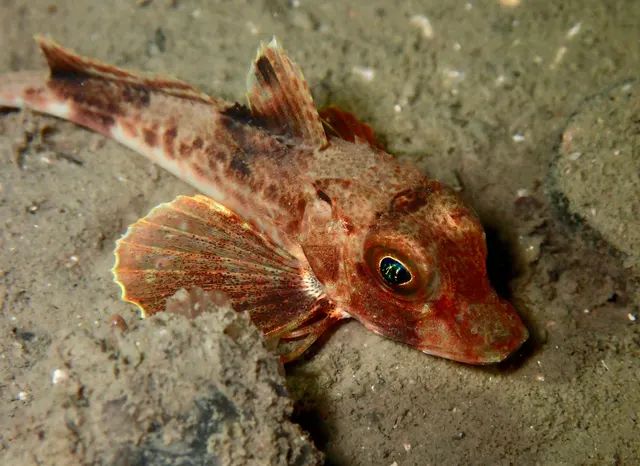 Grey gurnardThe two British gurnards an angler will meet. Look at the pectoral fins: a tub's are enormous and peacock blue, a grey's are short and drab. Size settles it too — a gurnard much over 45 cm is a tub.
Environment and conservation
Sources and evidence
- The Fishes of the British Isles and North-West Europe — Macmillan, 1969 (Reference work)Relied on for: Distribution, habitat, identification characters and biology of the fishes of the British Isles and north-west Europe.States this directlyCitation checked — the work exists and is described correctly
- FAO Species Identification Guides for Fishery Purposes and the FAO Species Catalogues — Food and Agriculture Organization of the United Nations (Scientific institute)Relied on for: Diagnostic identification characters, family placement and distribution as set out in the FAO species identification sheets for the eastern Atlantic and Mediterranean.States this directlyCitation checked — the work exists and is described correctly
- Cefas science, advice and data on marine and freshwater environments — Centre for Environment, Fisheries and Aquaculture Science (Government fisheries body)Relied on for: UK marine fisheries science: stock monitoring, survey data and the biological basis of management advice for the species concerned.States this directlyCitation checked — the work exists and is described correctly
- Sea Angler — Bauer Media (Specialist angling publication)Relied on for: Contemporary UK and European sea angling practice as reported by practitioners, including regional ground, seasonal timing and species behaviour.States this directlyCitation checked — the work exists and is described correctly
- Good Fish Guide — Marine Conservation Society (Conservation authority)Relied on for: Sustainability ratings for commercially caught species and the stock and gear considerations behind them.Background and mechanism onlyCitation checked — the work exists and is described correctly
Why the 14 connections on this page are here, and the sources
Similar and related fish
Backed by research — 1 connection
Supported by peer-reviewed research or fisheries science. The sources are listed and can be checked.
Lesser sandeel
A dietary claim naming Ammodytes marinus specifically, because the edge asserts something about that species rather than about small fish in general.
- The Fishes of the British Isles and North-West Europe — Macmillan, 1969 (Reference work)Relied on for: The diet of Chelidonichthys lucerna, including a substantial fish component, and the abundance of Ammodytes marinus on the clean sandy ground the two share in British and north-west European waters.States this directlyCitation checked — the work exists and is described correctly
- Cefas science, advice and data on marine and freshwater environments — Centre for Environment, Fisheries and Aquaculture Science (Government fisheries body)Relied on for: UK survey data on the distribution and abundance of Ammodytes marinus on sandy grounds and on the demersal community that feeds on it.States this directlyCitation checked — the work exists and is described correctly
How it is caught
What experienced anglers do — 3 connections
Widely and independently recommended by experienced anglers and specialist sources. This is real angling knowledge, not proof: controlled evidence for it is limited, and FishingHQ records it as convention rather than as a demonstrated effect.
Drift fishing
A statement about how a species is fished, which is angling convention rather than biology and is labelled as such.
- Sea Angler — Bauer Media (Specialist angling publication)Relied on for: Contemporary UK and European sea angling practice as reported by practitioners, including ground, seasonal timing, bait and method convention.States this directlyCitation checked — the work exists and is described correctly
- General angling website restatements of established technique — Various (Credible secondary source)Relied on for: Widely restated descriptions of species behaviour and regional angling practice, recorded as consensus rather than as scholarship.Background and mechanism onlyCitation checked — the work exists and is described correctly
Jigging
A statement about how a species is fished, which is angling convention rather than biology and is labelled as such.
- Sea Angler — Bauer Media (Specialist angling publication)Relied on for: Contemporary UK and European sea angling practice as reported by practitioners, including ground, seasonal timing, bait and method convention.States this directlyCitation checked — the work exists and is described correctly
- General angling website restatements of established technique — Various (Credible secondary source)Relied on for: Widely restated descriptions of species behaviour and regional angling practice, recorded as consensus rather than as scholarship.Background and mechanism onlyCitation checked — the work exists and is described correctly
Ledgering
A statement about how a species is fished, which is angling convention rather than biology and is labelled as such.
- Sea Angler — Bauer Media (Specialist angling publication)Relied on for: Contemporary UK and European sea angling practice as reported by practitioners, including ground, seasonal timing, bait and method convention.States this directlyCitation checked — the work exists and is described correctly
- General angling website restatements of established technique — Various (Credible secondary source)Relied on for: Widely restated descriptions of species behaviour and regional angling practice, recorded as consensus rather than as scholarship.Background and mechanism onlyCitation checked — the work exists and is described correctly
Gear for this fish
What experienced anglers do — 2 connections
Widely and independently recommended by experienced anglers and specialist sources. This is real angling knowledge, not proof: controlled evidence for it is limited, and FishingHQ records it as convention rather than as a demonstrated effect.
Fish strip and cut bait
A bait joined to the fish it is conventionally used for. Convention, recorded as convention.
- Sea Angler — Bauer Media (Specialist angling publication)Relied on for: Contemporary UK and European sea angling practice as reported by practitioners, including ground, seasonal timing, bait and method convention.States this directlyCitation checked — the work exists and is described correctly
- General angling website restatements of established technique — Various (Credible secondary source)Relied on for: Widely restated descriptions of species behaviour and regional angling practice, recorded as consensus rather than as scholarship.Background and mechanism onlyCitation checked — the work exists and is described correctly
Ragworm
A bait joined to the fish it is conventionally used for. Convention, recorded as convention.
- Sea Angler — Bauer Media (Specialist angling publication)Relied on for: Contemporary UK and European sea angling practice as reported by practitioners, including ground, seasonal timing, bait and method convention.States this directlyCitation checked — the work exists and is described correctly
- General angling website restatements of established technique — Various (Credible secondary source)Relied on for: Widely restated descriptions of species behaviour and regional angling practice, recorded as consensus rather than as scholarship.Background and mechanism onlyCitation checked — the work exists and is described correctly
Where it lives
Backed by research — 3 connections
Supported by peer-reviewed research or fisheries science. The sources are listed and can be checked.
Estuary
A distributional claim about where a species is found, which is a claim about the world and rests on the standard regional reference works rather than on angling report.
- The Fishes of the British Isles and North-West Europe — Macmillan, 1969 (Reference work)Relied on for: Distribution, habitat association, identification and biology of the fishes of the British Isles and north-west Europe.States this directlyCitation checked — the work exists and is described correctly
- FAO Species Identification Guides for Fishery Purposes and the FAO Species Catalogues — Food and Agriculture Organization of the United Nations (Scientific institute)Relied on for: Diagnostic characters, habitat and depth range as set out in the FAO species identification sheets for the eastern Atlantic and Mediterranean.States this directlyCitation checked — the work exists and is described correctly
Inshore ground
A distributional claim about where a species is found, which is a claim about the world and rests on the standard regional reference works rather than on angling report.
- The Fishes of the British Isles and North-West Europe — Macmillan, 1969 (Reference work)Relied on for: Distribution, habitat association, identification and biology of the fishes of the British Isles and north-west Europe.States this directlyCitation checked — the work exists and is described correctly
- FAO Species Identification Guides for Fishery Purposes and the FAO Species Catalogues — Food and Agriculture Organization of the United Nations (Scientific institute)Relied on for: Diagnostic characters, habitat and depth range as set out in the FAO species identification sheets for the eastern Atlantic and Mediterranean.States this directlyCitation checked — the work exists and is described correctly
Surf beaches
A distributional claim about where a species is found, which is a claim about the world and rests on the standard regional reference works rather than on angling report.
- The Fishes of the British Isles and North-West Europe — Macmillan, 1969 (Reference work)Relied on for: Distribution, habitat association, identification and biology of the fishes of the British Isles and north-west Europe.States this directlyCitation checked — the work exists and is described correctly
- FAO Species Identification Guides for Fishery Purposes and the FAO Species Catalogues — Food and Agriculture Organization of the United Nations (Scientific institute)Relied on for: Diagnostic characters, habitat and depth range as set out in the FAO species identification sheets for the eastern Atlantic and Mediterranean.States this directlyCitation checked — the work exists and is described correctly
Understanding this fish
Backed by research — 1 connection
Supported by peer-reviewed research or fisheries science. The sources are listed and can be checked.
Decapod crustaceans as prey
A dietary claim recorded at GROUP level against a modelled prey concept, because the sources describe the prey as a group and inventing a species to point at would be the fabrication the precision audit exists to prevent.
- Cefas science, advice and data on marine and freshwater environments — Centre for Environment, Fisheries and Aquaculture Science (Government fisheries body)Relied on for: UK marine fisheries science: survey data, distribution and the biological basis of management advice for the species concerned.States this directlyCitation checked — the work exists and is described correctly
- The Fishes of the British Isles and North-West Europe — Macmillan, 1969 (Reference work)Relied on for: Distribution, habitat and biology of the fishes of the British Isles and north-west Europe.States this directlyCitation checked — the work exists and is described correctly
Told apart from
What experienced anglers do — 2 connections
Widely and independently recommended by experienced anglers and specialist sources. This is real angling knowledge, not proof: controlled evidence for it is limited, and FishingHQ records it as convention rather than as a demonstrated effect.
Red gurnard
A comparison a reader with the animal or the decision in front of them actually needs, joining two records that resolve one another.
- The Fishes of the British Isles and North-West Europe — Macmillan, 1969 (Reference work)Relied on for: Distribution, habitat association, identification and biology of the fishes and inshore fauna of the British Isles and north-west Europe.States this directlyCitation checked — the work exists and is described correctly
- FAO Species Identification Guides for Fishery Purposes and the FAO Species Catalogues — Food and Agriculture Organization of the United Nations (Scientific institute)Relied on for: Diagnostic characters, family placement, habitat and depth range as set out in the FAO species identification sheets for the eastern Atlantic and Mediterranean.States this directlyCitation checked — the work exists and is described correctly
Grey gurnard
Two records a reader will hold together — here because the fish are confused with one another in the hand, which is an identification problem rather than a preference.
- The Fishes of the British Isles and North-West Europe — Macmillan, 1969 (Reference work)Relied on for: Distribution, habitat association, identification and biology of the fishes of the British Isles and north-west Europe.States this directlyCitation checked — the work exists and is described correctly
- FAO Species Identification Guides for Fishery Purposes and the FAO Species Catalogues — Food and Agriculture Organization of the United Nations (Scientific institute)Relied on for: Diagnostic characters, habitat and depth range as set out in the FAO species identification sheets for the eastern Atlantic and Mediterranean.States this directlyCitation checked — the work exists and is described correctly
Backed by research — 1 connection
Supported by peer-reviewed research or fisheries science. The sources are listed and can be checked.
Red gurnard
Taxonomic and practical relatedness recorded because confusable species matter more to a reader than a shared family does, with the evidence naming the species the edge is about.
- The Fishes of the British Isles and North-West Europe — Macmillan, 1969 (Reference work)Relied on for: Identification characters, family placement and biology of Chelidonichthys lucerna and of the species it is confused with, as set out for the fauna of the British Isles and north-west Europe.States this directlyCitation checked — the work exists and is described correctly
- FAO Species Identification Guides for Fishery Purposes and the FAO Species Catalogues — Food and Agriculture Organization of the United Nations (Scientific institute)Relied on for: Diagnostic characters and family placement of Chelidonichthys lucerna as set out in the FAO species identification sheets for the region concerned.States this directlyCitation checked — the work exists and is described correctly
Safety reading
Official guidance — 1 connection
Stated by a fisheries authority, scientific institute or recognised angling body. Authoritative, but summarising rather than demonstrating.
Venomous and spined fish
A hazard carried by this page joined to the topic that explains it in full, so that the warning on the page has somewhere to lead.
- The Fishes of the British Isles and North-West Europe — Macmillan, 1969 (Reference work)Relied on for: Distribution, habitat association, identification and biology of the fishes of the British Isles and north-west Europe.States this directlyCitation checked — the work exists and is described correctly
- FAO Species Identification Guides for Fishery Purposes and the FAO Species Catalogues — Food and Agriculture Organization of the United Nations (Scientific institute)Relied on for: Diagnostic characters, habitat and depth range as set out in the FAO species identification sheets for the eastern Atlantic and Mediterranean.States this directlyCitation checked — the work exists and is described correctly
Environment and conservation
Backed by research — 1 connection
Supported by peer-reviewed research or fisheries science. The sources are listed and can be checked.
Climate change and shifting fish distributions
A claim about a changing distribution, which is a claim about the world and rests on survey science rather than on angling report.
- Cefas science, advice and data on marine and freshwater environments — Centre for Environment, Fisheries and Aquaculture Science (Government fisheries body)Relied on for: UK marine fisheries science: survey data, distribution and the biological basis of management advice for the species concerned.States this directlyCitation checked — the work exists and is described correctly
- The Fishes of the British Isles and North-West Europe — Macmillan, 1969 (Reference work)Relied on for: Distribution, habitat and biology of the fishes of the British Isles and north-west Europe.States this directlyCitation checked — the work exists and is described correctly
How FishingHQ labels evidence is explained in the evidence policy.