What does tub gurnard eat?
What is established about how tub gurnard feeds, kept separate from what anglers infer from it.
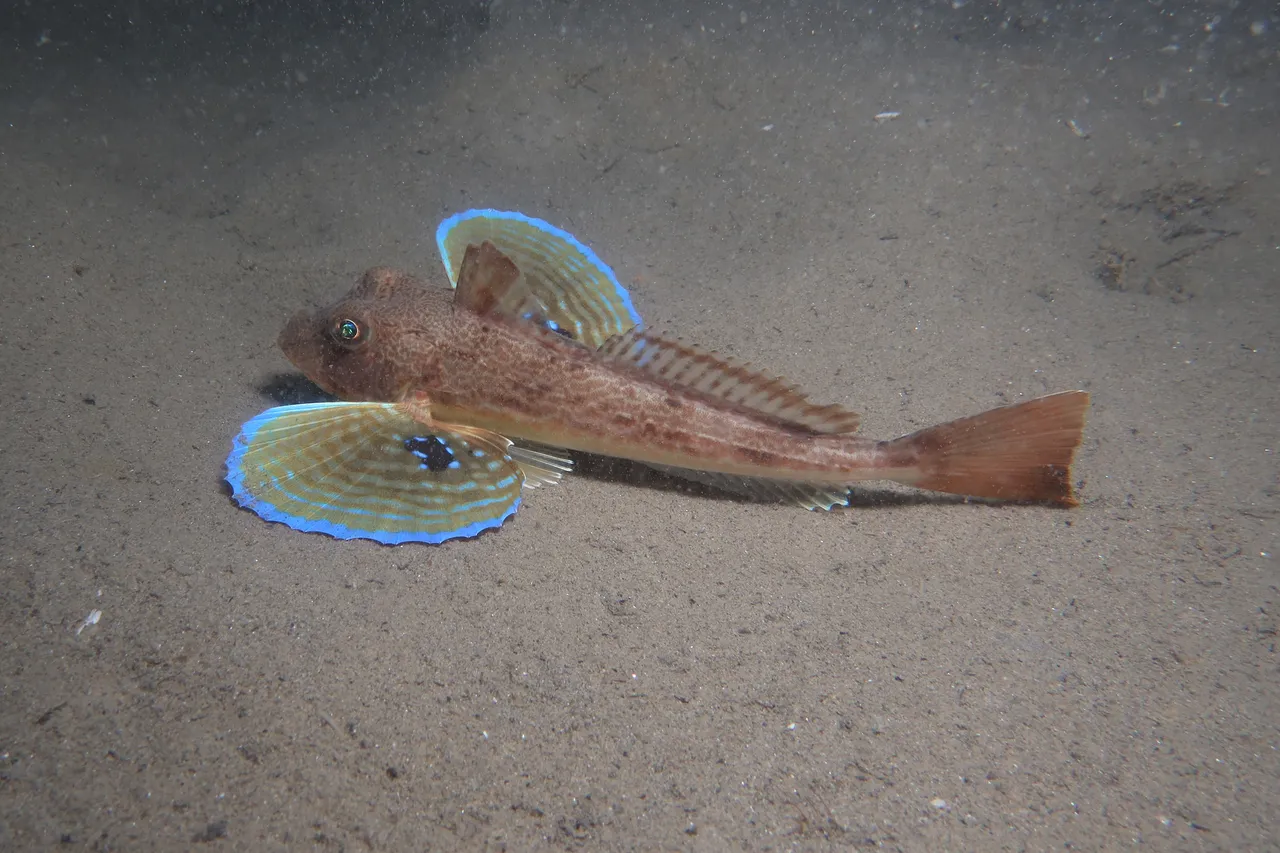
How this was identified, and who took it
Identified by: Both pectoral fins fully spread, showing the great fan area, the bright blue outer margin and the green-yellow inner surface that place this in Chelidonichthys lucerna rather than in the red or grey gurnard, together with the three free finger-like pectoral rays, the armoured head and the spiny first dorsal. Two agreeing identifications on the source, none disagreeing.Julien Renoult — CC BY, via iNaturalist — source, licenceWhat is known about how it feeds
The tub gurnard has the same apparatus as every gurnard and uses a larger share of its diet differently, and that difference is what separates the two British species in practice.
The free finger-like pectoral rays are present and fully functional: the fish props on them, probes the sediment, and detects buried crustaceans and worms by touch and taste. Decapod crustaceans carry a verified relationship on exactly that basis.
But a substantially larger proportion of the tub gurnard's diet is fish, and it is taken by chasing and ambushing rather than by probing. Sandeels carry a verified species-level relationship — Ammodytes marinus is the abundant small fish of precisely the clean sandy ground the two share — and gobies, small flatfish and juveniles of other species make up the rest.
That shift towards mobile prey means vision plays a larger role here than in the grey gurnard. A fish taking a meaningful share of moving prey has to see it and judge its course, so this is a predator with two ways in — probing and pursuit — rather than one.
Size compounds the difference. A tub gurnard reaches well beyond the maximum size of a grey gurnard, and a larger mouth on a larger fish makes a larger share of the fish community available to it.
Juveniles feed in shallow inshore and estuarine water, which adults do not use, so the nursery diet is drawn from a different community — a genuine ontogenetic habitat shift rather than only a change of prey size.
The food
Prey with a verified dietary link to this fish. Each entry carries its own evidence, and each is written at the precision the source actually used: a named species where the source named one, a group or food category where it said “polychaetes”, “crustaceans” or “detritus” and meant it. That is why this list is shorter than the animal’s real diet rather than longer.
- Decapod crustaceans as prey — a group rather than a species: the evidence names the group
Crustaceans probed out of the sediment as in every gurnard, though a smaller share of the diet than in the grey gurnard.
- Lesser sandeel — Ammodytes marinus
Tub gurnards take a substantially larger proportion of fish prey than grey gurnards and will chase and ambush rather than only probe. That shift is what makes them a genuine lure species.
Food with no page of its own here yet
These are real components of the diet, listed as plain text because FishingHQ has no page for them yet. Inventing pages to make the list look fuller would be the fabrication this whole approach exists to prevent.
- gobies
- small flatfish
- juvenile fish of other species
- polychaete worms
- amphipods and mysids in the estuarine nursery
What anglers do with this
Everything below is interpretation, not finding. It is what experienced anglers conclude from the biology above, and the reasoning is usually sound and almost never tested. It is separated from the biology deliberately.
The tub gurnard's move from dismissed bycatch to deliberate catch rests almost entirely on the fish component of its diet, and the reasoning is practitioner reasoning.
LURES ARE THE POINT. Jigs, small soft plastics and baited spoons worked slowly along the bottom take tub gurnards properly rather than incidentally, and the argument is that a predator taking a real share of mobile fish prey will chase something that behaves like one. That is coherent inference and it is not a controlled finding.
BAIT STILL WORKS, and for the other half of the same reason: the pectoral fingers are fully functional, so a scented bait lying on the seabed is still exactly what the fish is walking over the bottom to find. Mackerel and squid strip are conventional, reflecting the fish component; worm takes the smaller inshore fish.
WHERE TO FISH follows from the ground rather than from the diet: clean sand, muddy sand and gravel that the fingers can probe, and structure only at its edges.
The handling consequence is not interpretation and is more serious than for the grey gurnard, because everything is larger. The same spines, bigger, on a stronger fish that fans its pectorals hard in the hand — which is a common reason people drop a spiny fish onto their own foot.
What this does not establish
The crustacean relationship is group-level and establishes no proportions. The sandeel relationship is species-level and rests on the co-occurrence of the two species on the same ground together with a diet described in general terms; it does not establish that Ammodytes marinus is a dominant prey item, only that it is taken. Nothing here quantifies the balance between fish and invertebrate prey, which varies with the size of the individual, and nothing establishes the diet of the estuarine juvenile phase in any detail.
Where this connects
These are the baits, lures, methods and explainers FishingHQ already joins to this fish — which is why the list is sometimes short. They are not chosen for this page, and a link here means an evidenced relationship exists, not that it follows from the diet.
Baits recorded for this species
Methods used for it
Where it lives
This page covers feeding. The Tub gurnard record covers identification, lifecycle, seasonal behaviour, handling and the sources behind all of it.
Reviewed 2026-08-15.