What does mahi-mahi eat?
What is established about how mahi-mahi feeds, kept separate from what anglers infer from it.
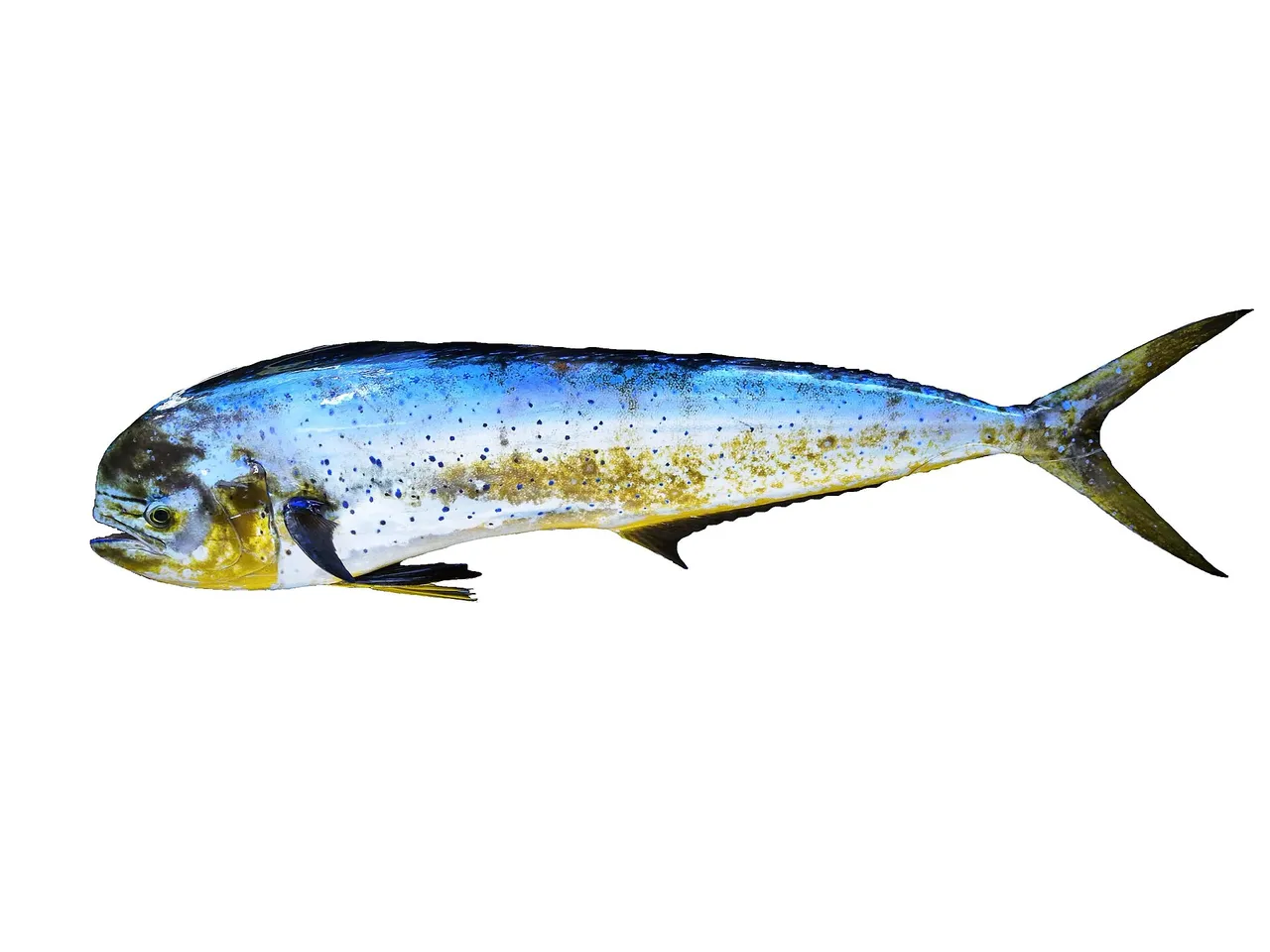
How this was identified, and who took it
Identified by: Cut-out specimen in full lateral view. The single dorsal fin running almost the whole length of the back, the deeply forked tail and the blue spotting over gold are unmistakable. Blunt head, so not a mature male.Hugues Evano (IFREMER, Délégation océan Indien (DOI), Département Ressources Biologiques et Environnement (RBE), F-97420 Le Port, France) — CC BY 4.0, via Wikimedia Commons — source, licenceWhat is known about how it feeds
The dolphinfish lives fast and eats almost anything, and the two facts are connected.
Growth is among the fastest of any bony fish — a mahi-mahi may reach a metre within a year — and it lives only four or five years. Sustaining that requires eating continuously and without discrimination, and the diet reflects it: almost all forms of small fish, zooplankton, crustaceans and squid.
The two verified relationships are the items that matter most in the tropical western Atlantic. Ballyhoo, taken around weed lines and floating structure, and cephalopods at group level.
Floating objects are the organising feature of the species' ecology. Weed lines, logs, debris and anything else adrift accumulate small fish beneath them within days and predators within weeks, and mahi-mahi are the most reliable of those predators. A single floating object in open ocean is a mark for exactly this reason.
Flying fish are a staple too, and the species' habit of feeding at and just below the surface follows from what it eats.
Schooling is by size, and the largest fish are frequently solitary or in pairs — a pattern that changes both what an angler encounters and how the fish behaves when hooked.
The food
Prey with a verified dietary link to this fish. Each entry carries its own evidence, and each is written at the precision the source actually used: a named species where the source named one, a group or food category where it said “polychaetes”, “crustaceans” or “detritus” and meant it. That is why this list is shorter than the animal’s real diet rather than longer.
- Ballyhoo — Hemiramphus brasiliensis
Ballyhoo are a principal prey around weed lines and floating structure, which is where both species concentrate.
- Cephalopods as prey — a group rather than a species: the evidence names the group
Squid are a regular part of the diet, taken in open water and around floating objects.
Food with no page of its own here yet
These are real components of the diet, listed as plain text because FishingHQ has no page for them yet. Inventing pages to make the list look fuller would be the fabrication this whole approach exists to prevent.
- flying fish
- juvenile fish sheltering under debris
- triggerfish and filefish
- crustaceans
- zooplankton
What anglers do with this
Everything below is interpretation, not finding. It is what experienced anglers conclude from the biology above, and the reasoning is usually sound and almost never tested. It is separated from the biology deliberately.
Floating structure is the location method and it is close to a rule: weed lines and debris hold bait, bait holds mahi-mahi, and searching for the object rather than the fish is how the fishery is conducted.
The indiscriminate feeding converts into a practical convention anglers state directly — that presentation type matters less than being in the right place with something moving — and it follows from the documented breadth of the diet.
The schooling behaviour underlies the practice of keeping a hooked fish in the water to hold the school, which is observation rather than inference.
The fast growth and short life mean the species sustains fishing pressure better than most on FishingHQ, which is a genuine biological difference rather than a licence.
What this does not establish
The cephalopod relationship is group-level. Two relationships for a diet that is genuinely close to indiscriminate. Composition varies with ocean, region and what is drifting, and nothing here establishes proportions.
Where this connects
These are the baits, lures, methods and explainers FishingHQ already joins to this fish — which is why the list is sometimes short. They are not chosen for this page, and a link here means an evidenced relationship exists, not that it follows from the diet.
Lures recorded for this species
Methods used for it
Where it lives
The science behind the feeding
This page covers feeding. The Mahi-mahi record covers identification, lifecycle, seasonal behaviour, handling and the sources behind all of it.
Reviewed 2026-08-12.