What does dusky kob eat?
What is established about how dusky kob feeds, kept separate from what anglers infer from it.
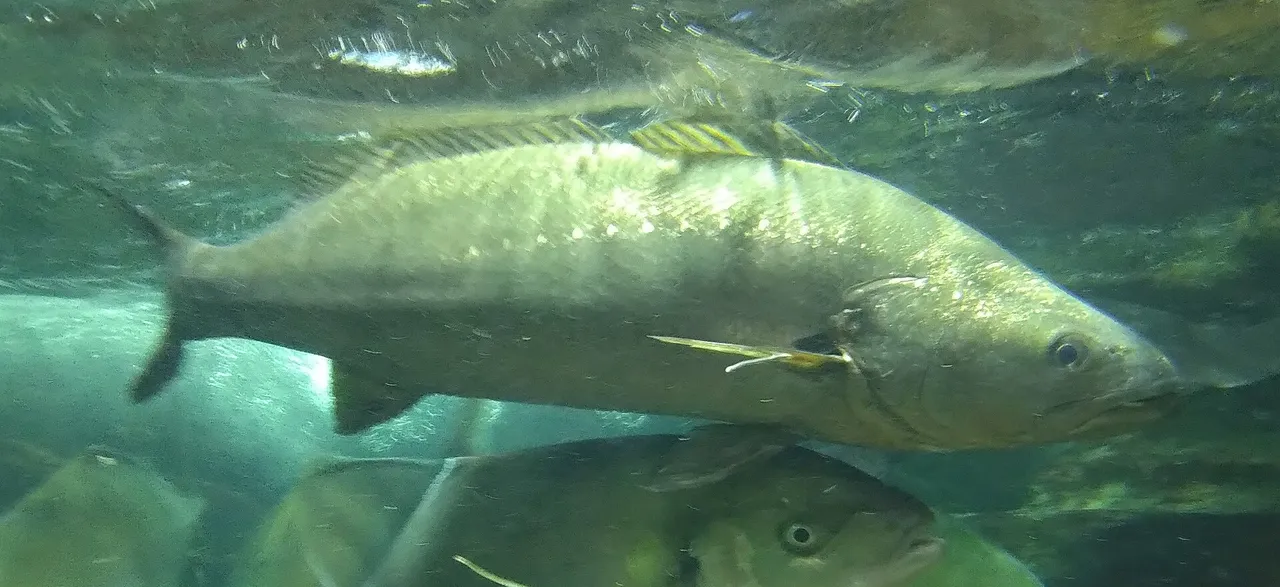
How this was identified, and who took it
Identified by: Full lateral view showing the elongate body, the two dorsal fins, the pointed snout and the row of pale spots following the lateral line that places it in Argyrosomus. Photographed through aquarium water; colour is green-shifted.タウナギ — CC BY-SA 4.0, via Wikimedia Commons — source, licenceWhat is known about how it feeds
The dusky kob feeds in water that has been stirred up, and it is one of the few species on FishingHQ for which rough conditions are a feeding cue rather than an obstacle.
FishBase records the species at a trophic level of about 4.5, which places it firmly among the higher predators. Fish and crustaceans are taken across three quite different environments — the surf zone, the deeper estuary channels and nearshore ground — and the feeding is weighted heavily towards darkness and towards discoloured water after a sea has been running.
The two verified relationships describe both components. Decapod crustaceans — prawns above all — dominate in estuarine water and in juveniles using estuaries as nursery habitat. Pilchards standing for the shoaling fish taken by adults in coastal water, including during the annual sardine run along the south-east African coast.
The association with discoloured water is the distinctive part. A kob hunting in churned surf is exploiting prey that has lost its bearings and its cover, which is the same logic a European bass applies to a tide race, arrived at independently on the other side of the world.
The species is long-lived and slow-growing, and the largest fish are old. Stocks along the southern African coast have been heavily depleted, and management measures are correspondingly strict.
Juveniles are estuary-dependent, which makes estuarine water quality a stock issue rather than only a habitat one.
The food
Prey with a verified dietary link to this fish. Each entry carries its own evidence, and each is written at the precision the source actually used: a named species where the source named one, a group or food category where it said “polychaetes”, “crustaceans” or “detritus” and meant it. That is why this list is shorter than the animal’s real diet rather than longer.
- Decapod crustaceans as prey — a group rather than a species: the evidence names the group
Prawns and crustaceans are a major part of the kob diet in estuarine water, particularly in juveniles using estuaries as nursery habitat.
- Pacific sardine — Sardinops sagax
Adult kob feed on pilchards and other shoaling fish in coastal water, and the annual sardine run along the southern African east coast is a substantial feeding event for them.
Food with no page of its own here yet
These are real components of the diet, listed as plain text because FishingHQ has no page for them yet. Inventing pages to make the list look fuller would be the fabrication this whole approach exists to prevent.
- mullet
- small squid
- crabs
- shad and other coastal fish
- marine worms
What anglers do with this
Everything below is interpretation, not finding. It is what experienced anglers conclude from the biology above, and the reasoning is usually sound and almost never tested. It is separated from the biology deliberately.
The association with discoloured water and night is the timing, and it converts directly: the conditions most anglers would avoid are the ones the species feeds in. That is convention with a documented basis.
The estuarine crustacean component underlies the use of prawn baits in estuaries, and the coastal fish component the use of larger offerings in the surf — two approaches for the same species in two places.
The conservation position is the part that is not interpretation. Dusky kob stocks are depleted, size and bag limits are strict, and juveniles in estuaries are protected in several jurisdictions. What applies is a question for the relevant authority.
What this does not establish
The crustacean relationship is group-level. Two relationships for a broad predatory diet that varies substantially between estuarine juveniles and coastal adults. The account describes the southern African population; the species occurs more widely. Nothing establishes proportions.
Where this connects
These are the baits, lures, methods and explainers FishingHQ already joins to this fish — which is why the list is sometimes short. They are not chosen for this page, and a link here means an evidenced relationship exists, not that it follows from the diet.
Methods used for it
Where it lives
This page covers feeding. The Dusky kob record covers identification, lifecycle, seasonal behaviour, handling and the sources behind all of it.
Reviewed 2026-08-12.