Meagre vs Dusky kob
How to tell them apart, and what follows from getting it right.
Why they get confused
Congeners in Argyrosomus that look extremely similar and are conflated constantly in international angling writing, largely because each is the big estuary drum of its own region — meagre in Europe and West Africa, dusky kob in southern Africa and Australia — and articles about one are read as being about the other.
Meagre
Argyrosomus regius — Sciaenidae
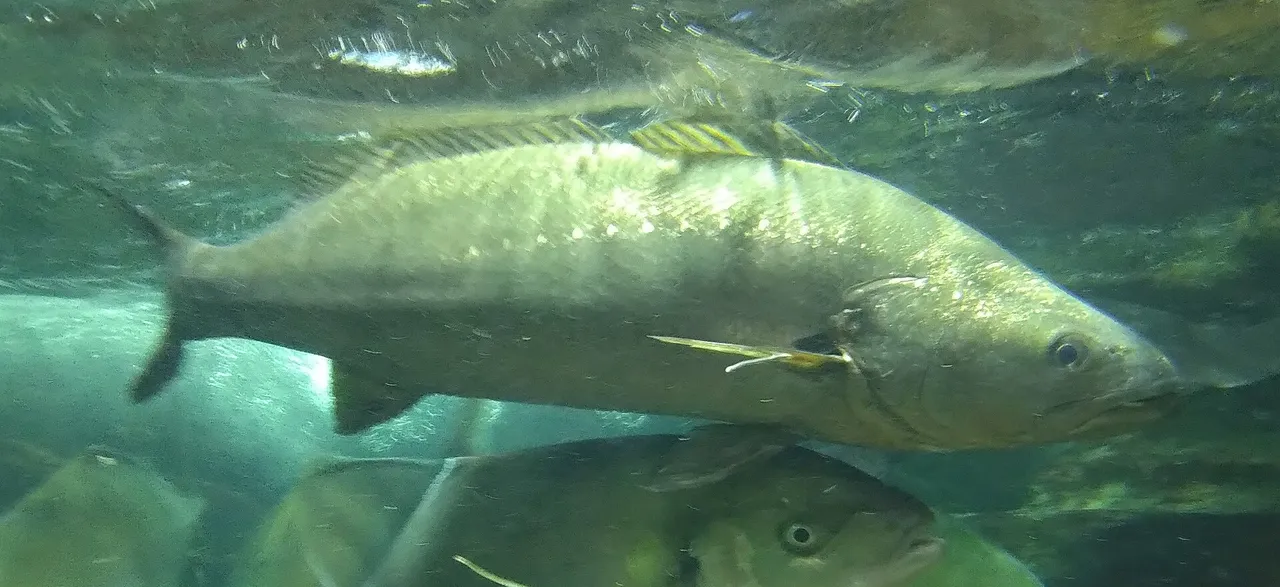
No photograph of Meagre has passed identity review yet, so none is shown. A photograph is published only once somebody has checked the animal in it against the diagnostic features described on this page.

The differences
Each difference is marked with how far it can be trusted on its own. A single diagnostic character settles the identification; suggestive ones only narrow it.
| Character | Meagre | Dusky kob | Reliability |
|---|---|---|---|
| RangeRange | Eastern Atlantic and Mediterranean, from Europe down the West African coast. | Indo-Pacific: southern Africa, and separately Australian waters. | Diagnostic on its own |
| Mouth colourIdentification | Distinctly yellow-tinged mouth interior. | Mouth interior without the yellow cast, generally paler. | Supporting — use with others |
| Lateral line poresIdentification | A pearly row of pores and small pale spots following the lateral line. | A comparable row of pale spots along the lateral line, typical of the genus. | Suggestive only — varies |
| HandlingHandling | Support a large fish horizontally; never hold vertically by the jaw. | Identical requirement, and both are commonly caught at sizes where a vertical lift causes damage. | Supporting — use with others |
Why it matters
Geography settles this pair, which is unusual and useful. The practical value is in reading: technique, size expectation and conservation position written for one species should not be applied to the other simply because both are called kob, meagre or croaker somewhere.
The full records
This page compares two species. Each of them has a complete record covering biology, behaviour, handling and the evidence behind all of it.
More about meagre
Where it lives, how it is caught, and what else it is confused with.
Similar and related fish
How it is caught
Gear for this fish
Where it lives
Why the 7 connections on this page are here, and the sources
Similar and related fish
Backed by research — 1 connection
Supported by peer-reviewed research or fisheries science. The sources are listed and can be checked.
Dusky kob
An identification comparison naming both binomials: Argyrosomus regius and Argyrosomus japonicus.
- FishBase: a global information system on fishes — Froese, R. and D. Pauly, eds. — FishBase Consortium (Scientific institute)Relied on for: Morphological and distributional data for Argyrosomus regius and for Argyrosomus japonicus.States this directlyPassage read and verified
- The IUCN Red List of Threatened Species — International Union for Conservation of Nature (Conservation authority)Relied on for: Separate assessments treating Argyrosomus regius and Argyrosomus japonicus as distinct species.States this directlyCitation checked — the work exists and is described correctly
How it is caught
What experienced anglers do — 3 connections
Widely and independently recommended by experienced anglers and specialist sources. This is real angling knowledge, not proof: controlled evidence for it is limited, and FishingHQ records it as convention rather than as a demonstrated effect.
Livebaiting at sea
A practitioner claim about how Argyrosomus regius is commonly fished, following from where and how it feeds.
- General angling website restatements of established technique — Various (Credible secondary source)Relied on for: Widely restated practitioner accounts of fishing for meagre.Citation checked — the work exists and is described correctly
- Sea Angler — Bauer Media (Specialist angling publication)Relied on for: Practitioner treatment of the methods used for meagre and comparable species.Citation checked — the work exists and is described correctly
Spinning
A practitioner claim about how Argyrosomus regius is commonly fished, following from where and how it feeds.
- General angling website restatements of established technique — Various (Credible secondary source)Relied on for: Widely restated practitioner accounts of fishing for meagre.Citation checked — the work exists and is described correctly
- Sea Angler — Bauer Media (Specialist angling publication)Relied on for: Practitioner treatment of the methods used for meagre and comparable species.Citation checked — the work exists and is described correctly
Surfcasting
A practitioner claim about how Argyrosomus regius is commonly fished, following from where and how it feeds.
- General angling website restatements of established technique — Various (Credible secondary source)Relied on for: Widely restated practitioner accounts of fishing for meagre.Citation checked — the work exists and is described correctly
- Sea Angler — Bauer Media (Specialist angling publication)Relied on for: Practitioner treatment of the methods used for meagre and comparable species.Citation checked — the work exists and is described correctly
Gear for this fish
What experienced anglers do — 1 connection
Widely and independently recommended by experienced anglers and specialist sources. This is real angling knowledge, not proof: controlled evidence for it is limited, and FishingHQ records it as convention rather than as a demonstrated effect.
Soft plastics
A practitioner claim about tackle commonly used for Argyrosomus regius.
- General angling website restatements of established technique — Various (Credible secondary source)Relied on for: Widely restated practitioner accounts of this presentation for meagre.Citation checked — the work exists and is described correctly
- Angling Times — Bauer Media (Specialist angling publication)Relied on for: Practitioner treatment of comparable presentations for the species group.Citation checked — the work exists and is described correctly
Where it lives
Backed by research — 2 connections
Supported by peer-reviewed research or fisheries science. The sources are listed and can be checked.
Estuary
A habitat association for Argyrosomus regius taken from the environment and distribution data on its FishBase summary.
- FishBase: a global information system on fishes — Froese, R. and D. Pauly, eds. — FishBase Consortium (Scientific institute)Relied on for: The environment, depth range and habitat description recorded for Argyrosomus regius.States this directlyPassage read and verified
Surf beaches
A habitat association for Argyrosomus regius taken from the environment and distribution data on its FishBase summary.
- FishBase: a global information system on fishes — Froese, R. and D. Pauly, eds. — FishBase Consortium (Scientific institute)Relied on for: The environment, depth range and habitat description recorded for Argyrosomus regius.States this directlyPassage read and verified
Reviewed 2026-08-10. FishingHQ does not state what any rule is or where any rule applies. Where this page says the two species are managed differently, that is a reason to check the authority for the water you are on — not a statement of what it requires.