What does red drum eat?
What is established about how red drum feeds, kept separate from what anglers infer from it.
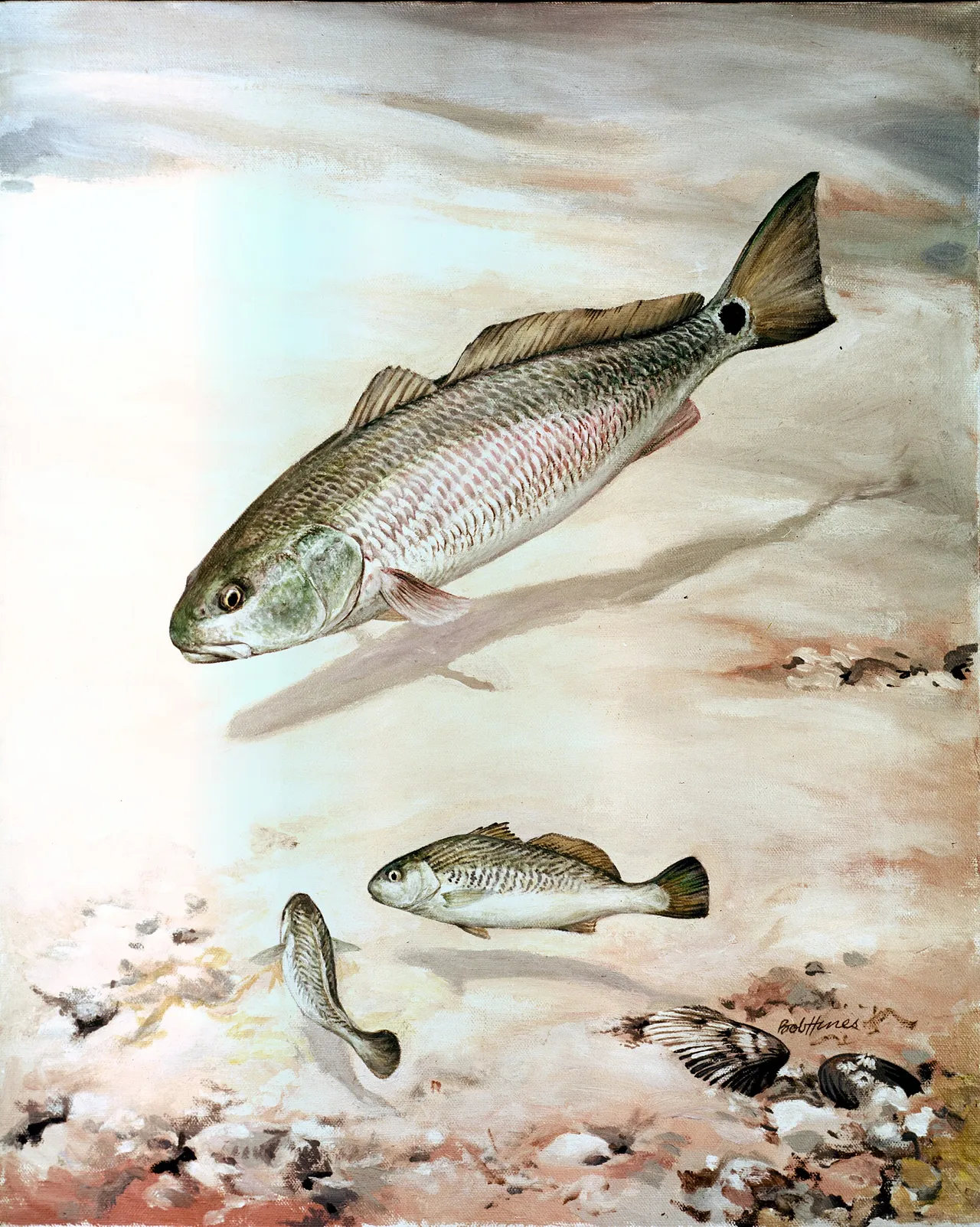
How this was identified, and who took it
Identified by: The dark ocellus at the base of the tail, a blunt snout with the mouth set beneath it, and coppery-bronze flanks — the species' three signature characters.Hines, Robert W., Public domain, via Wikimedia Commons — source, licenceWhat is known about how it feeds
A tailing red drum is a fish that has committed its whole body to reaching something in the sediment, and that posture is the single most informative thing about the species' diet.
The mouth is inferior — set beneath a blunt snout — and the fish feeds head-down, rooting in sand and mud for crabs, shrimp and shellfish. In water shallow enough that the fish cannot level out, the tail breaks the surface, which is the behaviour the entire sight fishery on the flats is built on.
The crustacean relationship FishingHQ records belongs to that mode. Blue crabs in particular are a major item, and the red drum is one of the principal predators on them in estuarine systems.
The second verified relationship is menhaden, and it belongs to a different mode entirely: in deeper water, in the surf and in the coastal schools, adult red drum feed actively on baitfish in the water column, and the head-down rooting is nowhere in evidence.
So the species runs two feeding behaviours depending on where it is, and both are normal. A flats fish and a surf fish are doing different things with different senses — the first tactile and chemosensory, the second visual.
The life history reinforces the split. Juveniles and sub-adults use estuaries; large adults move to nearshore coastal water and form the schools the autumn fishery targets.
The food
Prey with a verified dietary link to this fish. Each entry carries its own evidence, and each is written at the precision the source actually used: a named species where the source named one, a group or food category where it said “polychaetes”, “crustaceans” or “detritus” and meant it. That is why this list is shorter than the animal’s real diet rather than longer.
- Atlantic menhaden — Brevoortia tyrannus
Adult red drum feed on menhaden in coastal water, and the large autumn schools follow them along the beaches.
- Decapod crustaceans as prey — a group rather than a species: the evidence names the group
Crabs are the item most associated with red drum feeding in shallow water, and the tailing behaviour that makes sight fishing possible is crab-directed feeding on the bottom.
Food with no page of its own here yet
These are real components of the diet, listed as plain text because FishingHQ has no page for them yet. Inventing pages to make the list look fuller would be the fabrication this whole approach exists to prevent.
- mullet
- Atlantic croaker and small sciaenids
- oysters and clams
- marine worms
- shrimp
What anglers do with this
Everything below is interpretation, not finding. It is what experienced anglers conclude from the biology above, and the reasoning is usually sound and almost never tested. It is separated from the biology deliberately.
Tailing is the location method for the flats fishery, and it works because of the anatomy rather than because of a habit: a fish that must tip to reach the bottom in shallow water announces itself.
The two feeding modes convert into two approaches, and anglers treat them separately. The crustacean-directed flats fishing and the baitfish-directed surf and schooling fishing use different presentations for the same species, which is inference from the recorded diet and is well supported by practice.
The inferior mouth has a presentation consequence anglers state consistently: an offering on the bottom is in the fish's field of operation and one above it frequently is not. That is mechanical reasoning rather than a tested comparison.
What this does not establish
The crustacean relationship is group-level. Two relationships for a broad diet that varies with habitat, size and season, and the estuarine and coastal populations feed quite differently. Nothing here establishes proportions.
Where this connects
These are the baits, lures, methods and explainers FishingHQ already joins to this fish — which is why the list is sometimes short. They are not chosen for this page, and a link here means an evidenced relationship exists, not that it follows from the diet.
Lures recorded for this species
Methods used for it
Where it lives
The science behind the feeding
This page covers feeding. The Red drum record covers identification, lifecycle, seasonal behaviour, handling and the sources behind all of it.
Reviewed 2026-08-12.