How to identify red drum
Sciaenops ocellatus · Sciaenidae
The characters that identify red drum, ranked by how far each one can be trusted on its own.
Safety: injury while handling fish — can cause injury needing treatment. One more point applies here.
How this was identified, and who took it
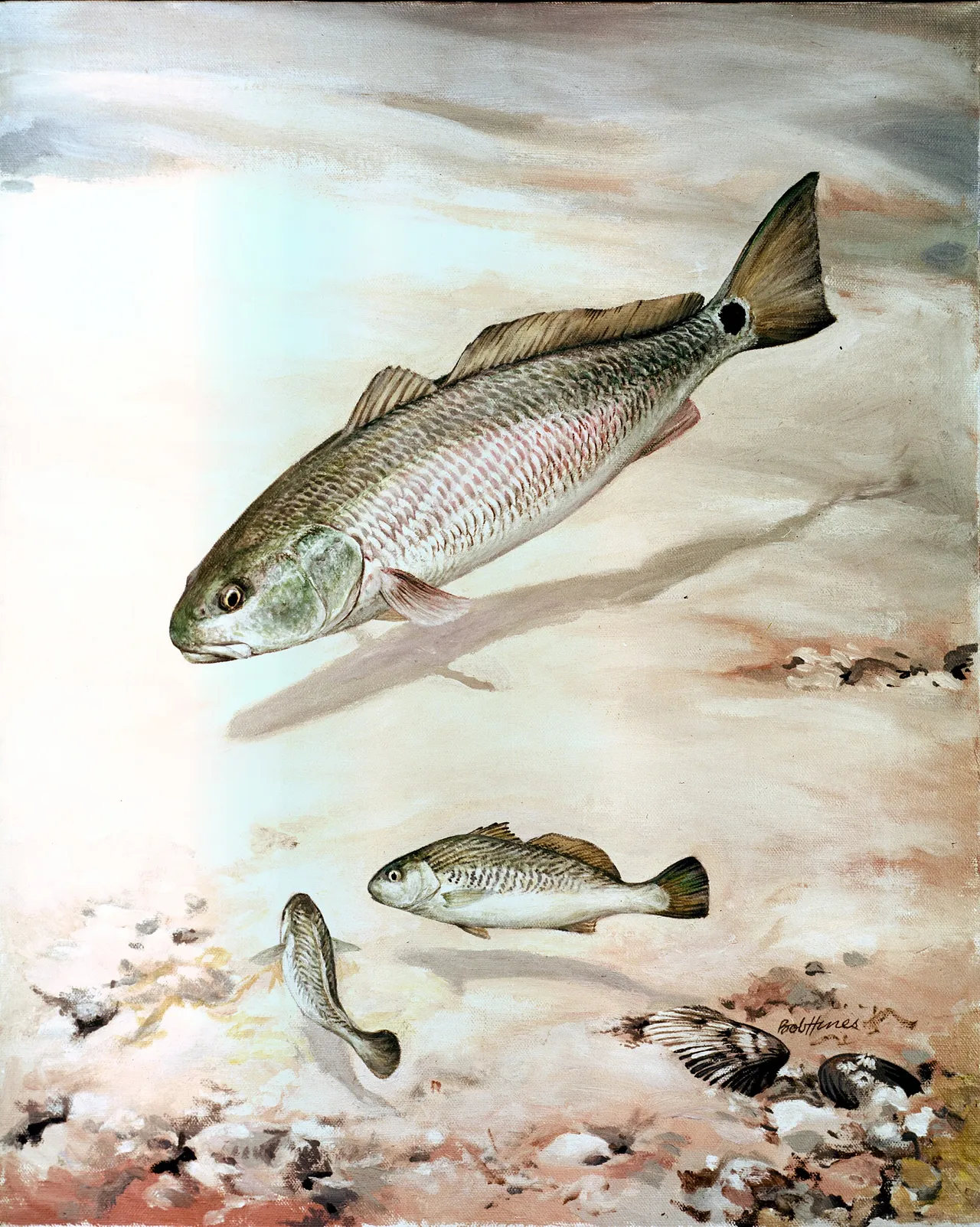
Identified by: The dark ocellus at the base of the tail, a blunt snout with the mouth set beneath it, and coppery-bronze flanks — the species' three signature characters.Hines, Robert W., Public domain, via Wikimedia Commons — source, licenceAbout the image above: It is a US Fish and Wildlife Service scientific illustration rather than a photograph. It shows the eyespot and the underslung mouth more clearly than most photographs manage, which is why it is here — but it is a rendering of the species rather than a picture of one fish, and a live red drum's colour will not be this even.
Look at this first
Find the base of the tail. A red drum carries a black eyespot there — usually one, sometimes a scatter of them. Then run a finger under the chin: nothing. No barbels. Spot present and chin bare is a red drum and not a black drum.
Diagnostic — settles it on its own
Each of these settles the identification on its own. If one is clear, you have your answer.
A bare chin
No barbels beneath the lower jaw at all. Black drum, the fish this is confused with in every estuary the two share, carries a fringe of them. It takes one touch and it works on a fish of any size and any colour.
An eyespot at the tail base
One or more dark ocelli where the body meets the tail. Ranked below the chin check for a specific reason: a small proportion of red drum have none, and a page that leads with a character a fish can simply lack has ranked it wrong.
Supporting — use with other characters
Real characters that are not conclusive by themselves. Use two or three together.
A blunt snout with the mouth underneath it
The head is rounded off in front and the mouth opens below rather than at the tip, which is what a fish that feeds nose-down on a sand bottom needs. Shared with black drum, so useful for placing the family rather than the species.
A shoulder on big fish
Large adults thicken behind the head into a distinct hump that smaller fish do not have. A size-dependent character, which is why it supports rather than decides.
Suggestive only — varies with condition
Hints only. These vary with condition, season, water and how long the fish has been out of it, and a fish that contradicts them is still the same species.
The copper in the flanks
The colour the species is named for, and it moves. Fish over grass are dark and heavily bronzed, fish over clean sand can be nearly pale, and the same individual changes within hours of moving between them.
What it gets confused with
- Black drum, sharing the same water and the same feeding posture. Chin barbels settle it in one movement.
- Juvenile black drum, whose vertical barring is nothing like a red drum but which are still confused by people going on general shape.
- Spotted seatrout in the same estuaries, which have obvious spots over the whole rear body rather than at the tail base alone.
Side by side: Red drum vs Black drum.
Where this stops working
The eyespot varies more than its reputation suggests — multiple spots are common and none at all is possible — so a fish without one is not thereby something else. Colour is close to useless across habitats. Where slot limits protect large breeding fish, correct identification carries a legal consequence and the rules differ by state and by season; check with the relevant fisheries authority rather than a page.
The full record
This page covers identification only. The Red drum record covers behaviour, lifecycle, distribution, handling and the sources behind all of it.
Reviewed 2026-08-14.
More about this fish
Telling it apart is one question. Here are the others.
Similar and related fish
- Atlantic menhadenAdult red drum feed on menhaden in coastal water, and the large autumn schools follow them along the beaches.
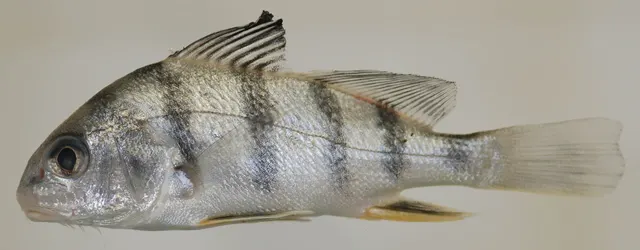 Black drumSciaenids sharing the same estuaries. Black drum have chin barbels and crush shellfish; red drum have none and an eyespot at the tail. Both drum with the swim bladder.
How it is caught
Where it lives
Where you will find it
- North American saltwater fishingThe dominant inshore fish of the south-east and Gulf, and the reason the flats and marsh fishery developed as it did.
- The Gulf of MexicoOccupies the extensive northern marsh and estuary system as juveniles and the nearshore coastal water as adults, aggregating near the passes to spawn.
Why the 8 connections on this page are here, and the sources
Similar and related fish
Backed by research — 2 connections
Supported by peer-reviewed research or fisheries science. The sources are listed and can be checked.
Atlantic menhaden
Recorded diet evidence identifies Brevoortia tyrannus as a food item of this predator at species level. The edge is written at that granularity and no further.
- FishBase: a global information system on fishes — Froese, R. and D. Pauly, eds. — FishBase Consortium (Scientific institute)Relied on for: Food items recorded for this predator, including Brevoortia tyrannus.States this directlyPassage read and verified
- FAO Species Identification Guides for Fishery Purposes and the FAO Species Catalogues — Food and Agriculture Organization of the United Nations (Scientific institute)Relied on for: Species account describing the diet of this predator in the region where Brevoortia tyrannus occurs.Background and mechanism onlyCitation checked — the work exists and is described correctly
Black drum
An identification comparison naming both binomials.
- FishBase: a global information system on fishes — Froese, R. and D. Pauly, eds. — FishBase Consortium (Scientific institute)Relied on for: That Pogonias cromis and Sciaenops ocellatus are both Sciaenidae of the western Atlantic occupying coastal waters and estuaries.States this directlyPassage read and verified
How it is caught
What experienced anglers do — 3 connections
Widely and independently recommended by experienced anglers and specialist sources. This is real angling knowledge, not proof: controlled evidence for it is limited, and FishingHQ records it as convention rather than as a demonstrated effect.
Saltwater fly fishing
The page names sight fishing with fly on shallow flats first, and it is a genuinely distinct fishery from the surf and structure ones: the fish is located visually before anything is presented to it.
- Florida saltwater fishing regulations and Keys sanctuary rules — Florida state wildlife authority and the Florida Keys National Marine Sanctuary (Government fisheries body)Relied on for: Documents which fishery and which technique takes this species.States this directlyCitation checked — the work exists and is described correctly
- General angling website restatements of established technique — Various (Credible secondary source)Relied on for: Independently corroborates the species' recreational capture and range.Background and mechanism onlyCitation checked — the work exists and is described correctly
Spinning
The page names light lures alongside fly for the flats fishery, and around structure and passes where a fly cannot be presented. The two share the water and not the tackle.
- Florida saltwater fishing regulations and Keys sanctuary rules — Florida state wildlife authority and the Florida Keys National Marine Sanctuary (Government fisheries body)Relied on for: Documents which fishery and which technique takes this species.States this directlyCitation checked — the work exists and is described correctly
- General angling website restatements of established technique — Various (Credible secondary source)Relied on for: Independently corroborates the species' recreational capture and range.Background and mechanism onlyCitation checked — the work exists and is described correctly
Surfcasting
The page names the surf bait fishery as one of three, and it is the one that does not require a boat or sighted fish — which makes it the most widely practised of them.
- Florida saltwater fishing regulations and Keys sanctuary rules — Florida state wildlife authority and the Florida Keys National Marine Sanctuary (Government fisheries body)Relied on for: Documents which fishery and which technique takes this species.States this directlyCitation checked — the work exists and is described correctly
- General angling website restatements of established technique — Various (Credible secondary source)Relied on for: Independently corroborates the species' recreational capture and range.Background and mechanism onlyCitation checked — the work exists and is described correctly
Where it lives
Backed by research — 1 connection
Supported by peer-reviewed research or fisheries science. The sources are listed and can be checked.
Estuary
A habitat claim held to a scientific standard.
- FishBase: a global information system on fishes — Froese, R. and D. Pauly, eds. — FishBase Consortium (Scientific institute)Relied on for: That Sciaenops ocellatus occurs usually over sand and sandy mud bottoms in coastal waters and estuaries and is abundant in the surf zone.States this directlyPassage read and verified
Where you will find it
Backed by research — 2 connections
Supported by peer-reviewed research or fisheries science. The sources are listed and can be checked.
North American saltwater fishing
A distributional claim taken from reference sources on the species rather than from angling report. It states presence and asserts nothing about a fishery.
- FishBase: a global information system on fishes — Froese, R. and D. Pauly, eds. — FishBase Consortium (Scientific institute)Relied on for: Distribution, habitat association, depth range and life history recorded for the species concerned.States this directlyPassage read and verified
- The IUCN Red List of Threatened Species — International Union for Conservation of Nature (Conservation authority)Relied on for: Global distribution, population trend and extinction-risk assessment for the species concerned.States this directlyCitation checked — the work exists and is described correctly
The Gulf of Mexico
A distribution association between an animal and a kind of water, rather than a claim about any named mark.
- FishBase: a global information system on fishes — Froese, R. and D. Pauly, eds. — FishBase Consortium (Scientific institute)Relied on for: Distribution, habitat association and depth range recorded for the species, including its occurrence in the water body concerned.States this directlyPassage read and verified
- The IUCN Red List of Threatened Species — International Union for Conservation of Nature (Conservation authority)Relied on for: Assessment and range account for the species, including the systems and coasts it occupies.Background and mechanism onlyCitation checked — the work exists and is described correctly
Safety
Injury while handling fish — Can cause injury needing treatment
Sharp gill covers and dorsal spines, on a heavy and strong fish frequently handled while wading.
What reduces it: Wet hands, support the body horizontally, keep fingers clear of the gill plates, and use pliers for unhooking.
Encounters with marine life — Can cause injury needing treatment
Shallow flats and marsh hold stingrays resting in soft bottom, and a wading angler who steps on one may be barbed in the foot or lower leg. Some parts of the range also hold alligators in brackish marsh.
What reduces it: Shuffle rather than step when wading soft ground, which moves rays aside instead of onto. Wear wading boots. Treat local warnings about large reptiles as authoritative.