How to identify white bass
Morone chrysops · Moronidae
The characters that identify white bass, ranked by how far each one can be trusted on its own.
Safety: injury while handling fish — minor injury.
How this was identified, and who took it
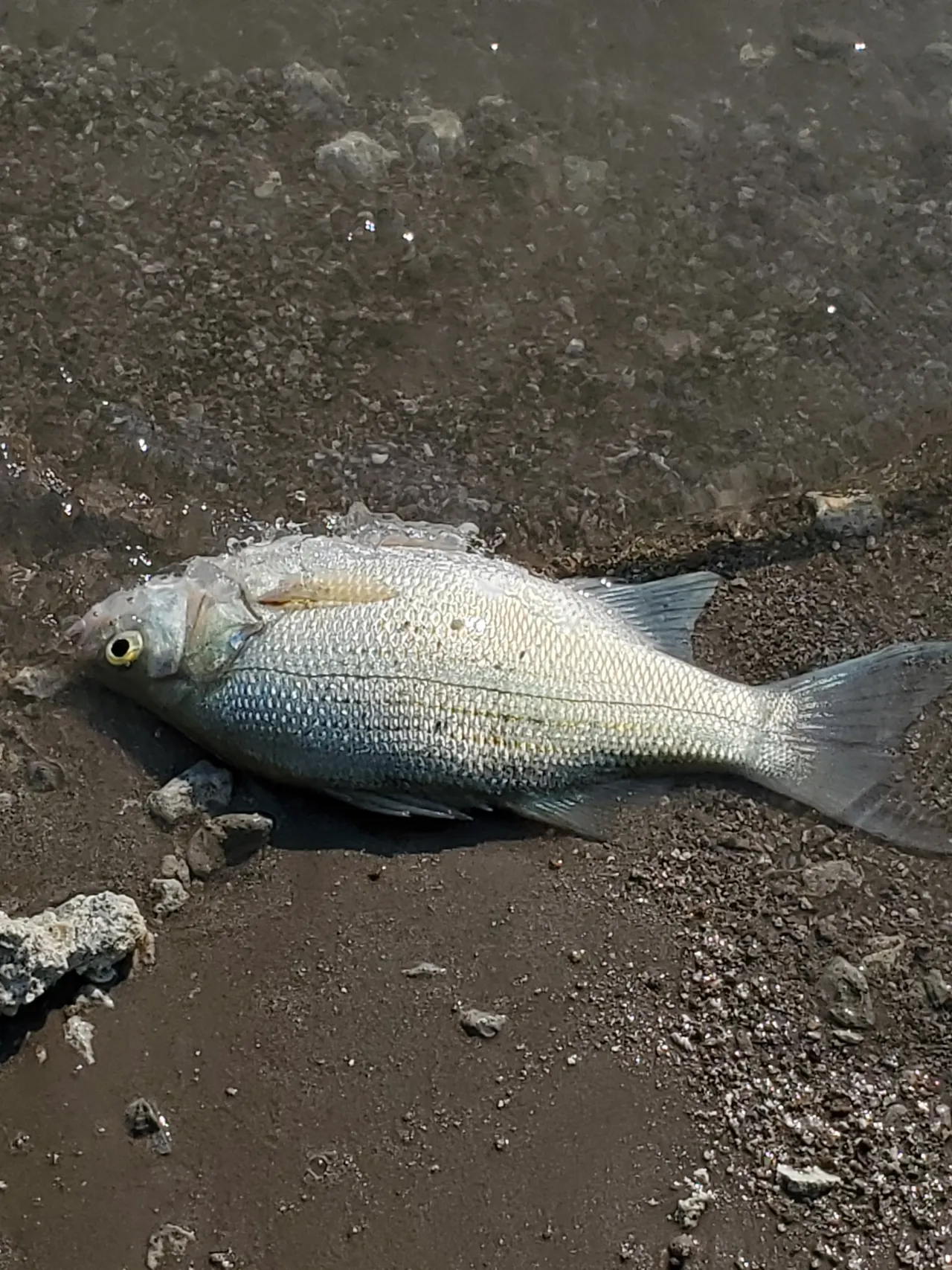
Identified by: The record's separating character is legible: the horizontal stripes on the flank are faint and BROKEN rather than the clean unbroken lines of a striped bass, and they fade out entirely above the lateral line. The body is deep and strongly compressed at roughly a third of standard length in depth, which is the white bass proportion rather than the more elongate striper, and the back is arched behind the head.Bennett Grappone — CC BY, via iNaturalist — source, licenceAbout the image above: The photograph shows a dead fish on a lakeshore mudflat with the dorsal fins collapsed and the back scuffed. The stripe pattern the page leads on is legible, but it is already fading; on a live fish the same lines are clearer and more contrasted.
Look at this first
Follow one stripe from the gill cover backwards and see whether it makes it to the tail in one piece. On a white bass the stripes are faint and break up, and they fade away above the lateral line; on a striped bass several run clean and unbroken from shoulder to tail. Do that before looking at anything else, and then read the body depth as a check.
Diagnostic — settles it on its own
Each of these settles the identification on its own. If one is clear, you have your answer.
Stripes faint and broken rather than clean and continuous
Pick a single dark line on the flank and trace it. A white bass's lines are dim, interrupted, offset where they cross, and largely absent above the lateral line. A striped bass carries seven or eight sharp continuous lines that hold from behind the gill cover to the tail. The pattern is legible on a fresh fish and degrades within hours of death, so read it early.
One tooth patch on the tongue, not two
Put a thumb on the tongue and feel. White bass carries a single rough patch; striped bass carries two parallel ones. This is the character that separates both from the hybrid, which usually carries two patches that are joined at the rear, and it is the only reliable way any of the three are told apart when the stripes are ambiguous. It requires the fish in hand and a willingness to feel inside its mouth.
Supporting — use with other characters
Real characters that are not conclusive by themselves. Use two or three together.
A deep body for its length, arched behind the head
White bass is roughly a third as deep as it is long and the dorsal profile rises sharply behind the head. A striped bass of the same length is noticeably more elongate and slab-sided with a straighter back. Because it is a proportion it survives handling, and it is the character to fall back on when the stripes have faded.
Two clearly separated dorsal fins
The spiny first dorsal and the soft second dorsal are separate rather than joined by a membrane. This places the fish in Morone and removes the sunfishes and the drums; it does nothing to separate the three Morone a reader is actually choosing between.
Size class as a prior
A white bass over about two kilos is exceptional; striped bass reach many times that. So a large striped fish is unlikely to be a white bass, though a small striper is entirely likely to be mistaken for one, which is the direction the error actually runs.
What it gets confused with
- Striped bass, the main confusion, separated on stripe continuity, body depth and the tongue tooth patches.
- The white × striped hybrid, stocked into thousands of reservoirs and often the most abundant of the three; broken stripes AND two joined tongue patches point to it.
- Yellow bass, which has broken stripes as well but carries a distinctly yellow flank and whose lower stripes are offset in a characteristic step.
- White perch, a smaller Morone with no stripes at all as an adult, common in eastern waters.
Side by side: White bass vs Striped bass.
Where this stops working
Across most of the white bass's stocked range the hybrid is present, frequently in numbers, and the hybrid is specifically designed to look like both parents. Broken stripes do not rule it out; they are what a hybrid usually shows. The tongue patch is the character that separates the three and it needs the fish in hand. Where the identification has consequences — a size or bag rule that differs between species, a record claim — the answer must come from the current regulations of the state fisheries agency and, if it is genuinely close, from somebody with the fish. Any published stripe-pattern rule fails on a proportion of hybrids and this one does too.
The full record
This page covers identification only. The White bass record covers behaviour, lifecycle, distribution, handling and the sources behind all of it.
Reviewed 2026-08-16.
More about this fish
Telling it apart is one question. Here are the others.
How it is caught
Where it lives
Why the 4 connections on this page are here, and the sources
How it is caught
What experienced anglers do — 2 connections
Widely and independently recommended by experienced anglers and specialist sources. This is real angling knowledge, not proof: controlled evidence for it is limited, and FishingHQ records it as convention rather than as a demonstrated effect.
Jigging
A practitioner claim about how Morone chrysops is commonly fished, following from where and how it feeds.
- General angling website restatements of established technique — Various (Credible secondary source)Relied on for: Widely restated practitioner accounts of fishing for white bass.Citation checked — the work exists and is described correctly
- Sea Angler — Bauer Media (Specialist angling publication)Relied on for: Practitioner treatment of the methods used for white bass and comparable species.Citation checked — the work exists and is described correctly
Spinning
A practitioner claim about how Morone chrysops is commonly fished, following from where and how it feeds.
- General angling website restatements of established technique — Various (Credible secondary source)Relied on for: Widely restated practitioner accounts of fishing for white bass.Citation checked — the work exists and is described correctly
- Sea Angler — Bauer Media (Specialist angling publication)Relied on for: Practitioner treatment of the methods used for white bass and comparable species.Citation checked — the work exists and is described correctly
Where it lives
Backed by research — 2 connections
Supported by peer-reviewed research or fisheries science. The sources are listed and can be checked.
Lowland rivers
A habitat association for Morone chrysops taken from the environment and distribution data on its FishBase summary.
- FishBase: a global information system on fishes — Froese, R. and D. Pauly, eds. — FishBase Consortium (Scientific institute)Relied on for: The environment, depth range and habitat description recorded for Morone chrysops.States this directlyPassage read and verified
Lowland stillwaters
A habitat association for Morone chrysops taken from the environment and distribution data on its FishBase summary.
- FishBase: a global information system on fishes — Froese, R. and D. Pauly, eds. — FishBase Consortium (Scientific institute)Relied on for: The environment, depth range and habitat description recorded for Morone chrysops.States this directlyPassage read and verified
Safety
Injury while handling fish — Minor injury
The spiny dorsal and the rear edge of the gill cover both cut, and a fish thrashing during unhooking can drive a hook into a hand.
What reduces it: Grip across the body with the dorsal folded, use pliers, and keep fingers clear of the gill plate edge.