Burbot
Fish · Last reviewed 2026-08-10
The only freshwater cod, a nocturnal cold-water bottom predator with a single chin barbel that spawns under ice in midwinter.
Safety: hypothermia — can cause injury needing treatment.
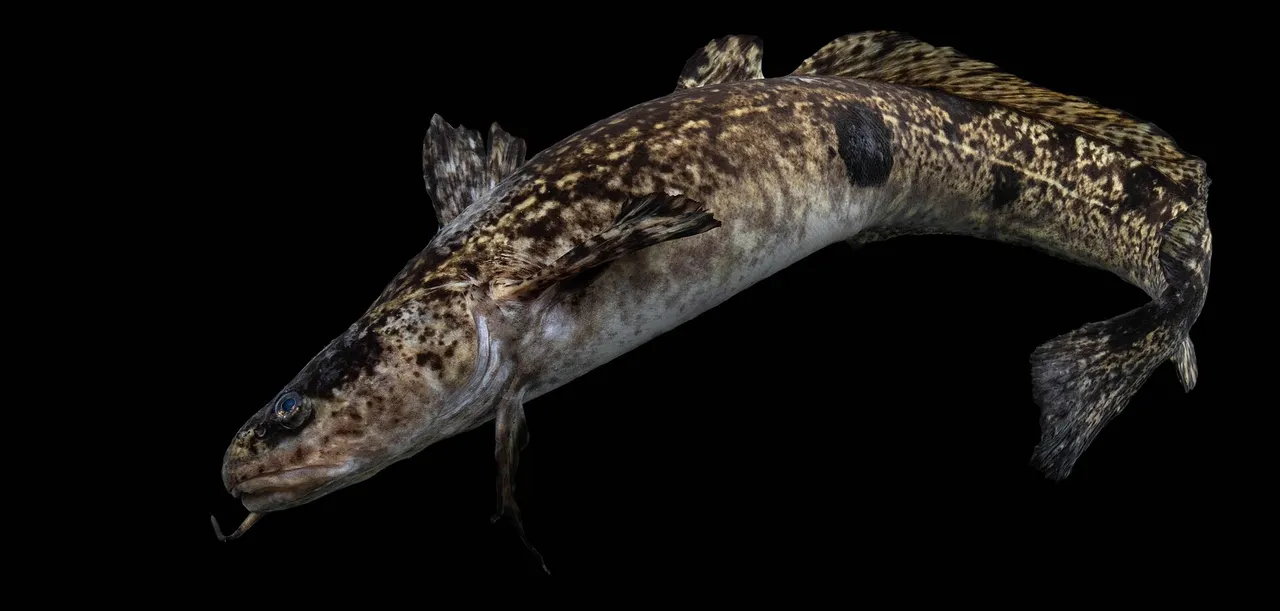
How this was identified, and who took it
Identified by: Identified on a combination nothing else in fresh water carries: a SINGLE chin barbel, a short first dorsal followed by a very long second dorsal running most of the back, a long anal fin, a rounded caudal and a marbled yellow-brown pattern. Burbot is the only freshwater cod, and this fin arrangement with one barbel cannot be a catfish, eelpout or loach. Whole animal on a plain background, by a named agency photographer.U.S. Fish and Wildlife Service — public domain, via Wikimedia Commons — source, licence_(52880431837).jpg)
Catching Burbot
Everything here on fishing for it. Each entry opens the page behind it.
Burbot is the only member of the cod family that lives entirely in fresh water, and it behaves like a cod that has moved indoors — a long, mottled, bottom-hugging predator with a single chin barbel, hunting at night in cold, deep, clean water across the whole northern hemisphere.
Its most striking habit is winter spawning. Burbot spawn under ice in midwinter, in shallow water, in writhing communal balls of fish — behaviour almost unique among freshwater fishes and the reason the species is fished for hardest in the coldest part of the year.
It was extirpated from Britain during the twentieth century and remains absent, which is a genuine and unusual case of a British freshwater extinction.
How it is caught
Gear for this fish
Identification
- Scientific name
- Lota lota
- Family
- Lotidae
- Water
- Freshwater
- Conservation status
- Least Concern
- Regions
- Northern Europe, Central & Eastern Europe, North America, Arctic & Subarctic, East Asia
- A single barbel on the chin, with smaller barbels at the nostrils.
- Two dorsal fins — a short first and a very long second running to the tail — with a long anal fin beneath.
- Long, cylindrical, eel-like body with mottled dark marbling over yellow-brown, and very small embedded scales.
- Rounded tail, unlike the forked tail of any similar freshwater fish.
Size
- Typical
- 0.5–2 kg (1.1–4.4 lb)
- Large
- 3–6 kg (6.6–13 lb)
Exceptional: FishBase records a maximum of 152 cm and 34 kg
The only gadid in fresh water, handled in conditions that hurt the angler
Burbot handling is unusual in that the fish poses very little risk and the circumstances pose a great deal, and the guidance is genuinely more about the person than the animal.
THE FISH IS AWKWARD RATHER THAN DANGEROUS. A burbot is a long, muscular, extremely slippery cod relative with small teeth that do not matter and no spines worth the name. What it does is wrap — the body coils around a forearm the way an eel's does, and the more firmly it is squeezed the more it works. Squeezing is also the thing that damages it: a burbot's body is soft-walled and the internal organs, particularly the very large liver the species is prized for, are easily crushed by a hard grip.
SO IT IS SUPPORTED RATHER THAN GRIPPED. A wet cloth or a gloved hand under the body, taking the weight, with no attempt to squeeze it into stillness. Long pliers unhook it. A fish that is coiling is contained rather than fought.
AND THE REAL HAZARD IS THE SETTING. Burbot are fished in winter, in the dark, frequently through ice, in temperatures well below freezing. Wet hands in those conditions lose function within minutes and freeze in a way that causes real injury, and the sequence — unhook a slippery fish, get soaked, carry on — is how people end a session with damaged fingers. The answer is dry gloves in reserve, a way of drying hands, and the discipline to stop and deal with it rather than fish through.
THE ICE ITSELF IS THE SEVERE VERSION OF THE SAME POINT. Ice thickness varies across a lake and is unreliable near inlets, outlets and moving water. Local guidance on thickness is authoritative, it should be measured rather than assumed, and nobody should be on it alone in the dark, which is when this fish feeds.
What experienced anglers do — why, and the sources (4)
Widely and independently recommended by experienced anglers and specialist sources. This is real angling knowledge, not proof: controlled evidence for it is limited, and FishingHQ records it as convention rather than as a demonstrated effect.
- FishBase: a global information system on fishes — Froese, R. and D. Pauly, eds. — FishBase Consortium (Scientific institute)Relied on for: Morphology, dentition, spination, thermal tolerance, reproductive strategy and depth range recorded for the species.States this directlyPassage read and verified
- The IUCN Red List of Threatened Species — International Union for Conservation of Nature (Conservation authority)Relied on for: Assessment, population trend and the life-history traits — longevity, growth rate, sex structure — that determine a population's sensitivity to the removal of large individuals.Background and mechanism onlyCitation checked — the work exists and is described correctly
- Sea Angler — Bauer Media (Specialist angling publication)Relied on for: Established boat and shore practice for handling and returning the species.States this directlyCitation checked — the work exists and is described correctly
- IGFA International Angling Rules and World Record Requirements — International Game Fish Association (Angling or fisheries organisation)Relied on for: Handling, release and tackle conventions in recognised sport fisheries for the species.Background and mechanism onlyPassage read and verified
A cod in a river: cold, deep, dark, and gone from England
Burbot occupy a habitat niche no other European freshwater fish occupies, and the reason is that they are not really a freshwater fish in the ordinary sense — they are the only gadid that completed the move into fresh water and stayed.
THE REQUIREMENT IS COLD. Burbot are circumarctic, and they behave like the cold-water marine relatives they descend from: they are most active at low temperatures, spawn under ice in mid-winter, and become progressively less active as water warms. That inverts the seasonal pattern of everything around them and it sets a hard southern limit on the range — a river that does not get cold enough for long enough does not hold burbot, whatever else it offers.
WITHIN A WATER THEY ARE BENTHIC, NOCTURNAL AND STRUCTURE-DWELLING. Burbot spend daylight hidden — under rocks, in root masses, among woody debris, in deep holes — and emerge at night to hunt over the bottom. They locate food by scent and by touch, using the single chin barbel and the sensory equipment of a fish that expects to work in darkness, which is why they can occupy deep, turbid or ice-covered water where sight-hunting fails. In lakes they go deep in summer and shallow in winter, which is the opposite of most species and follows directly from the thermal preference.
THEY NEED CLEAN, WELL-OXYGENATED, STRUCTURALLY COMPLEX BOTTOM, and that is where the conservation story sits. Burbot are sensitive to siltation, to the removal of woody debris and boulders, to river impoundment and to warming, and they have declined across large parts of the European range as a result.
AND ENGLAND LOST THEM ENTIRELY. Burbot were native to eastern English rivers and are now extirpated there — the last confirmed records are decades old. That is a rare and unambiguous case of a British freshwater fish going extinct nationally, attributed largely to habitat degradation, drainage, river engineering and warming rather than to fishing. It is worth stating plainly because it is the clearest demonstration on FishingHQ that habitat loss removes species from places where the water still looks like a river.
Backed by research — why, and the sources (2)
Supported by peer-reviewed research or fisheries science. The sources are listed and can be checked.
- FishBase: a global information system on fishes — Froese, R. and D. Pauly, eds. — FishBase Consortium (Scientific institute)Relied on for: Habitat association, depth range, substrate preference, salinity tolerance and temperature range recorded for the species.States this directlyPassage read and verified
- The IUCN Red List of Threatened Species — International Union for Conservation of Nature (Conservation authority)Relied on for: Assessment and habitat account, including the habitats on which the species depends and the threats to them.Background and mechanism onlyCitation checked — the work exists and is described correctly
Lifecycle and reproduction
Long-lived and slow-growing in cold water, with northern populations reaching considerable ages. Requires cold, well-oxygenated water and declines sharply where rivers warm or are impounded.
Spawns in midwinter, frequently under ice, in shallow gravel or sand areas, with groups of fish forming writhing spawning balls. Eggs are broadcast and left; no parental care.
Feeding and senses
A nocturnal bottom predator taking fish, crayfish and invertebrates, locating prey by smell and by the chin barbel in complete darkness.
Hunts at night and in deep dark water using chemoreception through the barbel and lateral-line detection rather than sight, which is why it is caught almost exclusively after dark on scented baits.
Through the year
Most active and most catchable in the coldest months, spawning under ice in midwinter, and retreating to deep cold water through summer where it is largely inaccessible.
Distribution
Circumarctic in freshwater . Europe: Loire drainage, France eastward to White, Barents and Arctic Sea basins; upper Volga drainage; western Caspian basin; rivers draining to Black Sea; Rhône drainage (France); in Italy native only in Po drainage; eastrward England (now extirpated). In Siberia eastward to River Lena. Reported that populations from eastern Siberia and North America belong to a different species, Lota maculosa . North America: Throughout Canada, Alaska and northern USA (south to Pennysylvannia, Kentucky, Missouri, Wyoming and Washington
This is a biological range — where the species occurs, not a prediction that you will catch one. To browse the fishing geography FishingHQ holds, start at fishing places.
Why anglers care
A specialist cold-season target in Scandinavia, the Baltic, Russia, Canada and the northern United States, taken on scented dead baits fished hard on the bottom after dark and through the ice. Its significance is seasonal inversion: burbot fishing peaks precisely when almost all other freshwater fishing stops. Regarded as excellent eating, with the liver particularly prized.
Handling and returning
Slippery, muscular and difficult to grip; the fish wraps around an arm like an eel. Support the body firmly with a wet cloth or gloved hand rather than squeezing, and use pliers for unhooking. Cold-weather handling means wet hands freeze quickly, which is a genuine risk to the angler as well as the fish.
Going further
- Burbot vs Ling — how to tell them apart.
Safety
Hypothermia — Can cause injury needing treatment
Burbot fishing takes place in freezing conditions, often on ice, where wet hands and immersion carry real risk of cold injury and where ice conditions may be unsafe.
What reduces it: Carry dry gloves, minimise hand immersion, and follow local ice-safety guidance. Do not fish alone on ice.
Where to go next
Similar and related fish
Where it lives
- Deep cold lakesThe only wholly freshwater cod, and a coldwater fish that occupies the deep cold layer of large lakes through summer and becomes accessible in shallow water in winter.
- Lowland riversHunts at night on the bottom of cold deep clean waters.
- Lowland stillwatersHunts at night on the bottom of cold deep clean waters.
Where you will find it
- Lake VänernA cold-water fish with a winter following, taken through the ice where conditions allow and largely ignored in summer.
- The Baltic SeaPresent in the low-salinity northern and eastern gulfs and a significant winter target through the ice there.
- The Baltic statesThe only freshwater cod, spawning under ice in midwinter, and one of the few European fisheries deliberately prosecuted in the coldest part of the year.
- The Finnish lake districtGenuinely important here rather than a curiosity: most active and most catchable in the coldest months, spawning under ice in midwinter, and a target of set lines and night fishing through the ice.
Sources and evidence
- FishBase: a global information system on fishes — Froese, R. and D. Pauly, eds. — FishBase Consortium (Scientific institute)Relied on for: Family, maximum size, depth and environment, distribution and the IUCN assessment for Lota lota.States this directlyPassage read and verified
- The IUCN Red List of Threatened Species — International Union for Conservation of Nature (Conservation authority)Relied on for: The Least Concern assessment for Lota lota, assessed 28 May 2022.States this directlyCitation checked — the work exists and is described correctly
Why the 11 connections on this page are here, and the sources
Similar and related fish
Backed by research — 1 connection
Supported by peer-reviewed research or fisheries science. The sources are listed and can be checked.
Ling
An identification comparison naming both binomials: Lota lota and Molva molva.
- FishBase: a global information system on fishes — Froese, R. and D. Pauly, eds. — FishBase Consortium (Scientific institute)Relied on for: Morphological and distributional data for Lota lota and for Molva molva.States this directlyPassage read and verified
- The IUCN Red List of Threatened Species — International Union for Conservation of Nature (Conservation authority)Relied on for: Separate assessments treating Lota lota and Molva molva as distinct species.States this directlyCitation checked — the work exists and is described correctly
How it is caught
What experienced anglers do — 2 connections
Widely and independently recommended by experienced anglers and specialist sources. This is real angling knowledge, not proof: controlled evidence for it is limited, and FishingHQ records it as convention rather than as a demonstrated effect.
Ice fishing
A practitioner claim about how Lota lota is commonly fished, following from where and how it feeds.
- General angling website restatements of established technique — Various (Credible secondary source)Relied on for: Widely restated practitioner accounts of fishing for burbot.Citation checked — the work exists and is described correctly
- Sea Angler — Bauer Media (Specialist angling publication)Relied on for: Practitioner treatment of the methods used for burbot and comparable species.Citation checked — the work exists and is described correctly
Ledgering
A practitioner claim about how Lota lota is commonly fished, following from where and how it feeds.
- General angling website restatements of established technique — Various (Credible secondary source)Relied on for: Widely restated practitioner accounts of fishing for burbot.Citation checked — the work exists and is described correctly
- Sea Angler — Bauer Media (Specialist angling publication)Relied on for: Practitioner treatment of the methods used for burbot and comparable species.Citation checked — the work exists and is described correctly
Gear for this fish
What experienced anglers do — 1 connection
Widely and independently recommended by experienced anglers and specialist sources. This is real angling knowledge, not proof: controlled evidence for it is limited, and FishingHQ records it as convention rather than as a demonstrated effect.
Sea deadbaits
A practitioner claim about tackle commonly used for Lota lota.
- General angling website restatements of established technique — Various (Credible secondary source)Relied on for: Widely restated practitioner accounts of this presentation for burbot.Citation checked — the work exists and is described correctly
- Angling Times — Bauer Media (Specialist angling publication)Relied on for: Practitioner treatment of comparable presentations for the species group.Citation checked — the work exists and is described correctly
Where it lives
Backed by research — 3 connections
Supported by peer-reviewed research or fisheries science. The sources are listed and can be checked.
Deep cold lakes
A claim that the species depends on the cold layer below the summer thermocline, which is a thermal-tolerance claim about the animal rather than an angling observation, and rests on the reference literature accordingly.
- Freshwater Fishes of the British Isles — HarperCollins (New Naturalist 75), 1992 (Reference work)Relied on for: Distribution, habitat association, thermal requirements and life history of the freshwater fishes of the British Isles and north-west Europe.States this directlyCitation checked — the work exists and is described correctly
- FishBase: a global information system on fishes — Froese, R. and D. Pauly, eds. — FishBase Consortium (Scientific institute)Relied on for: Recorded depth range, temperature tolerance and habitat association for the species.States this directlyPassage read and verified
Lowland rivers
A habitat association for Lota lota taken from the environment and distribution data on its FishBase summary.
- FishBase: a global information system on fishes — Froese, R. and D. Pauly, eds. — FishBase Consortium (Scientific institute)Relied on for: The environment, depth range and habitat description recorded for Lota lota.States this directlyPassage read and verified
Lowland stillwaters
A habitat association for Lota lota taken from the environment and distribution data on its FishBase summary.
- FishBase: a global information system on fishes — Froese, R. and D. Pauly, eds. — FishBase Consortium (Scientific institute)Relied on for: The environment, depth range and habitat description recorded for Lota lota.States this directlyPassage read and verified
Where you will find it
Backed by research — 4 connections
Supported by peer-reviewed research or fisheries science. The sources are listed and can be checked.
Lake Vänern
A distributional claim taken from reference works and databases on the fishes of the region rather than from angling report. It states presence and asserts nothing about a fishery.
- FishBase: a global information system on fishes — Froese, R. and D. Pauly, eds. — FishBase Consortium (Scientific institute)Relied on for: Distribution, habitat association, life history and size recorded for the species concerned.States this directlyPassage read and verified
- Freshwater Fishes of the British Isles — HarperCollins (New Naturalist 75), 1992 (Reference work)Relied on for: Biology, distribution, life history and conservation status of northern European freshwater and diadromous fishes.States this directlyCitation checked — the work exists and is described correctly
The Baltic Sea
Occurrence of the species in this system or along this coast: a statement about the animal's distribution, not a venue recommendation.
- Freshwater Fishes of the British Isles — HarperCollins (New Naturalist 75), 1992 (Reference work)Relied on for: Distribution and habitat association of European freshwater fishes, including their occurrence in brackish and coastal waters.States this directlyCitation checked — the work exists and is described correctly
- FishBase: a global information system on fishes — Froese, R. and D. Pauly, eds. — FishBase Consortium (Scientific institute)Relied on for: Salinity tolerance and distribution recorded for the species.States this directlyPassage read and verified
The Baltic states
That a species occurs in these waters, drawn from distribution science and stock assessment. It is a statement about where the animal lives and is not a statement that anybody will catch one, still less where.
- Freshwater Fishes of the British Isles — HarperCollins (New Naturalist 75), 1992 (Reference work)Relied on for: Distribution, habitat requirement and life history of European freshwater fishes, including their occurrence across the continental range named.States this directlyCitation checked — the work exists and is described correctly
- FishBase: a global information system on fishes — Froese, R. and D. Pauly, eds. — FishBase Consortium (Scientific institute)Relied on for: Recorded distribution and habitat association of the freshwater and migratory species named.States this directlyPassage read and verified
The Finnish lake district
A claim that a place contains the ground, water and seasonal conditions the species is associated with. It is a distributional statement about the world, it rests on the regional reference literature, and it deliberately asserts nothing about access, permission or catch.
- Freshwater Fishes of the British Isles — HarperCollins (New Naturalist 75), 1992 (Reference work)Relied on for: Distribution, ecology and conservation status of European freshwater and migratory fishes, including in modified and artificial waters.States this directlyCitation checked — the work exists and is described correctly
- FishBase: a global information system on fishes — Froese, R. and D. Pauly, eds. — FishBase Consortium (Scientific institute)Relied on for: Recorded distribution, habitat association and life history for the freshwater and migratory species named.States this directlyPassage read and verified
How FishingHQ labels evidence is explained in the evidence policy.