Burbot vs Ling
How to tell them apart, and what follows from getting it right.
Why they get confused
They are the same family, and the resemblance is not superficial: long body, two dorsal fins with a very long second, a long anal fin beneath, and a single prominent barbel on the chin. The confusion is made worse by the words. Burbot is called ling across much of North America, alongside eelpout and lawyer, so an angler reading about one can easily be reading about the other, and photographs are captioned across the two in both directions.
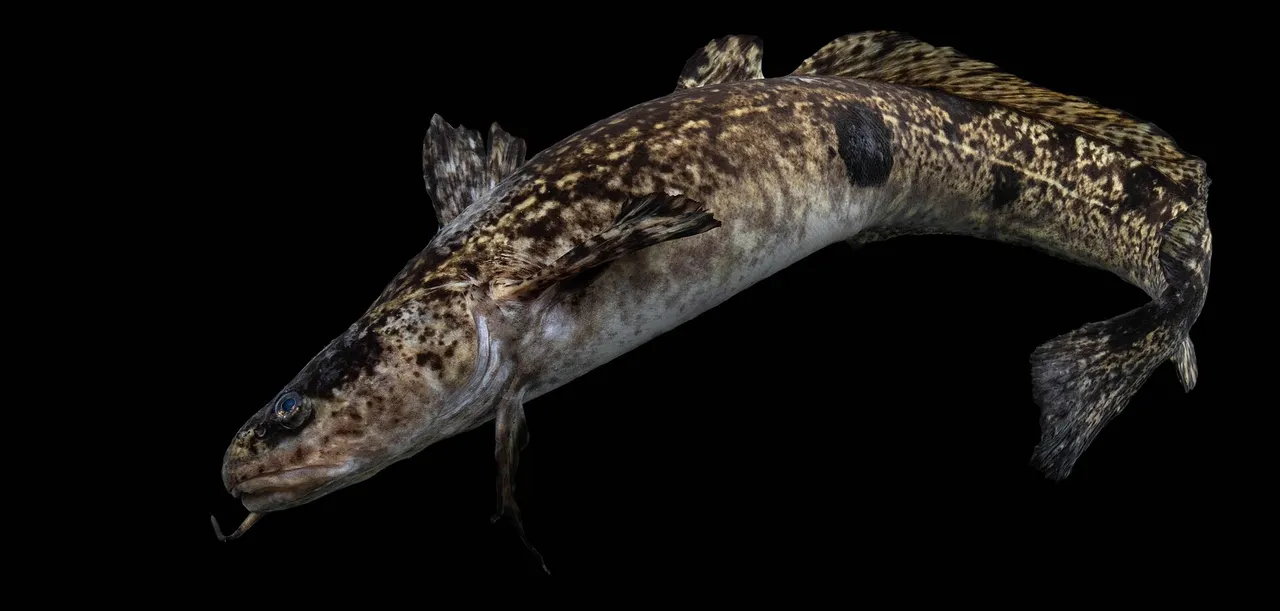
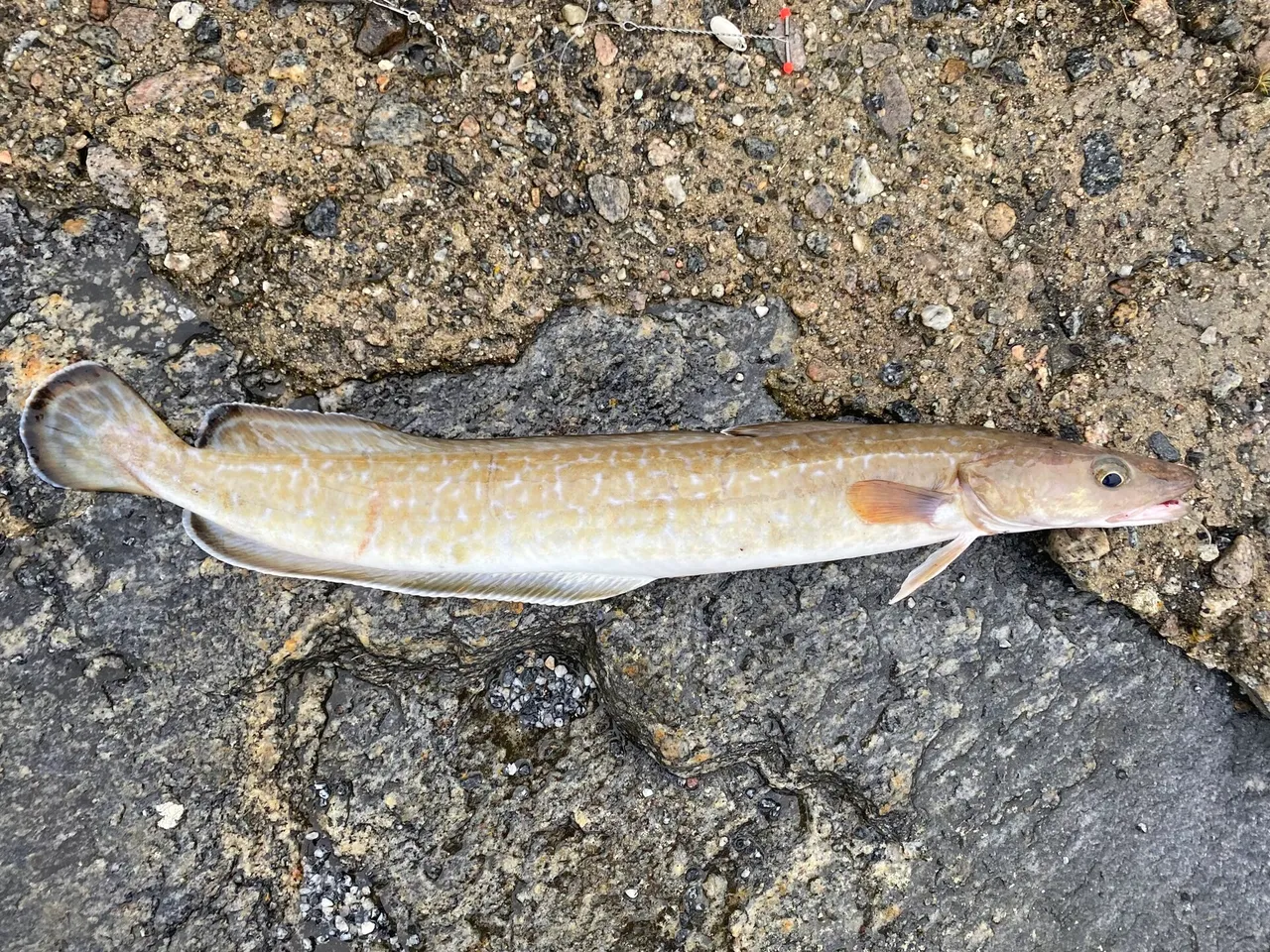
Burbot
Lota lota — Lotidae
_(52880431837).jpg)

The differences
Each difference is marked with how far it can be trusted on its own. A single diagnostic character settles the identification; suggestive ones only narrow it.
| Character | Burbot | Ling | Reliability |
|---|---|---|---|
| Fresh water or salt, and how deepRange | Fresh water only, circumarctic — rivers and cold lakes across northern Europe, Siberia and North America. It is the only gadid in fresh water, and it is extirpated from England. | The sea, and generally deep: hard ground, reefs and wrecks between roughly 100 and 400 m from the Barents Sea and Iceland south to Morocco. There is no overlap of any kind. | Diagnostic on its own |
| A dark spot at the back of each dorsal finIdentification | None. The fins carry the same mottled marbling as the body and nothing that reads as a discrete mark. | Present on both the first and the second dorsal fin, at the rear edge. On a fish coming over the gunwale it is the quickest mark on the animal. | Diagnostic on its own |
| The pattern on the bodyIdentification | Mottled dark marbling over yellow-brown, with very small embedded scales — a camouflage pattern for a nocturnal bottom fish. | Marbled brown to bronze above with a paler belly, but the effect is a wash rather than the strong dark network a burbot carries. | Supporting — use with others |
| The shape of the tailIdentification | Rounded, and the record notes this as unlike the forked tail of any similar freshwater fish. | Not rounded, and the whole rear of the fish is built differently — the fins are distinct and separate, which is what separates a ling from an eel as well as from a burbot. | Supporting — use with others |
| The size the fish reachesSize | Ordinary fish run half a kilo to two, a good one three to six, and FishBase records a maximum of 152 cm and 34 kg from the far north of the range. | Ordinary fish run three to eight kilos, large ones twelve to twenty, and the maximum published weight is 45 kg. A twenty-kilo fish on a wreck is a ling and nothing else. | Suggestive only — varies |
| When each one spawnsSpawning | Midwinter, frequently under ice, in shallow gravel or sand, in writhing spawning balls of many fish. That is a behaviour nothing marine does. | Spring and early summer, in deep water, broadcasting eggs with pelagic larvae. Slow growth and site fidelity mean a heavily fished wreck loses its large fish and does not quickly regain them. | Supporting — use with others |
Why it matters
The identification is easy and the naming is not, which reverses the usual problem. An angler searching for advice on 'ling' in North America will find burbot material — ice fishing, midwinter spawning, a nocturnal freshwater bottom fish — and an angler searching the same word in Europe will find deep wreck fishing at 100 to 400 m with pirks and heavy tackle. Nothing transfers between them: not the depth, not the season, not the tackle, and not the release position. Ling from those depths suffer severe barotrauma and cannot be released successfully, so what is retained is decided before the drop, and no freshwater burbot advice prepares anybody for that.
The full records
This page compares two species. Each of them has a complete record covering biology, behaviour, handling and the evidence behind all of it.
More about burbot
Where it lives, how it is caught, and what else it is confused with.
Similar and related fish
How it is caught
Gear for this fish
Where it lives
- Deep cold lakesThe only wholly freshwater cod, and a coldwater fish that occupies the deep cold layer of large lakes through summer and becomes accessible in shallow water in winter.
- Lowland riversHunts at night on the bottom of cold deep clean waters.
- Lowland stillwatersHunts at night on the bottom of cold deep clean waters.
Why the 7 connections on this page are here, and the sources
Similar and related fish
Backed by research — 1 connection
Supported by peer-reviewed research or fisheries science. The sources are listed and can be checked.
Ling
An identification comparison naming both binomials: Lota lota and Molva molva.
- FishBase: a global information system on fishes — Froese, R. and D. Pauly, eds. — FishBase Consortium (Scientific institute)Relied on for: Morphological and distributional data for Lota lota and for Molva molva.States this directlyPassage read and verified
- The IUCN Red List of Threatened Species — International Union for Conservation of Nature (Conservation authority)Relied on for: Separate assessments treating Lota lota and Molva molva as distinct species.States this directlyCitation checked — the work exists and is described correctly
How it is caught
What experienced anglers do — 2 connections
Widely and independently recommended by experienced anglers and specialist sources. This is real angling knowledge, not proof: controlled evidence for it is limited, and FishingHQ records it as convention rather than as a demonstrated effect.
Ice fishing
A practitioner claim about how Lota lota is commonly fished, following from where and how it feeds.
- General angling website restatements of established technique — Various (Credible secondary source)Relied on for: Widely restated practitioner accounts of fishing for burbot.Citation checked — the work exists and is described correctly
- Sea Angler — Bauer Media (Specialist angling publication)Relied on for: Practitioner treatment of the methods used for burbot and comparable species.Citation checked — the work exists and is described correctly
Ledgering
A practitioner claim about how Lota lota is commonly fished, following from where and how it feeds.
- General angling website restatements of established technique — Various (Credible secondary source)Relied on for: Widely restated practitioner accounts of fishing for burbot.Citation checked — the work exists and is described correctly
- Sea Angler — Bauer Media (Specialist angling publication)Relied on for: Practitioner treatment of the methods used for burbot and comparable species.Citation checked — the work exists and is described correctly
Gear for this fish
What experienced anglers do — 1 connection
Widely and independently recommended by experienced anglers and specialist sources. This is real angling knowledge, not proof: controlled evidence for it is limited, and FishingHQ records it as convention rather than as a demonstrated effect.
Sea deadbaits
A practitioner claim about tackle commonly used for Lota lota.
- General angling website restatements of established technique — Various (Credible secondary source)Relied on for: Widely restated practitioner accounts of this presentation for burbot.Citation checked — the work exists and is described correctly
- Angling Times — Bauer Media (Specialist angling publication)Relied on for: Practitioner treatment of comparable presentations for the species group.Citation checked — the work exists and is described correctly
Where it lives
Backed by research — 3 connections
Supported by peer-reviewed research or fisheries science. The sources are listed and can be checked.
Deep cold lakes
A claim that the species depends on the cold layer below the summer thermocline, which is a thermal-tolerance claim about the animal rather than an angling observation, and rests on the reference literature accordingly.
- Freshwater Fishes of the British Isles — HarperCollins (New Naturalist 75), 1992 (Reference work)Relied on for: Distribution, habitat association, thermal requirements and life history of the freshwater fishes of the British Isles and north-west Europe.States this directlyCitation checked — the work exists and is described correctly
- FishBase: a global information system on fishes — Froese, R. and D. Pauly, eds. — FishBase Consortium (Scientific institute)Relied on for: Recorded depth range, temperature tolerance and habitat association for the species.States this directlyPassage read and verified
Lowland rivers
A habitat association for Lota lota taken from the environment and distribution data on its FishBase summary.
- FishBase: a global information system on fishes — Froese, R. and D. Pauly, eds. — FishBase Consortium (Scientific institute)Relied on for: The environment, depth range and habitat description recorded for Lota lota.States this directlyPassage read and verified
Lowland stillwaters
A habitat association for Lota lota taken from the environment and distribution data on its FishBase summary.
- FishBase: a global information system on fishes — Froese, R. and D. Pauly, eds. — FishBase Consortium (Scientific institute)Relied on for: The environment, depth range and habitat description recorded for Lota lota.States this directlyPassage read and verified
Reviewed 2026-08-16. FishingHQ does not state what any rule is or where any rule applies. Where this page says the two species are managed differently, that is a reason to check the authority for the water you are on — not a statement of what it requires.