Ling
Fish · Last reviewed 2026-08-10
A long, eel-shaped gadoid of deep northern wrecks and rough ground, reaching over two metres and forty kilograms, and the classic wreck-fishing prize.
Safety: barotrauma and pressure injury — can cause serious injury or death. 5 more points apply here.
Barotrauma and pressure injury — Can cause serious injury or death
Fish brought up from wreck depths suffer catastrophic swim bladder expansion and cannot return, so release is largely ineffective.
What reduces it: Decide what will be kept before fishing. Do not fish for numbers on a mark whose population is finite and slow to replace. Where release matters, this is not the fishery for it.
Catching Ling
Everything here on fishing for it. Each entry opens the page behind it.
- Ground
- Where
- 16 places FishingHQ documents — strongest claim anywhere: regular local target · From the shore, From a boat, From a kayak, On a charter
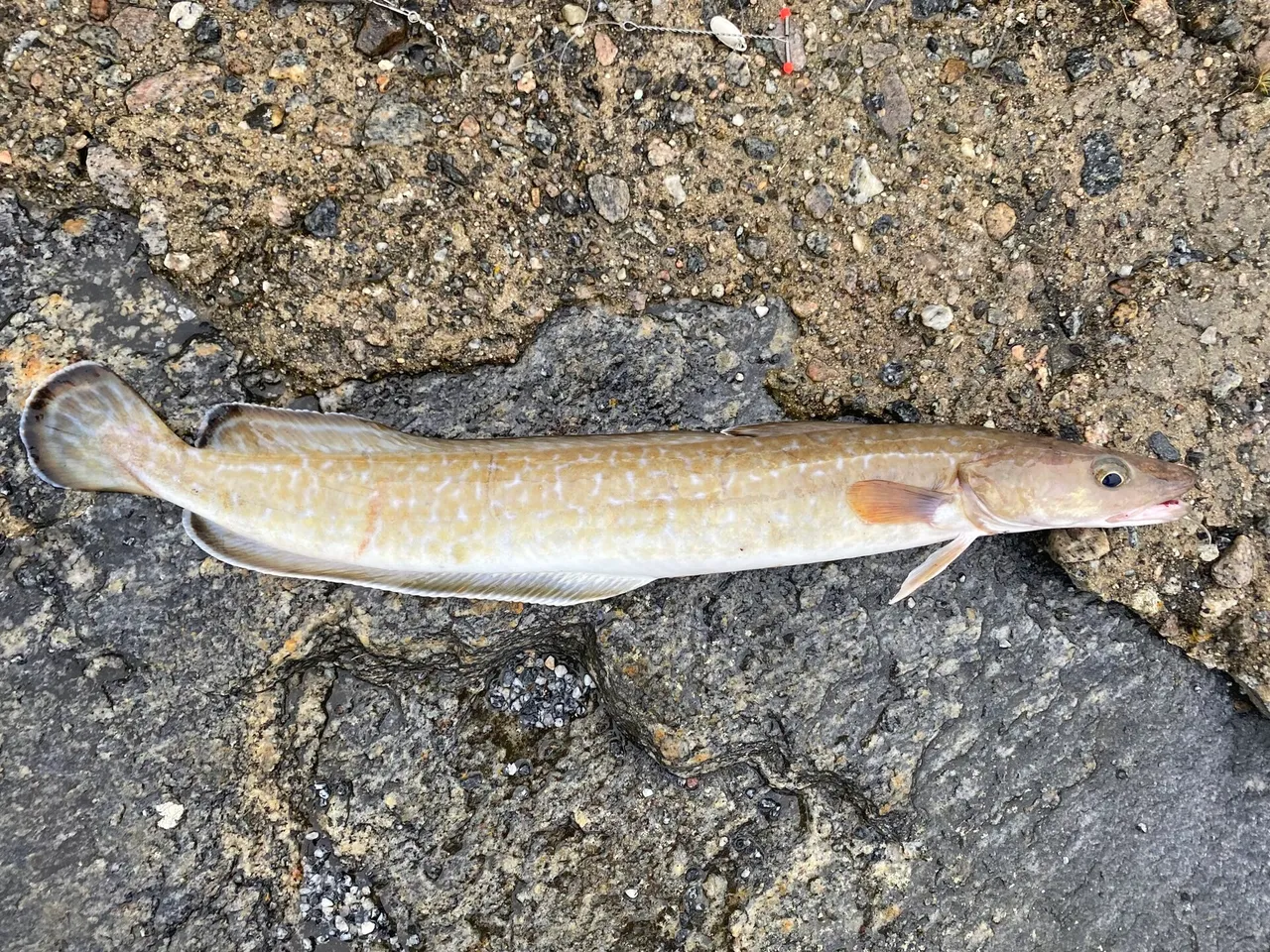
The ling is what happens when a cod becomes long. It belongs to the same broad group but is built quite differently: an elongate, almost eel-like body, a long soft second dorsal fin running most of the way to the tail, a single chin barbel and a large mouth full of sharp teeth.
It lives on and around hard structure in deep water — wrecks, reefs, rocky pinnacles — which makes it the definitive wreck-fishing target across northern Europe. Ling hold tight to the structure and take large baits and pirks, and they are strong enough that getting one out of a wreck before it gets back into it is the whole problem.
It reaches over two metres and forty kilograms, grows slowly, matures late and lives a long time, which is the familiar pattern for deep-water species and carries the familiar consequence: a large ling represents many years and local populations on a specific wreck can be depleted quickly.
The teeth deserve stating plainly. A ling has a mouth full of sharp backward-pointing teeth, and it is handled at the side of a boat in a sea. This is one of the sea species where careless handling reliably draws blood.
How it is caught
Where Ling is documented
Places where public sources describe this species as fished, with how it is fished and how strongly the evidence supports it. This is not a range map and it is not a recommendation — it is what has been written down about a fishery rather than a record of any individual catch, and being listed is never permission to fish.
The Moray Firth
2 documented places
Breakwater
Recorded here
From a boat
Harbour wall
Regular local target
From a boat
The Cornish and Devon coasts
2 documented places
Estuary mark
Occasional
From a kayak
Sea area
Repeatedly reported
On a charter · From a boat
Norway and the Nordic coast
4 documented places
Sound or strait
Recorded here
From a boat · On a charter
Island
Recorded here
From a boat · On a charter
Sea loch
Recorded here
From a boat
Offshore bank
Recorded here
From a boat · On a charter
East Lothian and the Firth of Forth coast
2 documented places
Headland
Recorded here
From the shore
Harbour wall
Recorded here
From the shore
Also documented on 2 more coasts
Fewer places each, or less strongly supported. Each one names its own marks.
What these strengths mean
- Recorded here
- At least one credible public account of this species being caught here. That is all it means.
- Occasional
- Caught here, and described as unusual rather than normal. Do not plan a session around it.
- Regular local target
- Fishing sources describe this as a normal local target here, not merely as caught.
- Repeatedly reported
- Several independent public accounts. Enough to say it happens more than once; not enough to call it a fishery.
Identification
- Scientific name
- Molva molva
- Family
- Lotidae
- Water
- Saltwater
- Conservation status
- Not assessed
- Regions
- Northern Europe, Britain & Ireland, Western Europe, Arctic & Subarctic, Mediterranean, North Africa
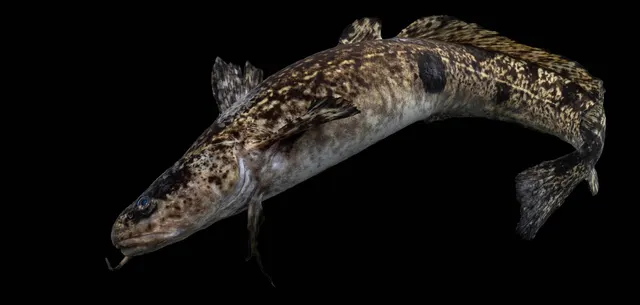
- Very elongate, almost eel-shaped body, quite unlike any other northern gadoid.
- Two dorsal fins, the second very long and running most of the way to the tail; a long anal fin mirrors it.
- A single prominent chin barbel.
- Marbled brown to bronze above with a paler belly, and a dark spot at the rear of both the first and second dorsal fins.
- Large mouth with sharp backward-pointing teeth. Separated from conger eel by the presence of pelvic fins and distinct separate fins.
Size
- Typical
- 3–8 kg (6.6–18 lb)
- Large
- 12–20 kg (26–44 lb)
Exceptional: Over 25 kg (55 lb); maximum published weight 45 kg
Teeth, depth and a fish that is all muscle behind the head
Ling combine three separate problems and boat anglers meet all of them in the same thirty seconds.
THE MOUTH holds bands of small, sharp, backward-set teeth on the jaws and on the roof, which grip rather than cut. A hand withdrawn from a ling's mouth is rasped and held. They are not conger teeth and they are not harmless.
THE BODY IS ELONGATED AND EXTREMELY POWERFUL, and a large ling on a deck behaves much like a conger: it convulses, and it does so after a period of apparent stillness. A fish held across the middle can produce a whole-body movement that nobody expects from something that looked finished.
THE DEPTH IS THE THIRD. Ling are taken from deep rough ground and suffer severe barotrauma. Large fish arriving from depth are often not viable release candidates, and a fish released at the surface floating will not survive. Where fish must be returned, recompression is the only option with evidence behind it.
HANDLING SEQUENCE. Control the head first, using a gloved hand behind the gill covers or a purpose tool, keep the body contained or on a wet surface, and use long pliers. Do not attempt to hold a large ling across the body without head control; that is the arrangement that produces injuries.
AND THE PRACTICAL CONSEQUENCE. Ling from deep water are largely a retention fishery, and the useful decision is made when choosing the mark and the size of hook rather than when the fish is on the deck.
What experienced anglers do — why, and the sources (2)
Widely and independently recommended by experienced anglers and specialist sources. This is real angling knowledge, not proof: controlled evidence for it is limited, and FishingHQ records it as convention rather than as a demonstrated effect.
- FishBase: a global information system on fishes — Froese, R. and D. Pauly, eds. — FishBase Consortium (Scientific institute)Relied on for: Dentition, fin and spine morphology, body form, air-breathing capability and distribution for the species, which are the anatomical facts the handling practice below follows from.States this directlyPassage read and verified
- General angling website restatements of established technique — Various (Credible secondary source)Relied on for: Widely restated angling practice for handling this species, recorded as practitioner consensus rather than as tested fact.Background and mechanism onlyCitation checked — the work exists and is described correctly
A wreck fish with almost no season and a very tight tidal window
Ling are the clearest case in British sea angling of a species whose fishing is governed by boat handling rather than by biology, and separating those two is the useful thing this section can do.
THE FISH ARE THERE ALL YEAR. Ling are deep-water structure dwellers — wrecks, pinnacles, rough ground, generally in substantial depth — and they occupy that structure permanently. They move to deeper water to spawn in the warmer half of the year in the north-east Atlantic, and outside that they are essentially resident. There is no inshore–offshore migration of the kind that shapes the cod or sole year, and no season in which a wreck stops holding ling.
SO WHY DOES THE FISHERY HAVE A RHYTHM? Because a boat has to hold position over a specific wreck in deep water, and that is only possible when the tidal stream permits it. Too much flow and a bait cannot be got down to the structure, let alone kept on it; the boat is carried off the mark before the gear reaches bottom. The window is therefore around slack water, and it is wider on neap tides than on springs.
THAT IS A CONSTRAINT ON THE VESSEL, NOT ON THE FISH, and the distinction matters because it is almost universally reported the other way round — as though ling feed at slack water. They do not particularly; slack water is when a boat can present a bait to them.
THE FISH ITSELF IS AN AMBUSH PREDATOR THAT DOES NOT LEAVE ITS STRUCTURE. Ling hold in and against the wreckage and take what comes within reach, which is why the fishing is vertical, why baits and lures are worked hard on the bottom, and why a presentation drifting ten metres above the wreck catches nothing at all.
WHICH GIVES THE PRACTICAL SUMMARY: the calendar barely matters, the tide table and the spring–neap cycle matter enormously, and the depth at which the bait is fished matters most of all.
What experienced anglers do — why, and the sources (4)
Widely and independently recommended by experienced anglers and specialist sources. This is real angling knowledge, not proof: controlled evidence for it is limited, and FishingHQ records it as convention rather than as a demonstrated effect.
- FishBase: a global information system on fishes — Froese, R. and D. Pauly, eds. — FishBase Consortium (Scientific institute)Relied on for: Depth range, migration, spawning season and temperature association recorded for the species.States this directlyPassage read and verified
- ICES Advice on fishing opportunities, catch and effort — International Council for the Exploration of the Sea (Scientific institute)Relied on for: Stock distribution, seasonal movement between spawning and feeding grounds, and the assessment basis for the stock.States this directlyCitation checked — the work exists and is described correctly
- The Fishes of the British Isles and North-West Europe — Macmillan, 1969 (Reference work)Relied on for: Seasonal distribution and inshore–offshore movement of fishes in British and north-west European waters.States this directlyCitation checked — the work exists and is described correctly
- Sea Angler — Bauer Media (Specialist angling publication)Relied on for: Established seasonal practice in the British and Irish shore and boat fisheries.Background and mechanism onlyCitation checked — the work exists and is described correctly
Deep rough ground and a fish that lives inside the wreck rather than over it
Ling habitat can be stated in one sentence and it is still worth expanding: deep, cold, hard, broken ground, and the deeper and rougher it is the better.
THE ANIMAL IS A CREVICE-DWELLING PREDATOR OF DEEP HARD BOTTOM. Ling occupy rocky reef, pinnacles, boulder ground and — very characteristically — wrecks, generally well down the shelf and onto the shelf edge. They are not a fish of open sand or of shallow inshore ground except as juveniles, and their vertical distribution is deep enough that most inshore angling never meets a large one.
WRECKS ARE THE CLEAREST CASE AND THEY EXPLAIN THE FISH. A wreck provides exactly what ling need: a large complex hard structure standing off a soft seabed, full of holes to lie in, in deep cold water, concentrating prey fish. Ling live *in* the structure rather than around it — inside the hull, under plating, in the internal spaces — and that is why the fishing for them is a vertical, tight-to-the-structure proposition and why tackle loss is part of the fishery. A wreck may hold a population of ling that a nearby open bottom of identical depth holds none of.
TEMPERATURE IS A HARD CONSTRAINT AND IT SETS THE SOUTHERN LIMIT. Ling are a cold-water species of the north-east Atlantic, and the shallower part of their range in southern waters is unsuitable — where the water is warm, the ling are deep. That is why the species is a northern and offshore fish through most of its British range and why it becomes progressively more accessible from the shore the further north the coast.
JUVENILE HABITAT IS SHALLOWER AND DIFFERENT. Young ling use inshore rough ground, kelp and shallow reef, and move progressively deeper as they grow. A small ling from a rock mark and a large one from a wreck sixty metres down are the same species doing different stages of the same life.
THE DIET FOLLOWS THE GROUND. Ling take fish, cephalopods and crustaceans from around and within the structure, and their abundance on a piece of ground tracks the prey the structure concentrates.
AND THE HABITAT EXPLAINS THE STOCK PROBLEM. A long-lived, slow-maturing, structure-bound predator that aggregates on known wrecks and pinnacles is trivially easy to locate and to fish out locally, and ling on individual marks are depleted far faster than the wider stock. Marks do not refill quickly, because the fish do not move much once settled.
Backed by research — why, and the sources (2)
Supported by peer-reviewed research or fisheries science. The sources are listed and can be checked.
- The Fishes of the British Isles and North-West Europe — Macmillan, 1969 (Reference work)Relied on for: Habitat association, depth and ground type of fishes in British and north-west European waters.States this directlyCitation checked — the work exists and is described correctly
- FishBase: a global information system on fishes — Froese, R. and D. Pauly, eds. — FishBase Consortium (Scientific institute)Relied on for: Habitat association, depth range and substrate preference recorded for the species.States this directlyPassage read and verified
A deep-water broadcast spawner whose big old females carry the stock
Ling reproduction is straightforward in mechanism and consequential in structure, and the consequence is the part worth understanding.
SPAWNING IS A BROADCAST EVENT ON DEEP HARD GROUND. Ling gather on deep offshore banks, ridges and rough ground in spring, releasing very large numbers of buoyant eggs into the water column. The eggs and larvae then drift in the upper layers for an extended period before the young fish settle onto shallower inshore rough ground and work their way deeper as they grow.
FECUNDITY SCALES STEEPLY WITH FEMALE SIZE, AND THAT IS THE KEY FACT. A large old female ling produces disproportionately more eggs than several smaller ones of the same combined weight, and the eggs are frequently of better quality — larger, better provisioned, producing larvae with better survival prospects. So the reproductive output of a ling population is concentrated in its biggest, oldest females.
WHICH IS WHY SIZE-SELECTIVE FISHING HAS AN OUTSIZED EFFECT HERE. Removing the large fish removes the majority of the reproductive capacity while removing a minority of the individuals, and a stock can look reasonably numerous while having lost most of its ability to replace itself. This is the general 'big old fat fecund female' problem, and ling are one of the clearest cases of it in the north-east Atlantic.
MATURITY IS LATE AND GROWTH IS SLOW BY INSHORE STANDARDS, so a ling reaching the size at which it contributes most has taken many years to get there and is not quickly replaced.
AGGREGATION MAKES IT WORSE. Spawning ling concentrate on known ground, which is exactly the ground that is fished, and a fishery operating on a spawning aggregation of large females is operating on the most valuable fish in the stock at the least forgiving moment.
AND THE JUVENILE HABITAT IS SOMEWHERE ELSE ENTIRELY, on shallow inshore rough ground and kelp, which means recruitment depends on inshore habitat that adult-focused management may never consider.
WHAT MAY BE TAKEN, WHERE AND WHEN IS AN ASSESSED AND REGULATED MATTER that differs between areas and is revised. The competent authority is the only source, and nothing above indicates it.
Backed by research — why, and the sources (2)
Supported by peer-reviewed research or fisheries science. The sources are listed and can be checked.
- ICES Advice on fishing opportunities, catch and effort — International Council for the Exploration of the Sea (Scientific institute)Relied on for: Stock assessment and advice, including spawning stock biomass, recruitment and the reproductive parameters the assessment rests on.States this directlyCitation checked — the work exists and is described correctly
- FishBase: a global information system on fishes — Froese, R. and D. Pauly, eds. — FishBase Consortium (Scientific institute)Relied on for: Spawning season, fecundity, maturity and larval development for the species.Background and mechanism onlyPassage read and verified
Lifecycle and reproduction
Slow-growing, late-maturing and long-lived, with maturity around five to eight years and a lifespan of well over twenty. Spawns in deep water in spring and early summer, producing very large numbers of pelagic eggs. Adults are strongly associated with specific hard structure and show considerable site fidelity, which means an individual wreck holds a finite and slowly replaced population.
Deep-water broadcast spawning in spring and early summer, with extremely high fecundity and pelagic eggs and larvae. Despite the fecundity, the species' slow growth and site fidelity mean that a heavily fished wreck loses its large fish and does not quickly regain them, which is the practical conservation point for an angler choosing where to fish and how often.
Feeding and senses
A predator taking fish — including other gadoids, flatfish and small ling — along with crustaceans and cephalopods, hunting from and around hard structure. The large mouth and sharp teeth suit seizing substantial prey, which is why large baits and heavy pirks work and why small baits fished for other species are frequently taken by ling anyway.
Adapted to the low light of deep water, with the barbel and lateral line contributing substantially to prey detection alongside sight. Ling hold in and around structure and take prey that comes close, which is an ambush strategy suited to the sensory environment rather than a preference.
Through the year
Present on structure year-round, with movement to deeper water for spawning in spring and early summer. The recreational fishery is largely tide-driven rather than season-driven: a wreck fishes when the tide is right for holding position over it, which for most marks means around slack water on smaller tides.
Distribution
North East Atlantic: from the Barents Sea and Iceland south to Morocco, including the North Sea and the western Mediterranean, on hard ground and around wrecks and reefs generally between about 100 and 400 m.
This is a biological range — where the species occurs, not a prediction that you will catch one. To browse the fishing geography FishingHQ holds, start at fishing places.
Why anglers care
The classic northern European wreck-fishing target, taken on large baits and heavy pirks fished tight to structure. Highly regarded and strong enough that heavy tackle is required rather than preferred. A significant commercial species as well, and one where local depletion of individual marks is a real and observable effect.
Handling and returning
A mouth full of sharp backward-pointing teeth on a large powerful fish handled at boatside in a sea. Never put a hand in the mouth. Use long pliers or a de-hooking tool with the fish controlled, and gloves for handling. Fish from these depths suffer severe barotrauma and cannot be released successfully, so the decision about what to retain is effectively made before the drop.
Going further
- What does ling eat? — feeding biology, kept separate from what anglers infer from it.
- Ling vs Burbot — how to tell them apart.
Safety
Barotrauma and pressure injury is set out at the top of this page, where it cannot be missed.
Species that bite — Can cause injury needing treatment
Sharp backward-pointing teeth in a large mouth, on a strong fish handled on a moving deck.
What reduces it: Never put a hand in the mouth. Control the fish before unhooking, use long pliers or a de-hooking tool, and wear gloves.
Precautions that always apply here
- Wear a buoyancy aid or lifejacket. Cold water incapacitates strong swimmers within a minute, long before swimming ability matters.
- Keep fingers out of the gills and clear of the teeth. Gill damage is usually fatal to the fish, and several species will remove skin from a finger.
- Tell somebody where you are going and when you expect to be back.
- Carry a charged phone in a waterproof case, or another means of calling for help.
Check the rules before you fish
Fishing laws, bylaws, access rules, seasons, bait restrictions and permitted methods vary by location and can change. Check the current rules from the relevant authority and the water you intend to fish before fishing.
Check with:
- Current national or regional law for where you are fishing
- Current local bylaws
- The relevant fisheries authority
- The landowner, club or fishery whose water it is
- Any restrictions specific to the species or the method you intend to use
Where to go next
Similar and related fish

Where it lives
Where you will find it
Understanding this fish
Sources and evidence
- FishBase: a global information system on fishes — Froese, R. and D. Pauly, eds. — FishBase Consortium (Scientific institute)Relied on for: Scientific name, family placement in the Lotidae, a maximum length of 200 cm TL, a maximum published weight of 45.0 kg, a maximum reported age of 25 years.States this directlyPassage read and verified
- FishBase: a global information system on fishes — Froese, R. and D. Pauly, eds. — FishBase Consortium (Scientific institute)Relied on for: Environment, climate zone and depth range as recorded: Marine; demersal; oceanodromous ; depth range 100 - 1000 m , usually 100 - 400 m . Temperate; 75°N - 35°N, 55°W - 44°EStates this directlyPassage read and verified
- ICES Advice on fishing opportunities, catch and effort — International Council for the Exploration of the Sea (Scientific institute)Relied on for: That North East Atlantic demersal stocks are assessed through international scientific advice feeding management.States this directlyCitation checked — the work exists and is described correctly
- Good Fish Guide — Marine Conservation Society (Conservation authority)Relied on for: That slow growth, late maturity and site fidelity are material to whether a local population can sustain harvest.FishingHQ's interpretation of what it saysCitation checked — the work exists and is described correctly
Why the 8 connections on this page are here, and the sources
Similar and related fish
Backed by research — 2 connections
Supported by peer-reviewed research or fisheries science. The sources are listed and can be checked.
Atlantic herring
Recorded diet evidence identifies Clupea harengus as a food item of this predator at species level. The edge is written at that granularity and no further.
- FishBase: a global information system on fishes — Froese, R. and D. Pauly, eds. — FishBase Consortium (Scientific institute)Relied on for: Food items recorded for this predator, including Clupea harengus.States this directlyPassage read and verified
- FAO Species Identification Guides for Fishery Purposes and the FAO Species Catalogues — Food and Agriculture Organization of the United Nations (Scientific institute)Relied on for: Species account describing the diet of this predator in the region where Clupea harengus occurs.Background and mechanism onlyCitation checked — the work exists and is described correctly
Burbot
An identification comparison naming both binomials: Lota lota and Molva molva.
- FishBase: a global information system on fishes — Froese, R. and D. Pauly, eds. — FishBase Consortium (Scientific institute)Relied on for: Morphological and distributional data for Lota lota and for Molva molva.States this directlyPassage read and verified
- The IUCN Red List of Threatened Species — International Union for Conservation of Nature (Conservation authority)Relied on for: Separate assessments treating Lota lota and Molva molva as distinct species.States this directlyCitation checked — the work exists and is described correctly
How it is caught
What experienced anglers do — 2 connections
Widely and independently recommended by experienced anglers and specialist sources. This is real angling knowledge, not proof: controlled evidence for it is limited, and FishingHQ records it as convention rather than as a demonstrated effect.
Drift fishing
The page names wreck fishing as the defining fishery and notes that local depletion of individual marks is a real and observable effect — which is a fact about drifting a known wreck repeatedly.
- Sea Angler — Bauer Media (Specialist angling publication)Relied on for: Documents which fishery and which technique takes this species.States this directlyCitation checked — the work exists and is described correctly
- FishBase: a global information system on fishes — Froese, R. and D. Pauly, eds. — FishBase Consortium (Scientific institute)Relied on for: Independently corroborates the species' recreational capture and range.Background and mechanism onlyPassage read and verified
Jigging
The page names heavy pirks alongside large baits, and says the fish is strong enough that heavy tackle is required rather than preferred.
- Sea Angler — Bauer Media (Specialist angling publication)Relied on for: Documents which fishery and which technique takes this species.States this directlyCitation checked — the work exists and is described correctly
- FishBase: a global information system on fishes — Froese, R. and D. Pauly, eds. — FishBase Consortium (Scientific institute)Relied on for: Independently corroborates the species' recreational capture and range.Background and mechanism onlyPassage read and verified
Gear for this fish
What experienced anglers do — 1 connection
Widely and independently recommended by experienced anglers and specialist sources. This is real angling knowledge, not proof: controlled evidence for it is limited, and FishingHQ records it as convention rather than as a demonstrated effect.
Metal jigs
A practitioner claim about which lure family answers this species' feeding or holding behaviour.
- Sea Angler — Bauer Media (Specialist angling publication)Relied on for: Established shore and boat lure practice for the species in north-west European seas.States this directlyCitation checked — the work exists and is described correctly
- General angling website restatements of established technique — Various (Credible secondary source)Relied on for: Widely restated lure selection for this species, recorded as practitioner consensus rather than as tested fact.Background and mechanism onlyCitation checked — the work exists and is described correctly
Where it lives
Backed by research — 1 connection
Supported by peer-reviewed research or fisheries science. The sources are listed and can be checked.
Inshore ground
A habitat claim held to a scientific standard.
- FishBase: a global information system on fishes — Froese, R. and D. Pauly, eds. — FishBase Consortium (Scientific institute)Relied on for: That Molva molva is a marine demersal species of the North East Atlantic associated with hard ground, generally between about 100 and 400 m.States this directlyPassage read and verified
Where you will find it
Backed by research — 1 connection
Supported by peer-reviewed research or fisheries science. The sources are listed and can be checked.
Shetland
A distribution association between an animal and a kind of water, rather than a claim about any named mark.
- The Fishes of the British Isles and North-West Europe — Macmillan, 1969 (Reference work)Relied on for: Distribution, habitat association, depth and ground preference of fishes in British and north-west European waters.States this directlyCitation checked — the work exists and is described correctly
- FishBase: a global information system on fishes — Froese, R. and D. Pauly, eds. — FishBase Consortium (Scientific institute)Relied on for: Distribution, habitat association and depth range recorded for the species.Background and mechanism onlyPassage read and verified
Understanding this fish
Backed by research — 1 connection
Supported by peer-reviewed research or fisheries science. The sources are listed and can be checked.
Decapod crustaceans as prey
Recorded diet evidence identifies decapod crustaceans as a food item of this predator at group level rather than to species. The edge points at the taxon record for that reason, and encoding it as a species-level claim would assert something the source does not.
- FishBase: a global information system on fishes — Froese, R. and D. Pauly, eds. — FishBase Consortium (Scientific institute)Relied on for: Food items recorded for this predator, given as decapod crustaceans.States this directlyPassage read and verified
- FAO Species Identification Guides for Fishery Purposes and the FAO Species Catalogues — Food and Agriculture Organization of the United Nations (Scientific institute)Relied on for: Species account describing this predator's diet, recorded at the level of decapod crustaceans.Background and mechanism onlyCitation checked — the work exists and is described correctly
How FishingHQ labels evidence is explained in the evidence policy.