How to identify ling
Molva molva · Lotidae
The characters that identify ling, ranked by how far each one can be trusted on its own.
Safety: barotrauma and pressure injury — can cause serious injury or death. One more point applies here.
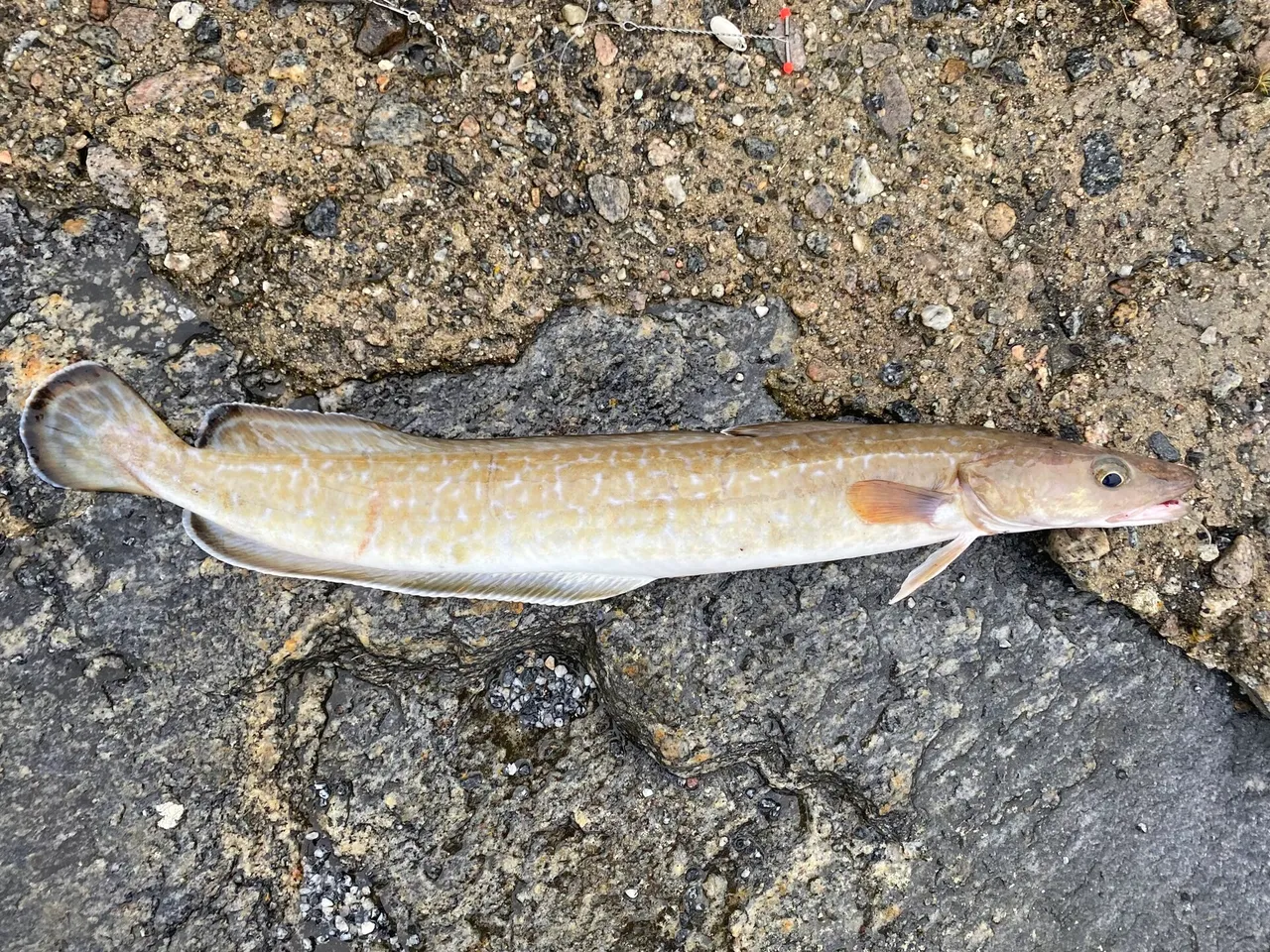
How this was identified, and who took it
Identified by: Whole fish in lateral view on wet rock. The very long second dorsal and anal fins, the rounded dark-margined tail, the chin barbel and the marbled gold flank are all legible.Vsevolod — CC BY 4.0, via Wikimedia Commons — source, licenceLook at this first
The shape settles it before any detail does. A ling is long and almost eel-like, quite unlike the deep-bodied northern gadoids, and it carries a second dorsal fin that runs most of the way to the tail. Nothing else in northern waters looks like it.
Diagnostic — settles it on its own
Each of these settles the identification on its own. If one is clear, you have your answer.
A very long second dorsal fin
Two dorsal fins, the first short and the second running back along most of the body towards the tail, mirrored below by a similarly long anal fin. Cod, haddock, pollack and saithe all have three dorsals and two anals, so the count alone separates ling from every one of them.
Pelvic fins present, and separate fins throughout
The character that separates ling from conger eel, which is the other long dark fish taken on the same wrecks. A conger has no pelvic fins and its dorsal, tail and anal fins are continuous; a ling has pelvics under the throat and distinct separate fins.
Supporting — use with other characters
Real characters that are not conclusive by themselves. Use two or three together.
A single prominent chin barbel
One clear whisker under the jaw, as in cod. Combined with the elongate body it is conclusive, and it is another point of separation from conger, which has none.
A dark spot at the rear of each dorsal fin
Both the first and the second dorsal carry a dark mark at the trailing edge. Consistent enough to be worth checking and not something to rely on alone.
Suggestive only — varies with condition
Hints only. These vary with condition, season, water and how long the fish has been out of it, and a fish that contradicts them is still the same species.
Marbled brown and bronze above
Attractive and variable. Ling from deep water are paler, and the marbling fades in a dead fish.
What it gets confused with
- Conger eel, which is the serious confusion on a wreck. Pelvic fins and separate fins settle it.
- Burbot, in fresh water — the only freshwater member of the family, and not found in the same places.
- Small ling and large whiting, briefly, until the fin count is checked.
Side by side: Ling vs Burbot.
Where this stops working
The identification is easy in an adult and less so in a small fish, where the body is proportionally deeper and the second dorsal less obviously elongate. Nothing here depends on colour. A ling that has been gaffed or badly handled can lose the dorsal spots, which is why the fin arrangement leads.
The full record
This page covers identification only. The Ling record covers behaviour, lifecycle, distribution, handling and the sources behind all of it.
Reviewed 2026-08-13.
More about this fish
Telling it apart is one question. Here are the others.
Similar and related fish
How it is caught
Where it lives
Where you will find it
Why the 6 connections on this page are here, and the sources
Similar and related fish
Backed by research — 2 connections
Supported by peer-reviewed research or fisheries science. The sources are listed and can be checked.
Atlantic herring
Recorded diet evidence identifies Clupea harengus as a food item of this predator at species level. The edge is written at that granularity and no further.
- FishBase: a global information system on fishes — Froese, R. and D. Pauly, eds. — FishBase Consortium (Scientific institute)Relied on for: Food items recorded for this predator, including Clupea harengus.States this directlyPassage read and verified
- FAO Species Identification Guides for Fishery Purposes and the FAO Species Catalogues — Food and Agriculture Organization of the United Nations (Scientific institute)Relied on for: Species account describing the diet of this predator in the region where Clupea harengus occurs.Background and mechanism onlyCitation checked — the work exists and is described correctly
Burbot
An identification comparison naming both binomials: Lota lota and Molva molva.
- FishBase: a global information system on fishes — Froese, R. and D. Pauly, eds. — FishBase Consortium (Scientific institute)Relied on for: Morphological and distributional data for Lota lota and for Molva molva.States this directlyPassage read and verified
- The IUCN Red List of Threatened Species — International Union for Conservation of Nature (Conservation authority)Relied on for: Separate assessments treating Lota lota and Molva molva as distinct species.States this directlyCitation checked — the work exists and is described correctly
How it is caught
What experienced anglers do — 2 connections
Widely and independently recommended by experienced anglers and specialist sources. This is real angling knowledge, not proof: controlled evidence for it is limited, and FishingHQ records it as convention rather than as a demonstrated effect.
Drift fishing
The page names wreck fishing as the defining fishery and notes that local depletion of individual marks is a real and observable effect — which is a fact about drifting a known wreck repeatedly.
- Sea Angler — Bauer Media (Specialist angling publication)Relied on for: Documents which fishery and which technique takes this species.States this directlyCitation checked — the work exists and is described correctly
- FishBase: a global information system on fishes — Froese, R. and D. Pauly, eds. — FishBase Consortium (Scientific institute)Relied on for: Independently corroborates the species' recreational capture and range.Background and mechanism onlyPassage read and verified
Jigging
The page names heavy pirks alongside large baits, and says the fish is strong enough that heavy tackle is required rather than preferred.
- Sea Angler — Bauer Media (Specialist angling publication)Relied on for: Documents which fishery and which technique takes this species.States this directlyCitation checked — the work exists and is described correctly
- FishBase: a global information system on fishes — Froese, R. and D. Pauly, eds. — FishBase Consortium (Scientific institute)Relied on for: Independently corroborates the species' recreational capture and range.Background and mechanism onlyPassage read and verified
Where it lives
Backed by research — 1 connection
Supported by peer-reviewed research or fisheries science. The sources are listed and can be checked.
Inshore ground
A habitat claim held to a scientific standard.
- FishBase: a global information system on fishes — Froese, R. and D. Pauly, eds. — FishBase Consortium (Scientific institute)Relied on for: That Molva molva is a marine demersal species of the North East Atlantic associated with hard ground, generally between about 100 and 400 m.States this directlyPassage read and verified
Where you will find it
Backed by research — 1 connection
Supported by peer-reviewed research or fisheries science. The sources are listed and can be checked.
Shetland
A distribution association between an animal and a kind of water, rather than a claim about any named mark.
- The Fishes of the British Isles and North-West Europe — Macmillan, 1969 (Reference work)Relied on for: Distribution, habitat association, depth and ground preference of fishes in British and north-west European waters.States this directlyCitation checked — the work exists and is described correctly
- FishBase: a global information system on fishes — Froese, R. and D. Pauly, eds. — FishBase Consortium (Scientific institute)Relied on for: Distribution, habitat association and depth range recorded for the species.Background and mechanism onlyPassage read and verified
Safety
Barotrauma and pressure injury is set out at the top of this page, where it cannot be missed.
Species that bite — Can cause injury needing treatment
Sharp backward-pointing teeth in a large mouth, on a strong fish handled on a moving deck.
What reduces it: Never put a hand in the mouth. Control the fish before unhooking, use long pliers or a de-hooking tool, and wear gloves.