What does ling eat?
What is established about how ling feeds, kept separate from what anglers infer from it.
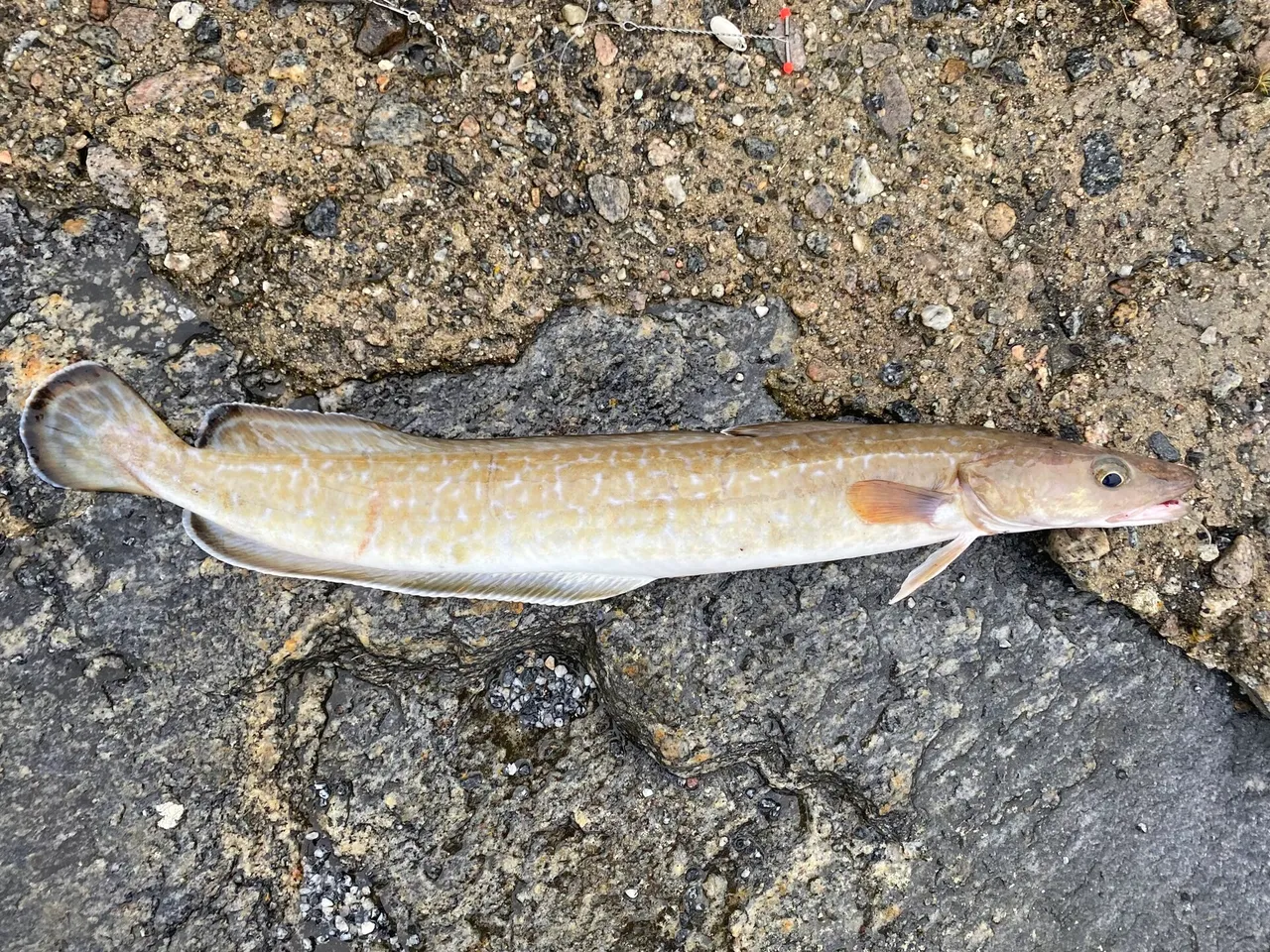
How this was identified, and who took it
Identified by: Whole fish in lateral view on wet rock. The very long second dorsal and anal fins, the rounded dark-margined tail, the chin barbel and the marbled gold flank are all legible.Vsevolod — CC BY 4.0, via Wikimedia Commons — source, licenceWhat is known about how it feeds
Ling occupy structure and let the food come close. The mouth is large, the teeth are sharp and recurved, and the fish is built to seize substantial prey at short range rather than to run it down.
The two verified relationships reflect the two halves of what passes within reach: herring, standing for the shoaling fish that move over and around deep structure, and decapod crustaceans taken on and around the rough ground itself. Other gadoids, flatfish and smaller ling all appear in the diet, and the cannibalism is not incidental.
Depth shapes the sensory arrangement. In the low light of deep water the barbel and the lateral line contribute substantially alongside sight, which is the profile of a fish that detects rather than watches.
The result reads as ambush and is better described as opportunism constrained by habitat. A ling is not hiding; it is living where it lives, and the hunting strategy follows from that.
Size is the other variable that matters. Ling grow large and grow slowly, and a big fish takes prey that would be implausible for the same species at half the length. As with most long-lived deep-water predators, the largest individuals represent many years of accumulation in a population that produces few of them.
The food
Prey with a verified dietary link to this fish. Each entry carries its own evidence, and each is written at the precision the source actually used: a named species where the source named one, a group or food category where it said “polychaetes”, “crustaceans” or “detritus” and meant it. That is why this list is shorter than the animal’s real diet rather than longer.
- Atlantic herring — Clupea harengus
Ling take herring and other shoaling fish that come within reach of the structure they hold on, rather than hunting them in open water.
- Decapod crustaceans as prey — a group rather than a species: the evidence names the group
Crustaceans make up a substantial part of the diet, particularly in smaller fish and on rough ground where crabs are abundant.
Food with no page of its own here yet
These are real components of the diet, listed as plain text because FishingHQ has no page for them yet. Inventing pages to make the list look fuller would be the fabrication this whole approach exists to prevent.
- pouting, poor cod and other small gadoids
- flatfish
- squid
- smaller ling (cannibalism)
- starfish
What anglers do with this
Everything below is interpretation, not finding. It is what experienced anglers conclude from the biology above, and the reasoning is usually sound and almost never tested. It is separated from the biology deliberately.
The association with structure means the fishery is a wreck and reef fishery, and that is a direct consequence of the biology rather than a tactical choice.
The large mouth and the size of the prey recorded are the reasoning behind using substantial baits, and the same anatomy explains why ling are so frequently taken by accident on offerings intended for other species. Both are convention.
The fight has a specific character that follows from where the fish lives: a hooked ling makes for the structure, and everything about how it is played is decided by that. It is a mechanical fact rather than an interpretation.
The slow growth and the age of large fish are the argument for restraint that the conservation bodies make, and it is worth reading alongside the catch rather than after it.
What this does not establish
The crustacean relationship is group-level, and the herring relationship stands for a broader group of shoaling fish. Diet composition varies with depth, structure and fish size, and the fish component is much broader than one species. Nothing here establishes proportions.
Where this connects
These are the baits, lures, methods and explainers FishingHQ already joins to this fish — which is why the list is sometimes short. They are not chosen for this page, and a link here means an evidenced relationship exists, not that it follows from the diet.
Lures recorded for this species
Methods used for it
Where it lives
This page covers feeding. The Ling record covers identification, lifecycle, seasonal behaviour, handling and the sources behind all of it.
Reviewed 2026-08-12.