How to identify burbot
Lota lota · Lotidae
The characters that identify burbot, ranked by how far each one can be trusted on its own.
Safety: hypothermia — can cause injury needing treatment.
How this was identified, and who took it
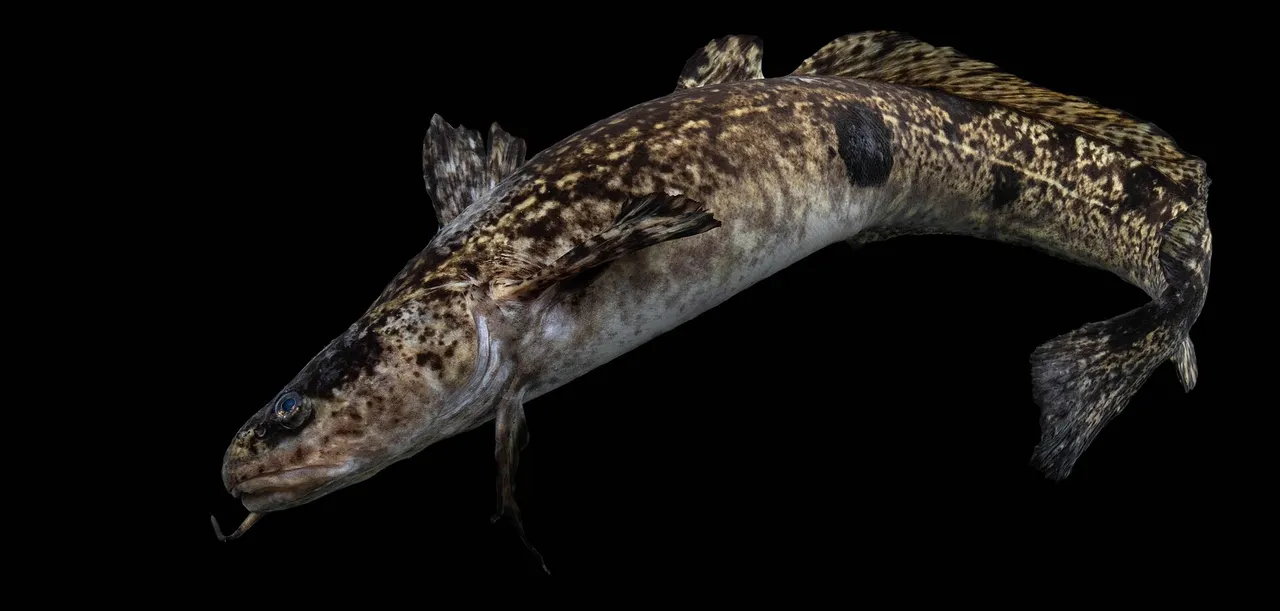
Identified by: Identified on a combination nothing else in fresh water carries: a SINGLE chin barbel, a short first dorsal followed by a very long second dorsal running most of the back, a long anal fin, a rounded caudal and a marbled yellow-brown pattern. Burbot is the only freshwater cod, and this fin arrangement with one barbel cannot be a catfish, eelpout or loach. Whole animal on a plain background, by a named agency photographer.U.S. Fish and Wildlife Service — public domain, via Wikimedia Commons — source, licenceLook at this first
Look under the chin. A burbot has a single barbel hanging from the point of the lower jaw, and behind it two dorsal fins — a short one followed by a very long one running most of the back. Nothing else in fresh water carries that combination.
Diagnostic — settles it on its own
Each of these settles the identification on its own. If one is clear, you have your answer.
One barbel at the point of the chin
A single fleshy barbel hangs from the tip of the lower jaw. Catfish carry barbels in pairs around the mouth and have no scales; a loach has several short ones and no long second dorsal. One central chin barbel, on a scaled fish with two dorsal fins, is burbot and nothing else.
A short first dorsal and a very long second
The first dorsal fin is short and rounded; the second runs from just behind it almost to the tail. The anal fin mirrors it below. This is the fin arrangement of a cod, which is what a burbot is — the only member of the family that lives its whole life in fresh water.
Supporting — use with other characters
Real characters that are not conclusive by themselves. Use two or three together.
A rounded tail, not a forked one
The caudal fin is rounded and continuous in outline with the long dorsal and anal fins, giving the back half of the fish an eel-like look. Every superficially similar freshwater fish of the same size — pike, catfish, eel — differs here.
Suggestive only — varies with condition
Hints only. These vary with condition, season, water and how long the fish has been out of it, and a fish that contradicts them is still the same species.
Marbled yellow-brown mottling
The body carries a marbled or camouflage pattern in yellow, olive and dark brown, strongest on the back and fading on the belly. It varies a great deal with water and habitat, which is why it sits below the structural characters rather than beside them.
What it gets confused with
- Catfish, at a glance and in poor light. Count the barbels: burbot has one, on the chin; catfish have several, in pairs.
- Eels, from the shape of the back half. An eel has no separate dorsal, anal and tail fins — they form one continuous fringe — and no barbels at all.
- Loaches in small sizes, which have several short barbels and no long second dorsal fin.
Side by side: Burbot vs Ling.
Where this stops working
The colour pattern is the least reliable part of the description and varies enough between waters that two burbot from different systems can look like different fish. Very small burbot are darker and less marbled. The identification does not depend on any of it: the chin barbel and the two dorsals settle the fish at any size, in any condition, and are worth looking for first rather than last. Burbot has also been lost from much of its former range in western Europe, including Britain, so a claimed burbot outside its current range deserves a photograph.
The full record
This page covers identification only. The Burbot record covers behaviour, lifecycle, distribution, handling and the sources behind all of it.
Reviewed 2026-08-15.
More about this fish
Telling it apart is one question. Here are the others.
Similar and related fish
How it is caught
Where it lives
- Deep cold lakesThe only wholly freshwater cod, and a coldwater fish that occupies the deep cold layer of large lakes through summer and becomes accessible in shallow water in winter.
- Lowland riversHunts at night on the bottom of cold deep clean waters.
- Lowland stillwatersHunts at night on the bottom of cold deep clean waters.
Where you will find it
- Lake VänernA cold-water fish with a winter following, taken through the ice where conditions allow and largely ignored in summer.
- The Baltic SeaPresent in the low-salinity northern and eastern gulfs and a significant winter target through the ice there.
- The Baltic statesThe only freshwater cod, spawning under ice in midwinter, and one of the few European fisheries deliberately prosecuted in the coldest part of the year.
- The Finnish lake districtGenuinely important here rather than a curiosity: most active and most catchable in the coldest months, spawning under ice in midwinter, and a target of set lines and night fishing through the ice.
Why the 10 connections on this page are here, and the sources
Similar and related fish
Backed by research — 1 connection
Supported by peer-reviewed research or fisheries science. The sources are listed and can be checked.
Ling
An identification comparison naming both binomials: Lota lota and Molva molva.
- FishBase: a global information system on fishes — Froese, R. and D. Pauly, eds. — FishBase Consortium (Scientific institute)Relied on for: Morphological and distributional data for Lota lota and for Molva molva.States this directlyPassage read and verified
- The IUCN Red List of Threatened Species — International Union for Conservation of Nature (Conservation authority)Relied on for: Separate assessments treating Lota lota and Molva molva as distinct species.States this directlyCitation checked — the work exists and is described correctly
How it is caught
What experienced anglers do — 2 connections
Widely and independently recommended by experienced anglers and specialist sources. This is real angling knowledge, not proof: controlled evidence for it is limited, and FishingHQ records it as convention rather than as a demonstrated effect.
Ice fishing
A practitioner claim about how Lota lota is commonly fished, following from where and how it feeds.
- General angling website restatements of established technique — Various (Credible secondary source)Relied on for: Widely restated practitioner accounts of fishing for burbot.Citation checked — the work exists and is described correctly
- Sea Angler — Bauer Media (Specialist angling publication)Relied on for: Practitioner treatment of the methods used for burbot and comparable species.Citation checked — the work exists and is described correctly
Ledgering
A practitioner claim about how Lota lota is commonly fished, following from where and how it feeds.
- General angling website restatements of established technique — Various (Credible secondary source)Relied on for: Widely restated practitioner accounts of fishing for burbot.Citation checked — the work exists and is described correctly
- Sea Angler — Bauer Media (Specialist angling publication)Relied on for: Practitioner treatment of the methods used for burbot and comparable species.Citation checked — the work exists and is described correctly
Where it lives
Backed by research — 3 connections
Supported by peer-reviewed research or fisheries science. The sources are listed and can be checked.
Deep cold lakes
A claim that the species depends on the cold layer below the summer thermocline, which is a thermal-tolerance claim about the animal rather than an angling observation, and rests on the reference literature accordingly.
- Freshwater Fishes of the British Isles — HarperCollins (New Naturalist 75), 1992 (Reference work)Relied on for: Distribution, habitat association, thermal requirements and life history of the freshwater fishes of the British Isles and north-west Europe.States this directlyCitation checked — the work exists and is described correctly
- FishBase: a global information system on fishes — Froese, R. and D. Pauly, eds. — FishBase Consortium (Scientific institute)Relied on for: Recorded depth range, temperature tolerance and habitat association for the species.States this directlyPassage read and verified
Lowland rivers
A habitat association for Lota lota taken from the environment and distribution data on its FishBase summary.
- FishBase: a global information system on fishes — Froese, R. and D. Pauly, eds. — FishBase Consortium (Scientific institute)Relied on for: The environment, depth range and habitat description recorded for Lota lota.States this directlyPassage read and verified
Lowland stillwaters
A habitat association for Lota lota taken from the environment and distribution data on its FishBase summary.
- FishBase: a global information system on fishes — Froese, R. and D. Pauly, eds. — FishBase Consortium (Scientific institute)Relied on for: The environment, depth range and habitat description recorded for Lota lota.States this directlyPassage read and verified
Where you will find it
Backed by research — 4 connections
Supported by peer-reviewed research or fisheries science. The sources are listed and can be checked.
Lake Vänern
A distributional claim taken from reference works and databases on the fishes of the region rather than from angling report. It states presence and asserts nothing about a fishery.
- FishBase: a global information system on fishes — Froese, R. and D. Pauly, eds. — FishBase Consortium (Scientific institute)Relied on for: Distribution, habitat association, life history and size recorded for the species concerned.States this directlyPassage read and verified
- Freshwater Fishes of the British Isles — HarperCollins (New Naturalist 75), 1992 (Reference work)Relied on for: Biology, distribution, life history and conservation status of northern European freshwater and diadromous fishes.States this directlyCitation checked — the work exists and is described correctly
The Baltic Sea
Occurrence of the species in this system or along this coast: a statement about the animal's distribution, not a venue recommendation.
- Freshwater Fishes of the British Isles — HarperCollins (New Naturalist 75), 1992 (Reference work)Relied on for: Distribution and habitat association of European freshwater fishes, including their occurrence in brackish and coastal waters.States this directlyCitation checked — the work exists and is described correctly
- FishBase: a global information system on fishes — Froese, R. and D. Pauly, eds. — FishBase Consortium (Scientific institute)Relied on for: Salinity tolerance and distribution recorded for the species.States this directlyPassage read and verified
The Baltic states
That a species occurs in these waters, drawn from distribution science and stock assessment. It is a statement about where the animal lives and is not a statement that anybody will catch one, still less where.
- Freshwater Fishes of the British Isles — HarperCollins (New Naturalist 75), 1992 (Reference work)Relied on for: Distribution, habitat requirement and life history of European freshwater fishes, including their occurrence across the continental range named.States this directlyCitation checked — the work exists and is described correctly
- FishBase: a global information system on fishes — Froese, R. and D. Pauly, eds. — FishBase Consortium (Scientific institute)Relied on for: Recorded distribution and habitat association of the freshwater and migratory species named.States this directlyPassage read and verified
The Finnish lake district
A claim that a place contains the ground, water and seasonal conditions the species is associated with. It is a distributional statement about the world, it rests on the regional reference literature, and it deliberately asserts nothing about access, permission or catch.
- Freshwater Fishes of the British Isles — HarperCollins (New Naturalist 75), 1992 (Reference work)Relied on for: Distribution, ecology and conservation status of European freshwater and migratory fishes, including in modified and artificial waters.States this directlyCitation checked — the work exists and is described correctly
- FishBase: a global information system on fishes — Froese, R. and D. Pauly, eds. — FishBase Consortium (Scientific institute)Relied on for: Recorded distribution, habitat association and life history for the freshwater and migratory species named.States this directlyPassage read and verified
Safety
Hypothermia — Can cause injury needing treatment
Burbot fishing takes place in freezing conditions, often on ice, where wet hands and immersion carry real risk of cold injury and where ice conditions may be unsafe.
What reduces it: Carry dry gloves, minimise hand immersion, and follow local ice-safety guidance. Do not fish alone on ice.