Catla
Fish · Last reviewed 2026-08-10
The largest of the major Indian carps, a surface and midwater plankton feeder with an enormous upturned mouth and a very deep body.
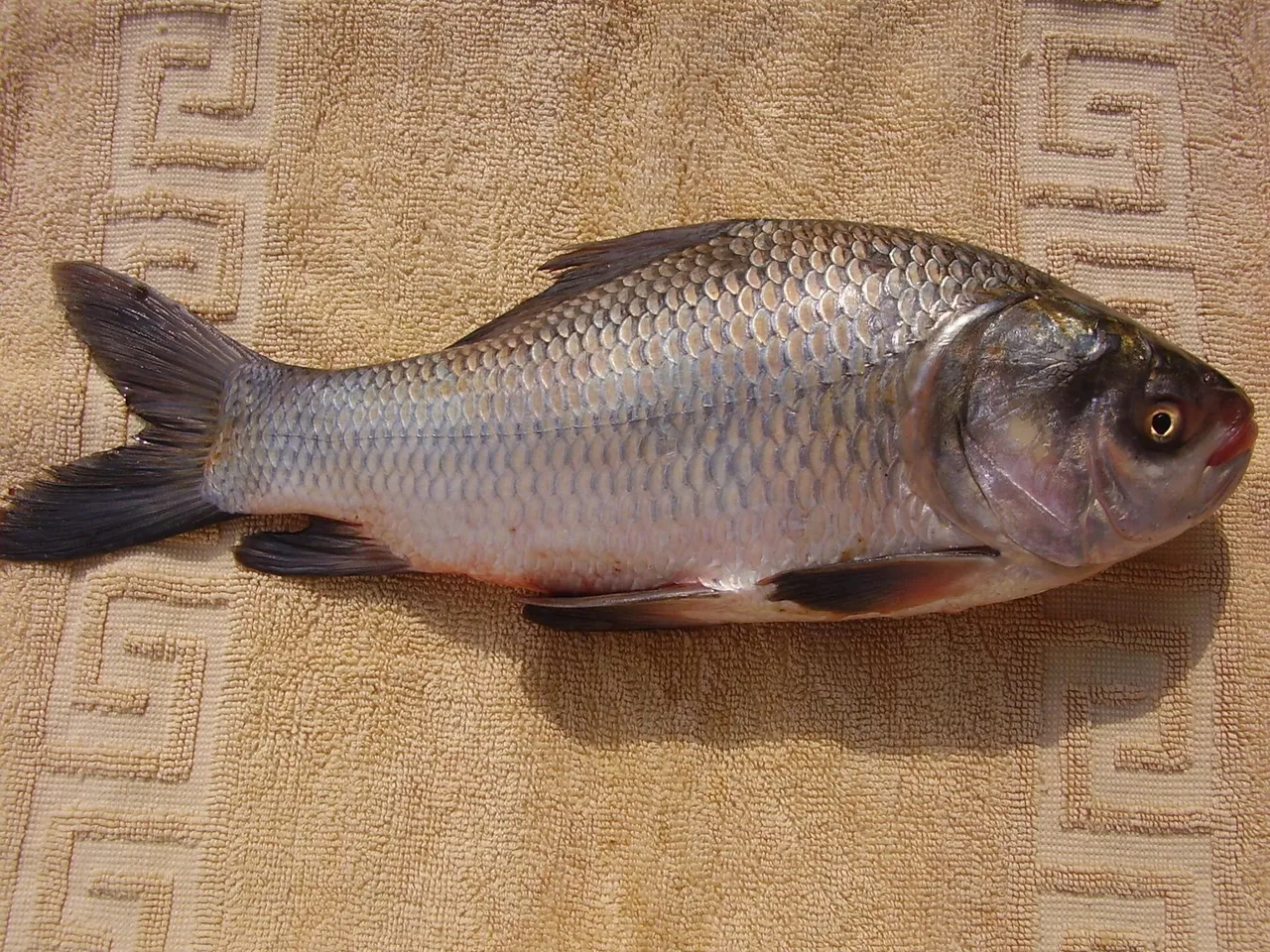
How this was identified, and who took it
Identified by: The record's leading character is what the frame shows: the head is close to a third of the body length and the body is deep, and the mouth is broad and strongly upturned with the lower jaw projecting. That is the separation from the small-headed, blunt-snouted rohu and mrigal. A candidate staged as catla in the same round was rejected for showing the rohu pattern instead; this frame and the rohu below are from the same photographer and setting, which is what made the difference visible.Khalid Mahmood — CC BY-SA 4.0, via Wikimedia Commons — source, licence
Catching Catla
Everything here on fishing for it. Each entry opens the page behind it.
Catla is the largest of the three major Indian carps and the most distinctive to look at: an enormously deep-bodied fish with a very large head and a broad upturned mouth that opens like a scoop.
That mouth defines its niche. Catla is a surface and upper-column plankton feeder, taking zooplankton from the water above, while rohu works the middle layer and mrigal the bottom. The three together fill a pond's feeding layers without competing, which is the basis of the polyculture system used across South Asia.
It grows fast and grows big — the largest of the Indian carps — and it is a substantial angling target in reservoirs and large tanks.
How it is caught
Gear for this fish
Identification
- Scientific name
- Labeo catla
- Family
- Cyprinidae
- Water
- Freshwater
- Conservation status
- Least Concern
- Regions
- South Asia, South-East Asia
- Very deep body with a disproportionately large head — deeper and larger-headed than rohu or mrigal.
- A broad upturned mouth with a protruding lower jaw and no barbels.
- Large greyish scales over a silvery flank, darker along the back.
- Deeply forked tail and a body that is strongly compressed laterally.
Size
- Typical
- 2–8 kg (4.4–18 lb)
- Large
- 15–30 kg (33–66 lb)
Exceptional: FishBase records a maximum of 182 cm and 38.6 kg
A monsoon spawner whose year is the rains
Catla seasonality is driven almost entirely by the monsoon, and the fish's whole annual cycle is arranged around it.
THE RAINS ARE THE EVENT. Catla spawn during the monsoon, cued by rising water, falling temperature with rain, and the flooding of marginal habitat. Outside that period the fish feed and grow but do not reproduce.
IN RIVERS THE SPAWNING MIGRATION FOLLOWS THE FLOOD, with fish moving into inundated marginal and floodplain habitat, and recruitment depends on the extent and timing of the flood.
IN PONDS AND RESERVOIRS SPAWNING FREQUENTLY DOES NOT HAPPEN NATURALLY, because the flow and flooding cues are absent. That is why induced breeding — hormonally stimulated spawning in hatcheries — is the basis of the enormous Indian carp aquaculture industry, and why catla in a still water are usually a stocked crop rather than a self-sustaining population.
FEEDING IS TEMPERATURE-DRIVEN, with growth fastest in the warm months and slowing in the cool season across the northern part of the range.
CATLA ARE SURFACE AND MID-WATER PLANKTON FEEDERS, so their feeding season tracks plankton production, which itself peaks with warmth and nutrient input after the rains.
AND THE POLYCULTURE CONTEXT MATTERS. Catla are farmed alongside rohu and mrigal precisely because the three feed at different levels of the water column, so the species' seasonality in most of its modern range is an agricultural calendar as much as a biological one.
Backed by research — why, and the sources (2)
Supported by peer-reviewed research or fisheries science. The sources are listed and can be checked.
- FishBase: a global information system on fishes — Froese, R. and D. Pauly, eds. — FishBase Consortium (Scientific institute)Relied on for: Distribution, habitat association, depth range, size, reproduction and life-history parameters recorded for the species.States this directlyPassage read and verified
- The IUCN Red List of Threatened Species — International Union for Conservation of Nature (Conservation authority)Relied on for: Assessment and range account for the species, including the habitats it depends on, its life history and the pressures acting on it.States this directlyCitation checked — the work exists and is described correctly
Lifecycle and reproduction
The fastest-growing and largest of the major Indian carps, maturing in two to three years. Central to aquaculture and to reservoir fisheries across the subcontinent.
Spawns during the monsoon in flowing river water and in flooded margins, with breeding triggered by rising water. Hatchery-induced spawning is routine and supports very large-scale stocking.
Feeding and senses
Filters zooplankton from the surface and upper water column with a large upturned mouth and fine gill rakers, rather than grazing the bottom.
Feeds in the upper layers by filtering rather than by targeting individual prey, so vision and scent matter less than position in the water column.
Through the year
Breeding and rapid growth follow the monsoon, with spawning triggered by rising water and the strongest feeding through the warm months. Growth slows in the cooler part of the year in the north of the range, and in tank fisheries the fish move deeper as surface water heats.
Distribution
Asia: Pakistan, India, Bangladesh, Nepal and Myanmar. Introduced elsewhere
This is a biological range — where the species occurs, not a prediction that you will catch one. To browse the fishing geography FishingHQ holds, start at fishing places.
Why anglers care
A major reservoir and tank angling target across South Asia, fished with paste and dough baits presented in midwater and near the surface rather than hard on the bottom — a direct consequence of where the fish feeds. Its significance is as both a very large accessible freshwater fish and one of the most important food species in the region.
Handling and returning
A large, deep-bodied, soft-scaled fish. Support horizontally with both hands, wet hands and mat, and return promptly. Its bulk means poor handling causes real damage.
Going further
- Catla vs Rohu — how to tell them apart.
Where to go next
Where it lives
Told apart from
More fish
Not related to this page — just the rest of the section. There is little else joined to this subject yet, and a short page should still lead somewhere.
Sources and evidence
- FishBase: a global information system on fishes — Froese, R. and D. Pauly, eds. — FishBase Consortium (Scientific institute)Relied on for: Family, maximum size, depth and environment, distribution and the IUCN assessment for Labeo catla.States this directlyPassage read and verified
- The IUCN Red List of Threatened Species — International Union for Conservation of Nature (Conservation authority)Relied on for: The Least Concern assessment for Labeo catla, assessed 08 October 2009.States this directlyCitation checked — the work exists and is described correctly
Why the 5 connections on this page are here, and the sources
How it is caught
What experienced anglers do — 1 connection
Widely and independently recommended by experienced anglers and specialist sources. This is real angling knowledge, not proof: controlled evidence for it is limited, and FishingHQ records it as convention rather than as a demonstrated effect.
Float fishing
A practitioner claim about how Labeo catla is commonly fished, following from where and how it feeds.
- General angling website restatements of established technique — Various (Credible secondary source)Relied on for: Widely restated practitioner accounts of fishing for catla.Citation checked — the work exists and is described correctly
- Sea Angler — Bauer Media (Specialist angling publication)Relied on for: Practitioner treatment of the methods used for catla and comparable species.Citation checked — the work exists and is described correctly
Gear for this fish
What experienced anglers do — 1 connection
Widely and independently recommended by experienced anglers and specialist sources. This is real angling knowledge, not proof: controlled evidence for it is limited, and FishingHQ records it as convention rather than as a demonstrated effect.
Particle baits
A practitioner claim about tackle commonly used for Labeo catla.
- General angling website restatements of established technique — Various (Credible secondary source)Relied on for: Widely restated practitioner accounts of this presentation for catla.Citation checked — the work exists and is described correctly
- Angling Times — Bauer Media (Specialist angling publication)Relied on for: Practitioner treatment of comparable presentations for the species group.Citation checked — the work exists and is described correctly
Where it lives
Backed by research — 2 connections
Supported by peer-reviewed research or fisheries science. The sources are listed and can be checked.
Lowland rivers
A habitat association for Labeo catla taken from the environment and distribution data on its FishBase summary.
- FishBase: a global information system on fishes — Froese, R. and D. Pauly, eds. — FishBase Consortium (Scientific institute)Relied on for: The environment, depth range and habitat description recorded for Labeo catla.States this directlyPassage read and verified
Lowland stillwaters
A habitat association for Labeo catla taken from the environment and distribution data on its FishBase summary.
- FishBase: a global information system on fishes — Froese, R. and D. Pauly, eds. — FishBase Consortium (Scientific institute)Relied on for: The environment, depth range and habitat description recorded for Labeo catla.States this directlyPassage read and verified
Told apart from
Backed by research — 1 connection
Supported by peer-reviewed research or fisheries science. The sources are listed and can be checked.
Rohu
An identification link between two species readers genuinely mistake for one another, resting on published morphological characters rather than on angling lore, and naming the character that separates them.
- FishBase: a global information system on fishes — Froese, R. and D. Pauly, eds. — FishBase Consortium (Scientific institute)Relied on for: Morphological description, meristic counts, family placement, distribution and environment of the species named.States this directlyPassage read and verified
- FAO Species Identification Guides for Fishery Purposes and the FAO Species Catalogues — Food and Agriculture Organization of the United Nations (Scientific institute)Relied on for: Identification characters and distribution for inland and coastal fishes, from regional identification guides prepared for fishery purposes.States this directlyCitation checked — the work exists and is described correctly
An identification comparison naming both binomials: Labeo rohita and Labeo catla.
- FishBase: a global information system on fishes — Froese, R. and D. Pauly, eds. — FishBase Consortium (Scientific institute)Relied on for: Morphological and distributional data for Labeo rohita and for Labeo catla.States this directlyPassage read and verified
- The IUCN Red List of Threatened Species — International Union for Conservation of Nature (Conservation authority)Relied on for: Separate assessments treating Labeo rohita and Labeo catla as distinct species.States this directlyCitation checked — the work exists and is described correctly
How FishingHQ labels evidence is explained in the evidence policy.