Rohu
Fish · Last reviewed 2026-08-10
One of the major Indian carps, a fast-growing river and pond cyprinid of enormous food importance and a principal bait-fishing target across South Asia.
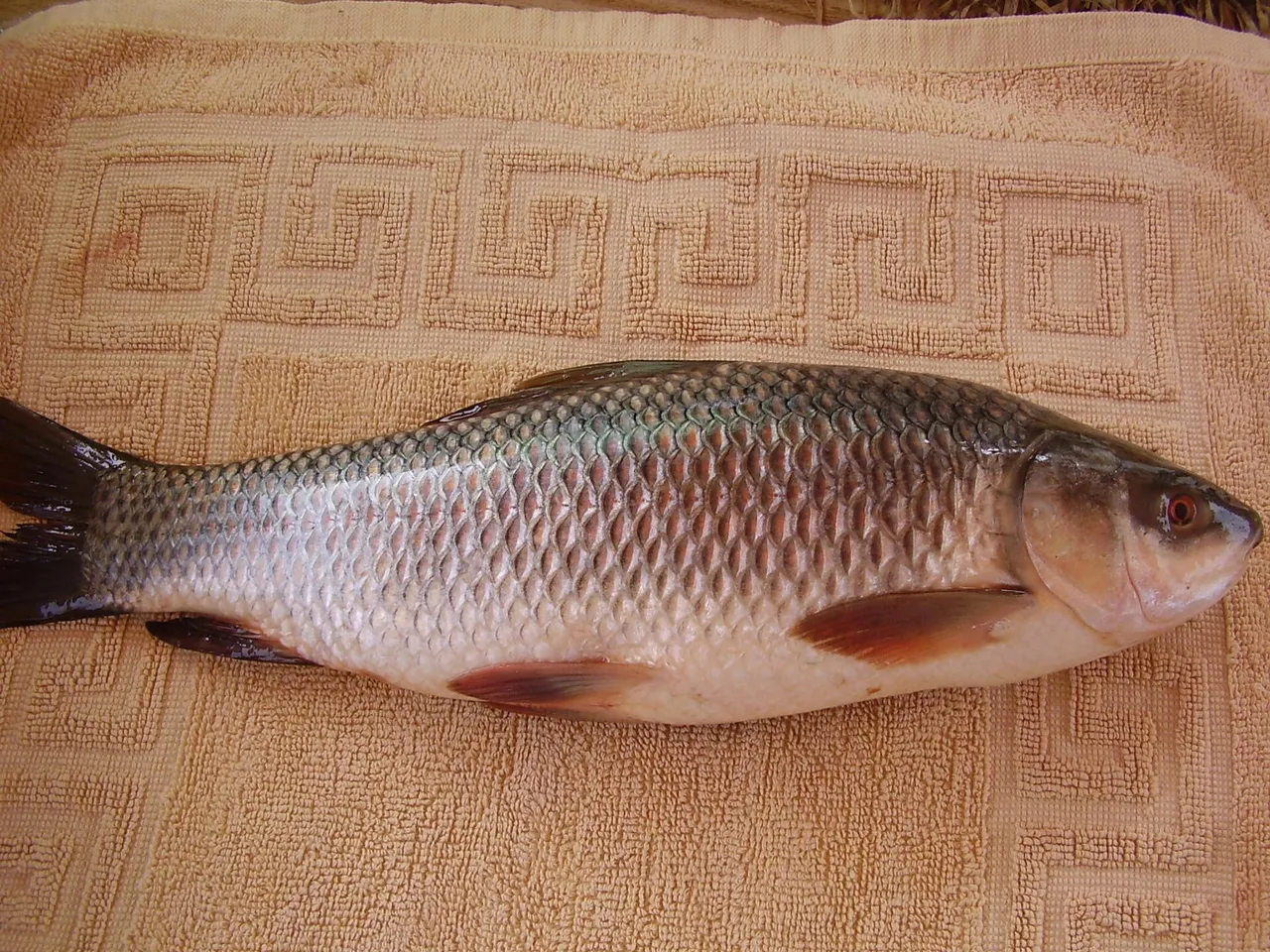
How this was identified, and who took it
Identified by: All the record's characters are legible: a deep body with a strongly arched back, a bluntly rounded snout overhanging a small subterminal mouth with thick fringed lips, and the small head that separates rohu from the large-headed catla photographed in the same series. Large cycloid scales, orange-red pelvic and anal fins, dark caudal.Khalid Mahmood — CC BY-SA 4.0, via Wikimedia Commons — source, licence
Catching Rohu
Everything here on fishing for it. Each entry opens the page behind it.
Rohu is one of the three major Indian carps and among the most important freshwater food fish in the world by volume. It is a deep-bodied cyprinid with a distinctly arched back, thick fringed lips and a small downturned mouth suited to grazing.
It occupies the middle of the water column in rivers, tanks and ponds across the Indian subcontinent, feeding on plankton and plant material, and it grows quickly — which is why it forms the backbone of polyculture aquaculture together with catla and mrigal, each occupying a different feeding layer.
For anglers it is a major bait-fishing target across South Asia, fished with paste and dough baits in a style with a long local tradition of its own.
How it is caught
Gear for this fish
Identification
- Scientific name
- Labeo rohita
- Family
- Cyprinidae
- Water
- Freshwater
- Conservation status
- Least Concern
- Regions
- South Asia, South-East Asia
- Deep body with a strongly arched back and a bluntly rounded snout.
- Small downturned mouth with thick fringed lips, suited to grazing rather than grabbing.
- Large silver scales, often with a reddish or coppery cast on the flank in mature fish.
- A pair of small barbels on the upper lip, and a deeply forked tail.
Size
- Typical
- 1–4 kg (2.2–8.8 lb)
- Large
- 6–12 kg (13–26 lb)
Exceptional: FishBase records a maximum of 200 cm and 45 kg
Lifecycle and reproduction
Fast-growing, reaching a substantial size within a few years, and maturing in two to three years. Central to South Asian aquaculture, where it is raised alongside catla and mrigal in a layered feeding system.
Spawns during the monsoon in flooded river margins and in flowing water, with breeding triggered by rising water and rainfall. Induced spawning in hatcheries is routine and supports the aquaculture industry.
Feeding and senses
A column feeder taking plankton, algae and decaying plant material, grazing with thick fringed lips rather than hunting. It works the middle layer of the water rather than the surface or the bottom, which is the niche that lets it be farmed alongside catla above it and mrigal below it.
Feeds by taste and touch in turbid monsoon-influenced water, using the barbels and lips at close range; sight plays a lesser role.
Through the year
Spawning and heavy feeding follow the monsoon; feeding continues through warm periods and reduces in the coolest months in the north of the range.
Distribution
Asia: Pakistan, India, Bangladesh, Myanmar and Nepal
This is a biological range — where the species occurs, not a prediction that you will catch one. To browse the fishing geography FishingHQ holds, start at fishing places.
Why anglers care
A major bait-fishing target across India, Bangladesh, Pakistan, Nepal and Myanmar, fished with dough, paste and prepared vegetable baits on float and bottom tackle in rivers, tanks and reservoirs. Its significance is food security first and angling second — but the angling tradition around it is long-established and substantial, with its own bait recipes and techniques.
Handling and returning
A soft-scaled cyprinid easily damaged by dry handling. Wet hands, support the body, use an unhooking mat or wet cloth, and return promptly where fish are released. Do not move live fish between water bodies.
Going further
- Rohu vs Catla — how to tell them apart.
Where to go next
Where it lives
Told apart from
More fish
Not related to this page — just the rest of the section. There is little else joined to this subject yet, and a short page should still lead somewhere.
Sources and evidence
- FishBase: a global information system on fishes — Froese, R. and D. Pauly, eds. — FishBase Consortium (Scientific institute)Relied on for: Family, maximum size, depth and environment, distribution and the IUCN assessment for Labeo rohita.States this directlyPassage read and verified
- The IUCN Red List of Threatened Species — International Union for Conservation of Nature (Conservation authority)Relied on for: The Least Concern assessment for Labeo rohita, assessed 20 March 2010.States this directlyCitation checked — the work exists and is described correctly
Why the 6 connections on this page are here, and the sources
How it is caught
What experienced anglers do — 2 connections
Widely and independently recommended by experienced anglers and specialist sources. This is real angling knowledge, not proof: controlled evidence for it is limited, and FishingHQ records it as convention rather than as a demonstrated effect.
Float fishing
A practitioner claim about how Labeo rohita is commonly fished, following from where and how it feeds.
- General angling website restatements of established technique — Various (Credible secondary source)Relied on for: Widely restated practitioner accounts of fishing for rohu.Citation checked — the work exists and is described correctly
- Sea Angler — Bauer Media (Specialist angling publication)Relied on for: Practitioner treatment of the methods used for rohu and comparable species.Citation checked — the work exists and is described correctly
Ledgering
A practitioner claim about how Labeo rohita is commonly fished, following from where and how it feeds.
- General angling website restatements of established technique — Various (Credible secondary source)Relied on for: Widely restated practitioner accounts of fishing for rohu.Citation checked — the work exists and is described correctly
- Sea Angler — Bauer Media (Specialist angling publication)Relied on for: Practitioner treatment of the methods used for rohu and comparable species.Citation checked — the work exists and is described correctly
Gear for this fish
What experienced anglers do — 1 connection
Widely and independently recommended by experienced anglers and specialist sources. This is real angling knowledge, not proof: controlled evidence for it is limited, and FishingHQ records it as convention rather than as a demonstrated effect.
Particle baits
A practitioner claim about tackle commonly used for Labeo rohita.
- General angling website restatements of established technique — Various (Credible secondary source)Relied on for: Widely restated practitioner accounts of this presentation for rohu.Citation checked — the work exists and is described correctly
- Angling Times — Bauer Media (Specialist angling publication)Relied on for: Practitioner treatment of comparable presentations for the species group.Citation checked — the work exists and is described correctly
Where it lives
Backed by research — 2 connections
Supported by peer-reviewed research or fisheries science. The sources are listed and can be checked.
Lowland rivers
A habitat association for Labeo rohita taken from the environment and distribution data on its FishBase summary.
- FishBase: a global information system on fishes — Froese, R. and D. Pauly, eds. — FishBase Consortium (Scientific institute)Relied on for: The environment, depth range and habitat description recorded for Labeo rohita.States this directlyPassage read and verified
Lowland stillwaters
A habitat association for Labeo rohita taken from the environment and distribution data on its FishBase summary.
- FishBase: a global information system on fishes — Froese, R. and D. Pauly, eds. — FishBase Consortium (Scientific institute)Relied on for: The environment, depth range and habitat description recorded for Labeo rohita.States this directlyPassage read and verified
Told apart from
Backed by research — 1 connection
Supported by peer-reviewed research or fisheries science. The sources are listed and can be checked.
Catla
An identification comparison naming both binomials: Labeo rohita and Labeo catla.
- FishBase: a global information system on fishes — Froese, R. and D. Pauly, eds. — FishBase Consortium (Scientific institute)Relied on for: Morphological and distributional data for Labeo rohita and for Labeo catla.States this directlyPassage read and verified
- The IUCN Red List of Threatened Species — International Union for Conservation of Nature (Conservation authority)Relied on for: Separate assessments treating Labeo rohita and Labeo catla as distinct species.States this directlyCitation checked — the work exists and is described correctly
An identification link between two species readers genuinely mistake for one another, resting on published morphological characters rather than on angling lore, and naming the character that separates them.
- FishBase: a global information system on fishes — Froese, R. and D. Pauly, eds. — FishBase Consortium (Scientific institute)Relied on for: Morphological description, meristic counts, family placement, distribution and environment of the species named.States this directlyPassage read and verified
- FAO Species Identification Guides for Fishery Purposes and the FAO Species Catalogues — Food and Agriculture Organization of the United Nations (Scientific institute)Relied on for: Identification characters and distribution for inland and coastal fishes, from regional identification guides prepared for fishery purposes.States this directlyCitation checked — the work exists and is described correctly
How FishingHQ labels evidence is explained in the evidence policy.