How to identify rohu
Labeo rohita · Cyprinidae
The characters that identify rohu, ranked by how far each one can be trusted on its own.
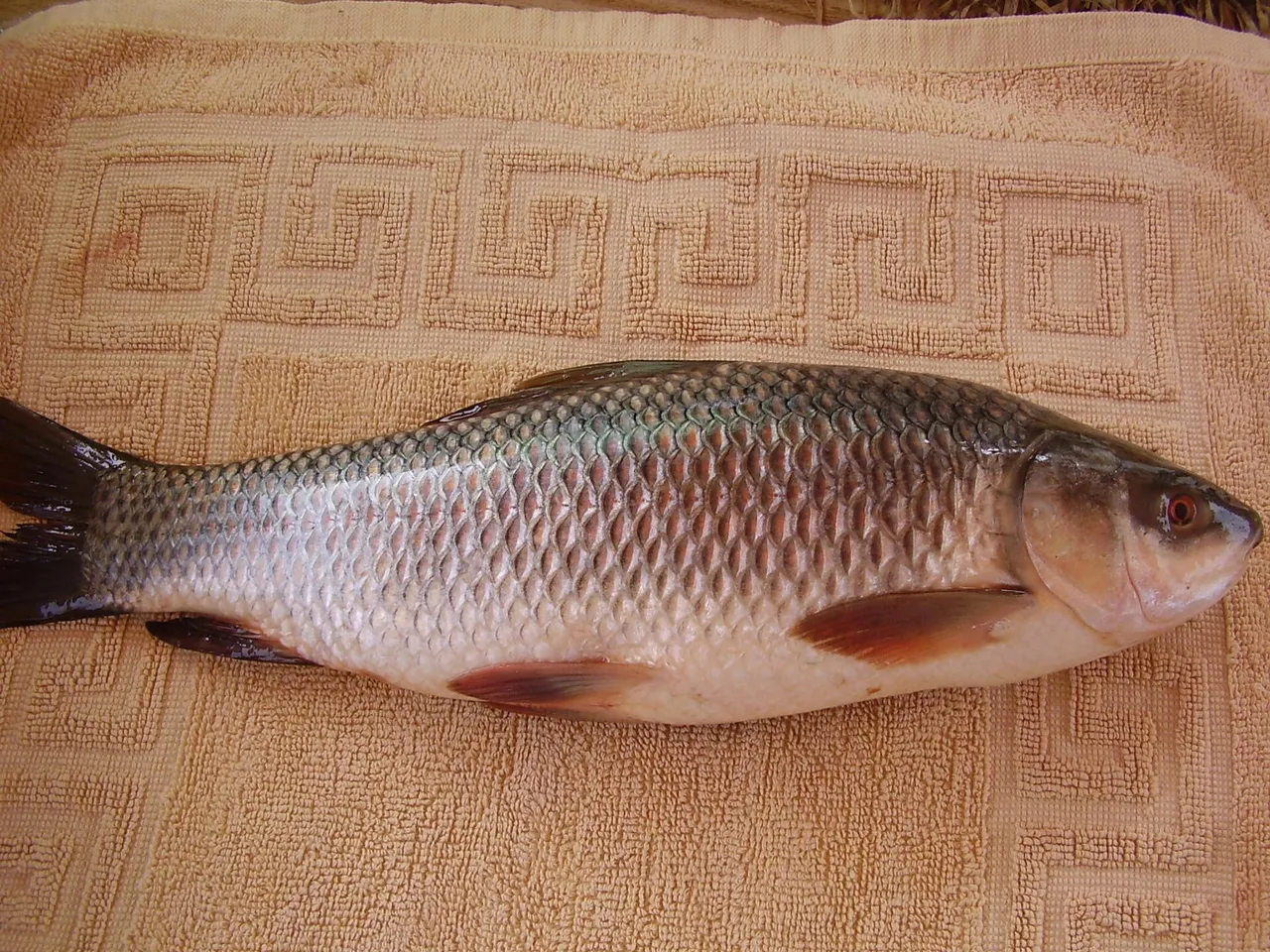
How this was identified, and who took it
Identified by: All the record's characters are legible: a deep body with a strongly arched back, a bluntly rounded snout overhanging a small subterminal mouth with thick fringed lips, and the small head that separates rohu from the large-headed catla photographed in the same series. Large cycloid scales, orange-red pelvic and anal fins, dark caudal.Khalid Mahmood — CC BY-SA 4.0, via Wikimedia Commons — source, licenceAbout the image above: The photograph shows a dead fish laid on a domestic towel. Colour is post-mortem and the coppery flank cast the page mentions is not the tone shown; the snout, mouth and body proportion carry the identification and are unaffected.
Look at this first
Start at the snout. A rohu's is blunt and rounded and hangs out over the mouth, and the mouth itself is small, points down, and is edged with thick fringed lips built for grazing surfaces rather than seizing anything. Put that head beside a catla's, which is a third of the fish with the jaw angled up, and the two stop being confusable.
Diagnostic — settles it on its own
Each of these settles the identification on its own. If one is clear, you have your answer.
A blunt rounded snout overhanging a small downturned mouth
Look at the head in profile. The snout projects forward and downward over the mouth, so the gape opens beneath rather than in front, and the lips are thick and visibly fringed or plicate at the edge. That is the apparatus of a fish that grazes algae and detritus off surfaces. Catla's mouth is broad, upturned and thin-lipped; mrigal's is small and blunt but does not carry the fringed lip. This is structural and it holds on a dead fish on a market slab.
A small head on a deep, strongly arched body
The head is roughly a quarter of the total length and the dorsal profile rises steeply behind it into a pronounced arch before falling away to the tail. The combination of a small head and a humped back is the rohu silhouette and it reads at distance in clear water. Catla is the exact inverse — big head, less arch — and that inversion is the whole of the separation.
Supporting — use with other characters
Real characters that are not conclusive by themselves. Use two or three together.
A pair of small barbels on the upper lip
Rohu carries one pair, on the upper lip, and they are short. Catla carries none. Mrigal carries a pair at the corners of the mouth rather than on the upper lip. They are easy to overlook on a handled fish, so use them to confirm the snout rather than to lead.
Suggestive only — varies with condition
Hints only. These vary with condition, season, water and how long the fish has been out of it, and a fish that contradicts them is still the same species.
Large silver scales, often with a coppery cast in mature fish
The flank is silver with big cycloid scales and mature fish frequently carry a reddish or coppery wash along the sides, which is where the vernacular name comes from in several languages. The cast is real, it is strongest in breeding condition, and it fades quickly after death, so it is the last thing on the page rather than the first.
What it gets confused with
- Catla, the main confusion; catla's head is roughly a third of the fish with an upturned mouth and no barbels, where a rohu's is a quarter with a downturned fringed mouth and one pair.
- Mrigal, which shares the small head and blunt snout but lacks the fringed lip and is slimmer, with a less arched back and barbels at the mouth corners rather than on the upper lip.
- Kalbasu, another Labeo of the same rivers, which is darker overall and deeper through the body with a more terminal mouth.
- Stocked hybrids of rohu with catla or mrigal, which carry intermediate snouts and cannot be named in the hand.
Side by side: Rohu vs Catla.
Where this stops working
Labeo is a large genus and South and South-East Asia hold many species that share the blunt overhanging snout and the fringed lip, several of which are locally common and none of which a page written around the three major carps will separate. Hybrids between rohu, catla and mrigal are produced deliberately in aquaculture and escape into open water. The fringed-lip character also varies with age: a young rohu's lips are much less obviously fringed than an adult's. Where the answer has to be certain, it needs a specialist with the specimen rather than a photograph, and a reader outside the Indian subcontinent should treat a large blunt-snouted Labeo as a genus-level identification until somebody local looks at it.
The full record
This page covers identification only. The Rohu record covers behaviour, lifecycle, distribution, handling and the sources behind all of it.
Reviewed 2026-08-16.
More about this fish
Telling it apart is one question. Here are the others.
How it is caught
Where it lives
Why the 4 connections on this page are here, and the sources
How it is caught
What experienced anglers do — 2 connections
Widely and independently recommended by experienced anglers and specialist sources. This is real angling knowledge, not proof: controlled evidence for it is limited, and FishingHQ records it as convention rather than as a demonstrated effect.
Float fishing
A practitioner claim about how Labeo rohita is commonly fished, following from where and how it feeds.
- General angling website restatements of established technique — Various (Credible secondary source)Relied on for: Widely restated practitioner accounts of fishing for rohu.Citation checked — the work exists and is described correctly
- Sea Angler — Bauer Media (Specialist angling publication)Relied on for: Practitioner treatment of the methods used for rohu and comparable species.Citation checked — the work exists and is described correctly
Ledgering
A practitioner claim about how Labeo rohita is commonly fished, following from where and how it feeds.
- General angling website restatements of established technique — Various (Credible secondary source)Relied on for: Widely restated practitioner accounts of fishing for rohu.Citation checked — the work exists and is described correctly
- Sea Angler — Bauer Media (Specialist angling publication)Relied on for: Practitioner treatment of the methods used for rohu and comparable species.Citation checked — the work exists and is described correctly
Where it lives
Backed by research — 2 connections
Supported by peer-reviewed research or fisheries science. The sources are listed and can be checked.
Lowland rivers
A habitat association for Labeo rohita taken from the environment and distribution data on its FishBase summary.
- FishBase: a global information system on fishes — Froese, R. and D. Pauly, eds. — FishBase Consortium (Scientific institute)Relied on for: The environment, depth range and habitat description recorded for Labeo rohita.States this directlyPassage read and verified
Lowland stillwaters
A habitat association for Labeo rohita taken from the environment and distribution data on its FishBase summary.
- FishBase: a global information system on fishes — Froese, R. and D. Pauly, eds. — FishBase Consortium (Scientific institute)Relied on for: The environment, depth range and habitat description recorded for Labeo rohita.States this directlyPassage read and verified