Catla vs Rohu
How to tell them apart, and what follows from getting it right.
Why they get confused
The two most important carps of South Asian fresh water are farmed together, stocked together, sold side by side on the same slab and caught out of the same river in the same session. Both are large, deep-bodied, big-scaled silver cyprinids, and a reader who has learned 'Indian major carp' as one thing has to unlearn it before either name means anything. Photographs of the two are routinely captioned as each other, including in the candidate queue this comparison came out of.
Catla
Labeo catla — Cyprinidae
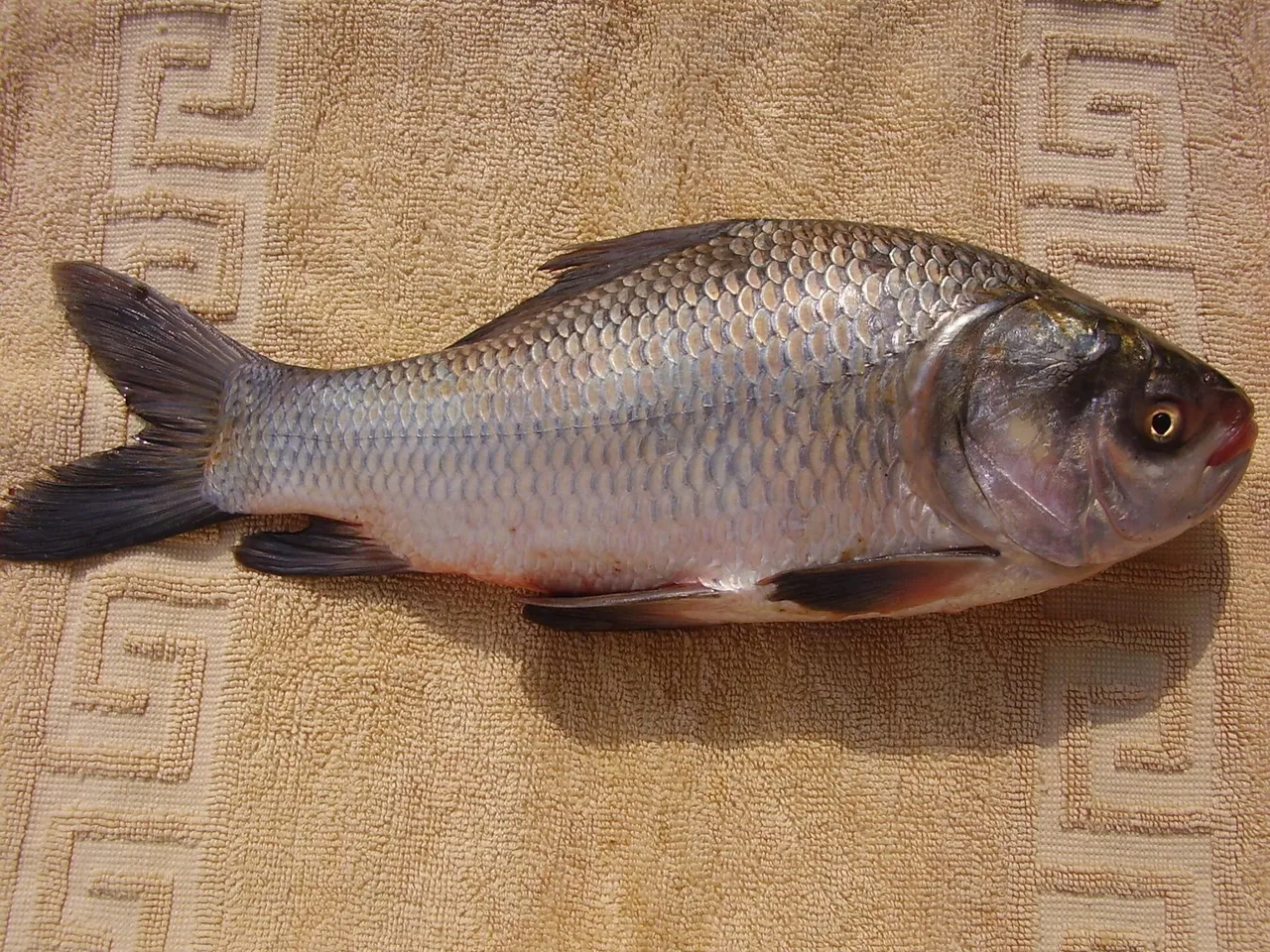
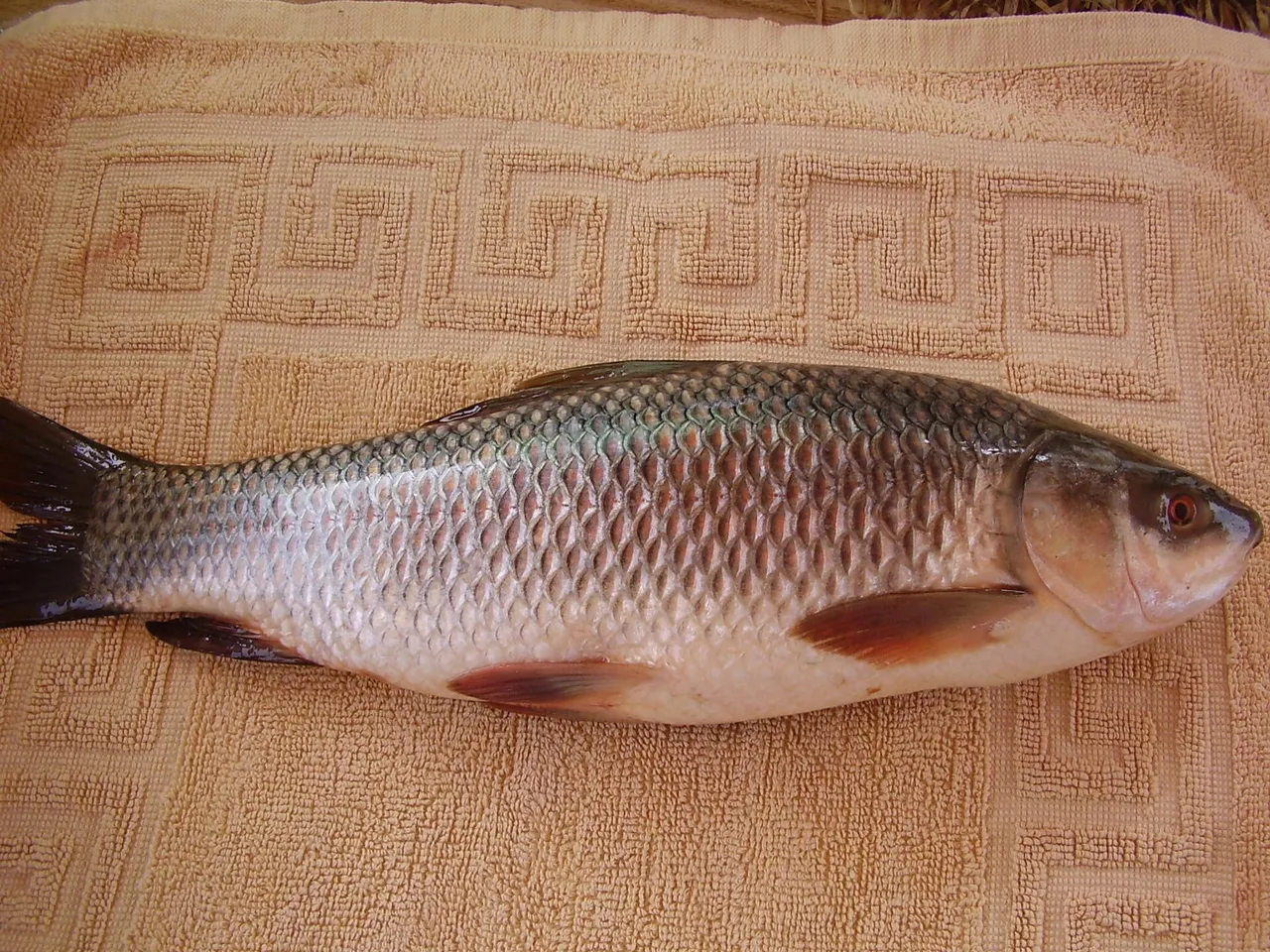


The differences
Each difference is marked with how far it can be trusted on its own. A single diagnostic character settles the identification; suggestive ones only narrow it.
| Character | Catla | Rohu | Reliability |
|---|---|---|---|
| Head length against body lengthIdentification | The head runs to roughly a third of the fish and dominates it, so the animal looks front-heavy even at a glance. | The head is nearer a quarter, so the body dominates and the fish reads as a deep hump behind a small neat face. | Diagnostic on its own |
| Which way the mouth pointsIdentification | Broad and angled upwards, with the lower jaw projecting past the upper — the mouth of a fish that feeds at and near the surface. | Small and angled downwards under an overhanging blunt snout, edged with thick fringed lips for grazing off surfaces. | Diagnostic on its own |
| BarbelsIdentification | None at all, on the lip or at the corners of the mouth. | One pair of short barbels on the upper lip, easy to overlook on a fish that has been handled. | Supporting — use with others |
| The line of the backIdentification | Deep and strongly compressed side to side, but without a marked hump; the depth is spread along the body. | Rises steeply behind the small head into a pronounced arch before falling away to the tail. | Supporting — use with others |
| How each one feeds, and where that puts itFeeding | A surface and upper-water filter feeder taking zooplankton, which is why the mouth is turned up and the head is built round a large gill basket. | A grazer working algae, detritus and soft plant matter off the bottom and off submerged surfaces, which is why the lips are fringed. | Supporting — use with others |
| Maximum sizeSize | FishBase records a maximum around 182 cm and 38.6 kg, and rod-caught fish of fifteen to thirty kilos occur. | FishBase records a larger maximum length again, around 200 cm and 45 kg, so size does not separate them at the top end. | Suggestive only — varies |
Why it matters
These are two of the most important food and sport fish in the world by weight and by the number of people who fish for them, and they behave completely differently. A catla feeds high in the water on plankton; a rohu grazes the bottom. An angler who has decided which fish is in front of them has decided where in the water column the next one will be. The two are also hybridised deliberately in aquaculture and hybrid stock escapes into open water, so a fish with an intermediate head and an intermediate mouth angle is a real possibility and cannot be named from either page.
The full records
This page compares two species. Each of them has a complete record covering biology, behaviour, handling and the evidence behind all of it.
More about catla
Where it lives, how it is caught, and what else it is confused with.
How it is caught
Gear for this fish
Where it lives
Why the 4 connections on this page are here, and the sources
How it is caught
What experienced anglers do — 1 connection
Widely and independently recommended by experienced anglers and specialist sources. This is real angling knowledge, not proof: controlled evidence for it is limited, and FishingHQ records it as convention rather than as a demonstrated effect.
Float fishing
A practitioner claim about how Labeo catla is commonly fished, following from where and how it feeds.
- General angling website restatements of established technique — Various (Credible secondary source)Relied on for: Widely restated practitioner accounts of fishing for catla.Citation checked — the work exists and is described correctly
- Sea Angler — Bauer Media (Specialist angling publication)Relied on for: Practitioner treatment of the methods used for catla and comparable species.Citation checked — the work exists and is described correctly
Gear for this fish
What experienced anglers do — 1 connection
Widely and independently recommended by experienced anglers and specialist sources. This is real angling knowledge, not proof: controlled evidence for it is limited, and FishingHQ records it as convention rather than as a demonstrated effect.
Particle baits
A practitioner claim about tackle commonly used for Labeo catla.
- General angling website restatements of established technique — Various (Credible secondary source)Relied on for: Widely restated practitioner accounts of this presentation for catla.Citation checked — the work exists and is described correctly
- Angling Times — Bauer Media (Specialist angling publication)Relied on for: Practitioner treatment of comparable presentations for the species group.Citation checked — the work exists and is described correctly
Where it lives
Backed by research — 2 connections
Supported by peer-reviewed research or fisheries science. The sources are listed and can be checked.
Lowland rivers
A habitat association for Labeo catla taken from the environment and distribution data on its FishBase summary.
- FishBase: a global information system on fishes — Froese, R. and D. Pauly, eds. — FishBase Consortium (Scientific institute)Relied on for: The environment, depth range and habitat description recorded for Labeo catla.States this directlyPassage read and verified
Lowland stillwaters
A habitat association for Labeo catla taken from the environment and distribution data on its FishBase summary.
- FishBase: a global information system on fishes — Froese, R. and D. Pauly, eds. — FishBase Consortium (Scientific institute)Relied on for: The environment, depth range and habitat description recorded for Labeo catla.States this directlyPassage read and verified
Reviewed 2026-08-16. FishingHQ does not state what any rule is or where any rule applies. Where this page says the two species are managed differently, that is a reason to check the authority for the water you are on — not a statement of what it requires.