How to identify catla
Labeo catla · Cyprinidae
The characters that identify catla, ranked by how far each one can be trusted on its own.
How this was identified, and who took it
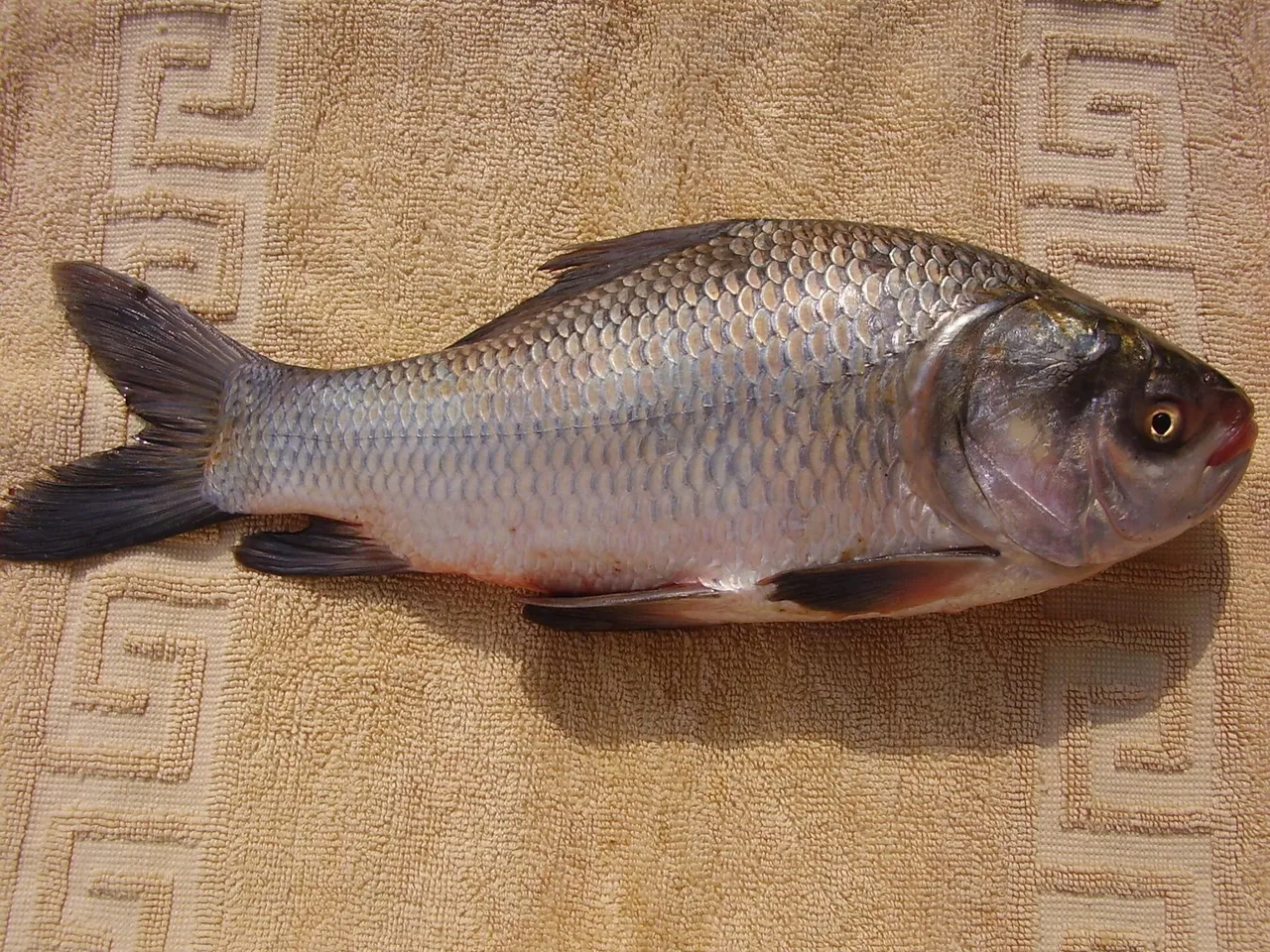
Identified by: The record's leading character is what the frame shows: the head is close to a third of the body length and the body is deep, and the mouth is broad and strongly upturned with the lower jaw projecting. That is the separation from the small-headed, blunt-snouted rohu and mrigal. A candidate staged as catla in the same round was rejected for showing the rohu pattern instead; this frame and the rohu below are from the same photographer and setting, which is what made the difference visible.Khalid Mahmood — CC BY-SA 4.0, via Wikimedia Commons — source, licenceAbout the image above: The photograph shows a dead fish on a domestic towel rather than a live animal in water. The colour is post-mortem and carries nothing; the head proportion and the angle of the mouth, which are what the page ranks, are unaffected.
Look at this first
Measure the head against the fish. On a catla the head runs to roughly a third of the whole animal and looks frankly too big for it, and the mouth turns upwards with the lower jaw pushed forward. Set it beside a rohu of the same weight and the rohu's head looks small and its snout blunt; that one proportion sorts the two commonest carps of the subcontinent faster than anything else.
Diagnostic — settles it on its own
Each of these settles the identification on its own. If one is clear, you have your answer.
Head roughly a third of the total length
Compare the distance from snout tip to the rear edge of the gill cover against the whole fish from snout to tail fork. On a catla it is close to a third and the head dominates the animal; on a rohu or a mrigal of the same length it is nearer a quarter and the body dominates. Because this is a ratio within one fish it survives death, ice, market handling and every lighting condition, which is why it outranks every colour on the page.
A broad mouth angled upwards with the lower jaw leading
The gape is wide and set at the front of the head tilting up, with the lower jaw projecting beyond the upper. That is the mouth of a fish that feeds at and near the surface. A rohu's mouth is small, points downwards and carries thick fringed lips for grazing; a mrigal's is small and blunt. Look at the direction the mouth points before anything else about it.
Supporting — use with other characters
Real characters that are not conclusive by themselves. Use two or three together.
No barbels on the lip
Catla carries none. Rohu carries a pair of small barbels on the upper lip and mrigal carries a pair at the corners, though both can be short and easy to miss on a fish that has been handled. Use this to confirm what the head proportion has already told you rather than to lead with it, because an absence is a weaker thing to see than a presence.
A deep, strongly compressed body with large greyish scales
The body is deep for its length and flattened side to side, with big cycloid scales over a silvery flank that darkens towards the back. It confirms the genus and the general build; several major carps share it closely enough that it settles nothing on its own.
Suggestive only — varies with condition
Hints only. These vary with condition, season, water and how long the fish has been out of it, and a fish that contradicts them is still the same species.
Size class as context rather than evidence
Catla is one of the largest of the Indian major carps and rod-caught fish of fifteen to thirty kilos are recorded, so a very large carp of this build in a South Asian river is more likely catla than mrigal. It is a prior and not a character, and a small catla is still a catla.
What it gets confused with
- Rohu, the everyday confusion; the rohu has a small head, a blunt overhanging snout and a small downturned fringed mouth, and the head proportion separates them instantly.
- Mrigal, which has a small head, a blunt snout and a mouth that is small and nearly straight, and which is slimmer through the body than a catla of the same length.
- Silver carp, which also has a large head and an upturned mouth but whose eye sits below the line of the mouth — a character catla does not share.
- Bighead carp, which shares the large head and is separated on the mottled flank and the position of the eye rather than on head size.
Side by side: Catla vs Rohu.
Where this stops working
The Indian major carps are farmed and stocked together across South and South-East Asia and hybrids between catla, rohu and mrigal are produced deliberately as well as occurring in stocked water. A hybrid can carry an intermediate head proportion and an intermediate mouth angle, and no field character will resolve it. The naming is also unstable: this species has been placed in Catla, in Gibelion and now generally in Labeo, so a reader searching the literature will meet all three binomials for the same animal. Where the identification carries weight — a stocking record, a fisheries return, a research sample — it needs somebody with the fish and a meristic count.
The full record
This page covers identification only. The Catla record covers behaviour, lifecycle, distribution, handling and the sources behind all of it.
Reviewed 2026-08-16.
More about this fish
Telling it apart is one question. Here are the others.
How it is caught
Where it lives
Why the 3 connections on this page are here, and the sources
How it is caught
What experienced anglers do — 1 connection
Widely and independently recommended by experienced anglers and specialist sources. This is real angling knowledge, not proof: controlled evidence for it is limited, and FishingHQ records it as convention rather than as a demonstrated effect.
Float fishing
A practitioner claim about how Labeo catla is commonly fished, following from where and how it feeds.
- General angling website restatements of established technique — Various (Credible secondary source)Relied on for: Widely restated practitioner accounts of fishing for catla.Citation checked — the work exists and is described correctly
- Sea Angler — Bauer Media (Specialist angling publication)Relied on for: Practitioner treatment of the methods used for catla and comparable species.Citation checked — the work exists and is described correctly
Where it lives
Backed by research — 2 connections
Supported by peer-reviewed research or fisheries science. The sources are listed and can be checked.
Lowland rivers
A habitat association for Labeo catla taken from the environment and distribution data on its FishBase summary.
- FishBase: a global information system on fishes — Froese, R. and D. Pauly, eds. — FishBase Consortium (Scientific institute)Relied on for: The environment, depth range and habitat description recorded for Labeo catla.States this directlyPassage read and verified
Lowland stillwaters
A habitat association for Labeo catla taken from the environment and distribution data on its FishBase summary.
- FishBase: a global information system on fishes — Froese, R. and D. Pauly, eds. — FishBase Consortium (Scientific institute)Relied on for: The environment, depth range and habitat description recorded for Labeo catla.States this directlyPassage read and verified