Longnose gar
Fish · Last reviewed 2026-08-10
A slender ancient predator armoured in diamond-shaped ganoid scales, with an extremely long toothed beak that makes conventional hooking difficult.
Safety: lead and toxic materials — can cause serious injury or death. One more point applies here.
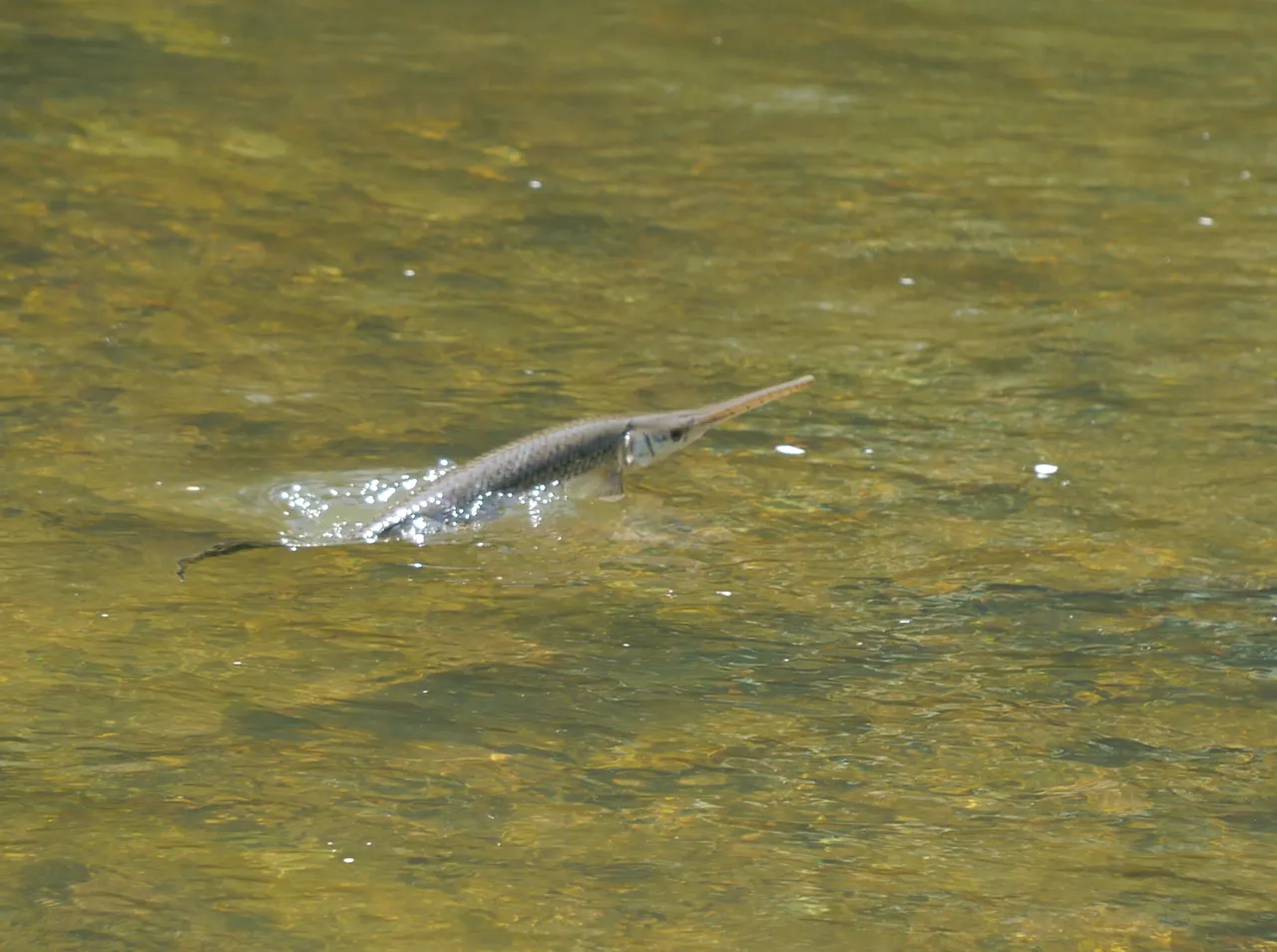
How this was identified, and who took it
Identified by: A very long narrow beak considerably more than twice the length of the rest of the head, lined with fine teeth, over a flank carrying the hard diamond-shaped ganoid scale armour the page names. The dorsal and anal fins sit far back near the tail and dark spotting covers the rear body. Four agreeing identifications.Matt Muir — CC BY, via iNaturalist — source, licenceCatching Longnose gar
Everything here on fishing for it. Each entry opens the page behind it.
Longnose gar is a survivor from a much older world: a long cylindrical fish sheathed in hard, diamond-shaped, enamel-covered ganoid scales, with a beak far longer than its head and lined with needle teeth.
That beak is the angling problem. It is narrow and almost entirely bone, and a conventional hook slides out of it more often than it holds — which is why anglers who target gar deliberately use rope lures that tangle in the teeth rather than hooks that penetrate them.
Like bowfin, gar can breathe air through a vascularised swim bladder and roll at the surface to gulp, and like bowfin they thrive in warm, still, oxygen-poor water where other predators cannot.
How it is caught
Identification
- Scientific name
- Lepisosteus osseus
- Family
- Lepisosteidae
- Water
- Freshwater, Brackish
- Conservation status
- Least Concern
- Regions
- North America
- A very long narrow beak, more than twice the length of the rest of the head, lined with fine sharp teeth.
- Hard diamond-shaped ganoid scales forming a rigid armour, unlike the flexible scales of other freshwater fish.
- Long cylindrical body with the dorsal and anal fins set far back close to the tail.
- Olive-brown above with dark spots on the fins and rear body, over a pale belly.
Size
- Typical
- 1.5–4 kg (3.3–8.8 lb)
- Large
- 5–9 kg (11–20 lb)
Exceptional: FishBase records a maximum of 200 cm and 22.8 kg
Armour, a beak full of needles, and roe that is genuinely poisonous
Gar present three separate problems and the third one is unique on FishingHQ.
THE BEAK. A long narrow jaw lined with many fine needle-sharp teeth, used to seize prey sideways. It punctures rather than cuts, the punctures are numerous, and a gar shakes its head. Hands do not approach the mouth: long pliers, and a gloved grip well behind the head.
THE ARMOUR. Gar are covered in hard, interlocking, enamel-like ganoid scales that are genuinely difficult to penetrate — historically used as arrowheads and abrasives. They are also sharp-edged. A hand run along a gar removes skin, and a fish thrashing against a bare forearm does the same. This armour is also why gar are hard to hook and why rope lures exist for them.
AND THE ROE IS TOXIC. Gar eggs are poisonous to humans and to many other animals — a real and documented toxicity, not a folk belief. A gar being prepared for the table must have the roe discarded and kept away from anybody who might eat it. This is the clearest case in FishingHQ of a fish where the handling advice extends into the kitchen.
THE FISH IS OTHERWISE ROBUST. Gar are air-breathers with a vascularised swim bladder, tolerate poor water and handling far better than most fish, and survive release readily.
AND THE LEAD POINT. Gar are frequently fished with heavy terminal tackle in freshwater systems where lead restrictions may apply, and the species' longevity means bioaccumulation is a live consideration for anybody eating large individuals. Both are local questions worth asking.
What experienced anglers do — why, and the sources (2)
Widely and independently recommended by experienced anglers and specialist sources. This is real angling knowledge, not proof: controlled evidence for it is limited, and FishingHQ records it as convention rather than as a demonstrated effect.
- FishBase: a global information system on fishes — Froese, R. and D. Pauly, eds. — FishBase Consortium (Scientific institute)Relied on for: Dentition, fin and spine morphology, body form, air-breathing capability and distribution for the species, which are the anatomical facts the handling practice below follows from.States this directlyPassage read and verified
- General angling website restatements of established technique — Various (Credible secondary source)Relied on for: Widely restated angling practice for handling this species, recorded as practitioner consensus rather than as tested fact.Background and mechanism onlyCitation checked — the work exists and is described correctly
Another air-breather, a different shape, and the same backwater
Longnose gar share their habitat with bowfin and arrived at it along a separate evolutionary route, which makes the pair a useful illustration of what that habitat actually demands.
THE WATER IS THE SAME. Warm, slow, shallow, vegetated: backwaters, oxbows, sluggish river reaches, reservoir margins and weedy lakes across a large part of eastern and central North America. Gars tolerate low oxygen, high temperature and turbidity that exclude most predatory fish, and they also tolerate brackish water — longnose gar occur in coastal and estuarine situations well down the salinity gradient, which extends the range considerably.
THE SOLUTION IS THE SAME AND SEPARATELY EVOLVED. Gars possess a vascularised, alveolated gas bladder that functions as a lung, and they surface to gulp air — visibly and frequently, which is how they are usually spotted. As with bowfin, this converts oxygen-poor water into an uncontested niche.
THE HUNTING SHAPE IS WHERE THEY DIVERGE. A gar is an extremely elongate fish with a long, narrow, tooth-lined beak, and it hunts by lying almost motionless near the surface and striking sideways with a rapid sweep of the head. That works in the upper water among weed and structure rather than from deep cover, so gars are frequently seen basking near the surface in a way a bowfin is not, and they hold in the top of the column where an air-breather has least to lose.
THE ARMOUR IS PART OF THE HABITAT STORY. Gars are covered in thick, interlocking, enamel-coated ganoid scales forming a rigid protective sheath. That is heavy and it costs flexibility, and it buys near-immunity from predation — which is a reasonable trade in shallow warm water shared with large predators, and part of why gars persist where they do.
AND THE SPAWNING TIES THEM TO FLOODED MARGINS. Gars spawn over vegetation in shallow warm water, and the eggs are toxic to many potential predators, which is a further adaptation to a habitat with nowhere to hide. River channelisation and floodplain disconnection remove exactly that spawning habitat, which is the principal pressure on the group.
Backed by research — why, and the sources (2)
Supported by peer-reviewed research or fisheries science. The sources are listed and can be checked.
- FishBase: a global information system on fishes — Froese, R. and D. Pauly, eds. — FishBase Consortium (Scientific institute)Relied on for: Habitat association, depth range, substrate preference, salinity tolerance and temperature range recorded for the species.States this directlyPassage read and verified
- The IUCN Red List of Threatened Species — International Union for Conservation of Nature (Conservation authority)Relied on for: Assessment and habitat account, including the habitats on which the species depends and the threats to them.Background and mechanism onlyCitation checked — the work exists and is described correctly
Lifecycle and reproduction
Long-lived and slow-maturing, with females growing considerably larger and living longer than males. Populations persist well in habitat degraded for other species.
Spawns in spring in shallow vegetated water, with several males attending a female and eggs scattered over weed and gravel. The eggs are toxic to many potential predators, including birds and mammals, which is unusual and effective.
Feeding and senses
An ambush predator taking small fish, held sideways in the beak with a sudden sweep of the head and then turned to swallow head-first. Hunting is slow and patient rather than pursuit-based.
Hunts by sight in the upper water column, holding motionless near the surface and striking sideways at close range. Air-gulping at the surface makes the fish visible to anglers and is often how they are located.
Through the year
Most visible and most catchable in warm months when fish hold near the surface in shallow water. Activity falls sharply in cold water.
Distribution
North and Central America: Atlantic Slope from Delaware River in New Jersey to central Florisa; St. Lawrence River in Quebec through Great Lakes and Mississippi River basin to Red River (Hudson Bay basin), North Dakota, and south to Louisiana; Gulf Slope drainages from central Florida to Rio Grande drainage in Texas and Mexico
This is a biological range — where the species occurs, not a prediction that you will catch one. To browse the fishing geography FishingHQ holds, start at fishing places.
Why anglers care
A deliberately targeted species in the American south and midwest, most characteristically with rope lures — frayed nylon that snags in the teeth — as well as live and cut bait. Its significance is as a native ancient predator that fights hard and requires a genuinely different technique from anything else in fresh water. Practitioner consensus is that conventional hooks fail often in the bony beak and that rope or long-shank stinger arrangements are more effective.
Handling and returning
The teeth are needle-sharp and the scales are hard enough to blunt tools; the fish thrashes powerfully. Control it behind the head, keep hands entirely clear of the beak, and use pliers. The eggs are toxic and must not be eaten.
Safety
Lead and toxic materials — Can cause serious injury or death
Gar eggs are toxic to humans and to many other animals.
What reduces it: Do not eat gar roe under any circumstances, and dispose of it appropriately if a fish is retained.
Injury while handling fish — Can cause injury needing treatment
The long beak is lined with fine sharp teeth that cause deep punctures, and gar thrash strongly when handled.
What reduces it: Control the fish behind the head, never handle the beak, and use long pliers or a dehooker.
Where to go next
Where it lives
Understanding this fish
More fish
Not related to this page — just the rest of the section. There is little else joined to this subject yet, and a short page should still lead somewhere.
Sources and evidence
- FishBase: a global information system on fishes — Froese, R. and D. Pauly, eds. — FishBase Consortium (Scientific institute)Relied on for: Family, maximum size, depth and environment, distribution and the IUCN assessment for Lepisosteus osseus.States this directlyPassage read and verified
- The IUCN Red List of Threatened Species — International Union for Conservation of Nature (Conservation authority)Relied on for: The Least Concern assessment for Lepisosteus osseus, assessed 14 November 2018.States this directlyCitation checked — the work exists and is described correctly
Why the 5 connections on this page are here, and the sources
How it is caught
What experienced anglers do — 2 connections
Widely and independently recommended by experienced anglers and specialist sources. This is real angling knowledge, not proof: controlled evidence for it is limited, and FishingHQ records it as convention rather than as a demonstrated effect.
Livebaiting
A practitioner claim about how Lepisosteus osseus is commonly fished, following from where and how it feeds.
- General angling website restatements of established technique — Various (Credible secondary source)Relied on for: Widely restated practitioner accounts of fishing for longnose gar.Citation checked — the work exists and is described correctly
- Sea Angler — Bauer Media (Specialist angling publication)Relied on for: Practitioner treatment of the methods used for longnose gar and comparable species.Citation checked — the work exists and is described correctly
Spinning
A practitioner claim about how Lepisosteus osseus is commonly fished, following from where and how it feeds.
- General angling website restatements of established technique — Various (Credible secondary source)Relied on for: Widely restated practitioner accounts of fishing for longnose gar.Citation checked — the work exists and is described correctly
- Sea Angler — Bauer Media (Specialist angling publication)Relied on for: Practitioner treatment of the methods used for longnose gar and comparable species.Citation checked — the work exists and is described correctly
Where it lives
Backed by research — 2 connections
Supported by peer-reviewed research or fisheries science. The sources are listed and can be checked.
Lowland rivers
A habitat association for Lepisosteus osseus taken from the environment and distribution data on its FishBase summary.
- FishBase: a global information system on fishes — Froese, R. and D. Pauly, eds. — FishBase Consortium (Scientific institute)Relied on for: The environment, depth range and habitat description recorded for Lepisosteus osseus.States this directlyPassage read and verified
Lowland stillwaters
A habitat association for Lepisosteus osseus taken from the environment and distribution data on its FishBase summary.
- FishBase: a global information system on fishes — Froese, R. and D. Pauly, eds. — FishBase Consortium (Scientific institute)Relied on for: The environment, depth range and habitat description recorded for Lepisosteus osseus.States this directlyPassage read and verified
Understanding this fish
Backed by research — 1 connection
Supported by peer-reviewed research or fisheries science. The sources are listed and can be checked.
How fish breathe
A species joined to the mechanism it is a worked example of, written only where the species demonstrates the mechanism unusually clearly rather than where it is merely subject to it.
- FishBase: a global information system on fishes — Froese, R. and D. Pauly, eds. — FishBase Consortium (Scientific institute)Relied on for: Recorded environment, respiration, oxygen tolerance, feeding biology, growth, longevity and distribution of the species named.States this directlyPassage read and verified
- The IUCN Red List of Threatened Species — International Union for Conservation of Nature (Conservation authority)Relied on for: Conservation assessment, recorded threats and population trend of the species named.States this directlyCitation checked — the work exists and is described correctly
How FishingHQ labels evidence is explained in the evidence policy.