Hampala barb
Fish · Last reviewed 2026-08-10
A predatory Southeast Asian barb with a bold black vertical bar and red-edged tail, hunting small fish in clear rivers and taken on lures.
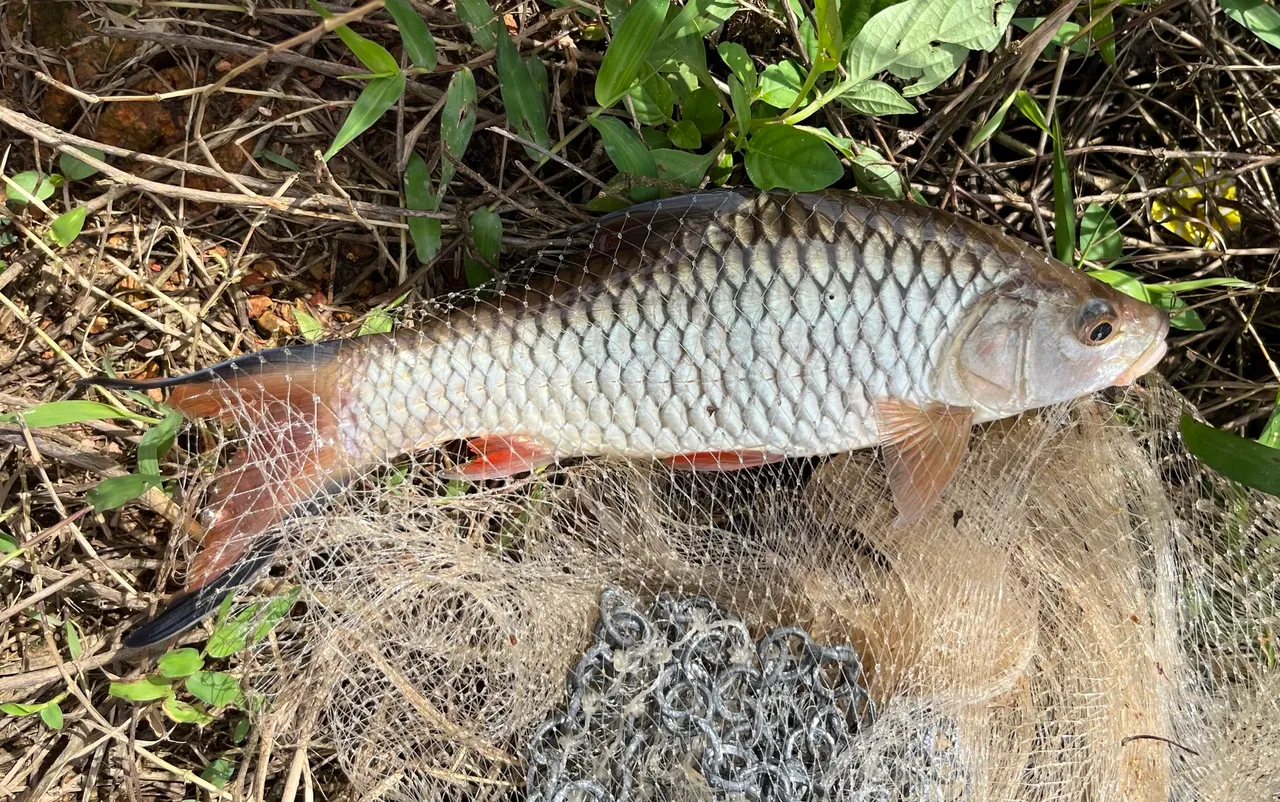
How this was identified, and who took it
Identified by: A forked tail with orange-red lobes each edged in a hard black margin, with very large silver scales and a big terminal mouth. Stated rather than glossed: the single bold black mid-flank bar the record leads on has faded on this large adult to a small dark blotch, so it did not carry the identification. Four agreeing identifications.Zakqary Roy — CC BY, via iNaturalist — source, licenceCatching Hampala barb
Everything here on fishing for it. Each entry opens the page behind it.
Hampala barb — sebarau in Malaysia and Indonesia — is a cyprinid that hunts. It has the streamlined build of a predator, a large mouth, and the speed to run down small fish in the clear rivers and reservoirs of Southeast Asia, and it takes lures with genuine aggression.
It is unmistakable: a broad black vertical bar across the middle of a silver flank, and a forked tail edged in red or orange. Nothing else in its water looks like it.
For lure anglers across Malaysia, Thailand, Indonesia and Cambodia it is a principal target — accessible, hard-fighting and widespread — and it is one of the species that has built the regional lure-fishing culture.
How it is caught
Gear for this fish
Identification
- Scientific name
- Hampala macrolepidota
- Family
- Cyprinidae
- Water
- Freshwater
- Conservation status
- Least Concern
- Regions
- South-East Asia
- A single bold black vertical bar across the middle of the flank.
- Forked tail with red or orange margins and dark edges to the lobes.
- Large silver scales over a streamlined body with a large terminal mouth.
- Two pairs of barbels at the mouth, small and easily missed.
Size
- Typical
- 0.5–2 kg (1.1–4.4 lb)
- Large
- 3–5 kg (6.6–11 lb)
Exceptional: FishBase records a maximum of 70 cm
Lifecycle and reproduction
Fast-growing and moderately long-lived, maturing within a few years. Populations do well in clear rivers and in reservoirs, and decline where water quality falls or flows are heavily modified.
Spawns in the wet season in flowing water, with movement into tributaries on rising flows. Eggs are scattered with no parental care.
Feeding and senses
Predatory on small fish, shrimp and insects, hunting actively in clear water rather than ambushing from cover. It works current seams and the edges of pools, and it will chase prey some distance rather than relying on a single strike, which is why fast-moving lures draw a response.
A daylight visual hunter of clear river and reservoir water, keying on movement and flash — the basis of its responsiveness to lures.
Through the year
Feeding and spawning follow the monsoon cycle, with the clearest and most productive lure fishing generally in the drier periods when visibility is good.
Distribution
Asia: Mekong and Chao Phraya basins, Malay Peninsula and Indonesia
This is a biological range — where the species occurs, not a prediction that you will catch one. To browse the fishing geography FishingHQ holds, start at fishing places.
Why anglers care
A principal freshwater lure target across Malaysia, Indonesia, Thailand and Cambodia, taken on small spoons, spinners, minnows and poppers in rivers and reservoirs. Its significance is that it provides genuine predator lure fishing in tropical fresh water on light tackle, and it has been central to the growth of recreational lure angling in the region.
Handling and returning
A hard-fighting fish with sharp fin spines and soft scales. Wet hands, support the body, unhook with pliers, and return promptly — tropical water temperatures mean recovery after a long fight is slower than in temperate conditions.
Where to go next
Where it lives
Where you will find it
More fish
Not related to this page — just the rest of the section. There is little else joined to this subject yet, and a short page should still lead somewhere.
Sources and evidence
- FishBase: a global information system on fishes — Froese, R. and D. Pauly, eds. — FishBase Consortium (Scientific institute)Relied on for: Family, maximum size, depth and environment, distribution and the IUCN assessment for Hampala macrolepidota.States this directlyPassage read and verified
- The IUCN Red List of Threatened Species — International Union for Conservation of Nature (Conservation authority)Relied on for: The Least Concern assessment for Hampala macrolepidota, assessed 01 February 2019.States this directlyCitation checked — the work exists and is described correctly
Why the 6 connections on this page are here, and the sources
How it is caught
What experienced anglers do — 1 connection
Widely and independently recommended by experienced anglers and specialist sources. This is real angling knowledge, not proof: controlled evidence for it is limited, and FishingHQ records it as convention rather than as a demonstrated effect.
Spinning
A practitioner claim about how Hampala macrolepidota is commonly fished, following from where and how it feeds.
- General angling website restatements of established technique — Various (Credible secondary source)Relied on for: Widely restated practitioner accounts of fishing for hampala barb.Citation checked — the work exists and is described correctly
- Sea Angler — Bauer Media (Specialist angling publication)Relied on for: Practitioner treatment of the methods used for hampala barb and comparable species.Citation checked — the work exists and is described correctly
Gear for this fish
What experienced anglers do — 2 connections
Widely and independently recommended by experienced anglers and specialist sources. This is real angling knowledge, not proof: controlled evidence for it is limited, and FishingHQ records it as convention rather than as a demonstrated effect.
Spinners
A practitioner claim about tackle commonly used for Hampala macrolepidota.
- General angling website restatements of established technique — Various (Credible secondary source)Relied on for: Widely restated practitioner accounts of this presentation for hampala barb.Citation checked — the work exists and is described correctly
- Angling Times — Bauer Media (Specialist angling publication)Relied on for: Practitioner treatment of comparable presentations for the species group.Citation checked — the work exists and is described correctly
Spoons
A practitioner claim about which lure family answers this species' feeding or holding behaviour.
- IGFA International Angling Rules and World Record Requirements — International Game Fish Association (Angling or fisheries organisation)Relied on for: Recognition of the species as an established sport fish taken on artificial lures, and the line and tackle classes used for it.States this directlyPassage read and verified
- General angling website restatements of established technique — Various (Credible secondary source)Relied on for: Widely restated lure practice for this species.Background and mechanism onlyCitation checked — the work exists and is described correctly
Where it lives
Backed by research — 2 connections
Supported by peer-reviewed research or fisheries science. The sources are listed and can be checked.
Lowland rivers
A habitat association for Hampala macrolepidota taken from the environment and distribution data on its FishBase summary.
- FishBase: a global information system on fishes — Froese, R. and D. Pauly, eds. — FishBase Consortium (Scientific institute)Relied on for: The environment, depth range and habitat description recorded for Hampala macrolepidota.States this directlyPassage read and verified
Lowland stillwaters
A habitat association for Hampala macrolepidota taken from the environment and distribution data on its FishBase summary.
- FishBase: a global information system on fishes — Froese, R. and D. Pauly, eds. — FishBase Consortium (Scientific institute)Relied on for: The environment, depth range and habitat description recorded for Hampala macrolepidota.States this directlyPassage read and verified
Where you will find it
Backed by research — 1 connection
Supported by peer-reviewed research or fisheries science. The sources are listed and can be checked.
The Mekong system
A distribution association between an animal and a kind of water, rather than a claim about any named mark.
- The IUCN Red List of Threatened Species — International Union for Conservation of Nature (Conservation authority)Relied on for: Assessment and habitat account for the species, including the river or lake system it occupies and the pressures acting on it.States this directlyCitation checked — the work exists and is described correctly
- FishBase: a global information system on fishes — Froese, R. and D. Pauly, eds. — FishBase Consortium (Scientific institute)Relied on for: Distribution, habitat association, size and life history recorded for the species in the system concerned.States this directlyPassage read and verified
How FishingHQ labels evidence is explained in the evidence policy.