Smallmouth bass
Fish · Last reviewed 2026-08-10
A hard-fighting river and rocky-lake predator of North America, reckoned pound for pound the strongest freshwater fish on the continent.
Safety: biosecurity and disease transfer — can cause serious injury or death. 5 more points apply here.
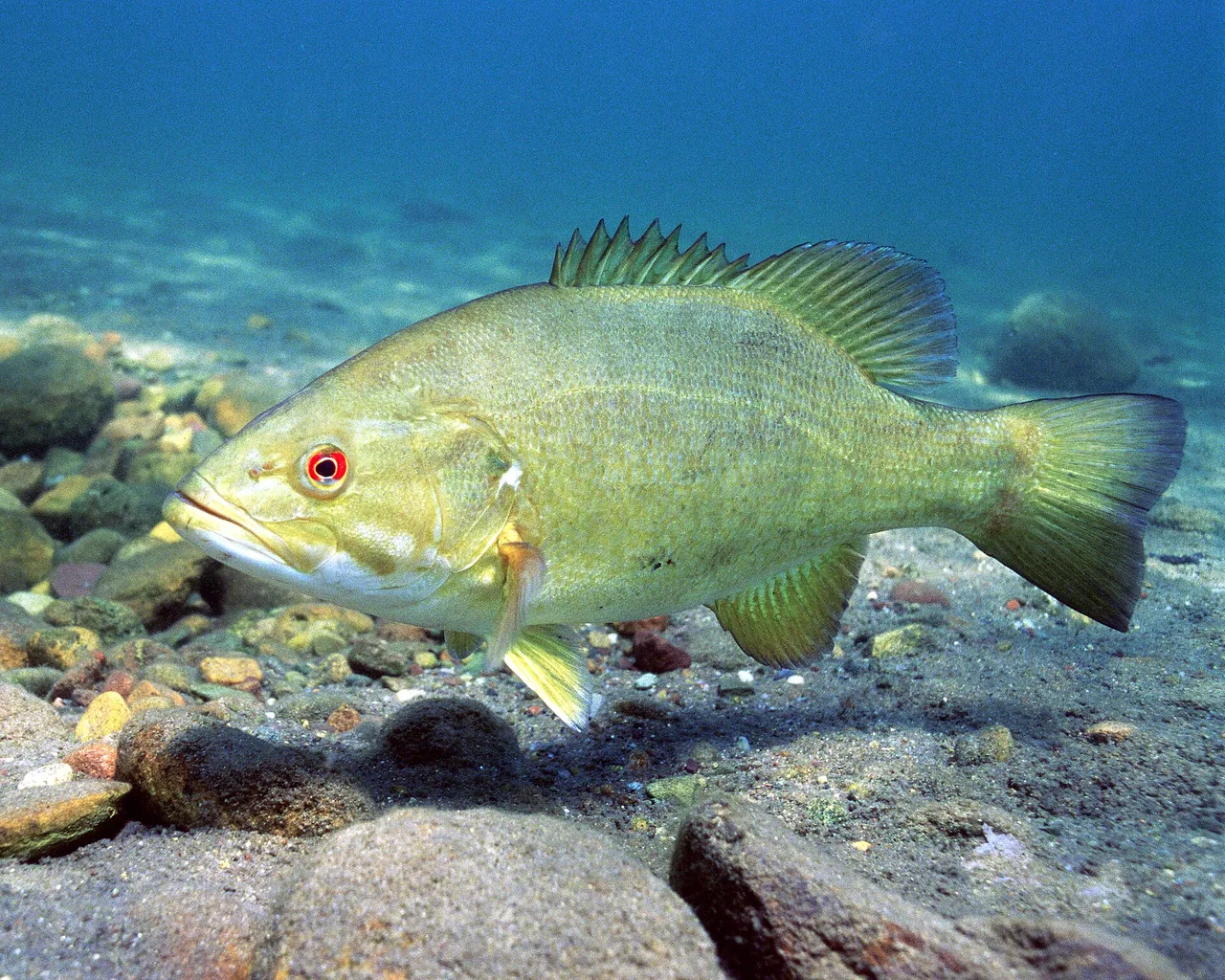
How this was identified, and who took it
Identified by: Red iris, upper jaw ending level with the rear edge of the eye rather than past it, and a dorsal fin only shallowly notched — the three characters separating it from largemouth bass.Eric Engbretson, U.S. Fish and Wildlife Service, Public domain, via Wikimedia Commons — source, licence
Catching Smallmouth bass
Everything here on fishing for it. Each entry opens the page behind it.
- Ground
The smallmouth bass is the largemouth's cool-water cousin and, among anglers who have caught both, the one that gets the respect. It is smaller, it lives in clearer and more oxygenated water, and it fights out of all proportion to its size — long runs, sustained pressure and repeated jumps rather than a short heavy lunge into cover.
Biologically it is a fish of rock and current. Where the largemouth wants warm, weedy, still water, the smallmouth wants gravel runs, rocky shoals, current seams and the clear northern lakes with hard bottoms. Crayfish are the diet's centre of gravity in a way they are not for any other North American bass, which is why so much smallmouth tackle is brown, and why presentations that crawl along the bottom outfish ones that swim above it.
It has been introduced widely outside its native range, including into rivers where it was not previously present, and several countries report ecological harm following introduction. That belongs on the record alongside the fishing, because a fish this effective at eating other fish does not stop being effective when it is moved somewhere new.
How it is caught
- Drop shottingDrop-shotting presents a small bait above bottom at a fixed height, which is the answer to smallmouth holding tight to deep rock where a bottom-dragged bait snags.
- SpinningSmallmouth relate to rock and current, and casting lures to boulder, ledge and gravel is how they are located and taken through most of the season.
Gear for this fish
- CrankbaitsSmallmouth relate to rock and current rather than to weed, and a crankbait deflecting off boulder and gravel is the presentation that both finds them and provokes them.
- Soft plasticsTubes and finesse plastics on light heads imitate the crayfish that dominate a smallmouth's diet on rocky bottom, and they are fished on the bottom for exactly that reason.
- Surface luresSmallmouth in rivers and clear lakes feed upward with unusual willingness, and surface fishing for them is a mainstream approach rather than a low-light-only one.
Identification
- Scientific name
- Micropterus dolomieu
- Family
- Centrarchidae
- Water
- Freshwater
- Conservation status
- Least Concern
- Regions
- North America, Western Europe, East Asia, East & Southern Africa
- Upper jaw ends level with or before the rear edge of the eye — the character that separates it from largemouth bass, whose jaw extends past it.
- Dorsal fin only shallowly notched between spiny and soft portions, appearing as one continuous fin rather than two.
- Vertical dark bars on the flank rather than a horizontal band, though these fade and intensify with mood and water clarity.
- Bronze to brown-green overall, giving the common name bronzeback; red or orange iris in many populations.
- Body more streamlined and less deep-bodied than a largemouth of the same length.
Size
- Typical
- 0.5–1.2 kg (1–2.5 lb)
- Large
- 1.8–2.5 kg (4–5.5 lb)
Exceptional: Over 3.5 kg (7.7 lb); maximum published weight 5.4 kg
A gravel nest, a guarding male, and a nest that fails without him
Smallmouth bass are nest builders with male parental care, and the dependence on the guarding male is unusually strict.
THE MALE BUILDS THE NEST, fanning a circular depression in gravel or coarse sand, usually beside cover and in a defined depth range, and he selects and prepares it before females arrive.
SPAWNING IS TRIGGERED BY WATER TEMPERATURE rising into a threshold band in spring, and timing shifts by weeks with latitude and season.
THE FEMALE DEPOSITS AND LEAVES; the male stays. He fans the eggs to keep silt off and oxygen flowing, defends the nest against egg predators, and continues to guard the fry after hatching while they remain as a school over the nest.
REMOVE THE MALE AND THE NEST GENERALLY FAILS. Egg and fry predators move in within minutes, and the brood is lost. That is a well-documented mechanism and it is the reason spring closures and release practice during the nesting period are common — a fact this page notes without stating what any current rule permits.
COLD SNAPS AND HIGH WATER DESTROY NESTS, and year-class strength varies substantially with spring weather.
MATURITY COMES AT SEVERAL YEARS and the species is comparatively slow-growing in cold northern water, so a large smallmouth in a cool lake may be considerably older than its size suggests.
Backed by research — why, and the sources (2)
Supported by peer-reviewed research or fisheries science. The sources are listed and can be checked.
- FishBase: a global information system on fishes — Froese, R. and D. Pauly, eds. — FishBase Consortium (Scientific institute)Relied on for: Distribution, habitat association, depth range, size, reproduction and life-history parameters recorded for the species.States this directlyPassage read and verified
- The IUCN Red List of Threatened Species — International Union for Conservation of Nature (Conservation authority)Relied on for: Assessment and range account for the species, including the habitats it depends on, its life history and the pressures acting on it.States this directlyCitation checked — the work exists and is described correctly
Shallow to spawn, deep in summer and winter, and a long autumn
Smallmouth bass seasonality is a depth and temperature cycle, and it is one of the more predictable patterns in freshwater fishing.
SPRING BRINGS THEM SHALLOW. As water warms, fish move from deep wintering areas onto shallow rock and gravel to spawn, and the pre-spawn and spawning period concentrates them in accessible water.
SUMMER SPLITS THE POPULATION. Some fish remain on shallow rock and current; others move to deeper structure, and in lakes the thermocline sets a limit. Smallmouth remain active through summer but are more dispersed.
AUTUMN IS THE BEST FEEDING PERIOD in many waters. Cooling water triggers heavy feeding, fish group on structure and follow bait, and the largest fish of the year are frequently taken then.
WINTER CONCENTRATES THEM DEEP AND SLOW. Smallmouth become notably inactive in cold water, holding in deep rocky areas in tight groups and feeding little. They are catchable but the presentation has to slow down to match a fish whose metabolism has.
IN RIVERS, FLOW REPLACES DEPTH as the seasonal variable, with fish moving between fast summer habitat and deeper slower winter holding areas, sometimes over substantial distances.
AND THE THERMAL SENSITIVITY IS THE THING TO CARRY: smallmouth respond to water temperature more sharply than largemouth do, so the same lake fishes very differently for the two species on the same day.
Backed by research — why, and the sources (2)
Supported by peer-reviewed research or fisheries science. The sources are listed and can be checked.
- FishBase: a global information system on fishes — Froese, R. and D. Pauly, eds. — FishBase Consortium (Scientific institute)Relied on for: Distribution, habitat association, depth range, size, reproduction and life-history parameters recorded for the species.States this directlyPassage read and verified
- The IUCN Red List of Threatened Species — International Union for Conservation of Nature (Conservation authority)Relied on for: Assessment and range account for the species, including the habitats it depends on, its life history and the pressures acting on it.States this directlyCitation checked — the work exists and is described correctly
The same jaw, a harder fight, and why recovery takes longer than you think
Smallmouth are handled like largemouth — the jaw is the same solid bony structure, the same lip grip works, and the same rotation toward horizontal with no supporting hand is the thing that injures them. What differs is what has happened to the fish before it gets to that point.
SMALLMOUTH FIGHT HARDER FOR THEIR SIZE THAN ALMOST ANY FRESHWATER FISH, and they do it in a specific way: repeated, violent, aerial, anaerobic bursts rather than a sustained pull. That is the mode of exertion that runs a fish furthest into oxygen debt in the shortest time, and clearing the resulting lactate takes far longer than the fight did.
THE FISH THEREFORE LOOKS RECOVERED LONG BEFORE IT IS. A smallmouth that has stopped struggling and is sitting upright in the water is frequently still deep in physiological debt, and letting it go at that moment produces a fish that swims off convincingly and dies later. The rule that follows is that the fish leaves when it swims out of an open hand under its own power, not when it stops moving.
AND SUMMER MULTIPLIES ALL OF IT. Smallmouth are frequently fished in rivers and clear lakes that warm substantially, and warm water supplies less oxygen while the fish demands more. The recovery period lengthens exactly as the water's ability to support it shortens. Holding a fish upright, facing into the current, in the coolest water available, for as long as it takes, is not a courtesy on a hot afternoon — it is the whole difference between a release and a delayed kill.
THE SPINES ARE SHARP and are met by the hand that supports the body rather than by the one on the jaw. And as with the other black basses, the species has been introduced widely and is invasive in a number of drainages, so whether a fish should go back at all is a local question.
Backed by research — why, and the sources (4)
Supported by peer-reviewed research or fisheries science. The sources are listed and can be checked.
- Do we need species-specific guidelines for catch-and-release recreational angling? — Biodiversity and Conservation 14:1195–1209, 2005 (Scientific literature)Relied on for: That post-release mortality varies with species, capture depth, water temperature, air exposure and handling duration, and that species-specific guidance outperforms general guidance.States this directlyCitation checked — the work exists and is described correctly
- A review of catch-and-release angling mortality with implications for no-take reserves — Reviews in Fish Biology and Fisheries 15:129–154, 2005 (Scientific literature)Relied on for: Review of hooking and release mortality across fisheries, including the contribution of capture depth, handling and anatomical hooking location.States this directlyCitation checked — the work exists and is described correctly
- Check Clean Dry — biosecurity guidance for water users — GB Non-native Species Secretariat (Conservation authority)Relied on for: Regulatory approach to high-risk invasive freshwater fish, including prohibitions on live possession, on return to the water and on movement between waters.States this directlyPassage read and verified
- JNCC species and habitat conservation advice — Joint Nature Conservation Committee (Conservation authority)Relied on for: Conservation advice on native species and the impact of introduced ones.Background and mechanism onlyCitation checked — the work exists and is described correctly
Rock, current and cool clear water — and everything largemouth habitat is not
Smallmouth bass are most usefully described by contrast with their close relative, because the two species are frequently present in the same system and occupy sharply different parts of it.
THE REQUIREMENT IS HARD BOTTOM AND COOL CLEAR WATER. Smallmouth occupy rock, gravel, cobble, boulder and ledge, in clear or lightly stained water, at temperatures below what largemouth prefer. Where a lake has a rocky, steep, clean end and a shallow, weedy, silty end, the smallmouth will be at the first and the largemouth at the second — reliably enough that the distribution is a useful diagnostic for what kind of water you are looking at.
IN RIVERS THEY ARE A CURRENT FISH, and this is the habitat many anglers never associate with the species. Smallmouth thrive in medium and large rivers with defined riffle-and-pool structure, holding in the slack behind boulders, in eddies at the head and tail of pools, along ledges and current seams. The behaviour is closer to a trout's station-holding than to a largemouth's ambush from cover, and it is why smallmouth rivers fish so well to a lure worked across current.
IN LAKES THEY RELATE TO STRUCTURE AND DEPTH RATHER THAN VEGETATION. Rocky points, reefs, humps, drop-offs, riprap and gravel flats hold them; dense weed beds generally do not. Smallmouth also use deeper water more readily than largemouth and are commonly found well down in clear lakes.
CRAYFISH ARE THE CENTRE OF THE FOOD WEB HERE and they explain the substrate preference precisely. Smallmouth are heavy crayfish predators, crayfish live in rock and cobble, and so smallmouth live in rock and cobble. Where crayfish are absent, the species leans on baitfish and its habitat use shifts accordingly.
SPAWNING REINFORCES THE SUBSTRATE REQUIREMENT. Males build and guard nests on gravel and sand in relatively shallow water, usually beside something solid, and a river or lake without clean firm substrate at the right depth will not recruit them well however good the adult habitat is.
AND CLARITY IS PART OF THE HABITAT RATHER THAN A BONUS. Smallmouth are sight predators in clear water; heavy turbidity and siltation degrade both their hunting and their spawning substrate, which is why the species declines in rivers receiving agricultural sediment while more tolerant fish persist.
Backed by research — why, and the sources (2)
Supported by peer-reviewed research or fisheries science. The sources are listed and can be checked.
- Freshwater Fishes of the British Isles — HarperCollins (New Naturalist 75), 1992 (Reference work)Relied on for: Habitat association, distribution and ecology of European freshwater fishes, including position within a water body.States this directlyCitation checked — the work exists and is described correctly
- FishBase: a global information system on fishes — Froese, R. and D. Pauly, eds. — FishBase Consortium (Scientific institute)Relied on for: Habitat association, depth range and water-type tolerance recorded for the species.States this directlyPassage read and verified
Current, clear water and a fish that fights above its weight
Smallmouth tackle sits between the finesse and the power ends of the black bass spectrum, and the position is set by the water they live in rather than by the fish.
THE WATER IS CLEAR AND THAT PUSHES EVERYTHING LIGHTER. The record's habitat section explains that smallmouth occupy clear, rocky, cool water — and clear water means the fish sees the tackle. Lighter line, fluorocarbon leaders and smaller, more natural presentations consistently out-fish the heavier arrangements that work for largemouth in cover.
THE GROUND IS ROCK, WHICH IS ABRASIVE RATHER THAN SNAGGING. Unlike matted vegetation, a rocky bottom does not trap a fish; it wears line. So the requirement is abrasion resistance in the last few metres rather than lifting power, and leaders are checked and re-tied through a session as a matter of routine.
CURRENT IS THE VARIABLE MOST ANGLERS UNDERESTIMATE. A river smallmouth holds behind structure in flow and uses the current in the fight exactly as a barbel does, which is why a two-pound river fish feels like considerably more. That argues for a rod with a forgiving tip that keeps a hook in during sudden changes of angle, and for a drag set to give line rather than to hold.
CRAYFISH SET THE PRESENTATION AND THE PRESENTATION SETS THE TACKLE. Smallmouth are heavy crayfish predators over rock, so bottom-contact presentations — jigs, tubes, small soft plastics — dominate, and those need sensitivity to fish properly. That pushes toward braid with a fluorocarbon leader, which is the common resolution.
THE FISH JUMPS AND THAT COSTS HOOK HOLDS. Smallmouth leave the water repeatedly, and a hook in a hard mouth with slack line comes out. Keeping the rod loaded through a jump is the practical answer.
AND THEY ARE OVERWHELMINGLY RELEASED, so barbless or crushed barbs and a quick unhooking are standard; in warm summer water a short fight matters as much here as it does for any salmonid.
What experienced anglers do — why, and the sources (2)
Widely and independently recommended by experienced anglers and specialist sources. This is real angling knowledge, not proof: controlled evidence for it is limited, and FishingHQ records it as convention rather than as a demonstrated effect.
- Coarse Fishing — A. & C. Black, 1912 (Specialist angling publication)Relied on for: Established coarse angling practice, including tackle, presentation and the reasoning behind them.States this directlyCitation checked — the work exists and is described correctly
- Freshwater Fishing — Macdonald & Jane's, 1975 (Specialist angling publication)Relied on for: Freshwater angling technique, tackle and the principles behind method selection.States this directlyCitation checked — the work exists and is described correctly
Crayfish, current seams and a lure that behaves like something that has lost its footing
Smallmouth lure fishing has a clearer organising principle than most: it is largely an imitation of crayfish on rock, and the presentations that work are the ones that behave like a crayfish in trouble.
CRAYFISH ARE THE CENTRE OF THE DIET AND THEY LIVE IN ROCK. That single fact explains why bottom-contact presentations dominate — tubes, jigs, small craw-profile soft plastics — and why they are fished by hopping, dragging and letting them fall among cobble rather than by swimming them. A crayfish flushed from cover darts backwards and settles, and a lure that does that gets eaten.
DEFLECTION TRIGGERS STRIKES, exactly as it does for largemouth. A crankbait knocking off a rock, a jig falling off a ledge, a tube tumbling in current — the change in behaviour is what commits a following fish, and anglers deliberately fish lures into things rather than around them.
IN RIVERS, CURRENT SUPPLIES THE MOVEMENT AND THE ANGLER SUPPLIES THE POSITION. Smallmouth hold behind boulders, in eddies and along current seams, and a lure cast up-current and allowed to tumble down past the lie is behaving like genuine drift. This is the closest thing in bass fishing to trout logic and it is why river smallmouth respond so well to a lure worked across flow.
CLEAR WATER PUSHES TOWARD REALISM AND SPEED. The record's habitat section explains that smallmouth occupy clear rocky water, and clear water gives a sight predator time to inspect — so natural colours, finer connections and a slightly faster presentation frequently out-fish the slow subtle approach that works in stained water.
BAITFISH PATTERNS EARN THEIR PLACE IN OPEN WATER, on lake points, reefs and humps where smallmouth are feeding on shad or alewife rather than crayfish. Matching which of the two food sources is in play is the most useful judgement on a given day.
THEY JUMP, AND HOOKS PULL. Keeping the rod loaded through a jump matters here as much as it does for any bass, and barbless or crushed barbs shorten unhooking on a fish that is almost always released.
What experienced anglers do — why, and the sources (2)
Widely and independently recommended by experienced anglers and specialist sources. This is real angling knowledge, not proof: controlled evidence for it is limited, and FishingHQ records it as convention rather than as a demonstrated effect.
- Angling Times — Bauer Media (Specialist angling publication)Relied on for: Contemporary lure angling practice, presentation and the reasoning behind it.States this directlyCitation checked — the work exists and is described correctly
- FishBase: a global information system on fishes — Froese, R. and D. Pauly, eds. — FishBase Consortium (Scientific institute)Relied on for: Diet, feeding mode, prey composition and sensory biology recorded for the species.Background and mechanism onlyPassage read and verified
Lifecycle and reproduction
Spawns in late spring when water reaches roughly 15 to 18 degrees, on gravel in shallow water. The male sweeps a nest, guards the eggs and then the fry, and remains aggressive towards intruders for some weeks. Growth is slower than largemouth in the same water because the smallmouth occupies cooler habitat, and northern populations are notably slow-growing and long-lived — which means a large fish from a cold lake represents a great many years.
Nest-building with prolonged male parental care. As with largemouth, the guarding male's aggression is what makes bed fishing possible and what makes it contentious, since removing him exposes the brood for as long as he is away. Closed seasons over the spawning period exist in many jurisdictions for exactly this reason, and FishingHQ does not state what any of them currently are.
Feeding and senses
Crayfish dominate the diet across most of the range, supplemented by fish, aquatic insects and terrestrial insects taken at the surface. Young fish take plankton and insect larvae. The species is recorded as cannibalistic. The crayfish emphasis is the practically important fact: presentations that move slowly along the bottom, in brown and orange, work because they imitate what the fish is actually eating.
Sight-dominant in the clear water it prefers, which is why smallmouth fishing rewards finer line and longer casts than largemouth fishing does. The lateral line matters in current, where a fish holding behind a rock detects prey swept past before it sees it. In stained water and at low light the balance shifts, and vibration-producing lures start to outfish subtle ones.
Through the year
Strongly temperature-driven and, because the range spans a wide band of latitude, best understood by water temperature rather than by month. Fish move shallow to spawn as water warms into the mid-teens, hold on structure and current through summer, feed heavily as temperatures fall, and go deep and slow in cold water. Activity drops sharply below about 10 degrees. In rivers, flow governs where fish hold on any given day more than season does.
Distribution
Native to the St Lawrence and Great Lakes system, the Hudson Bay drainage and the Mississippi basin, from southern Quebec west to North Dakota and south to northern Alabama and eastern Oklahoma. Introduced into many countries for sport fishing, with several reporting adverse ecological impact following introduction.
This is a biological range — where the species occurs, not a prediction that you will catch one. To browse the fishing geography FishingHQ holds, start at fishing places.
Why anglers care
One of North America's principal sport species and a major tournament fish, fished with soft plastics, crankbaits, jigs and topwater, and increasingly on fly. Catch-and-release is the strong norm in the recreational fishery. Where the species is introduced rather than native, whether a fish should be returned is a local question with a local answer.
Handling and returning
Lipped like a largemouth, with the body supported and the jaw not levered horizontally — a heavy fish held by the jaw alone at an angle can be damaged. Wet hands first. The dorsal spines are sharp. In warm water, fish fought hard take longer to recover, so hold the fish upright in the water until it swims off under its own power rather than releasing it the moment it is unhooked.
Going further
- What does smallmouth bass eat? — feeding biology, kept separate from what anglers infer from it.
- Smallmouth bass vs Spotted bass — how to tell them apart.
Safety
Biosecurity and disease transfer — Can cause serious injury or death
Smallmouth bass introduced outside their native range prey heavily on native fish, and several countries report adverse ecological impact following introduction. Moving live fish between waters is how it happens.
What reduces it: Never move live fish or water between waters, anywhere, for any reason. Clean, drain, dry and check equipment between waters. Where the species is non-native, establish what the local requirement is rather than assuming a fish should be returned.
Injury while handling fish — Minor injury
Sharp dorsal spines and abrasive jaw teeth. Neither is dangerous, but both catch out somebody expecting a smooth fish.
What reduces it: Wet hands before handling and lip the fish with the body supported.
Precautions that always apply here
- Wet your hands before touching a fish. Dry hands strip the protective mucus layer that keeps infection out.
- Support the fish's weight along its body, keep it out of the water for as short a time as possible, and hold it over something soft.
- Check, clean and dry your kit between different waters — the published guidance is 48 hours’ drying, in sunlight where possible, because a number of invasive species survive over two weeks in damp conditions. Nets, boots and wet mats move invasive species and disease more effectively than anything else anglers do.
- Never move live fish, live bait or water from one water to another.
Check the rules before you fish
Fishing laws, bylaws, access rules, seasons, bait restrictions and permitted methods vary by location and can change. Check the current rules from the relevant authority and the water you intend to fish before fishing.
Check with:
- Current national or regional law for where you are fishing
- Current local bylaws
- The relevant fisheries authority
- The landowner, club or fishery whose water it is
- Any restrictions specific to the species or the method you intend to use
Where to go next
Where it lives
Where you will find it
Understanding this fish
- Bass: the same word for unrelated fishA second Micropterus, and a third thing again from the temperate basses of Morone.
- Freshwater crayfish as preyCrayfish are the single most important food of adult smallmouth bass by weight in most of their range, and smallmouth habitat choice is largely crayfish habitat choice.
Told apart from
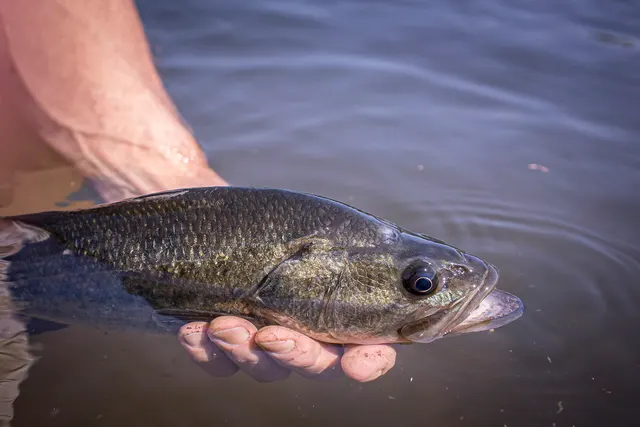 Largemouth bassThe jaw separates them and the habitat explains them: one is a cool clear rock-and-current fish, the other a warm weedy still-water ambusher, and almost every tackle difference follows.
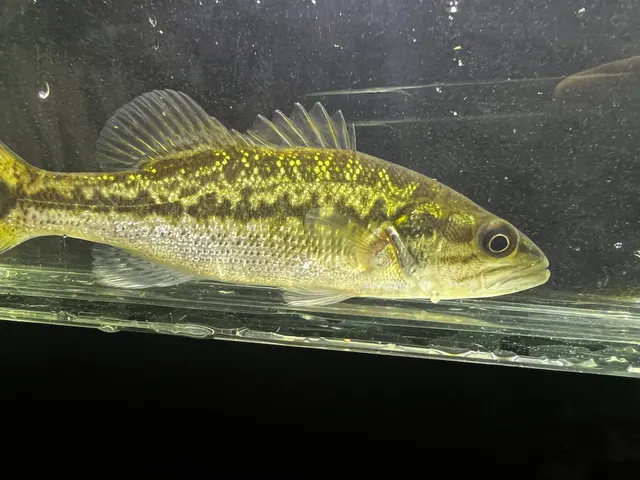 Spotted bassThe harder half of the same problem, and the one that catches out anglers who have learned the jaw rule. Neither has a jaw extending past the eye. A smallmouth is bronze with vertical bars and red eyes; a spotted bass is green with a lateral blotch line and the tongue tooth patch. Habitat helps and does not settle it, because the two overlap in exactly the current-swept rocky rivers both prefer.
Environment and conservation
Sources and evidence
- FishBase: a global information system on fishes — Froese, R. and D. Pauly, eds. — FishBase Consortium (Scientific institute)Relied on for: Scientific name, family placement, maximum length of 69 cm and maximum published weight of 5.4 kg, native distribution across the St Lawrence, Great Lakes, Hudson Bay and Mississippi basins, habitat as shallow rocky areas of lakes and gravel-bottom runs and pools of rivers, the crayfish-dominated adult diet with cannibalism recorded.States this directlyPassage read and verified
- FishBase: a global information system on fishes — Froese, R. and D. Pauly, eds. — FishBase Consortium (Scientific institute)Relied on for: The IUCN Red List category — Least Concern, assessed 1 March 2012 — is taken from FishBase's republication, the Red List itself being unreachable during this review.States this directlyPassage read and verified
- Check Clean Dry — biosecurity guidance for water users — GB Non-native Species Secretariat (Conservation authority)Relied on for: The general framework by which introduced predatory fish are assessed and managed, and live movement of fish as the transmission route.FishingHQ's interpretation of what it saysPassage read and verified
Why the 13 connections on this page are here, and the sources
How it is caught
What experienced anglers do — 2 connections
Widely and independently recommended by experienced anglers and specialist sources. This is real angling knowledge, not proof: controlled evidence for it is limited, and FishingHQ records it as convention rather than as a demonstrated effect.
Drop shotting
Established angling practice for this species, recorded as convention. The note states the property of the animal or its water that makes the method the answer.
- IGFA International Angling Rules and World Record Requirements — International Game Fish Association (Angling or fisheries organisation)Relied on for: Recognition of the species as an established sport fish and the angling methods and tackle classes conventionally used for it.States this directlyPassage read and verified
- General angling website restatements of established technique — Various (Credible secondary source)Relied on for: Widely restated practice connecting this species and method.Background and mechanism onlyCitation checked — the work exists and is described correctly
Spinning
Established angling practice for this species, recorded as convention. The note states the property of the animal or its water that makes the method the answer.
- IGFA International Angling Rules and World Record Requirements — International Game Fish Association (Angling or fisheries organisation)Relied on for: Recognition of the species as an established sport fish and the angling methods and tackle classes conventionally used for it.States this directlyPassage read and verified
- General angling website restatements of established technique — Various (Credible secondary source)Relied on for: Widely restated practice connecting this species and method.Background and mechanism onlyCitation checked — the work exists and is described correctly
Gear for this fish
What experienced anglers do — 3 connections
Widely and independently recommended by experienced anglers and specialist sources. This is real angling knowledge, not proof: controlled evidence for it is limited, and FishingHQ records it as convention rather than as a demonstrated effect.
Crankbaits
A practitioner claim about which lure family answers this species' feeding or holding behaviour.
- General angling website restatements of established technique — Various (Credible secondary source)Relied on for: Widely restated North American lure practice for this species.Background and mechanism onlyCitation checked — the work exists and is described correctly
- IGFA International Angling Rules and World Record Requirements — International Game Fish Association (Angling or fisheries organisation)Relied on for: Recognition of the species as an established sport fish taken on artificial lures, and the tackle conventions used for it.States this directlyPassage read and verified
Soft plastics
A practitioner claim about which lure family answers this species' feeding or holding behaviour.
- General angling website restatements of established technique — Various (Credible secondary source)Relied on for: Widely restated North American lure practice for this species.Background and mechanism onlyCitation checked — the work exists and is described correctly
- IGFA International Angling Rules and World Record Requirements — International Game Fish Association (Angling or fisheries organisation)Relied on for: Recognition of the species as an established sport fish taken on artificial lures, and the tackle conventions used for it.States this directlyPassage read and verified
Surface lures
A practitioner claim about which lure family answers this species' feeding or holding behaviour.
- General angling website restatements of established technique — Various (Credible secondary source)Relied on for: Widely restated North American lure practice for this species.Background and mechanism onlyCitation checked — the work exists and is described correctly
- IGFA International Angling Rules and World Record Requirements — International Game Fish Association (Angling or fisheries organisation)Relied on for: Recognition of the species as an established sport fish taken on artificial lures, and the tackle conventions used for it.States this directlyPassage read and verified
Where it lives
Backed by research — 1 connection
Supported by peer-reviewed research or fisheries science. The sources are listed and can be checked.
Lowland rivers
A habitat claim held to a scientific standard.
- FishBase: a global information system on fishes — Froese, R. and D. Pauly, eds. — FishBase Consortium (Scientific institute)Relied on for: That Micropterus dolomieu occupies shallow rocky areas of lakes and clear gravel-bottom runs and flowing pools of rivers, at 1 to 7 m and 9 to 30 degrees.States this directlyPassage read and verified
Where you will find it
Backed by research — 2 connections
Supported by peer-reviewed research or fisheries science. The sources are listed and can be checked.
Canada
A distribution association between an animal and a kind of water, rather than a claim about any named mark.
- FishBase: a global information system on fishes — Froese, R. and D. Pauly, eds. — FishBase Consortium (Scientific institute)Relied on for: Distribution, habitat association and depth range recorded for the species, including its occurrence in the water body concerned.States this directlyPassage read and verified
- The IUCN Red List of Threatened Species — International Union for Conservation of Nature (Conservation authority)Relied on for: Assessment and range account for the species, including the systems and coasts it occupies.Background and mechanism onlyCitation checked — the work exists and is described correctly
The Great Lakes
Occurrence of the species in this system or along this coast: a statement about the animal's distribution, not a venue recommendation.
- FishBase: a global information system on fishes — Froese, R. and D. Pauly, eds. — FishBase Consortium (Scientific institute)Relied on for: Distribution, salinity tolerance and habitat association recorded for the species, including its occurrence in this system.States this directlyPassage read and verified
- The IUCN Red List of Threatened Species — International Union for Conservation of Nature (Conservation authority)Relied on for: Assessment and range description for the species, including the waters in which it occurs.Background and mechanism onlyCitation checked — the work exists and is described correctly
Understanding this fish
Backed by research — 2 connections
Supported by peer-reviewed research or fisheries science. The sources are listed and can be checked.
Bass: the same word for unrelated fish
Three genera share the word inside North America alone.
- FishBase: a global information system on fishes — Froese, R. and D. Pauly, eds. — FishBase Consortium (Scientific institute)Relied on for: Family and genus placement for the unrelated fish that carry the common name bass, establishing that the name has no taxonomic content.States this directlyPassage read and verified
Freshwater crayfish as prey
Recorded diet evidence identifies freshwater crayfish as a food item of this predator at group level rather than to species. The edge points at the taxon record for that reason, and encoding it as a species-level claim would assert something the source does not.
- FishBase: a global information system on fishes — Froese, R. and D. Pauly, eds. — FishBase Consortium (Scientific institute)Relied on for: Food items recorded for this predator, given as freshwater crayfish.States this directlyPassage read and verified
- FAO Species Identification Guides for Fishery Purposes and the FAO Species Catalogues — Food and Agriculture Organization of the United Nations (Scientific institute)Relied on for: Species account describing this predator's diet, recorded at the level of freshwater crayfish.Background and mechanism onlyCitation checked — the work exists and is described correctly
Told apart from
Backed by research — 2 connections
Supported by peer-reviewed research or fisheries science. The sources are listed and can be checked.
Largemouth bass
A comparison resting on documented habitat and morphology rather than on angling opinion, which is what makes it useful for identification as well as for technique.
- FishBase: a global information system on fishes — Froese, R. and D. Pauly, eds. — FishBase Consortium (Scientific institute)Relied on for: That Micropterus dolomieu occupies shallow rocky areas of lakes and clear gravel-bottom river runs at 9 to 30 degrees, in contrast to the warm still weedy habitat recorded for Micropterus salmoides.States this directlyPassage read and verified
The inverse edge, resting on the same documented habitat separation.
- FishBase: a global information system on fishes — Froese, R. and D. Pauly, eds. — FishBase Consortium (Scientific institute)Relied on for: That Micropterus salmoides occupies warm still weedy water while Micropterus dolomieu occupies shallow rocky lake areas and clear gravel-bottom river runs.States this directlyPassage read and verified
Spotted bass
An identification comparison naming both binomials, addressing a three-way confusion among the black basses.
- FishBase: a global information system on fishes — Froese, R. and D. Pauly, eds. — FishBase Consortium (Scientific institute)Relied on for: That Micropterus punctulatus and Micropterus dolomieu are congeners in the genus Micropterus with overlapping ranges in the central United States.States this directlyPassage read and verified
An identification link between two species readers genuinely mistake for one another, resting on published morphological characters rather than on angling lore, and naming the character that separates them.
- FishBase: a global information system on fishes — Froese, R. and D. Pauly, eds. — FishBase Consortium (Scientific institute)Relied on for: Morphological description, meristic counts, family placement, distribution and environment of the species named.States this directlyPassage read and verified
- FAO Species Identification Guides for Fishery Purposes and the FAO Species Catalogues — Food and Agriculture Organization of the United Nations (Scientific institute)Relied on for: Identification characters and distribution for inland and coastal fishes, from regional identification guides prepared for fishery purposes.States this directlyCitation checked — the work exists and is described correctly
Environment and conservation
Official guidance — 1 connection
Stated by a fisheries authority, scientific institute or recognised angling body. Authoritative, but summarising rather than demonstrating.
Invasive species and biosecurity
An introduction-impact claim held to an authoritative standard.
- FishBase: a global information system on fishes — Froese, R. and D. Pauly, eds. — FishBase Consortium (Scientific institute)Relied on for: That Micropterus dolomieu has been introduced into many countries for sport fishing and that several countries report adverse ecological impact after introduction.States this directlyPassage read and verified
- Check Clean Dry — biosecurity guidance for water users — GB Non-native Species Secretariat (Conservation authority)Relied on for: The framework by which introduced predatory fish are assessed and managed, and live movement as the transmission route.FishingHQ's interpretation of what it saysPassage read and verified
How FishingHQ labels evidence is explained in the evidence policy.