How to identify smallmouth bass
Micropterus dolomieu · Centrarchidae
The characters that identify smallmouth bass, ranked by how far each one can be trusted on its own.
Safety: biosecurity and disease transfer — can cause serious injury or death. One more point applies here.
How this was identified, and who took it
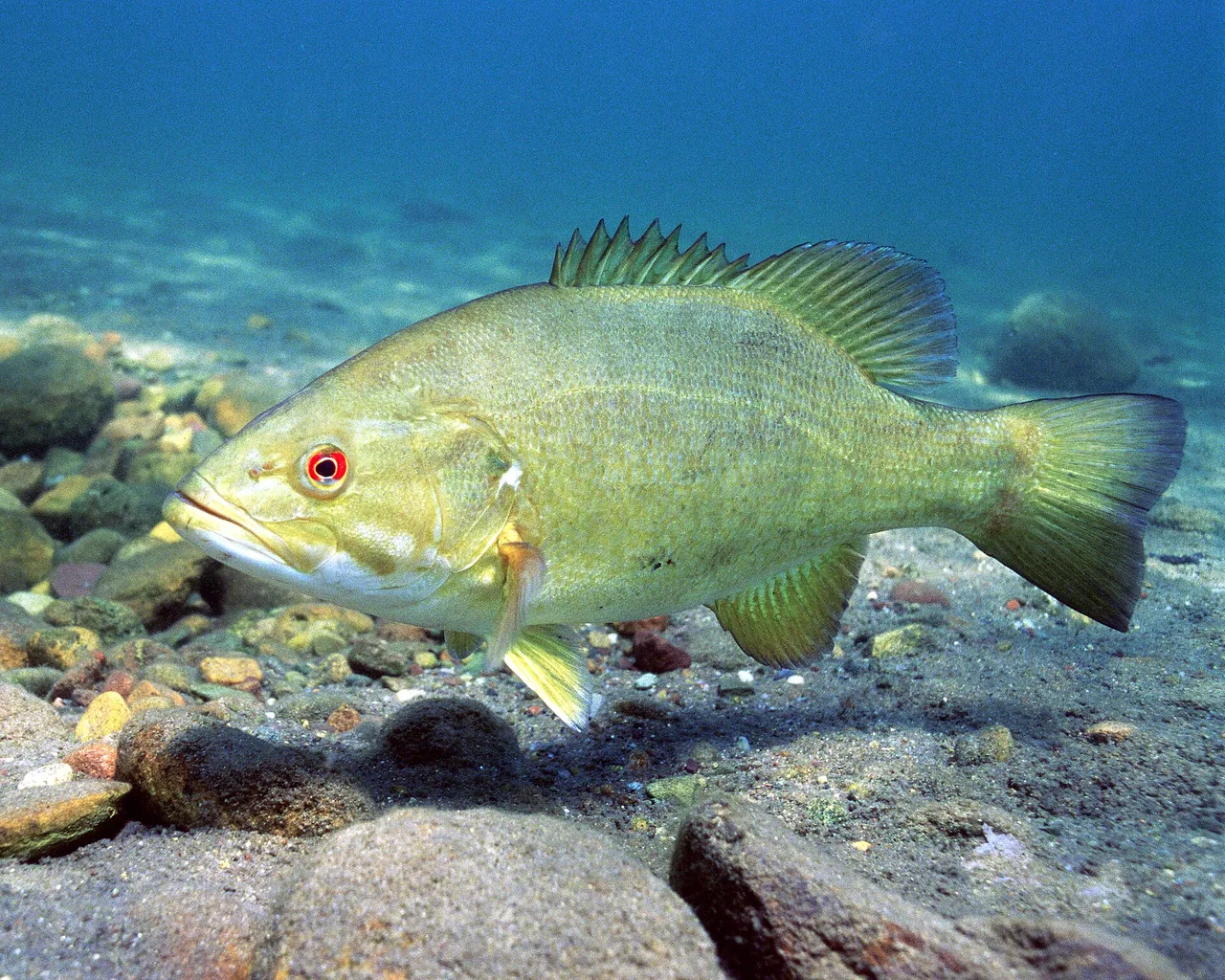
Identified by: Red iris, upper jaw ending level with the rear edge of the eye rather than past it, and a dorsal fin only shallowly notched — the three characters separating it from largemouth bass.Eric Engbretson, U.S. Fish and Wildlife Service, Public domain, via Wikimedia Commons — source, licenceLook at this first
Same check as for a largemouth, read the other way. Shut the mouth, find the hinge: on a smallmouth it stops level with the back of the eye or short of it. If the jaw stops and the eye keeps going, you have a smallmouth.
Diagnostic — settles it on its own
Each of these settles the identification on its own. If one is clear, you have your answer.
The jaw stops at the eye
The rear of the upper jaw ends beneath the pupil or at the eye's back edge, never past it. This is the reciprocal of the largemouth character and it is equally reliable — it is a bone relationship, not a marking.
One continuous dorsal fin
The dip between the spiny and soft portions is shallow enough that the fin reads as a single unit. Set this beside a largemouth's near-divided dorsal and the difference is obvious even in a poor photograph.
Supporting — use with other characters
Real characters that are not conclusive by themselves. Use two or three together.
Bars running down, not a stripe running along
The flank carries vertical smudged barring rather than the horizontal broken band of a largemouth. The bars come and go with the fish's mood and with water clarity, which is why they sit here rather than above.
Build
Longer and less deep through the body than a largemouth at the same weight, with a noticeably thicker tail wrist. Anglers who handle both describe it as the more athletic fish, and the impression is a real proportion difference.
Suggestive only — varies with condition
Hints only. These vary with condition, season, water and how long the fish has been out of it, and a fish that contradicts them is still the same species.
A red or orange iris
Common enough to be worth mentioning and far too variable to rely on. Many populations show it strongly, some barely at all, and largemouth occasionally show it too.
What it gets confused with
- Largemouth bass, wherever both occur. The jaw is the whole answer and it takes two seconds.
- Spotted bass, which shares the shallow dorsal notch and the jaw position and is the genuinely difficult one — check the tongue for a rough tooth patch.
- Young of either of the above, where the dorsal notch is less developed than in an adult.
Side by side: Smallmouth bass vs Spotted bass.
Where this stops working
Spotted bass is the real problem rather than largemouth, because it matches a smallmouth on both of the characters this page ranks as diagnostic. Where the two overlap in the Ohio and Tennessee systems, the tongue patch and the presence of a dark spot on the gill cover do more work than anything above. Introduced populations outside North America have frequently been stocked as mixed Micropterus and hybridise.
The full record
This page covers identification only. The Smallmouth bass record covers behaviour, lifecycle, distribution, handling and the sources behind all of it.
Reviewed 2026-08-14.
More about this fish
Telling it apart is one question. Here are the others.
How it is caught
- Drop shottingDrop-shotting presents a small bait above bottom at a fixed height, which is the answer to smallmouth holding tight to deep rock where a bottom-dragged bait snags.
- SpinningSmallmouth relate to rock and current, and casting lures to boulder, ledge and gravel is how they are located and taken through most of the season.
Where it lives
Where you will find it
Why the 5 connections on this page are here, and the sources
How it is caught
What experienced anglers do — 2 connections
Widely and independently recommended by experienced anglers and specialist sources. This is real angling knowledge, not proof: controlled evidence for it is limited, and FishingHQ records it as convention rather than as a demonstrated effect.
Drop shotting
Established angling practice for this species, recorded as convention. The note states the property of the animal or its water that makes the method the answer.
- IGFA International Angling Rules and World Record Requirements — International Game Fish Association (Angling or fisheries organisation)Relied on for: Recognition of the species as an established sport fish and the angling methods and tackle classes conventionally used for it.States this directlyPassage read and verified
- General angling website restatements of established technique — Various (Credible secondary source)Relied on for: Widely restated practice connecting this species and method.Background and mechanism onlyCitation checked — the work exists and is described correctly
Spinning
Established angling practice for this species, recorded as convention. The note states the property of the animal or its water that makes the method the answer.
- IGFA International Angling Rules and World Record Requirements — International Game Fish Association (Angling or fisheries organisation)Relied on for: Recognition of the species as an established sport fish and the angling methods and tackle classes conventionally used for it.States this directlyPassage read and verified
- General angling website restatements of established technique — Various (Credible secondary source)Relied on for: Widely restated practice connecting this species and method.Background and mechanism onlyCitation checked — the work exists and is described correctly
Where it lives
Backed by research — 1 connection
Supported by peer-reviewed research or fisheries science. The sources are listed and can be checked.
Lowland rivers
A habitat claim held to a scientific standard.
- FishBase: a global information system on fishes — Froese, R. and D. Pauly, eds. — FishBase Consortium (Scientific institute)Relied on for: That Micropterus dolomieu occupies shallow rocky areas of lakes and clear gravel-bottom runs and flowing pools of rivers, at 1 to 7 m and 9 to 30 degrees.States this directlyPassage read and verified
Where you will find it
Backed by research — 2 connections
Supported by peer-reviewed research or fisheries science. The sources are listed and can be checked.
Canada
A distribution association between an animal and a kind of water, rather than a claim about any named mark.
- FishBase: a global information system on fishes — Froese, R. and D. Pauly, eds. — FishBase Consortium (Scientific institute)Relied on for: Distribution, habitat association and depth range recorded for the species, including its occurrence in the water body concerned.States this directlyPassage read and verified
- The IUCN Red List of Threatened Species — International Union for Conservation of Nature (Conservation authority)Relied on for: Assessment and range account for the species, including the systems and coasts it occupies.Background and mechanism onlyCitation checked — the work exists and is described correctly
The Great Lakes
Occurrence of the species in this system or along this coast: a statement about the animal's distribution, not a venue recommendation.
- FishBase: a global information system on fishes — Froese, R. and D. Pauly, eds. — FishBase Consortium (Scientific institute)Relied on for: Distribution, salinity tolerance and habitat association recorded for the species, including its occurrence in this system.States this directlyPassage read and verified
- The IUCN Red List of Threatened Species — International Union for Conservation of Nature (Conservation authority)Relied on for: Assessment and range description for the species, including the waters in which it occurs.Background and mechanism onlyCitation checked — the work exists and is described correctly
Safety
Biosecurity and disease transfer — Can cause serious injury or death
Smallmouth bass introduced outside their native range prey heavily on native fish, and several countries report adverse ecological impact following introduction. Moving live fish between waters is how it happens.
What reduces it: Never move live fish or water between waters, anywhere, for any reason. Clean, drain, dry and check equipment between waters. Where the species is non-native, establish what the local requirement is rather than assuming a fish should be returned.
Injury while handling fish — Minor injury
Sharp dorsal spines and abrasive jaw teeth. Neither is dangerous, but both catch out somebody expecting a smooth fish.
What reduces it: Wet hands before handling and lip the fish with the body supported.