Largemouth bass vs Smallmouth bass
How to tell them apart, and what follows from getting it right.
Why they get confused
The two most widely fished black basses share lakes and rivers across North America and the many countries both have been introduced to, are caught on the same lures, and both change colour so much with water clarity that two fish of the same species can look like different ones. Colour is where most mistakes start; the jaw and the dorsal fin settle it.
Largemouth bass
Micropterus salmoides — Centrarchidae
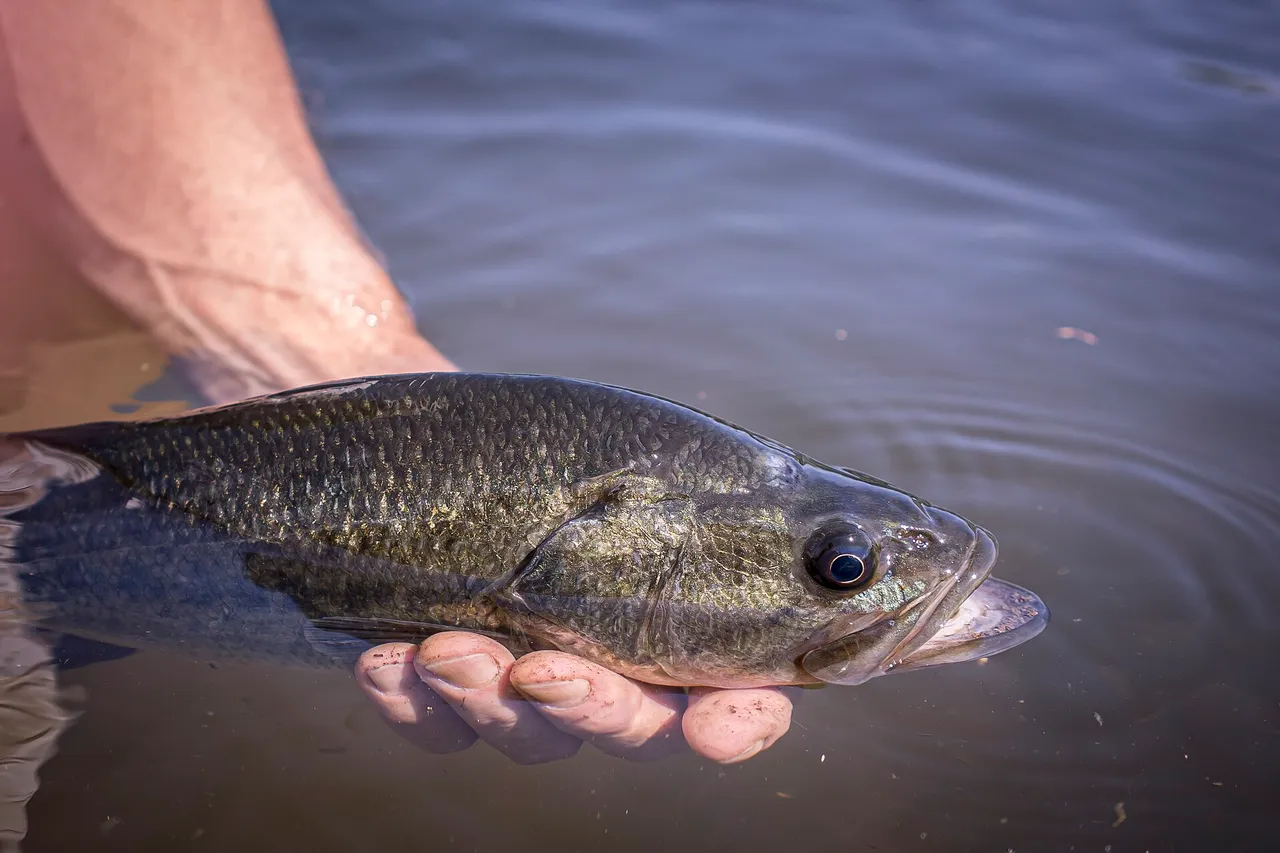
Photo: USFWS Mountain Prairie, via Wikimedia Commons, public domain. Resized and converted to WebP for the web; not otherwise altered.

Smallmouth bass
Micropterus dolomieu — Centrarchidae
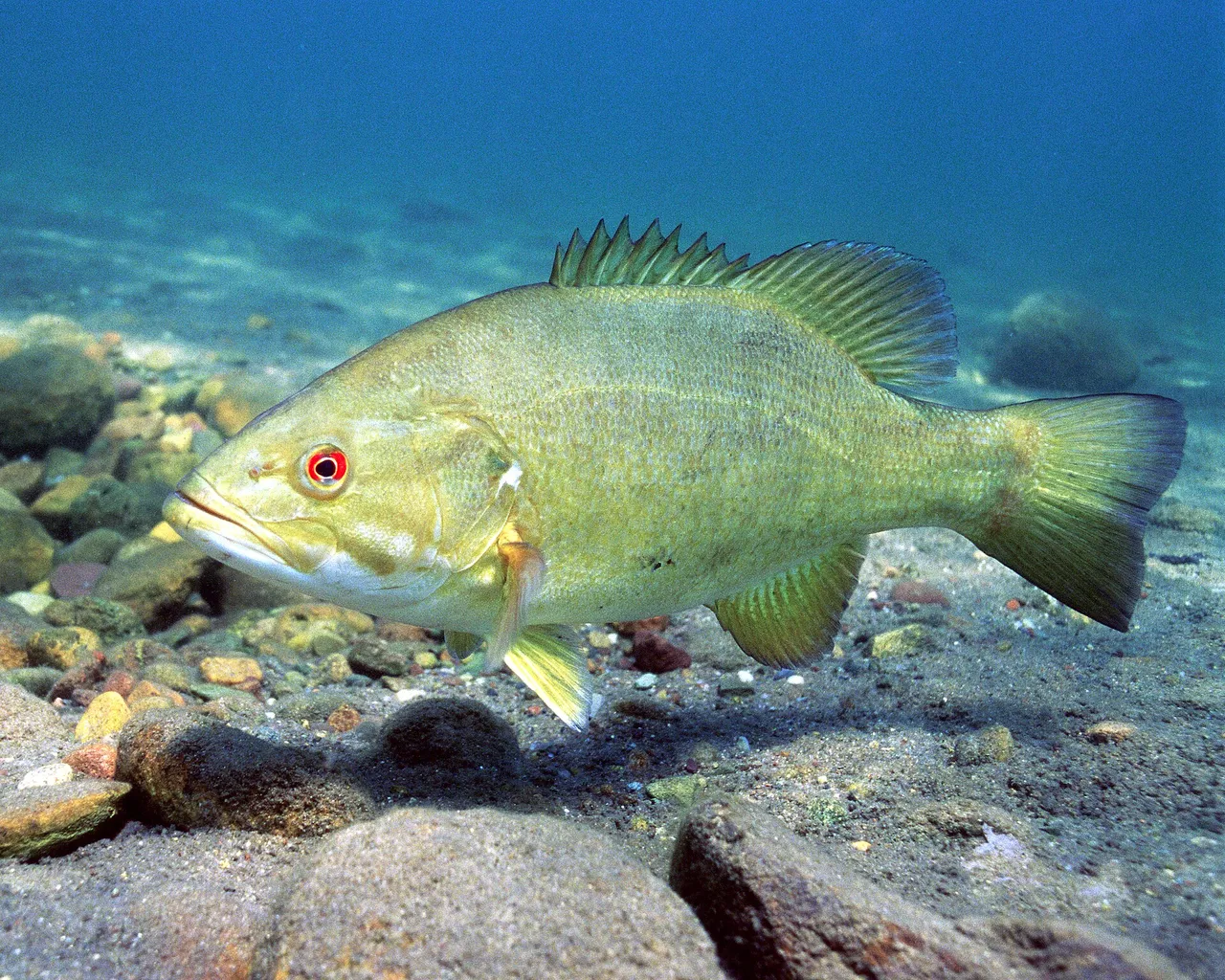
Photo: Eric Engbretson, U.S. Fish and Wildlife Service, via Wikimedia Commons, public domain. Resized and converted to WebP for the web; not otherwise altered.

The differences
Each difference is marked with how far it can be trusted on its own. A single diagnostic character settles the identification; suggestive ones only narrow it.
| Character | Largemouth bass | Smallmouth bass | Reliability |
|---|---|---|---|
| Where the upper jaw endsIdentification | Past the rear edge of the eye, seen in profile with the mouth shut. It is a bone relationship and does not change with season, size or water. | Level with or before the rear edge of the eye, never past it. | Diagnostic on its own |
| The dorsal finIdentification | Notched almost to the back between the spiny and soft halves, so it reads as two fins. | Only shallowly notched, so it reads as one continuous fin. | Diagnostic on its own |
| Markings on the flankIdentification | A dark, broken band running along the flank from behind the gill cover to the tail. Faint in stained water, near solid in clear water. | Vertical dark bars running down the flank, which come and go with mood and water clarity. | Supporting — use with others |
| BuildIdentification | Deep-bodied and heavier through the shoulder at the same length. | Longer and less deep for its weight, with a thicker tail wrist. | Supporting — use with others |
| Colour and eyeIdentification | Greenish above, pale beneath; darker in clear water, paler in turbid. | Bronze to brown-green, the 'bronzeback'; many populations have a red or orange iris, but largemouth occasionally show it too. | Suggestive only — varies |
Why it matters
Where the two are managed separately, size and bag limits and seasons can differ by species, so the identification decides what may be kept. Both are lipped in the same way, with the body supported and the jaw not levered horizontally, and both have sharp dorsal spines.
The full species pages
This page compares two species. Each of them has a full page covering biology, behaviour, handling and the evidence behind all of it.
More about largemouth bass
Where it lives, how it is caught, and what else it is confused with.
Similar and related fish
- BluegillThe relationship that governs pond management in North America. Where bass are scarce, bluegill reproduce until growth stops rather than until numbers do, producing waters full of small fish.
How it is caught
- Float-tube fishingFloat tubes are used on small, weedy North American waters where a boat cannot be launched and the shallow, timbered margins that hold bass are unreachable from the bank.
- Kayak fishingKayak bass fishing is a mainstream branch of the North American sport, reaching shallow, weedy and timbered water that a powered boat cannot enter.
- SpinningAlmost all bass fishing is lure fishing, and the tackle industry built around it is the reason so much modern lure design exists at all.
Gear for this fish
- CrankbaitsCrankbaits are how open-water and structure-holding largemouth are located, because a diving lure that contacts bottom or timber and deflects is both a search tool and a trigger.
- Jigs and jig headsThe skirted jig is the cold-water and heavy-cover answer, imitating a crayfish on the bottom rather than a fish in the column, which is what a largemouth is mostly eating outside the warm months.
- Soft plasticsThe soft plastic worm and its descendants were designed for this fish and remain the highest-percentage approach to it, because a largemouth holds in cover and a slow, weedless, falling bait can be delivered into cover that no other lure family survives.
3 more
- Spinnerbaits and bladed jigs Lure
- Surface lures Lure
- Swimbaits Lure
Where it lives
- Lowland stillwatersWarm, weedy, structured still water is the species' natural setting, and its tolerance of warmer and lower-oxygen conditions than most temperate predators is why it thrives in man-made ponds and reservoirs.
Why the 11 connections on this page are here, and the sources
Similar and related fish
Backed by research — 1 connection
Supported by peer-reviewed research or fisheries science. The sources are listed and can be checked.
Bluegill
A predator-prey claim naming the predator binomial, and the basis of the stunting argument on both records.
- FishBase: a global information system on fishes — Froese, R. and D. Pauly, eds. — FishBase Consortium (Scientific institute)Relied on for: That Micropterus salmoides is an opportunistic ambush predator taking fish, occupying the same warm weedy still water as Lepomis macrochirus.States this directlyPassage read and verified
How it is caught
What experienced anglers do — 3 connections
Widely and independently recommended by experienced anglers and specialist sources. This is real angling knowledge, not proof: controlled evidence for it is limited, and FishingHQ records it as convention rather than as a demonstrated effect.
Float-tube fishing
Established angling practice for this species, recorded as convention. The note states the property of the animal or its water that makes the method the answer.
- IGFA International Angling Rules and World Record Requirements — International Game Fish Association (Angling or fisheries organisation)Relied on for: Recognition of the species as an established sport fish and the angling methods and tackle classes conventionally used for it.States this directlyPassage read and verified
- General angling website restatements of established technique — Various (Credible secondary source)Relied on for: Widely restated practice connecting this species and method.Background and mechanism onlyCitation checked — the work exists and is described correctly
Kayak fishing
Established angling practice for this species, recorded as convention. The note states the property of the animal or its water that makes the method the answer.
- IGFA International Angling Rules and World Record Requirements — relied on for: Recognition of the species as an established sport fish and the angling methods and tackle classes conventionally used for it.
- General angling website restatements of established technique — relied on for: Widely restated practice connecting this species and method.
Spinning
A practitioner claim about the dominant method for the species.
- General angling website restatements of established technique — relied on for: Widely restated practitioner accounts of lure fishing as the dominant bass method.
- Angling Times — Bauer Media (Specialist angling publication)Relied on for: Contemporary lure fishing technique in the angling press.Citation checked — the work exists and is described correctly
Gear for this fish
What experienced anglers do — 6 connections
Widely and independently recommended by experienced anglers and specialist sources. This is real angling knowledge, not proof: controlled evidence for it is limited, and FishingHQ records it as convention rather than as a demonstrated effect.
Crankbaits
A practitioner claim about which lure family answers this species' feeding or holding behaviour.
- General angling website restatements of established technique — relied on for: Widely restated North American lure practice for this species.
- IGFA International Angling Rules and World Record Requirements — relied on for: Recognition of the species as an established sport fish taken on artificial lures, and the tackle conventions used for it.
Jigs and jig heads
A practitioner claim about which lure family answers this species' feeding or holding behaviour.
- General angling website restatements of established technique — relied on for: Widely restated North American lure practice for this species.
- IGFA International Angling Rules and World Record Requirements — relied on for: Recognition of the species as an established sport fish taken on artificial lures, and the tackle conventions used for it.
Soft plastics
A practitioner claim about which lure family answers this species' feeding or holding behaviour.
- General angling website restatements of established technique — relied on for: Widely restated North American lure practice for this species.
- IGFA International Angling Rules and World Record Requirements — relied on for: Recognition of the species as an established sport fish taken on artificial lures, and the tackle conventions used for it.
Spinnerbaits and bladed jigs
A practitioner claim about which lure family answers this species' feeding or holding behaviour.
- General angling website restatements of established technique — relied on for: Widely restated North American lure practice for this species.
- IGFA International Angling Rules and World Record Requirements — relied on for: Recognition of the species as an established sport fish taken on artificial lures, and the tackle conventions used for it.
Surface lures
A practitioner claim about which lure family answers this species' feeding or holding behaviour.
- General angling website restatements of established technique — relied on for: Widely restated North American lure practice for this species.
- IGFA International Angling Rules and World Record Requirements — relied on for: Recognition of the species as an established sport fish taken on artificial lures, and the tackle conventions used for it.
Swimbaits
A practitioner claim about a lure-species pairing and its origin.
- Angling Times — relied on for: Contemporary practitioner treatment of swimbait styles and the size-over-numbers trade-off.
- General angling website restatements of established technique — relied on for: Widely restated practitioner accounts of swimbait fishing for bass.
Where it lives
Backed by research — 1 connection
Supported by peer-reviewed research or fisheries science. The sources are listed and can be checked.
Lowland stillwaters
A habitat claim held to a scientific standard.
- FishBase: a global information system on fishes — relied on for: Recorded habitat and environmental tolerances for Micropterus salmoides.
- Freshwater Fishes of the British Isles — HarperCollins (New Naturalist 75), 1992 (Reference work)Relied on for: Habitat use of introduced centrarchids in European waters.Background and mechanism onlyCitation checked — the work exists and is described correctly
Reviewed 2026-10-19. FishingHQ does not state what any rule is or where any rule applies. Where this page says the two species are managed differently, that is a reason to check the authority for the water you are on — not a statement of what it requires.