Bluegill
Fish · Last reviewed 2026-08-10
Probably the most-caught freshwater fish in North America, the species most anglers there start on, and a nest-guarding sunfish with a genuine stunting problem.
Safety: venomous and spined species — can cause injury needing treatment. 5 more points apply here.
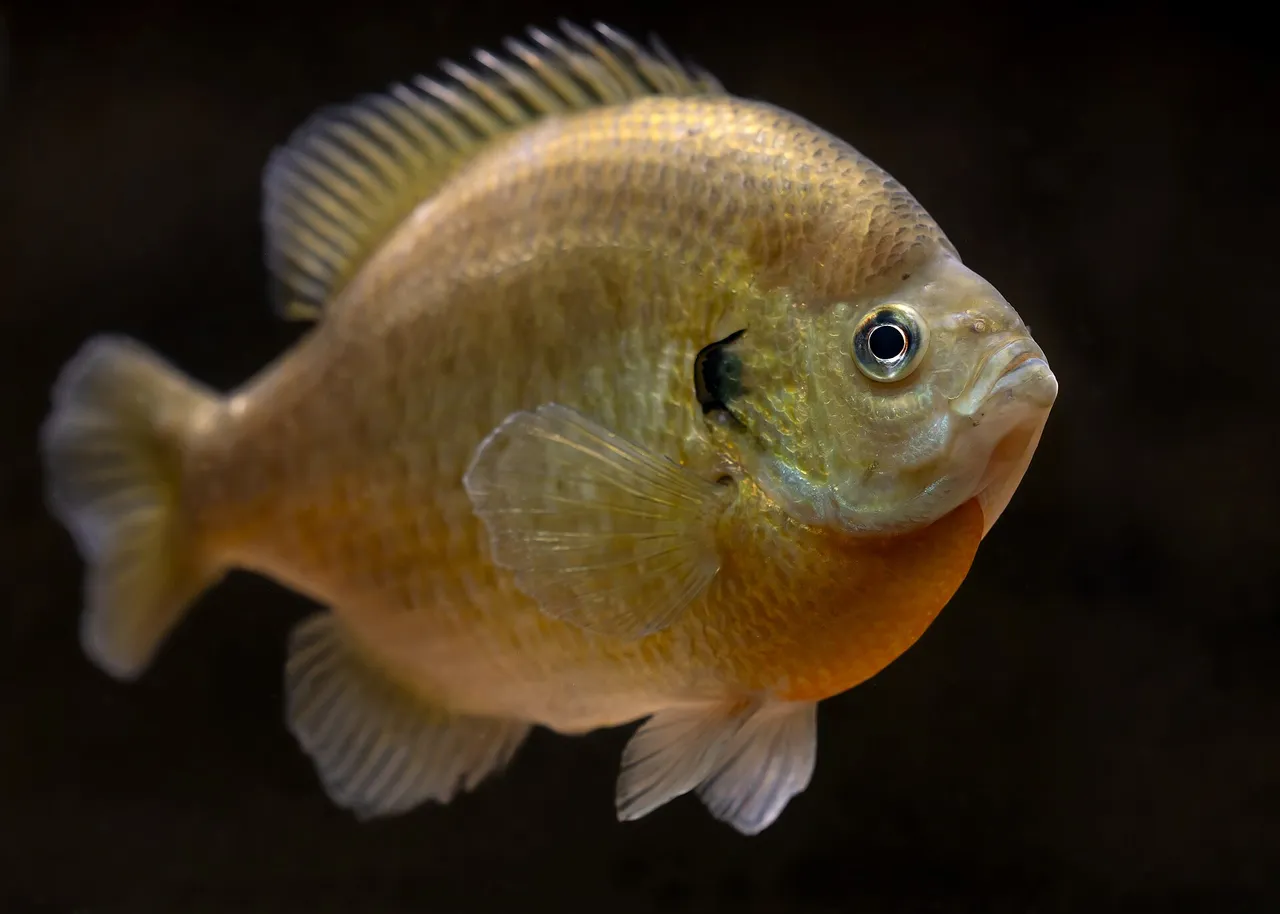
How this was identified, and who took it
Identified by: The solid dark opercular flap with no pale margin, the very small mouth and the long-based dorsal fin together identify the species and separate it from pumpkinseed. Photographed in an aquarium.USFWS Mountain Prairie — Public domain, via Wikimedia Commons — source, licence_black_background.jpg)
Catching Bluegill
Everything here on fishing for it. Each entry opens the page behind it.
- Ground
The bluegill is the fish that teaches North America to fish. It is abundant, willing, reachable from any bank or dock, small enough to be caught on the simplest tackle and good enough to eat that a bag of them is a meal. By number of captures it is very probably the most-caught freshwater fish on the continent.
Biologically it is a nest-guarding sunfish. Males sweep circular nests in colonies in shallow water, spawn, and then guard the eggs and fry aggressively — which is why they are so easy to catch during the spawning period and why that period is also when the population is most exposed. The colonies are visible from the bank in clear water, which makes the whole thing unusually legible.
Its characteristic management problem is stunting. Bluegill are extremely fecund and, where predators are scarce, they reproduce until growth stops rather than until numbers do — producing ponds full of small fish that never reach a useful size. The counter-intuitive consequence, well established in North American pond management, is that a bluegill population usually needs MORE predation rather than less, and that removing bass from a pond makes the bluegill worse rather than better.
It is also called bream across much of the American south, which has nothing to do with the European bream and is a good example of why FishingHQ works at species level.
How it is caught
- Float fishingA small bait under a float at a set depth is the method bluegill are most fished with, matching a small-mouthed fish that feeds on invertebrates in the column around cover.
- Ice fishingBluegill remain active under ice and are among the principal winter panfish across their range, taken on very small baits at a precisely held depth.
Identification
- Scientific name
- Lepomis macrochirus
- Family
- Centrarchidae
- Water
- Freshwater, Brackish
- Conservation status
- Least Concern
- Regions
- North America, Western Europe, East Asia, East & Southern Africa
- A solid dark blue-black flap at the rear edge of the gill cover, with no pale margin — the character the name refers to and the quickest separation from other sunfish.
- A dark blotch at the rear base of the soft dorsal fin, present in most individuals.
- Body very deep and strongly compressed, almost disc-like, with a small mouth.
- Vertical dark bars on the flank, variable and often faint; breeding males show orange to copper on the breast.
- Several Lepomis species overlap and hybridise readily; the solid dark ear flap and the dorsal blotch are the reliable characters rather than colour.
Size
- Typical
- 80–200 g (3–7 oz)
- Large
- 300–450 g (10–16 oz)
Exceptional: Over 700 g (1.5 lb); maximum published weight 2.2 kg
Warm, weedy, shallow water and the edges within it
Bluegill occupy warm shallow fresh water with vegetation, and they are among the most structure-dependent small fish in North American waters.
VEGETATION IS THE HABITAT. Bluegill hold in and along submerged weed beds, lily pads and emergent vegetation, which provide cover from predators and hold the invertebrates they feed on. A weedless lake holds few bluegill.
SHALLOW AND WARM SUITS THEM, and they tolerate higher temperatures and lower oxygen than many species, which is why they thrive in ponds, farm dams and shallow productive lakes.
EDGES ARE WHERE THEY CONCENTRATE — the outside line of a weed bed, the shade line under a dock or overhanging tree, the drop-off at the end of a flat. Bluegill sit on boundaries rather than in open water.
LARGE BLUEGILL GO DEEPER AND MORE OPEN, occupying deeper weed edges and open water over structure, which is why the biggest fish are frequently not where the numbers are.
THEY MOVE VERTICALLY AND HORIZONTALLY WITH LIGHT AND TEMPERATURE through the day, into shallows to feed and back to cover.
AND THEIR HABITAT ROLE IS DOUBLE-EDGED. Bluegill are prey for bass and pike and are also capable of overpopulating and stunting in waters without adequate predation — so the same habitat that supports them supports the predators that keep them in balance, and managing one without the other produces a lake full of small fish.
Backed by research — why, and the sources (2)
Supported by peer-reviewed research or fisheries science. The sources are listed and can be checked.
- FishBase: a global information system on fishes — Froese, R. and D. Pauly, eds. — FishBase Consortium (Scientific institute)Relied on for: Distribution, habitat association, depth range, size, reproduction and life-history parameters recorded for the species.States this directlyPassage read and verified
- The IUCN Red List of Threatened Species — International Union for Conservation of Nature (Conservation authority)Relied on for: Assessment and range account for the species, including the habitats it depends on, its life history and the pressures acting on it.States this directlyCitation checked — the work exists and is described correctly
A small fish handled by beginners, in numbers
Bluegill are the species most people catch first and most often, and their handling problems come from volume and from who is doing the handling rather than from any single danger.
The dorsal and anal spines are sharp on a fish small enough to be gripped in one hand without thinking. Punctures are common, minor and prone to infection, and they happen most to children being handed a fish by an adult who has not thought about which way the spines point. Stroking the hand from head to tail folds them down; approaching from the tail raises them.
The mouth is very small and the hooks used are correspondingly small, which is why deep hooking is more common here than the size of the fish suggests. A disgorger is worth more on this species than on almost any other, and striking early rather than letting a bite develop is the intervention that prevents the problem instead of solving it.
The welfare point that gets missed is nesting. Male bluegill guard a nest, and a male taken off one leaves the brood unguarded for as long as it takes to unhook and return him. In spring that is a real cost, and returning the fish promptly and close to where it came from is the whole of the remedy.
What experienced anglers do — why, and the sources (2)
Widely and independently recommended by experienced anglers and specialist sources. This is real angling knowledge, not proof: controlled evidence for it is limited, and FishingHQ records it as convention rather than as a demonstrated effect.
- Angling Trust guidance for anglers — Angling Trust (Angling or fisheries organisation)Relied on for: Guidance on unhooking equipment, small hooks and handling small fish.Background and mechanism onlyCitation checked — the work exists and is described correctly
- Still-Water Angling — MacGibbon & Kee, 1953 (Specialist angling publication)Relied on for: Still-water practice on handling small species and unhooking.Background and mechanism onlyCitation checked — the work exists and is described correctly
Bedding: a spawning cycle that repeats through the summer rather than happening once
Bluegill seasonality is unusual among temperate freshwater fish because the reproductive season is not a single event — it recurs through the warm months, and that changes the shape of the whole year.
SPAWNING BEGINS WHEN THE WATER REACHES A THRESHOLD AND THEN REPEATS. Male bluegill sweep circular nests in shallow sand or gravel, typically in dense colonies — the 'beds' — and spawn; and where the season is long enough, the colony re-forms and spawns again several times across the summer. So there is not one spring window but a series of them, and the shallow-water concentration of fish recurs rather than passing.
WHICH MAKES THE BEDS THE DEFINING SEASONAL FEATURE. A bedding colony is a large number of aggressive, guarding, catchable fish in shallow water in a small area, and it is both the easiest fishing of the year and the most consequential — a guarded nest left unguarded is predated quickly, so removing males from beds has an effect beyond the individual fish.
OUTSIDE THE BEDDING PERIODS THEY MOVE OUT AND DOWN. Between spawning episodes and after the season ends, bluegill relate to weed edges, structure and moderate depth, with larger individuals generally deeper than the small ones. The seasonal pattern is therefore an oscillation between shallow colonial spawning and dispersed structural feeding.
AUTUMN CONCENTRATES THEM AGAIN AS WEED DIES BACK, pushing fish onto remaining cover and deeper structure, and producing a period of reliable feeding before winter.
WINTER IS DEEP, SLOW AND STILL PRODUCTIVE. Bluegill remain active enough at low temperature to support a substantial ice fishery in the northern range, holding deep near basins and remaining weed.
TEMPERATURE SETS THE LENGTH OF THE WHOLE CYCLE AND THEREFORE THE SIZE OF THE FISH. In the southern part of the range the growing and spawning season is far longer, producing more spawning episodes and more recruitment — which is a substantial part of why so many southern waters hold enormous numbers of small bluegill. Stunting in this species is very often a consequence of an extended reproductive season with insufficient predation.
AND THE RULES ON BEDDING FISH VARY. Some fisheries manage the spawning period; most do not. Whether any restriction applies is a matter for the competent authority.
Backed by research — why, and the sources (2)
Supported by peer-reviewed research or fisheries science. The sources are listed and can be checked.
- Freshwater Fishes of the British Isles — HarperCollins (New Naturalist 75), 1992 (Reference work)Relied on for: Seasonal behaviour, spawning period and temperature-driven activity of freshwater fishes.Background and mechanism onlyCitation checked — the work exists and is described correctly
- FishBase: a global information system on fishes — Froese, R. and D. Pauly, eds. — FishBase Consortium (Scientific institute)Relied on for: Spawning season, temperature preference and seasonal behaviour for the species.States this directlyPassage read and verified
Colonial nesting, guarding males, and the sneaker males that beat them
Bluegill reproduction contains one of the best-documented alternative mating strategies in any fish, and it is genuinely surprising the first time you meet it.
THE OBVIOUS STRATEGY IS THE COLONIAL NEST. Males sweep circular depressions in shallow sand or gravel, packed close together in colonies that can number dozens of nests, and each male courts females, spawns, and then guards and fans the eggs and defends the fry. That investment — several weeks of guarding, fanning and fighting — is why males build up to it slowly and why they are so aggressive on the nest.
THE OTHER STRATEGY IS TO STEAL IT. A proportion of male bluegill never build nests at all. Instead they mature far earlier and much smaller, and adopt one of two approaches: darting into a nest during spawning to release sperm and fleeing — the sneaker — or, in some cases, mimicking female colouration and behaviour closely enough to be admitted to the nest and spawn there. These males invest nothing in care and obtain a real share of the fertilisations.
WHICH MEANS A BLUEGILL POPULATION CONTAINS TWO KINDS OF MALE FOLLOWING TWO DIFFERENT LIFE HISTORIES, with different growth rates, different ages at maturity and different lifespans. It is one of the clearest natural examples of alternative reproductive tactics coexisting stably.
SPAWNING REPEATS THROUGH THE WARM SEASON rather than happening once, so the colonies form, disperse and re-form several times across a summer where the season is long enough.
THE COLONY ITSELF IS A DEFENCE. Nests packed together mean more males defending a shared perimeter and fewer edges per nest, which reduces predation on any individual clutch — a straightforward selfish-herd effect applied to eggs.
AND THE HIGH REPRODUCTIVE OUTPUT IS WHY BLUEGILL STUNT SO READILY. An extended season, repeated spawning, parental care and early maturity in the sneakers together produce a great many young fish, and in the absence of adequate predation the population outgrows its food supply and stalls at a small size. Stunted bluegill are a predator-balance problem rather than a bluegill problem.
WHERE ANY RESTRICTION APPLIES TO FISHING OVER BEDS is a matter for the competent authority; most jurisdictions impose none.
Backed by research — why, and the sources (2)
Supported by peer-reviewed research or fisheries science. The sources are listed and can be checked.
- Freshwater Fishes of the British Isles — HarperCollins (New Naturalist 75), 1992 (Reference work)Relied on for: Spawning behaviour, substrate requirements, timing and recruitment of European freshwater fishes.States this directlyCitation checked — the work exists and is described correctly
- FishBase: a global information system on fishes — Froese, R. and D. Pauly, eds. — FishBase Consortium (Scientific institute)Relied on for: Reproductive mode, spawning season, fecundity and maturity for the species.States this directlyPassage read and verified
Lifecycle and reproduction
Matures early, often within a year or two, and lives up to about ten years. Spawns repeatedly through the warm months in colonies of circular nests swept in shallow water, with males guarding eggs and fry. The combination of early maturity and repeated spawning is what produces the stunting problem: a population with insufficient predation converts all available energy into more fish rather than bigger ones.
Colonial nest spawning in shallow water through the warmer months, with males sweeping circular depressions in gravel or sand, defending them, and guarding eggs and fry. Nests are grouped, sometimes in large numbers, and are readily visible in clear water. The guarding male's aggression is what makes bedded bluegill so easy to catch, and removing him exposes the brood for as long as he is away.
Feeding and senses
Feeds on aquatic insect larvae, small crustaceans, snails, zooplankton and occasionally small fish and fish eggs, taken with a small mouth adapted to picking rather than engulfing. The small mouth is the practically important fact: bluegill cannot take large baits, and the commonest reason a beginner fails to hook them is a hook and bait too big for the fish.
Sight-dominant in the clear shallow water it favours, feeding by picking individual items. In stained water and among weed the lateral line carries more of the load. The species' willingness to investigate almost anything small and moving is why it is so catchable and why it is such an effective introduction to fishing.
Through the year
Spawning is triggered by warming water and repeats through the warm months, which produces the long, reliable, accessible fishery the species is known for. Fish move shallow to spawn and to feed in warm conditions and hold deeper in cold water, remaining catchable through the ice across the northern part of the range. Introduced populations elsewhere follow local temperature rather than a calendar.
Distribution
North America: native to the eastern and central United States and southern Canada, from Quebec and the Great Lakes south to Florida and the Gulf, and west to Texas and New Mexico. Introduced very widely elsewhere in North America and internationally, including in Europe, Asia and Africa, where it is treated as invasive in several countries.
This is a biological range — where the species occurs, not a prediction that you will catch one. To browse the fishing geography FishingHQ holds, start at fishing places.
Why anglers care
Very probably the most-caught freshwater fish in North America by number of captures, and the species an enormous number of anglers begin with. Taken on worms, small jigs, tiny lures and fly, from banks, docks, small boats and through the ice. Excellent eating and a mainstay of family and pond fishing.
Handling and returning
The dorsal spines are sharp on a small fish handled in large numbers, frequently by children. Wet hands, hold the fish with the spines folded by stroking from head to tail, and use a disgorger for deeply taken baits — small hooks in a small mouth are where damage happens. Where a nesting male is caught, returning it promptly matters, because the brood is unguarded while it is away.
Going further
- What does bluegill eat? — feeding biology, kept separate from what anglers infer from it.
- Bluegill vs Pumpkinseed — how to tell them apart.
- Bluegill vs Redear sunfish — how to tell them apart.
- Bluegill vs Black crappie — how to tell them apart.
Safety
Venomous and spined species — Can cause injury needing treatment
Sharp dorsal and anal spines on a small fish handled repeatedly and often by beginners. Punctures are common and readily become infected.
What reduces it: Hold the fish from head to tail so the spines fold flat. Wet hands, use a disgorger rather than fingers, and clean any puncture properly.
Biosecurity and disease transfer — Can cause injury needing treatment
Bluegill are widely introduced outside their native range and are treated as invasive in several countries, where they compete with and prey on native fish.
What reduces it: Never move live fish or water between waters. Clean, drain, dry and check equipment. Where the species is non-native, establish the local requirement rather than assuming a fish should be returned.
Precautions that always apply here
- Handle spined and venomous species with the spines controlled. Know which local species have them before you fish, not afterwards.
- Wet your hands before touching a fish. Dry hands strip the protective mucus layer that keeps infection out.
- Check, clean and dry your kit between different waters — the published guidance is 48 hours’ drying, in sunlight where possible, because a number of invasive species survive over two weeks in damp conditions. Nets, boots and wet mats move invasive species and disease more effectively than anything else anglers do.
- Never move live fish, live bait or water from one water to another.
Check the rules before you fish
Fishing laws, bylaws, access rules, seasons, bait restrictions and permitted methods vary by location and can change. Check the current rules from the relevant authority and the water you intend to fish before fishing.
Check with:
- Current national or regional law for where you are fishing
- Current local bylaws
- The relevant fisheries authority
- The landowner, club or fishery whose water it is
- Any restrictions specific to the species or the method you intend to use
Where to go next
Similar and related fish
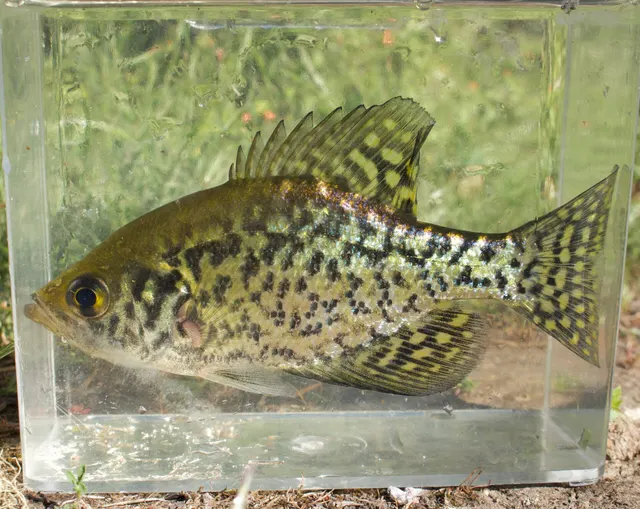 Black crappieBoth are sunfish of the Centrarchidae, and the difference that matters is diet: crappie eat small fish and take jigs and minnows, bluegill pick invertebrates and do not.
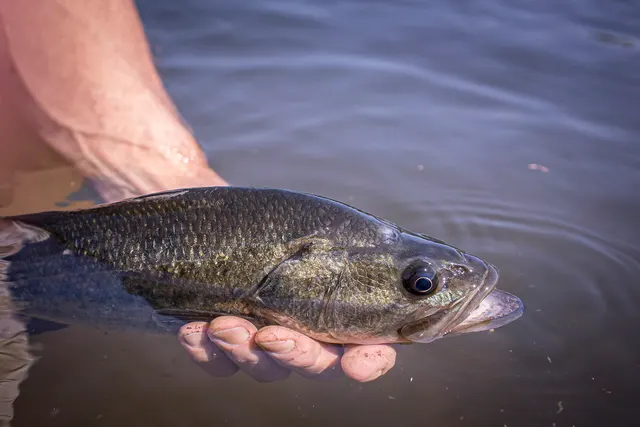 Largemouth bassThe relationship that governs pond management in North America. Where bass are scarce, bluegill reproduce until growth stops rather than until numbers do, producing waters full of small fish.
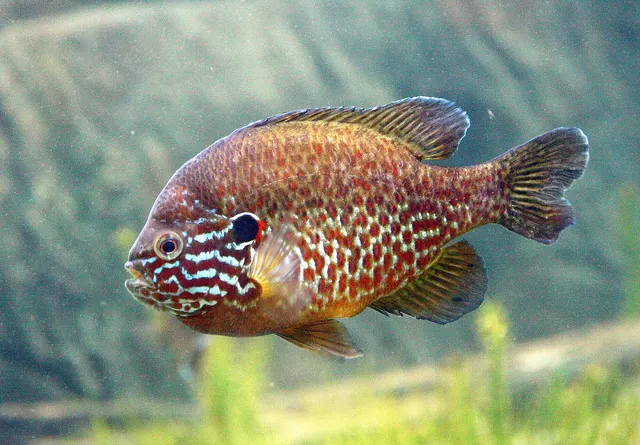 PumpkinseedSeparated by the orange-red margin on the gill flap, and the two hybridise where they occur together.
Where it lives
Understanding this fish
Told apart from
Sources and evidence
- FishBase: a global information system on fishes — Froese, R. and D. Pauly, eds. — FishBase Consortium (Scientific institute)Relied on for: Scientific name, family placement in the Centrarchidae, a maximum length of 41.0 cm TL, a maximum published weight of 2.2 kg, a maximum reported age of 10 years.States this directlyPassage read and verified
- FishBase: a global information system on fishes — Froese, R. and D. Pauly, eds. — FishBase Consortium (Scientific institute)Relied on for: Environment, climate zone and depth range as recorded: Freshwater; benthopelagic; pH range: 7.0 - 7.5; dH range: 10 - 15. Subtropical; 1°C - 36°C ; 50°N - 25°NStates this directlyPassage read and verified
- FishBase: a global information system on fishes — Froese, R. and D. Pauly, eds. — FishBase Consortium (Scientific institute)Relied on for: The IUCN Red List category for Lepomis macrochirus — Least Concern, assessed 21 August 2018 — as republished by FishBase, the Red List itself being unreachable during review.States this directlyPassage read and verified
- Check Clean Dry — biosecurity guidance for water users — GB Non-native Species Secretariat (Conservation authority)Relied on for: The framework by which introduced fish are assessed and managed, and live movement as the transmission route.FishingHQ's interpretation of what it saysPassage read and verified
Why the 8 connections on this page are here, and the sources
Similar and related fish
Backed by research — 3 connections
Supported by peer-reviewed research or fisheries science. The sources are listed and can be checked.
Black crappie
A comparison resting on shared family and differing feeding ecology, naming both binomials.
- FishBase: a global information system on fishes — Froese, R. and D. Pauly, eds. — FishBase Consortium (Scientific institute)Relied on for: That Pomoxis nigromaculatus and Lepomis macrochirus are both Centrarchidae, with the former taking a substantially piscivorous diet.States this directlyPassage read and verified
Largemouth bass
A predator-prey claim naming the predator binomial, and the basis of the stunting argument on both records.
- FishBase: a global information system on fishes — Froese, R. and D. Pauly, eds. — FishBase Consortium (Scientific institute)Relied on for: That Micropterus salmoides is an opportunistic ambush predator taking fish, occupying the same warm weedy still water as Lepomis macrochirus.States this directlyPassage read and verified
Pumpkinseed
An identification comparison naming both binomials: Lepomis gibbosus and Lepomis macrochirus.
- FishBase: a global information system on fishes — Froese, R. and D. Pauly, eds. — FishBase Consortium (Scientific institute)Relied on for: Morphological and distributional data for Lepomis gibbosus and for Lepomis macrochirus.States this directlyPassage read and verified
- The IUCN Red List of Threatened Species — International Union for Conservation of Nature (Conservation authority)Relied on for: Separate assessments treating Lepomis gibbosus and Lepomis macrochirus as distinct species.States this directlyCitation checked — the work exists and is described correctly
How it is caught
What experienced anglers do — 2 connections
Widely and independently recommended by experienced anglers and specialist sources. This is real angling knowledge, not proof: controlled evidence for it is limited, and FishingHQ records it as convention rather than as a demonstrated effect.
Float fishing
Established angling practice for this species, recorded as convention. The note states the property of the animal or its water that makes the method the answer.
- IGFA International Angling Rules and World Record Requirements — International Game Fish Association (Angling or fisheries organisation)Relied on for: Recognition of the species as an established sport fish and the angling methods and tackle classes conventionally used for it.States this directlyPassage read and verified
- General angling website restatements of established technique — Various (Credible secondary source)Relied on for: Widely restated practice connecting this species and method.Background and mechanism onlyCitation checked — the work exists and is described correctly
Ice fishing
Established angling practice for this species, recorded as convention. The note states the property of the animal or its water that makes the method the answer.
- IGFA International Angling Rules and World Record Requirements — International Game Fish Association (Angling or fisheries organisation)Relied on for: Recognition of the species as an established sport fish and the angling methods and tackle classes conventionally used for it.States this directlyPassage read and verified
- General angling website restatements of established technique — Various (Credible secondary source)Relied on for: Widely restated practice connecting this species and method.Background and mechanism onlyCitation checked — the work exists and is described correctly
Where it lives
Backed by research — 1 connection
Supported by peer-reviewed research or fisheries science. The sources are listed and can be checked.
Lowland stillwaters
A habitat claim held to a scientific standard.
- FishBase: a global information system on fishes — Froese, R. and D. Pauly, eds. — FishBase Consortium (Scientific institute)Relied on for: That Lepomis macrochirus occupies fresh and brackish water and is associated with vegetation in warm still habitats.States this directlyPassage read and verified
Understanding this fish
Backed by research — 1 connection
Supported by peer-reviewed research or fisheries science. The sources are listed and can be checked.
Aquatic insect larvae as prey
Recorded diet evidence identifies aquatic insect larvae as a food item of this predator at group level rather than to species. The edge points at the taxon record for that reason, and encoding it as a species-level claim would assert something the source does not.
- FishBase: a global information system on fishes — Froese, R. and D. Pauly, eds. — FishBase Consortium (Scientific institute)Relied on for: Food items recorded for this predator, given as aquatic insect larvae.States this directlyPassage read and verified
- FAO Species Identification Guides for Fishery Purposes and the FAO Species Catalogues — Food and Agriculture Organization of the United Nations (Scientific institute)Relied on for: Species account describing this predator's diet, recorded at the level of aquatic insect larvae.Background and mechanism onlyCitation checked — the work exists and is described correctly
Told apart from
Backed by research — 1 connection
Supported by peer-reviewed research or fisheries science. The sources are listed and can be checked.
Redear sunfish
An identification comparison naming both binomials: Lepomis microlophus and Lepomis macrochirus.
- FishBase: a global information system on fishes — Froese, R. and D. Pauly, eds. — FishBase Consortium (Scientific institute)Relied on for: Morphological and distributional data for Lepomis microlophus and for Lepomis macrochirus.States this directlyPassage read and verified
- The IUCN Red List of Threatened Species — International Union for Conservation of Nature (Conservation authority)Relied on for: Separate assessments treating Lepomis microlophus and Lepomis macrochirus as distinct species.States this directlyCitation checked — the work exists and is described correctly
An identification link between two species readers genuinely mistake for one another, resting on published morphological characters rather than on angling lore, and naming the character that separates them.
- FishBase: a global information system on fishes — Froese, R. and D. Pauly, eds. — FishBase Consortium (Scientific institute)Relied on for: Morphological description, meristic counts, family placement, distribution and environment of the species named.States this directlyPassage read and verified
- FAO Species Identification Guides for Fishery Purposes and the FAO Species Catalogues — Food and Agriculture Organization of the United Nations (Scientific institute)Relied on for: Identification characters and distribution for inland and coastal fishes, from regional identification guides prepared for fishery purposes.States this directlyCitation checked — the work exists and is described correctly
How FishingHQ labels evidence is explained in the evidence policy.