How to identify bluegill
Lepomis macrochirus · Centrarchidae
The characters that identify bluegill, ranked by how far each one can be trusted on its own.
Safety: venomous and spined species — can cause injury needing treatment. One more point applies here.
How this was identified, and who took it
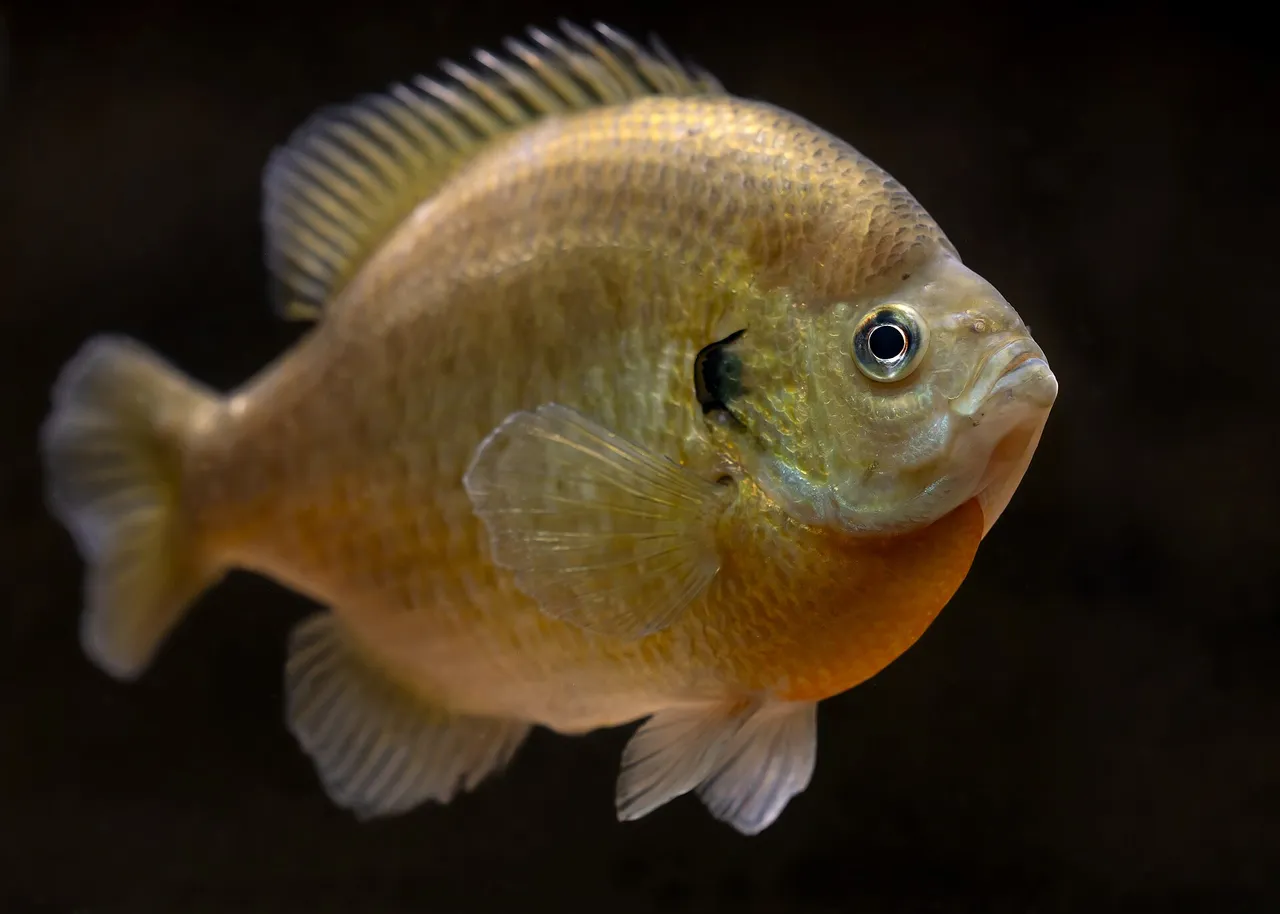
Identified by: The solid dark opercular flap with no pale margin, the very small mouth and the long-based dorsal fin together identify the species and separate it from pumpkinseed. Photographed in an aquarium.USFWS Mountain Prairie — Public domain, via Wikimedia Commons — source, licenceLook at this first
The flap at the back of the gill cover, and one question about it: does it have a pale edge? On a bluegill it does not — the flap is solid dark right to its margin. Every other common sunfish in the same water rims that flap with white, orange or red.
Diagnostic — settles it on its own
Each of these settles the identification on its own. If one is clear, you have your answer.
An ear flap with no pale margin
The opercular flap is uniformly dark to the very edge. This is the single most useful character in a genus that otherwise blurs, and it survives on faded fish, on juveniles and on a fish that has been in a bucket.
Supporting — use with other characters
Real characters that are not conclusive by themselves. Use two or three together.
A dark smudge at the back of the dorsal
Most bluegill carry a dusky blotch at the rear base of the soft dorsal fin. Present on the large majority and absent on a minority, which is exactly what separates a supporting character from a diagnostic one.
A very small mouth on a very deep body
The body is close to circular in profile and strongly flattened, and the mouth is tiny relative to it — smaller than in any other sunfish likely to be in the same net. It explains the diet and it explains why hooks come in small sizes here.
Suggestive only — varies with condition
Hints only. These vary with condition, season, water and how long the fish has been out of it, and a fish that contradicts them is still the same species.
Faint vertical barring
Bars down the flank that are strong on some fish and invisible on others, and that intensify when the fish is agitated or on a nest. A hint, not evidence.
Colour on the breast
Breeding males run copper to burnt orange across the chest and are unmistakable for a few weeks. Outside that window the same fish is plain, and females and juveniles never show it at all.
What it gets confused with
- Pumpkinseed, which rims the ear flap with bright orange or red and carries wavy blue lines across the cheek.
- Redear sunfish, whose flap is edged in red or orange in males and pale in females.
- Green sunfish, which has a much bigger mouth and a longer body than any of them.
- Hybrids between any two of the above, which are common in stocked water and are the reason this page ends where it does.
Side by side: Bluegill vs Pumpkinseed, Bluegill vs Redear sunfish, Bluegill vs Black crappie.
Where this stops working
Lepomis hybridise freely and hybrid sunfish are abundant in managed ponds, where they are sometimes stocked deliberately. A hybrid can carry a bluegill's dark flap and a pumpkinseed's cheek lines on the same fish, and no combination of the characters above resolves it. Juveniles of several species are close to inseparable in the field. If a fish looks like two species at once in water that has been stocked, it probably is.
The full record
This page covers identification only. The Bluegill record covers behaviour, lifecycle, distribution, handling and the sources behind all of it.
Reviewed 2026-08-14.
More about this fish
Telling it apart is one question. Here are the others.
Similar and related fish
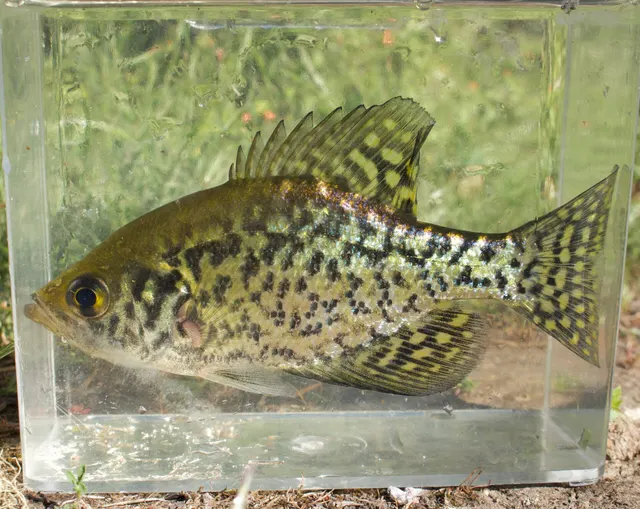 Black crappieBoth are sunfish of the Centrarchidae, and the difference that matters is diet: crappie eat small fish and take jigs and minnows, bluegill pick invertebrates and do not.
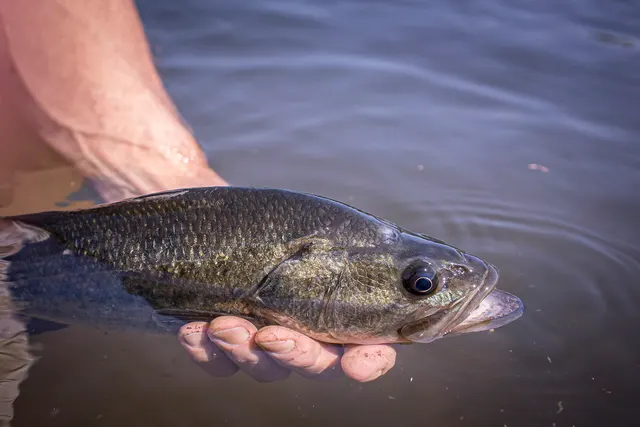 Largemouth bassThe relationship that governs pond management in North America. Where bass are scarce, bluegill reproduce until growth stops rather than until numbers do, producing waters full of small fish.
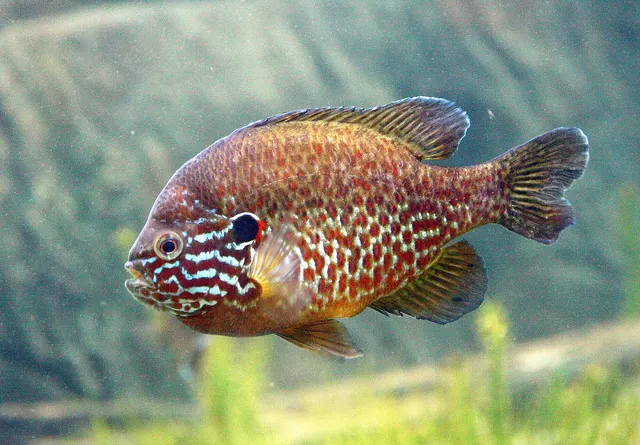 PumpkinseedSeparated by the orange-red margin on the gill flap, and the two hybridise where they occur together.
How it is caught
- Float fishingA small bait under a float at a set depth is the method bluegill are most fished with, matching a small-mouthed fish that feeds on invertebrates in the column around cover.
- Ice fishingBluegill remain active under ice and are among the principal winter panfish across their range, taken on very small baits at a precisely held depth.
Where it lives
Why the 6 connections on this page are here, and the sources
Similar and related fish
Backed by research — 3 connections
Supported by peer-reviewed research or fisheries science. The sources are listed and can be checked.
Black crappie
A comparison resting on shared family and differing feeding ecology, naming both binomials.
- FishBase: a global information system on fishes — Froese, R. and D. Pauly, eds. — FishBase Consortium (Scientific institute)Relied on for: That Pomoxis nigromaculatus and Lepomis macrochirus are both Centrarchidae, with the former taking a substantially piscivorous diet.States this directlyPassage read and verified
Largemouth bass
A predator-prey claim naming the predator binomial, and the basis of the stunting argument on both records.
- FishBase: a global information system on fishes — Froese, R. and D. Pauly, eds. — FishBase Consortium (Scientific institute)Relied on for: That Micropterus salmoides is an opportunistic ambush predator taking fish, occupying the same warm weedy still water as Lepomis macrochirus.States this directlyPassage read and verified
Pumpkinseed
An identification comparison naming both binomials: Lepomis gibbosus and Lepomis macrochirus.
- FishBase: a global information system on fishes — Froese, R. and D. Pauly, eds. — FishBase Consortium (Scientific institute)Relied on for: Morphological and distributional data for Lepomis gibbosus and for Lepomis macrochirus.States this directlyPassage read and verified
- The IUCN Red List of Threatened Species — International Union for Conservation of Nature (Conservation authority)Relied on for: Separate assessments treating Lepomis gibbosus and Lepomis macrochirus as distinct species.States this directlyCitation checked — the work exists and is described correctly
How it is caught
What experienced anglers do — 2 connections
Widely and independently recommended by experienced anglers and specialist sources. This is real angling knowledge, not proof: controlled evidence for it is limited, and FishingHQ records it as convention rather than as a demonstrated effect.
Float fishing
Established angling practice for this species, recorded as convention. The note states the property of the animal or its water that makes the method the answer.
- IGFA International Angling Rules and World Record Requirements — International Game Fish Association (Angling or fisheries organisation)Relied on for: Recognition of the species as an established sport fish and the angling methods and tackle classes conventionally used for it.States this directlyPassage read and verified
- General angling website restatements of established technique — Various (Credible secondary source)Relied on for: Widely restated practice connecting this species and method.Background and mechanism onlyCitation checked — the work exists and is described correctly
Ice fishing
Established angling practice for this species, recorded as convention. The note states the property of the animal or its water that makes the method the answer.
- IGFA International Angling Rules and World Record Requirements — International Game Fish Association (Angling or fisheries organisation)Relied on for: Recognition of the species as an established sport fish and the angling methods and tackle classes conventionally used for it.States this directlyPassage read and verified
- General angling website restatements of established technique — Various (Credible secondary source)Relied on for: Widely restated practice connecting this species and method.Background and mechanism onlyCitation checked — the work exists and is described correctly
Where it lives
Backed by research — 1 connection
Supported by peer-reviewed research or fisheries science. The sources are listed and can be checked.
Lowland stillwaters
A habitat claim held to a scientific standard.
- FishBase: a global information system on fishes — Froese, R. and D. Pauly, eds. — FishBase Consortium (Scientific institute)Relied on for: That Lepomis macrochirus occupies fresh and brackish water and is associated with vegetation in warm still habitats.States this directlyPassage read and verified
Safety
Venomous and spined species — Can cause injury needing treatment
Sharp dorsal and anal spines on a small fish handled repeatedly and often by beginners. Punctures are common and readily become infected.
What reduces it: Hold the fish from head to tail so the spines fold flat. Wet hands, use a disgorger rather than fingers, and clean any puncture properly.
Biosecurity and disease transfer — Can cause injury needing treatment
Bluegill are widely introduced outside their native range and are treated as invasive in several countries, where they compete with and prey on native fish.
What reduces it: Never move live fish or water between waters. Clean, drain, dry and check equipment. Where the species is non-native, establish the local requirement rather than assuming a fish should be returned.