Pumpkinseed
Fish · Last reviewed 2026-08-10
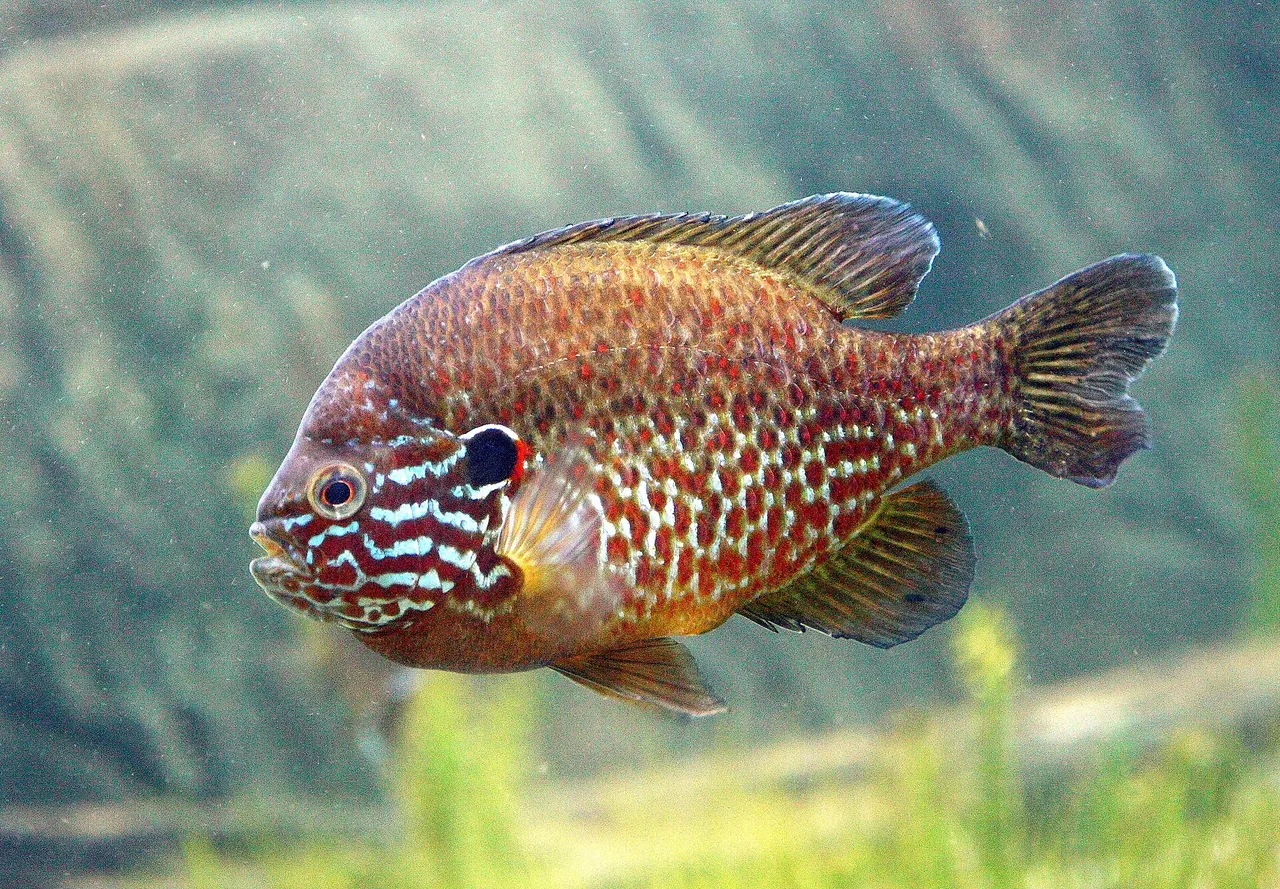
A vividly marked small sunfish, separated from bluegill by the orange-red spot on the rear edge of its gill flap and the wavy blue lines across its cheek.
Safety: injury while handling fish — minor injury.
How this was identified, and who took it
Identified by: Identified on two characters that together admit no other Lepomis, both unambiguous in a sharp full lateral: a black opercular flap carrying a bright orange-red spot at its rear tip, and wavy iridescent blue lines running across the cheek and gill cover. Dense orange-red spotting over an olive flank and a deep compressed body complete it.Cephas — CC BY-SA 3.0, via Wikimedia Commons — source, licence
Catching Pumpkinseed
Everything here on fishing for it. Each entry opens the page behind it.
- Ground
Pumpkinseed is the sunfish people remember, because it is the most brightly coloured freshwater fish most North Americans ever catch: olive-gold flanks speckled with orange, wavy iridescent blue lines running back across the cheek, and a hard black gill flap tipped with a crescent of orange-red.
That orange tip is the identification. Bluegill's ear flap is solid dark to its margin; pumpkinseed's carries a pale or orange-red edge, and the two species hybridise often enough that intermediate fish appear wherever both occur.
It is also an established introduction across much of western and central Europe, where it is regarded as invasive rather than welcome — it competes with native fish, tolerates poor water and breeds prolifically in still waters that suit it.
How it is caught
Identification
- Scientific name
- Lepomis gibbosus
- Family
- Centrarchidae
- Water
- Freshwater
- Conservation status
- Least Concern
- Regions
- North America, Western Europe, Central & Eastern Europe
- An orange-red crescent on the rear margin of the black gill flap; bluegill's flap is solid dark to the edge.
- Wavy iridescent blue lines running back across the cheek and gill cover.
- Small mouth not reaching the front of the eye, in a deep and strongly compressed body.
- Olive-gold flank heavily speckled with orange and blue, brightest in spawning males.
Size
- Typical
- 60–150 g (2–5 oz)
- Large
- 200–350 g (7–12 oz)
Exceptional: FishBase records a maximum of 40 cm and 0.63 kg
Weedy margins, hard-shelled prey and shallow warm water
Pumpkinseed occupy the shallow vegetated margins of warm still waters, and their habitat overlaps heavily with bluegill without being identical.
DENSE VEGETATION IS THE PREFERENCE, and pumpkinseed use it more heavily and stay shallower than bluegill in the same water. Weedy bays, lily pads, emergent stands and the vegetated edges of ponds and lakes are their habitat.
THEY EAT SNAILS, and it shapes where they live. Pumpkinseed have enlarged pharyngeal teeth adapted for crushing molluscs, and they specialise on snails to a greater degree than other sunfish. Habitat that supports a good snail population — vegetated, hard-water, productive shallows — supports pumpkinseed.
THAT SPECIALISATION IS HOW THEY COEXIST WITH BLUEGILL. Where the two occur together, pumpkinseed shift further towards molluscs and further into the vegetation while bluegill take more open-water invertebrates, which is one of the better-documented examples of resource partitioning in freshwater fish.
THEY TOLERATE WARM SHALLOW WATER and low oxygen reasonably well, thriving in small ponds and weedy bays.
JUVENILES USE THE SHALLOWEST AND DENSEST COVER available.
AND AS AN INTRODUCED SPECIES IN EUROPE they occupy the same vegetated warm shallows and are established across much of the continent, where their effect on native invertebrate and fish communities is a recognised conservation concern.
Backed by research — why, and the sources (2)
Supported by peer-reviewed research or fisheries science. The sources are listed and can be checked.
- FishBase: a global information system on fishes — Froese, R. and D. Pauly, eds. — FishBase Consortium (Scientific institute)Relied on for: Distribution, habitat association, depth range, size, reproduction and life-history parameters recorded for the species.States this directlyPassage read and verified
- The IUCN Red List of Threatened Species — International Union for Conservation of Nature (Conservation authority)Relied on for: Assessment and range account for the species, including the habitats it depends on, its life history and the pressures acting on it.States this directlyCitation checked — the work exists and is described correctly
A very small fish with a full set of spines, and the handling problem is the hand
A pumpkinseed is rarely longer than a hand's width, and that is precisely why it deserves a handling note: small fish are handled carelessly, and this one is armed.
THE DORSAL SPINES ARE THE WHOLE MECHANICAL STORY. Like every sunfish, a pumpkinseed carries a row of stiff spines along the front of the dorsal fin, plus spines at the front of the anal fin and a spine on each gill cover. They are not venomous and they do not need to be — a hand closing over the back of an alarmed sunfish drives them into the palm, and the fish's response to being gripped is to lock them upright.
THE GRIP THAT WORKS COMES FROM THE FRONT AND FLATTENS THEM. A hand sliding from the head backwards folds the dorsal spines down against the body rather than into the skin, and the fish is then held around the body with the fin trapped flat. This is the grip taught for perch and it is the same fish problem: an erectile row of spines that only injures somebody approaching from behind.
THE SECOND HAZARD IS THE HOOK RATHER THAN THE FISH. A pumpkinseed has a small mouth and takes a bait deliberately, which means deep hooking is common — and this is a species overwhelmingly caught by beginners and by children, on baits left in place. A deeply hooked small fish is not saved by digging for the hook. Cutting the line at the mouth and leaving it is the better outcome by a wide margin, and the reason is arithmetic rather than sentiment: the damage done retrieving a hook from a fish this size exceeds the damage the hook itself does.
THIRD, SIZE MAKES AIR EXPOSURE MATTER MORE, NOT LESS. A small-bodied fish loses heat, dries and is crushed more readily than a large one, and a summer bank in full sun is a hostile place. Wet hands, seconds rather than minutes, and back in the water.
AND ONE THING THAT IS NOT A HANDLING QUESTION AT ALL. Pumpkinseed are introduced and established well outside their native North American range, including in parts of Europe where they are treated as an invasive species, and what may be done with a captured fish differs sharply between jurisdictions and is sometimes the opposite of what the angler assumes. That is a legal question with a local answer, and it is not resolved by anything on this page.
What experienced anglers do — why, and the sources (2)
Widely and independently recommended by experienced anglers and specialist sources. This is real angling knowledge, not proof: controlled evidence for it is limited, and FishingHQ records it as convention rather than as a demonstrated effect.
- Understanding the Complexity of Catch-and-Release in Recreational Fishing — Reviews in Fisheries Science 15:75–167, 2007 (Scientific literature)Relied on for: Catch-and-release outcomes and the handling variables that govern them, including hooking location, air exposure and handling duration.States this directlyCitation checked — the work exists and is described correctly
- FishBase: a global information system on fishes — Froese, R. and D. Pauly, eds. — FishBase Consortium (Scientific institute)Relied on for: Size, fin-ray armature and general morphology recorded for the species.Background and mechanism onlyPassage read and verified
Lifecycle and reproduction
Fast-maturing and short-lived; most fish spawn in their second year and few live beyond eight. In crowded still waters growth stunts badly, producing large numbers of small fish, which is the usual outcome where the species has been introduced.
Males build and guard saucer-shaped nests in shallow water in late spring and early summer, often in dense colonies. Nesting can be repeated through a long season, which is part of why introduced populations expand quickly.
Feeding and senses
Takes insects, snails and small crustaceans. The pharyngeal teeth are heavy enough to crush snail shells, which is unusual among sunfish and lets the species exploit a food source bluegill largely cannot.
A daylight sight feeder that works close to weed and margins, picking individual items rather than filtering or ambushing.
Through the year
Shallow and highly visible from late spring through summer, retreating to deeper water as temperatures fall. Winter activity is low.
Distribution
North America: New Brunswick in Canada south to Savannah River in Georgia, USA; Great Lakes, Hudson Bay (Red River), and upper Mississippi River basins from Quebec west to southeastern Manitoba and North Dakota, and south to north Kentucky and Missouri, USA. Introduced to Pacific drainages from British Columbia to California. Several countries report adverse ecological impact after introduction
This is a biological range — where the species occurs, not a prediction that you will catch one. To browse the fishing geography FishingHQ holds, start at fishing places.
Why anglers care
A first fish for a great many anglers, taken on a worm under a float in almost any weedy margin. Its angling significance is disproportionate to its size: it is reliable, accessible from the bank and unfussy, which makes it the species most often used to teach. In Europe, where it is introduced, the angling interest is complicated by its status as a non-native that should not be moved between waters.
Handling and returning
Small and robust, but the dorsal spines are sharp and the fish is easily crushed by an over-firm grip. Wet hands, hold across the body with the spines folded, and unhook with forceps rather than fingers. Where the species is non-native, returning it to a different water is both irresponsible and often unlawful.
Going further
- Pumpkinseed vs Bluegill — how to tell them apart.
Safety
Injury while handling fish — Minor injury
The spiny dorsal will puncture a hand closed around the fish, and small punctures from fish spines readily become infected.
What reduces it: Fold the dorsal by gripping from front to back with a wet hand, and clean punctures promptly.
Where to go next
Similar and related fish
Where it lives
Told apart from
More fish
Not related to this page — just the rest of the section. There is little else joined to this subject yet, and a short page should still lead somewhere.
Sources and evidence
- FishBase: a global information system on fishes — Froese, R. and D. Pauly, eds. — FishBase Consortium (Scientific institute)Relied on for: Family, maximum size, depth and environment, distribution and the IUCN assessment for Lepomis gibbosus.States this directlyPassage read and verified
- The IUCN Red List of Threatened Species — International Union for Conservation of Nature (Conservation authority)Relied on for: The Least Concern assessment for Lepomis gibbosus, assessed 01 March 2012.States this directlyCitation checked — the work exists and is described correctly
Why the 4 connections on this page are here, and the sources
Similar and related fish
Backed by research — 1 connection
Supported by peer-reviewed research or fisheries science. The sources are listed and can be checked.
Bluegill
An identification comparison naming both binomials: Lepomis gibbosus and Lepomis macrochirus.
- FishBase: a global information system on fishes — Froese, R. and D. Pauly, eds. — FishBase Consortium (Scientific institute)Relied on for: Morphological and distributional data for Lepomis gibbosus and for Lepomis macrochirus.States this directlyPassage read and verified
- The IUCN Red List of Threatened Species — International Union for Conservation of Nature (Conservation authority)Relied on for: Separate assessments treating Lepomis gibbosus and Lepomis macrochirus as distinct species.States this directlyCitation checked — the work exists and is described correctly
How it is caught
What experienced anglers do — 1 connection
Widely and independently recommended by experienced anglers and specialist sources. This is real angling knowledge, not proof: controlled evidence for it is limited, and FishingHQ records it as convention rather than as a demonstrated effect.
Float fishing
A practitioner claim about how Lepomis gibbosus is commonly fished, following from where and how it feeds.
- General angling website restatements of established technique — Various (Credible secondary source)Relied on for: Widely restated practitioner accounts of fishing for pumpkinseed.Citation checked — the work exists and is described correctly
- Sea Angler — Bauer Media (Specialist angling publication)Relied on for: Practitioner treatment of the methods used for pumpkinseed and comparable species.Citation checked — the work exists and is described correctly
Where it lives
Backed by research — 1 connection
Supported by peer-reviewed research or fisheries science. The sources are listed and can be checked.
Lowland stillwaters
A habitat association for Lepomis gibbosus taken from the environment and distribution data on its FishBase summary.
- FishBase: a global information system on fishes — Froese, R. and D. Pauly, eds. — FishBase Consortium (Scientific institute)Relied on for: The environment, depth range and habitat description recorded for Lepomis gibbosus.States this directlyPassage read and verified
Told apart from
Backed by research — 1 connection
Supported by peer-reviewed research or fisheries science. The sources are listed and can be checked.
Redear sunfish
An identification link between two species readers genuinely mistake for one another, resting on published morphological characters rather than on angling lore, and naming the character that separates them.
- FishBase: a global information system on fishes — Froese, R. and D. Pauly, eds. — FishBase Consortium (Scientific institute)Relied on for: Morphological description, meristic counts, family placement, distribution and environment of the species named.States this directlyPassage read and verified
- FAO Species Identification Guides for Fishery Purposes and the FAO Species Catalogues — Food and Agriculture Organization of the United Nations (Scientific institute)Relied on for: Identification characters and distribution for inland and coastal fishes, from regional identification guides prepared for fishery purposes.States this directlyCitation checked — the work exists and is described correctly
How FishingHQ labels evidence is explained in the evidence policy.