Redear sunfish
Fish · Last reviewed 2026-08-10
A large sunfish with heavy throat teeth that crush snails and small mussels, giving it the name shellcracker and a role in controlling invasive snails.
Safety: injury while handling fish — minor injury.
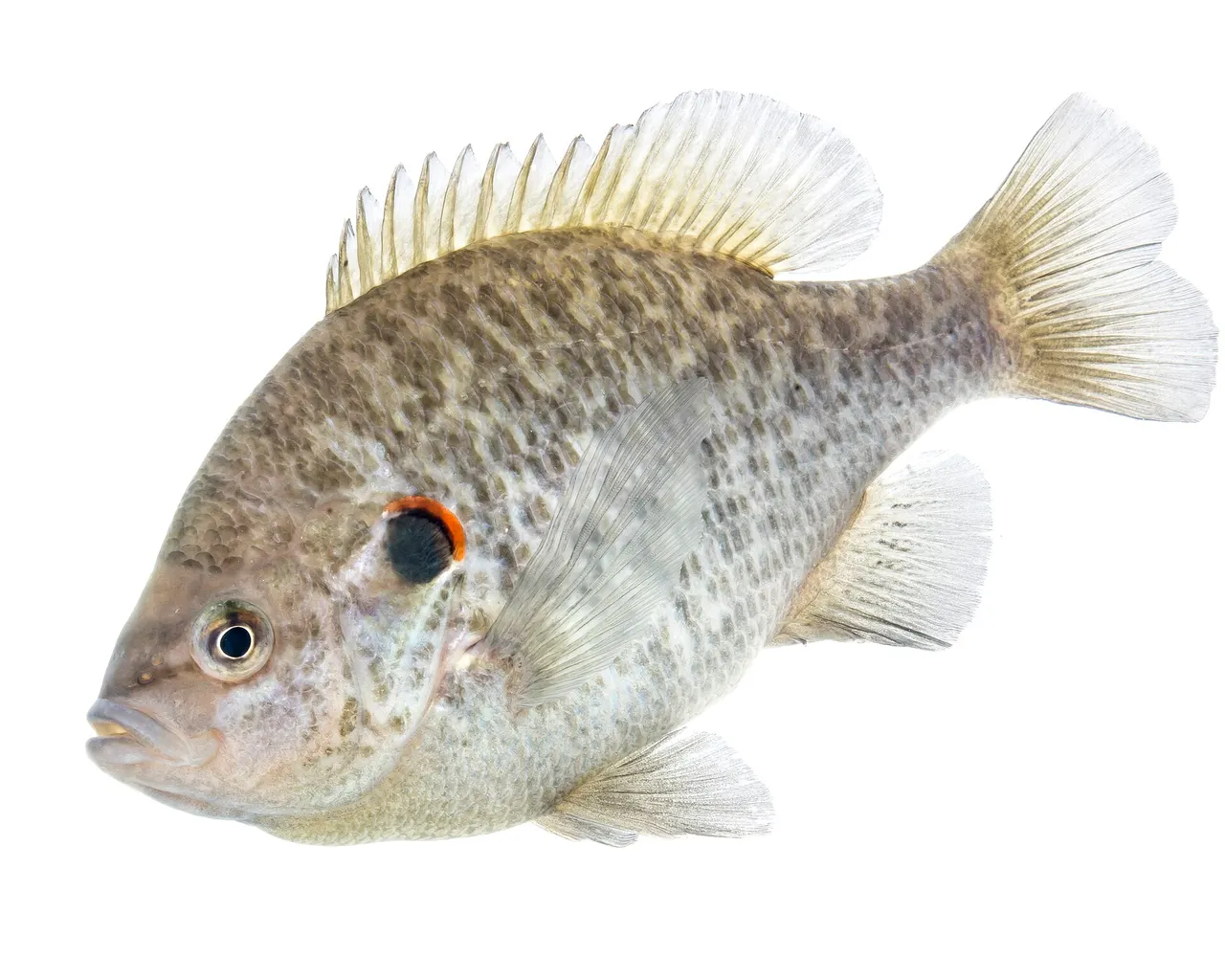
How this was identified, and who took it
Identified by: Identified on the opercular flap: a short black flap at the rear of the gill cover carrying a bright orange-red margin along its rear edge, which is the character separating this fish from bluegill, whose flap is wholly black. A studio photograph on white showing the whole fish in lateral, with the deep compressed body, small mouth and long-based dorsal all clear.USFWS Mountain-Prairie — public domain, via Wikimedia Commons — source, licence.jpg)
Catching Redear sunfish
Everything here on fishing for it. Each entry opens the page behind it.
- Ground
Redear sunfish is the sunfish that eats shells. It carries heavily developed pharyngeal teeth in the throat, and it uses them to crush snails, small mussels and other hard-shelled invertebrates that other sunfish cannot handle — which is where the name shellcracker comes from.
That specialisation has given it an unexpected modern role: redear have been stocked in some waters specifically to control invasive quagga and zebra mussels, and they do consume them.
It is separated from bluegill by the red or orange margin on the ear flap of males and by its larger size, and it feeds close to the bottom rather than in midwater.
How it is caught
Identification
- Scientific name
- Lepomis microlophus
- Family
- Centrarchidae
- Water
- Freshwater
- Conservation status
- Least Concern
- Regions
- North America
- A bright red or orange margin on the rear edge of the black ear flap, strongest in males.
- No dark blotch at the rear of the soft dorsal fin, which bluegill has.
- Longer, more pointed pectoral fins than most sunfish, and a comparatively small mouth.
- Olive-gold body with faint spotting, and heavy crushing teeth in the throat.
Size
- Typical
- 200–500 g (7 oz–1.1 lb)
- Large
- 0.8–1.5 kg (1.8–3.3 lb)
Exceptional: FishBase records a maximum of 43.2 cm and 0.22 kg
Lifecycle and reproduction
Grows larger than most sunfish and matures within two to three years. Less prone to the severe stunting that afflicts crowded bluegill populations, partly because its food source is different.
Nests colonially in shallow water in late spring and early summer, with males guarding saucer-shaped nests, generally spawning slightly earlier and deeper than bluegill in the same water.
Feeding and senses
Crushes snails, small mussels and other hard-shelled invertebrates with heavy pharyngeal teeth, feeding on and close to the bottom rather than in midwater.
A daylight bottom-oriented feeder locating prey by sight at close range over substrate and weed rather than intercepting drifting food.
Through the year
Spawns in late spring, feeds through summer close to the bottom, and becomes less active in cold water. Bottom orientation persists through the year.
Distribution
North America: Savannah River in South Carolina to Nueces River in Texas, north in Mississippi River basin to southern Indiana and Illinois in the USA
This is a biological range — where the species occurs, not a prediction that you will catch one. To browse the fishing geography FishingHQ holds, start at fishing places.
Why anglers care
A popular panfish target across the American south and increasingly elsewhere, taken on worms, small jigs and shellfish-imitating baits fished on the bottom rather than under a float in midwater. Its significance is size — it grows larger than most sunfish — and its bottom-feeding habit, which requires a genuinely different presentation from bluegill fishing.
Handling and returning
Sharp dorsal spines. Grip across the body with the spines folded and unhook with forceps. A robust fish that releases well with wet hands and minimal air exposure.
Going further
- Redear sunfish vs Bluegill — how to tell them apart.
Safety
Injury while handling fish — Minor injury
The spiny dorsal punctures a hand closed around the fish, and small fish-spine punctures readily become infected.
What reduces it: Fold the dorsal by gripping from front to back with a wet hand, and clean punctures promptly.
Where to go next
Where it lives
Told apart from
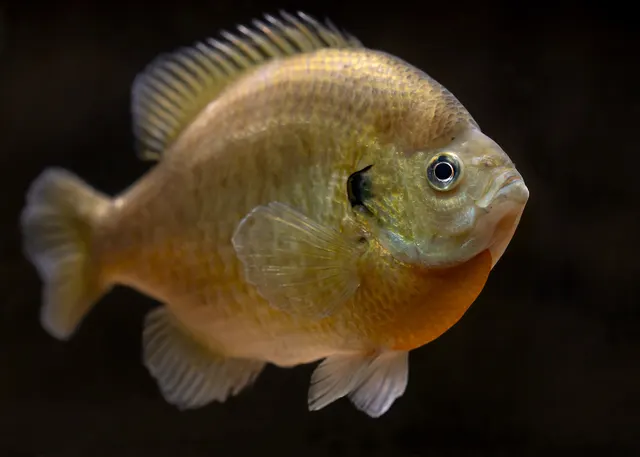 BluegillThe two are caught together constantly and the ear flap settles it: a redear's has a bright red or orange margin, a bluegill's is uniformly dark. A bluegill also has a dark blotch at the rear of the dorsal fin that a redear lacks, and the redear is the heavier-bodied of the two.
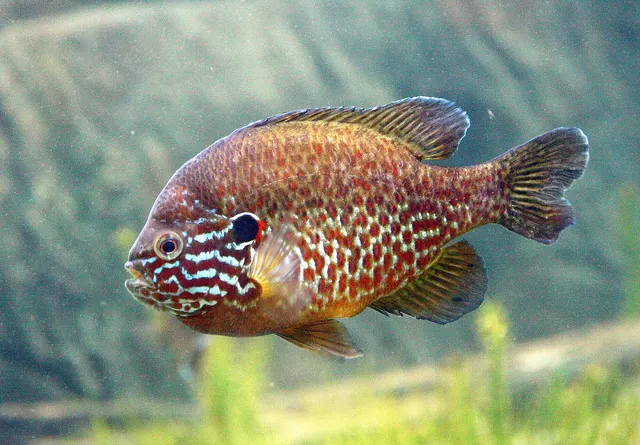 PumpkinseedThe harder version of the same character, because a pumpkinseed's ear flap ALSO carries a red or orange spot. The separation is the body: a pumpkinseed is smaller, more brightly patterned with wavy blue lines on the cheek and orange spotting, where a redear is plainer and larger. Both are widely introduced outside their native ranges, so geography does not help.
More fish
Not related to this page — just the rest of the section. There is little else joined to this subject yet, and a short page should still lead somewhere.
Sources and evidence
- FishBase: a global information system on fishes — Froese, R. and D. Pauly, eds. — FishBase Consortium (Scientific institute)Relied on for: Family, maximum size, depth and environment, distribution and the IUCN assessment for Lepomis microlophus.States this directlyPassage read and verified
- The IUCN Red List of Threatened Species — International Union for Conservation of Nature (Conservation authority)Relied on for: The Least Concern assessment for Lepomis microlophus, assessed 01 March 2012.States this directlyCitation checked — the work exists and is described correctly
Why the 5 connections on this page are here, and the sources
How it is caught
What experienced anglers do — 2 connections
Widely and independently recommended by experienced anglers and specialist sources. This is real angling knowledge, not proof: controlled evidence for it is limited, and FishingHQ records it as convention rather than as a demonstrated effect.
Float fishing
A practitioner claim about how Lepomis microlophus is commonly fished, following from where and how it feeds.
- General angling website restatements of established technique — Various (Credible secondary source)Relied on for: Widely restated practitioner accounts of fishing for redear sunfish.Citation checked — the work exists and is described correctly
- Sea Angler — Bauer Media (Specialist angling publication)Relied on for: Practitioner treatment of the methods used for redear sunfish and comparable species.Citation checked — the work exists and is described correctly
Ledgering
A practitioner claim about how Lepomis microlophus is commonly fished, following from where and how it feeds.
- General angling website restatements of established technique — Various (Credible secondary source)Relied on for: Widely restated practitioner accounts of fishing for redear sunfish.Citation checked — the work exists and is described correctly
- Sea Angler — Bauer Media (Specialist angling publication)Relied on for: Practitioner treatment of the methods used for redear sunfish and comparable species.Citation checked — the work exists and is described correctly
Where it lives
Backed by research — 1 connection
Supported by peer-reviewed research or fisheries science. The sources are listed and can be checked.
Lowland stillwaters
A habitat association for Lepomis microlophus taken from the environment and distribution data on its FishBase summary.
- FishBase: a global information system on fishes — Froese, R. and D. Pauly, eds. — FishBase Consortium (Scientific institute)Relied on for: The environment, depth range and habitat description recorded for Lepomis microlophus.States this directlyPassage read and verified
Told apart from
Backed by research — 2 connections
Supported by peer-reviewed research or fisheries science. The sources are listed and can be checked.
Bluegill
An identification comparison naming both binomials: Lepomis microlophus and Lepomis macrochirus.
- FishBase: a global information system on fishes — Froese, R. and D. Pauly, eds. — FishBase Consortium (Scientific institute)Relied on for: Morphological and distributional data for Lepomis microlophus and for Lepomis macrochirus.States this directlyPassage read and verified
- The IUCN Red List of Threatened Species — International Union for Conservation of Nature (Conservation authority)Relied on for: Separate assessments treating Lepomis microlophus and Lepomis macrochirus as distinct species.States this directlyCitation checked — the work exists and is described correctly
An identification link between two species readers genuinely mistake for one another, resting on published morphological characters rather than on angling lore, and naming the character that separates them.
- FishBase: a global information system on fishes — Froese, R. and D. Pauly, eds. — FishBase Consortium (Scientific institute)Relied on for: Morphological description, meristic counts, family placement, distribution and environment of the species named.States this directlyPassage read and verified
- FAO Species Identification Guides for Fishery Purposes and the FAO Species Catalogues — Food and Agriculture Organization of the United Nations (Scientific institute)Relied on for: Identification characters and distribution for inland and coastal fishes, from regional identification guides prepared for fishery purposes.States this directlyCitation checked — the work exists and is described correctly
Pumpkinseed
An identification link between two species readers genuinely mistake for one another, resting on published morphological characters rather than on angling lore, and naming the character that separates them.
- FishBase: a global information system on fishes — Froese, R. and D. Pauly, eds. — FishBase Consortium (Scientific institute)Relied on for: Morphological description, meristic counts, family placement, distribution and environment of the species named.States this directlyPassage read and verified
- FAO Species Identification Guides for Fishery Purposes and the FAO Species Catalogues — Food and Agriculture Organization of the United Nations (Scientific institute)Relied on for: Identification characters and distribution for inland and coastal fishes, from regional identification guides prepared for fishery purposes.States this directlyCitation checked — the work exists and is described correctly
How FishingHQ labels evidence is explained in the evidence policy.