How to identify pumpkinseed
Lepomis gibbosus · Centrarchidae
The characters that identify pumpkinseed, ranked by how far each one can be trusted on its own.
Safety: injury while handling fish — minor injury.
How this was identified, and who took it
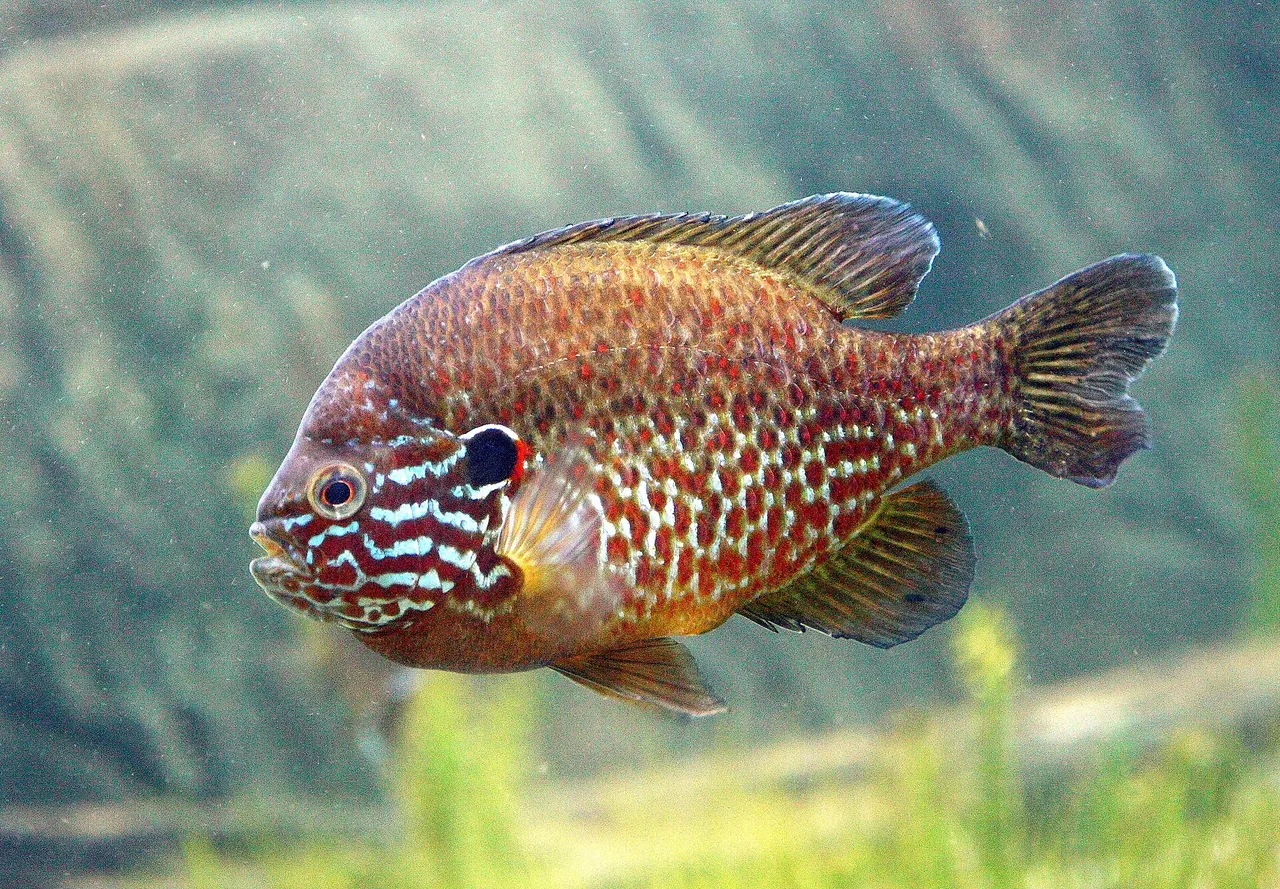
Identified by: Identified on two characters that together admit no other Lepomis, both unambiguous in a sharp full lateral: a black opercular flap carrying a bright orange-red spot at its rear tip, and wavy iridescent blue lines running across the cheek and gill cover. Dense orange-red spotting over an olive flank and a deep compressed body complete it.Cephas — CC BY-SA 3.0, via Wikimedia Commons — source, licenceLook at this first
Two things together and nothing else needed: wavy bright blue lines running back across the cheek, and a small orange-red crescent at the very tip of the black gill flap. Either alone is shared with something; the pair is pumpkinseed.
Diagnostic — settles it on its own
Each of these settles the identification on its own. If one is clear, you have your answer.
Wavy blue lines across the cheek and gill cover
Sinuous iridescent blue-green lines run backwards from the eye across the cheek and operculum, like the pattern on a wrasse. No other common sunfish of the same water carries them. They are structural markings rather than a flush of colour and they persist outside the spawning season, although they are brightest in a male on a nest.
Supporting — use with other characters
Real characters that are not conclusive by themselves. Use two or three together.
Orange-red crescent on the tip of the ear flap
The black flap at the rear of the gill cover carries a small bright crescent at its trailing edge. Bluegill's flap is black to the edge with nothing on it. Redear's flap has a red margin too, which is why this character is paired with the cheek lines rather than used alone.
Small mouth, not reaching the eye
The jaw hinge falls well short of the front of the eye. This separates the sunfishes proper from the black basses and from the crappies, all of which have larger mouths, and it is the first thing to check when a small deep-bodied fish comes to hand.
Suggestive only — varies with condition
Hints only. These vary with condition, season, water and how long the fish has been out of it, and a fish that contradicts them is still the same species.
Heavy orange speckling over an olive-gold flank
The flank carries dense orange and blue speckling over a gold-olive ground, most intense in a spawning male and much subdued in a female or an autumn fish. Handsome and highly variable, so it is a hint rather than a check.
What it gets confused with
- Bluegill, whose ear flap is solid black to its edge and which carries a dark blotch at the rear of the soft dorsal fin that pumpkinseed lacks.
- Redear sunfish, which also has a red-edged flap but no wavy blue cheek lines and a longer, more pointed pectoral fin.
- Hybrid sunfish, which are common wherever two species share a water and which routinely show intermediate flaps and partial cheek patterning.
Side by side: Pumpkinseed vs Bluegill.
Where this stops working
Sunfish hybridise readily and hybrid swarms are normal in many managed waters, so a fish with a half-formed flap crescent and faint cheek lines is a real and common outcome rather than a hard case. Female and non-breeding fish are far duller than the spawning males every photograph shows. Very small fish of several Lepomis are close to inseparable in the hand. Pumpkinseed is introduced and invasive across much of Europe and parts of western North America, and moving a live one to another water is irresponsible and frequently unlawful — check with the responsible authority for the water you are on.
The full record
This page covers identification only. The Pumpkinseed record covers behaviour, lifecycle, distribution, handling and the sources behind all of it.
Reviewed 2026-08-15.
More about this fish
Telling it apart is one question. Here are the others.
Similar and related fish
How it is caught
Where it lives
Why the 3 connections on this page are here, and the sources
Similar and related fish
Backed by research — 1 connection
Supported by peer-reviewed research or fisheries science. The sources are listed and can be checked.
Bluegill
An identification comparison naming both binomials: Lepomis gibbosus and Lepomis macrochirus.
- FishBase: a global information system on fishes — Froese, R. and D. Pauly, eds. — FishBase Consortium (Scientific institute)Relied on for: Morphological and distributional data for Lepomis gibbosus and for Lepomis macrochirus.States this directlyPassage read and verified
- The IUCN Red List of Threatened Species — International Union for Conservation of Nature (Conservation authority)Relied on for: Separate assessments treating Lepomis gibbosus and Lepomis macrochirus as distinct species.States this directlyCitation checked — the work exists and is described correctly
How it is caught
What experienced anglers do — 1 connection
Widely and independently recommended by experienced anglers and specialist sources. This is real angling knowledge, not proof: controlled evidence for it is limited, and FishingHQ records it as convention rather than as a demonstrated effect.
Float fishing
A practitioner claim about how Lepomis gibbosus is commonly fished, following from where and how it feeds.
- General angling website restatements of established technique — Various (Credible secondary source)Relied on for: Widely restated practitioner accounts of fishing for pumpkinseed.Citation checked — the work exists and is described correctly
- Sea Angler — Bauer Media (Specialist angling publication)Relied on for: Practitioner treatment of the methods used for pumpkinseed and comparable species.Citation checked — the work exists and is described correctly
Where it lives
Backed by research — 1 connection
Supported by peer-reviewed research or fisheries science. The sources are listed and can be checked.
Lowland stillwaters
A habitat association for Lepomis gibbosus taken from the environment and distribution data on its FishBase summary.
- FishBase: a global information system on fishes — Froese, R. and D. Pauly, eds. — FishBase Consortium (Scientific institute)Relied on for: The environment, depth range and habitat description recorded for Lepomis gibbosus.States this directlyPassage read and verified
Safety
Injury while handling fish — Minor injury
The spiny dorsal will puncture a hand closed around the fish, and small punctures from fish spines readily become infected.
What reduces it: Fold the dorsal by gripping from front to back with a wet hand, and clean punctures promptly.