Black crappie
Fish · Last reviewed 2026-08-10
A schooling, structure-loving panfish with a mouth so thin it is nicknamed papermouth — and one of North America's most popular table fish.
Safety: venomous and spined species — can cause injury needing treatment. 5 more points apply here.
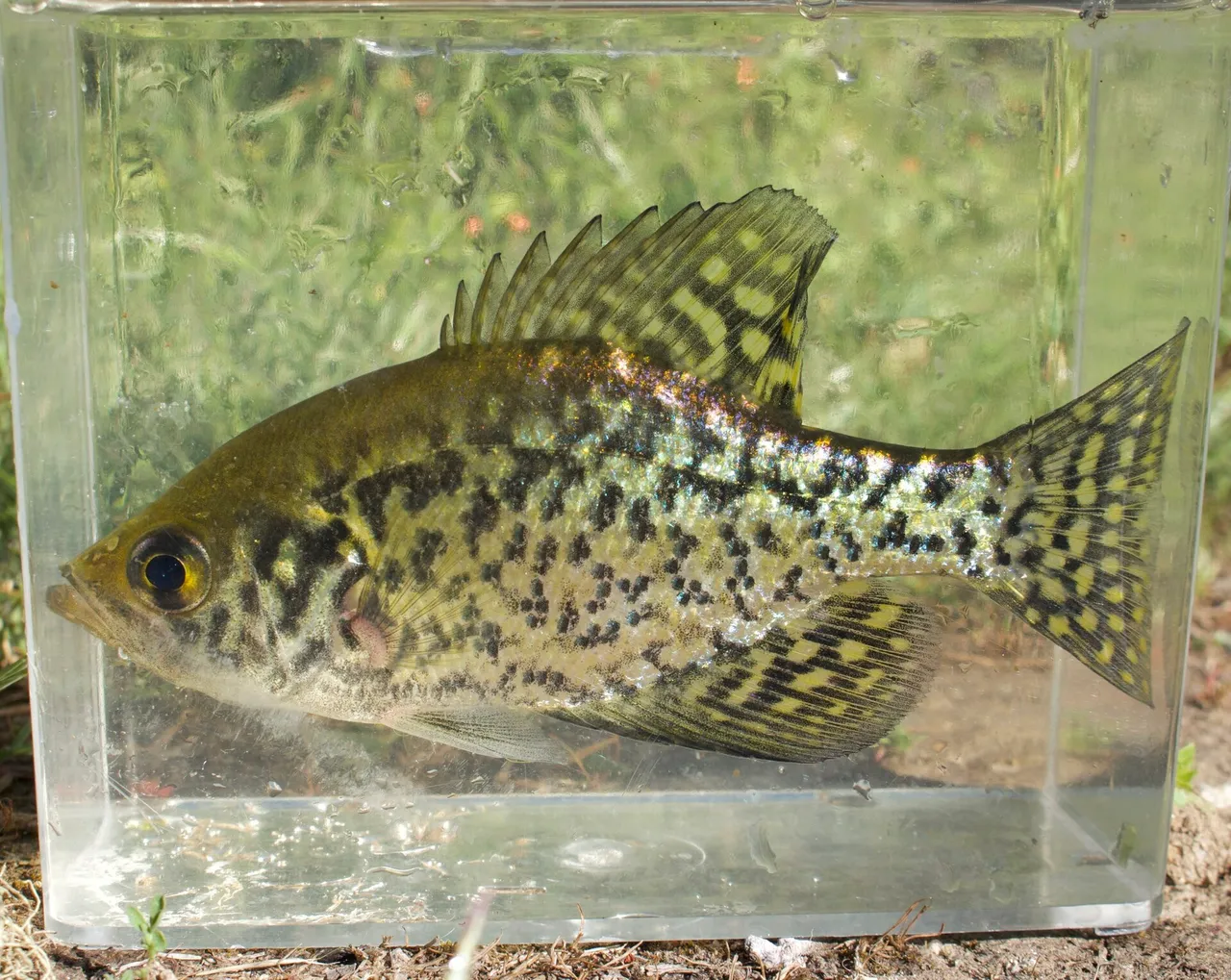
How this was identified, and who took it
Identified by: Full lateral view in a photographic tank. Irregular scattered blotches rather than vertical bars places it as black rather than white crappie; the large upturned mouth and rearward dorsal separate it from bluegill.André Giraldi — CC0 1.0 Public Domain Dedication, via Wikimedia Commons — source, licence
Catching Black crappie
Everything here on fishing for it. Each entry opens the page behind it.
The black crappie is a sunfish that behaves like a small predator. It schools, it holds tight to submerged structure — brush piles, standing timber, docks — and it feeds heavily on small fish, which makes it catchable on tiny jigs and minnows in a way most panfish are not.
Its nickname, papermouth, is the single most useful piece of practical information about it. The membrane around the mouth is extremely thin, and a hook pulls out of it with very little pressure. That is why crappie fishing uses light tackle, soft rods and a lifted rather than a struck hookset, and why anglers who strike hard lose fish they had properly hooked.
It schools by size and by depth, which is the other key behaviour. Finding crappie means finding the depth they are holding at rather than the spot — and once found, a school will often produce many fish from one place, which is both the appeal and the conservation problem.
The black crappie and the white crappie overlap widely and are frequently confused. The reliable separation is the dorsal spine count — black crappie have seven or eight, white crappie five or six — rather than the colouring, which varies too much to trust.
How it is caught
Gear for this fish
- Jigs and jig headsA small marabou or plastic jig suspended at the depth of a crappie school is the whole of this fishery, because the fish suspend in the column around cover rather than sitting on the bottom.
- Soft plasticsSmall soft plastic bodies on light heads answer a fish with a delicate mouth and a preference for small prey, and they are fished slowly for both reasons.
Identification
- Scientific name
- Pomoxis nigromaculatus
- Family
- Centrarchidae
- Water
- Freshwater
- Conservation status
- Least Concern
- Regions
- North America, Western Europe, Central & South America
- Seven or eight dorsal spines — the reliable separation from white crappie, which has five or six. Count them rather than trusting colour.
- Irregular dark speckling scattered over a silvery-green flank, without the vertical bars white crappie usually shows.
- Body very deep and strongly compressed, with a large upturned mouth for a panfish.
- Dorsal and anal fins similar in size and shape, giving the fish a symmetrical outline.
- The mouth membrane is conspicuously thin and translucent, which is the origin of papermouth and is visible in hand.
Size
- Typical
- 150–350 g (5–12 oz)
- Large
- 500–900 g (1–2 lb)
Exceptional: Over 1.5 kg (3.3 lb); maximum published weight 2.7 kg
A paper-thin mouth, and the reason crappie are lost at the net
Crappie handling has almost nothing to do with hazard to the angler and everything to do with a specific fragility that defines the fishery.
THE MOUTH TEARS. Crappie are called papermouths for a reason: the membrane around the jaws is thin and a hook pulls through it under very little load. That is why fish are lost at the moment of lifting, why a swung fish frequently drops off, and why the correct landing action is to net or lift with support rather than to hoist a fish clear on the line. A fish lost at the surface with a torn mouth is a released fish with an injury.
THE SPINES ARE MINOR AND REAL. A stiff spiny first dorsal and sharp gill cover edges, handled the same way as a perch: hand sliding forward from the tail with the dorsal folded flat.
HANDLE THE FISH WITH WET HANDS AND SUPPORT THE BODY, and use a hook-out tool rather than fingers — not for safety but because working a hook out of thin membrane with fingers enlarges the tear.
AND THE SIZE-SELECTION POINT. Crappie are shoal fish taken in numbers, and a livewell or bucket of small fish in warm water is where the mortality in this fishery actually occurs. If fish are being kept, keep them cold. If they are being released, release them as they come rather than accumulating them.
BIOSECURITY. Widely introduced outside its native range. Do not move live fish between waters.
What experienced anglers do — why, and the sources (2)
Widely and independently recommended by experienced anglers and specialist sources. This is real angling knowledge, not proof: controlled evidence for it is limited, and FishingHQ records it as convention rather than as a demonstrated effect.
- FishBase: a global information system on fishes — Froese, R. and D. Pauly, eds. — FishBase Consortium (Scientific institute)Relied on for: Dentition, fin and spine morphology, body form, air-breathing capability and distribution for the species, which are the anatomical facts the handling practice below follows from.States this directlyPassage read and verified
- General angling website restatements of established technique — Various (Credible secondary source)Relied on for: Widely restated angling practice for handling this species, recorded as practitioner consensus rather than as tested fact.Background and mechanism onlyCitation checked — the work exists and is described correctly
A fish that comes shallow once a year and is deep and hard to find the rest of it
Crappie seasonality is the most pronounced shallow-deep cycle of any popular North American panfish, and the spring event dominates the species' reputation to a degree that misleads people about the other ten months.
SPRING BRINGS THEM INTO THE SHALLOWS TO SPAWN AND IT IS TEMPERATURE-TRIGGERED. As water warms into the spawning range, black crappie move from deeper water into shallow cover — brush, timber, weed, docks, bank structure — where males build and guard nests. That movement is what produces the concentrated, accessible spring fishing the species is known for, and it happens at a water temperature rather than on a date, so it can vary by a month between years and between latitudes within the same lake system.
AFTER SPAWNING THEY LEAVE AND THE FISHERY GOES QUIET. Post-spawn crappie disperse to deeper water, relate to structure at depth — creek channels, brush piles, standing timber, drop-offs, thermocline depth — and become far harder to locate. Summer crappie are frequently suspended over deep water rather than on the bottom, and they move, which is why the summer fishery is a searching fishery.
AUTUMN BRINGS A SECOND, WEAKER SHALLOW MOVEMENT as water cools and baitfish move, and it is genuinely productive without ever being as concentrated as spring.
WINTER IS DEEP AND SLOW BUT NOT EMPTY. Crappie remain active at low temperatures relative to many warmwater fish, holding deep and tight and feeding sparingly. In the northern range they are a significant ice-fishing target, which is a seasonal fact worth stating because it contradicts the assumption that the species shuts down.
LIGHT MATTERS THROUGHOUT AND IT IS UNDER-APPRECIATED. Black crappie are strongly low-light feeders, most active at dawn, dusk and at night, and this modulates every seasonal pattern above — a summer population that appears absent in the middle of the day is feeding after dark.
BLACK AND WHITE CRAPPIE DIFFER SEASONALLY IN A WAY THAT MATTERS. Black crappie favour clearer, more vegetated water and white crappie tolerate turbidity better, so in a system holding both, the two species' seasonal positions and spawning timing are staggered rather than identical.
AND THE RULES ARE A SEPARATE SUBJECT. Some jurisdictions manage the spring spawning period specifically; whether they do, and how, is a matter for the competent authority.
Backed by research — why, and the sources (2)
Supported by peer-reviewed research or fisheries science. The sources are listed and can be checked.
- Freshwater Fishes of the British Isles — HarperCollins (New Naturalist 75), 1992 (Reference work)Relied on for: Seasonal behaviour, spawning period and temperature-driven activity of freshwater fishes.Background and mechanism onlyCitation checked — the work exists and is described correctly
- FishBase: a global information system on fishes — Froese, R. and D. Pauly, eds. — FishBase Consortium (Scientific institute)Relied on for: Spawning season, temperature preference and seasonal behaviour for the species.States this directlyPassage read and verified
A swept nest in a colony, and a male that guards in water a few feet deep
Black crappie reproduction is a colonial nest-guarding strategy in shallow water, and its timing and its vulnerability are the two things worth understanding.
MALES SWEEP NESTS AND THEY DO IT IN GROUPS. As water warms into the spawning range in spring, male black crappie clear shallow depressions on firm bottom — sand, gravel, or hard silt — typically near cover such as brush, timber or weed, and frequently in loose colonies rather than in isolation. The female deposits eggs and departs; the male guards them and then the fry.
THE COLONY IS THE VULNERABILITY. A concentration of guarding males in shallow accessible water, all aggressive toward anything approaching, is the most catchable the species ever becomes — and the record's season section explains that this is precisely the period the fishery is built around. Removing guarding males exposes nests, and a nest left unguarded is stripped quickly.
TEMPERATURE TRIGGERS IT AND VARIES IT WIDELY. Spawning begins at a water temperature rather than on a date, so it can shift by a month between years and between latitudes within the same system, and even between the north and south shores of one lake.
COVER IS PART OF THE REQUIREMENT. Crappie nest near structure, and waters with hardened, dredged or cover-free shorelines support far less successful spawning even where the substrate is suitable.
WATER LEVEL IS THE OTHER RISK. In managed reservoirs, a drawdown during the spawning period dewaters nests outright, and a rapid rise moves the fish off them. Reservoir crappie recruitment is consequently strongly tied to spring water-level management, which is a decision made for entirely unrelated reasons.
RECRUITMENT IS HIGHLY VARIABLE AND PRODUCES DOMINANT YEAR CLASSES, which is a defining feature of crappie populations — a single strong year can carry a fishery for several seasons and then leave a gap.
AND WHETHER ANY JURISDICTION PROTECTS THE SPAWNING PERIOD is a matter for the competent authority; many do not, and it is not inferable from the biology.
Backed by research — why, and the sources (2)
Supported by peer-reviewed research or fisheries science. The sources are listed and can be checked.
- Freshwater Fishes of the British Isles — HarperCollins (New Naturalist 75), 1992 (Reference work)Relied on for: Habitat association, spawning behaviour, seasonal activity and ecology of freshwater fishes, including position within a water body.States this directlyCitation checked — the work exists and is described correctly
- FishBase: a global information system on fishes — Froese, R. and D. Pauly, eds. — FishBase Consortium (Scientific institute)Relied on for: Habitat association, spawning season, temperature tolerance and water-type tolerance recorded for the species.States this directlyPassage read and verified
Lifecycle and reproduction
Matures at two to four years and lives around seven to ten. Spawns in spring in colonies, males sweeping nests in shallow water near cover and guarding eggs and fry. Growth and population structure are highly variable between waters and between years, with strong year classes dominating a fishery for several seasons — which makes crappie populations unusually boom-and-bust compared with other panfish.
Colonial nest spawning in spring in shallow water, generally associated with cover, with males guarding. Recruitment is notably variable year to year, producing dominant year classes that work through a fishery over several seasons. That variability is why crappie fishing can be excellent one year and poor the next in the same water without anything obvious having changed.
Feeding and senses
Feeds heavily on small fish, supplemented by aquatic insects and crustaceans, and the piscivorous element is more pronounced than in bluegill. Feeding is most active at low light. The fish-based diet is why small jigs, soft plastics and live minnows dominate the fishery, and why crappie will take a lure that a bluegill would ignore.
Adapted to low light, with large eyes and a strong dawn, dusk and night feeding pattern — one of the reasons crappie fishing under lights at night is a tradition in much of the range. Sight dominates when feeding on small fish; the lateral line supports it in the stained water and heavy cover the species favours.
Through the year
Moves shallow to spawn as water warms in spring, which is the most accessible period and the one most anglers fish. Through summer the schools hold deeper around structure and suspend at a preferred depth; in autumn they feed heavily; and through winter they remain catchable, including through the ice in the north. Finding the holding DEPTH matters more than finding the spot for most of the year.
Distribution
North America: native to the eastern and central United States and southern Canada, and introduced widely elsewhere on the continent and internationally, including in parts of Europe, Asia and Central America.
This is a biological range — where the species occurs, not a prediction that you will catch one. To browse the fishing geography FishingHQ holds, start at fishing places.
Why anglers care
Among the most popular freshwater sport and table fish in the United States, taken on small jigs, soft plastics and live minnows from boats, docks and banks, and through the ice. Schooling behaviour makes it possible to catch many fish from one location, which is both the appeal and the reason bag limits exist for it.
Handling and returning
The thin mouth membrane tears easily, so lift rather than strike, use light tackle and a soft rod, and support the fish rather than hanging it by the jaw. The dorsal spines are sharp. Wet hands and use a disgorger for small hooks. Where a school has been located, the honest consideration is that it is possible to remove a great many fish from one spot in one session.
Going further
- What does black crappie eat? — feeding biology, kept separate from what anglers infer from it.
- Black crappie vs Bluegill — how to tell them apart.
Safety
Venomous and spined species — Can cause injury needing treatment
Sharp dorsal and anal spines on a small fish handled in numbers.
What reduces it: Hold the fish with the spines folded, wet hands, and use a disgorger rather than fingers. Clean any puncture properly.
Biosecurity and disease transfer — Can cause injury needing treatment
Crappie are widely introduced beyond their native range, and the movement of live fish and of live minnow bait spreads both species and pathogens.
What reduces it: Never move live fish or water between waters. Do not release unused live bait. Clean, drain, dry and check equipment between waters.
Precautions that always apply here
- Handle spined and venomous species with the spines controlled. Know which local species have them before you fish, not afterwards.
- Wet your hands before touching a fish. Dry hands strip the protective mucus layer that keeps infection out.
- Check, clean and dry your kit between different waters — the published guidance is 48 hours’ drying, in sunlight where possible, because a number of invasive species survive over two weeks in damp conditions. Nets, boots and wet mats move invasive species and disease more effectively than anything else anglers do.
- Never move live fish, live bait or water from one water to another.
Check the rules before you fish
Fishing laws, bylaws, access rules, seasons, bait restrictions and permitted methods vary by location and can change. Check the current rules from the relevant authority and the water you intend to fish before fishing.
Check with:
- Current national or regional law for where you are fishing
- Current local bylaws
- The relevant fisheries authority
- The landowner, club or fishery whose water it is
- Any restrictions specific to the species or the method you intend to use
Where to go next
Similar and related fish
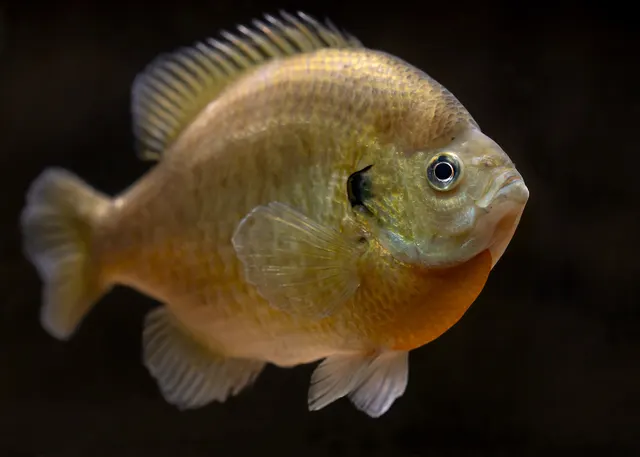 BluegillBoth are sunfish of the Centrarchidae, and the difference that matters is diet: crappie eat small fish and take jigs and minnows, bluegill pick invertebrates and do not.
- Gizzard shadYoung-of-year gizzard shad are a principal crappie prey through the warmer months, and the arrival of a strong shad year class changes crappie growth for a season.
Understanding this fish
Told apart from
Sources and evidence
- FishBase: a global information system on fishes — Froese, R. and D. Pauly, eds. — FishBase Consortium (Scientific institute)Relied on for: Scientific name, family placement in the Centrarchidae, a maximum length of 49.0 cm TL, a maximum published weight of 2.7 kg, a maximum reported age of 15 years.States this directlyPassage read and verified
- FishBase: a global information system on fishes — Froese, R. and D. Pauly, eds. — FishBase Consortium (Scientific institute)Relied on for: Environment, climate zone and depth range as recorded: Freshwater; benthopelagic; pH range: 6.0 - 7.5; depth range 0 - ? m . Subtropical; 14°C - 31°C ; 50°N - 25°N, 100°W - 73°WStates this directlyPassage read and verified
- FishBase: a global information system on fishes — Froese, R. and D. Pauly, eds. — FishBase Consortium (Scientific institute)Relied on for: The IUCN Red List category for Pomoxis nigromaculatus — Least Concern, assessed 01 March 2012 — as republished by FishBase, the Red List itself being unreachable during review.States this directlyPassage read and verified
- Check Clean Dry — biosecurity guidance for water users — GB Non-native Species Secretariat (Conservation authority)Relied on for: The framework by which introduced fish are assessed and managed, and live bait movement as a recognised pathway.FishingHQ's interpretation of what it saysPassage read and verified
Why the 7 connections on this page are here, and the sources
Similar and related fish
Backed by research — 2 connections
Supported by peer-reviewed research or fisheries science. The sources are listed and can be checked.
Bluegill
A comparison resting on shared family and differing feeding ecology, naming both binomials.
- FishBase: a global information system on fishes — Froese, R. and D. Pauly, eds. — FishBase Consortium (Scientific institute)Relied on for: That Pomoxis nigromaculatus and Lepomis macrochirus are both Centrarchidae, with the former taking a substantially piscivorous diet.States this directlyPassage read and verified
Gizzard shad
Recorded diet evidence identifies Dorosoma cepedianum as a food item of this predator at species level. The edge is written at that granularity and no further.
- FishBase: a global information system on fishes — Froese, R. and D. Pauly, eds. — FishBase Consortium (Scientific institute)Relied on for: Food items recorded for this predator, including Dorosoma cepedianum.States this directlyPassage read and verified
- FAO Species Identification Guides for Fishery Purposes and the FAO Species Catalogues — Food and Agriculture Organization of the United Nations (Scientific institute)Relied on for: Species account describing the diet of this predator in the region where Dorosoma cepedianum occurs.Background and mechanism onlyCitation checked — the work exists and is described correctly
How it is caught
What experienced anglers do — 1 connection
Widely and independently recommended by experienced anglers and specialist sources. This is real angling knowledge, not proof: controlled evidence for it is limited, and FishingHQ records it as convention rather than as a demonstrated effect.
Jigging
A practitioner claim about the dominant method for the species.
- General angling website restatements of established technique — Various (Credible secondary source)Relied on for: Widely restated practitioner accounts of jig fishing for crappie around structure and at located depths.Citation checked — the work exists and is described correctly
- Angling Times — Bauer Media (Specialist angling publication)Relied on for: Contemporary treatment of small jig and soft plastic technique.Citation checked — the work exists and is described correctly
Gear for this fish
What experienced anglers do — 2 connections
Widely and independently recommended by experienced anglers and specialist sources. This is real angling knowledge, not proof: controlled evidence for it is limited, and FishingHQ records it as convention rather than as a demonstrated effect.
Jigs and jig heads
A practitioner claim about which lure family answers this species' feeding or holding behaviour.
- General angling website restatements of established technique — Various (Credible secondary source)Relied on for: Widely restated North American lure practice for this species.Background and mechanism onlyCitation checked — the work exists and is described correctly
- IGFA International Angling Rules and World Record Requirements — International Game Fish Association (Angling or fisheries organisation)Relied on for: Recognition of the species as an established sport fish taken on artificial lures, and the tackle conventions used for it.States this directlyPassage read and verified
Soft plastics
A practitioner claim about which lure family answers this species' feeding or holding behaviour.
- General angling website restatements of established technique — Various (Credible secondary source)Relied on for: Widely restated North American lure practice for this species.Background and mechanism onlyCitation checked — the work exists and is described correctly
- IGFA International Angling Rules and World Record Requirements — International Game Fish Association (Angling or fisheries organisation)Relied on for: Recognition of the species as an established sport fish taken on artificial lures, and the tackle conventions used for it.States this directlyPassage read and verified
Understanding this fish
Backed by research — 1 connection
Supported by peer-reviewed research or fisheries science. The sources are listed and can be checked.
Aquatic insect larvae as prey
Recorded diet evidence identifies aquatic insect larvae as a food item of this predator at group level rather than to species. The edge points at the taxon record for that reason, and encoding it as a species-level claim would assert something the source does not.
- FishBase: a global information system on fishes — Froese, R. and D. Pauly, eds. — FishBase Consortium (Scientific institute)Relied on for: Food items recorded for this predator, given as aquatic insect larvae.States this directlyPassage read and verified
- FAO Species Identification Guides for Fishery Purposes and the FAO Species Catalogues — Food and Agriculture Organization of the United Nations (Scientific institute)Relied on for: Species account describing this predator's diet, recorded at the level of aquatic insect larvae.Background and mechanism onlyCitation checked — the work exists and is described correctly
Told apart from
Backed by research — 1 connection
Supported by peer-reviewed research or fisheries science. The sources are listed and can be checked.
White crappie
An identification comparison naming both binomials: Pomoxis annularis and Pomoxis nigromaculatus.
- FishBase: a global information system on fishes — Froese, R. and D. Pauly, eds. — FishBase Consortium (Scientific institute)Relied on for: Morphological and distributional data for Pomoxis annularis and for Pomoxis nigromaculatus.States this directlyPassage read and verified
- The IUCN Red List of Threatened Species — International Union for Conservation of Nature (Conservation authority)Relied on for: Separate assessments treating Pomoxis annularis and Pomoxis nigromaculatus as distinct species.States this directlyCitation checked — the work exists and is described correctly
An identification link between two species readers genuinely mistake for one another, resting on published morphological characters rather than on angling lore, and naming the character that separates them.
- FishBase: a global information system on fishes — Froese, R. and D. Pauly, eds. — FishBase Consortium (Scientific institute)Relied on for: Morphological description, meristic counts, family placement, distribution and environment of the species named.States this directlyPassage read and verified
- FAO Species Identification Guides for Fishery Purposes and the FAO Species Catalogues — Food and Agriculture Organization of the United Nations (Scientific institute)Relied on for: Identification characters and distribution for inland and coastal fishes, from regional identification guides prepared for fishery purposes.States this directlyCitation checked — the work exists and is described correctly
How FishingHQ labels evidence is explained in the evidence policy.