What does black crappie eat?
What is established about how black crappie feeds, kept separate from what anglers infer from it.
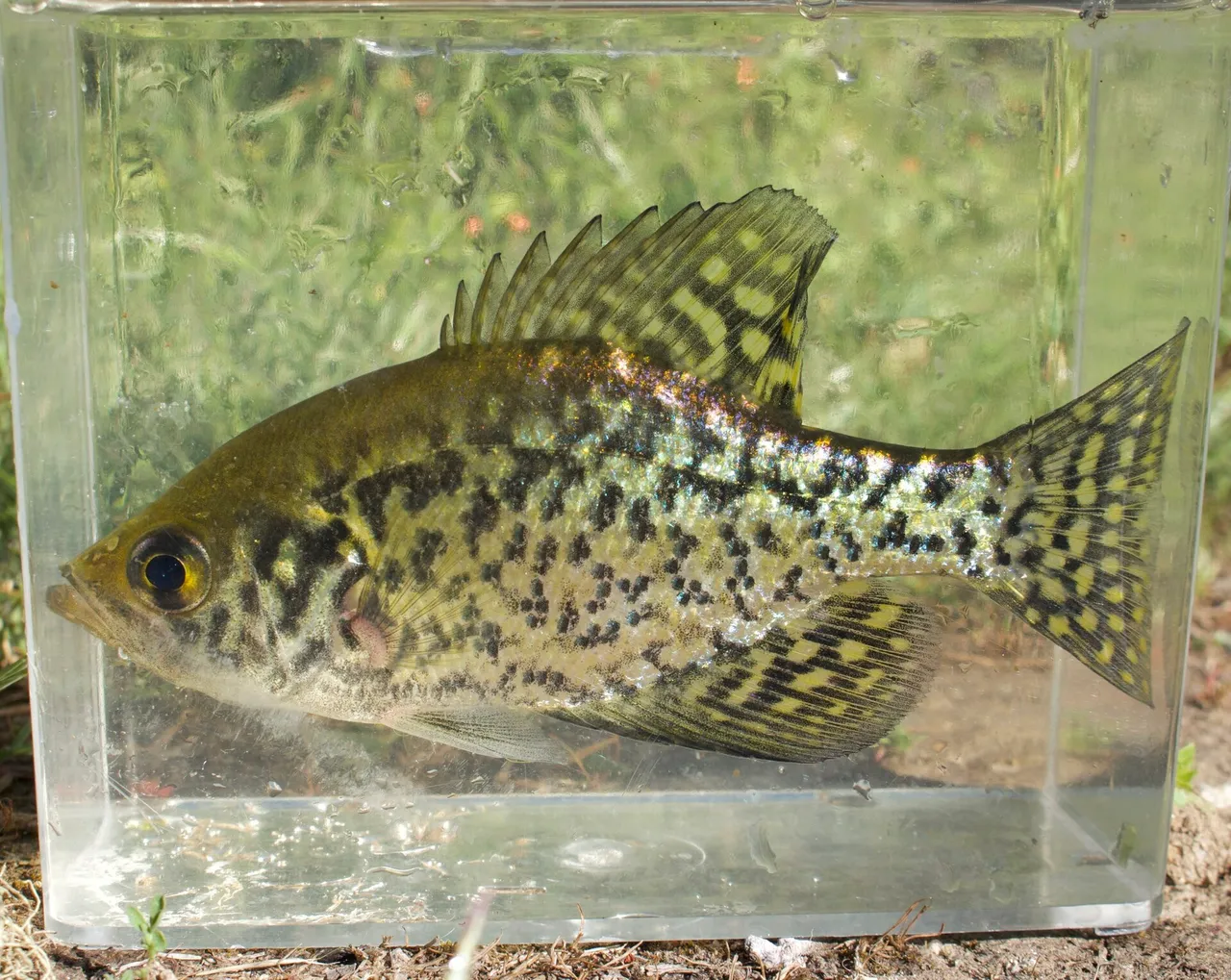
How this was identified, and who took it
Identified by: Full lateral view in a photographic tank. Irregular scattered blotches rather than vertical bars places it as black rather than white crappie; the large upturned mouth and rearward dorsal separate it from bluegill.André Giraldi — CC0 1.0 Public Domain Dedication, via Wikimedia Commons — source, licenceWhat is known about how it feeds
The black crappie feeds in open water rather than on the bottom, and that is what separates it from most of the panfish it is grouped with.
The species suspends over structure rather than sitting on it, and feeds upwards and outwards on small fish and invertebrates in the water column. Young-of-year gizzard shad — the verified relationship — are a principal item through the warmer months, and the arrival of a strong shad year class changes crappie growth for a season.
The second verified relationship is aquatic insect larvae, which dominate in smaller fish and remain significant in adults through the colder months when shad are less available.
The mouth is large for the size of the fish but the tissue around it is thin and delicate, which is a physical characteristic with consequences for how the fish is handled rather than for what it eats.
Feeding is strongly light-linked with peaks at dawn and dusk, and the species is notably active in cold water — crappie remain catchable through winter when many warm-water species have effectively stopped, which is why they support a substantial ice fishery at the northern edge of the range.
The suspension habit is the most useful single fact: a crappie shoal has a depth, and that depth is more informative than its horizontal position.
The food
Prey with a verified dietary link to this fish. Each entry carries its own evidence, and each is written at the precision the source actually used: a named species where the source named one, a group or food category where it said “polychaetes”, “crustaceans” or “detritus” and meant it. That is why this list is shorter than the animal’s real diet rather than longer.
- Gizzard shad — Dorosoma cepedianum
Young-of-year gizzard shad are a principal crappie prey through the warmer months, and the arrival of a strong shad year class changes crappie growth for a season.
- Aquatic insect larvae as prey — a group rather than a species: the evidence names the group
Insect larvae and zooplankton dominate the diet of smaller crappie and remain significant in adults through the colder months.
Food with no page of its own here yet
These are real components of the diet, listed as plain text because FishingHQ has no page for them yet. Inventing pages to make the list look fuller would be the fabrication this whole approach exists to prevent.
- threadfin shad
- small minnows and shiners
- zooplankton, in smaller fish
- small crayfish
What anglers do with this
Everything below is interpretation, not finding. It is what experienced anglers conclude from the biology above, and the reasoning is usually sound and almost never tested. It is separated from the biology deliberately.
Depth is the organising variable, and anglers treat it as such: a crappie shoal is located vertically as much as horizontally, and presentations are worked at a found depth rather than searched through the column indiscriminately.
The upward feeding orientation converts into the convention of presenting above the fish rather than below it, which follows from the observed suspension and feeding behaviour.
The delicate mouth tissue is not interpretation and it is the reason for the species' nickname among anglers: a heavy strike or a hard fight tears out, and the handling follows from the anatomy.
The cold-water activity converts into a genuine winter fishery, which is unusual for a warm-water panfish.
What this does not establish
The insect relationship is group-level and the shad relationship describes the warmer months. Composition varies with the forage base of the water and with the strength of a given shad year class, which changes annually. Nothing here establishes proportions.
Where this connects
These are the baits, lures, methods and explainers FishingHQ already joins to this fish — which is why the list is sometimes short. They are not chosen for this page, and a link here means an evidenced relationship exists, not that it follows from the diet.
Lures recorded for this species
Methods used for it
This page covers feeding. The Black crappie record covers identification, lifecycle, seasonal behaviour, handling and the sources behind all of it.
Reviewed 2026-08-12.