How to identify black crappie
Pomoxis nigromaculatus · Centrarchidae
The characters that identify black crappie, ranked by how far each one can be trusted on its own.
Safety: venomous and spined species — can cause injury needing treatment. One more point applies here.
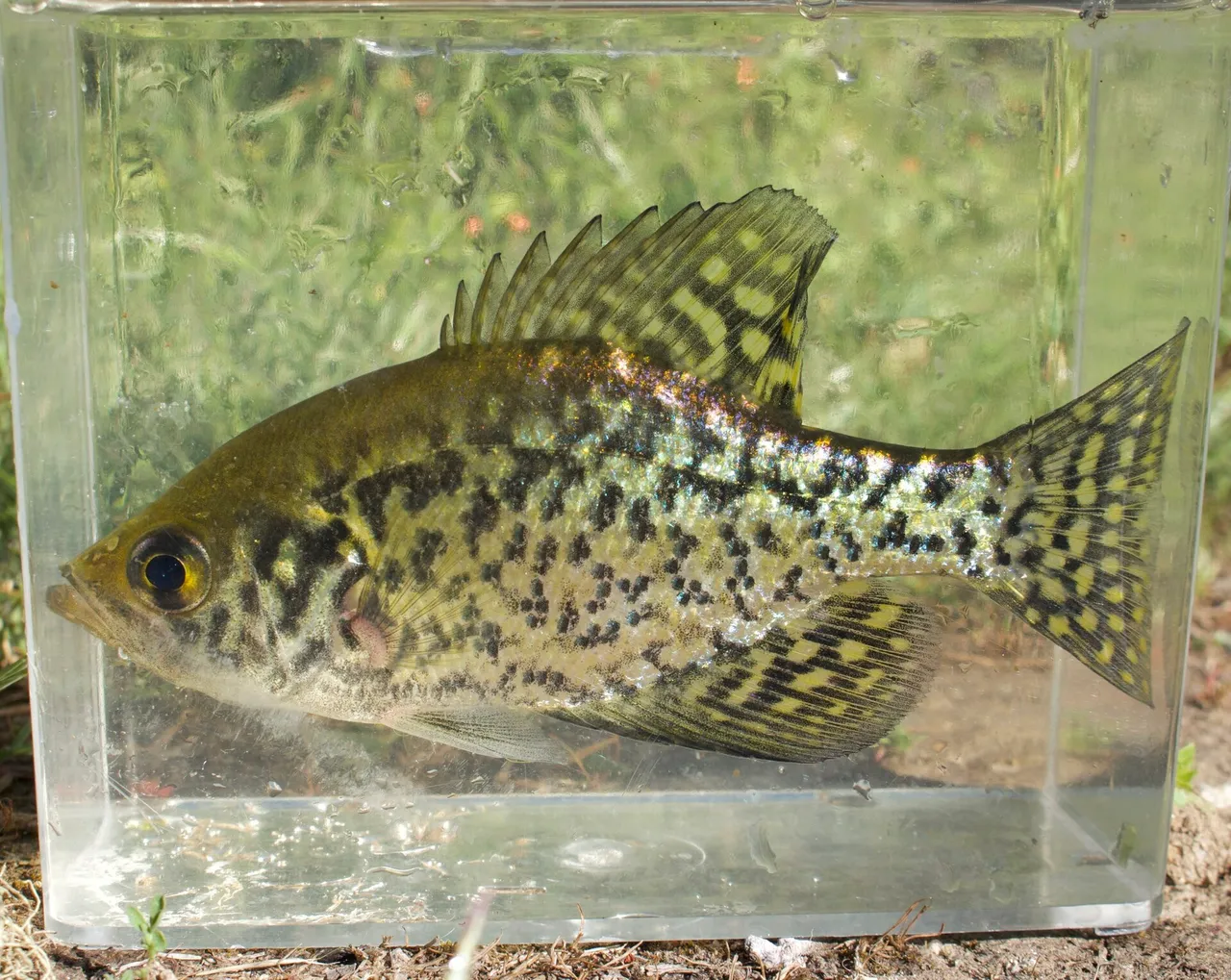
How this was identified, and who took it
Identified by: Full lateral view in a photographic tank. Irregular scattered blotches rather than vertical bars places it as black rather than white crappie; the large upturned mouth and rearward dorsal separate it from bluegill.André Giraldi — CC0 1.0 Public Domain Dedication, via Wikimedia Commons — source, licenceLook at this first
Count the spines at the front of the dorsal fin. Seven or eight means black crappie; five or six means white crappie. It takes longer than looking at the fish and it is the only separation that does not fail, because the two species vary in colour far more than the names suggest.
Diagnostic — settles it on its own
Each of these settles the identification on its own. If one is clear, you have your answer.
Seven or eight dorsal spines
Run a thumb forward along the leading edge of the dorsal and count the stiff rays before the fin softens. The count does not overlap between the two crappie, which is unusual and is why it outranks everything else on this page.
Supporting — use with other characters
Real characters that are not conclusive by themselves. Use two or three together.
Speckling scattered, not banded
Dark marks are distributed irregularly over the flank instead of gathering into the vertical bands a white crappie usually carries. Reliable on most fish and undone by the ones that are not most fish, particularly spawning males of either species.
A symmetrical outline
The dorsal and anal fins are close to the same size and shape and sit opposite one another, so the fish looks nearly mirrored top to bottom. Distinctive within the panfish, and shared with white crappie.
The papery mouth
The membrane around the jaws is thin enough to be translucent and tears under very little load. It identifies the genus rather than the species, and it is the reason these fish are lifted rather than swung.
Suggestive only — varies with condition
Hints only. These vary with condition, season, water and how long the fish has been out of it, and a fish that contradicts them is still the same species.
Overall darkness
The name invites a colour judgement and the colour will not support one. Crappie from clear water are dark and heavily marked, and the same species from a stained reservoir can be pale enough to be called a white crappie by somebody who did not count.
What it gets confused with
- White crappie, which is the only serious confusion and is settled entirely by the spine count.
- Hybrid crappie, stocked deliberately in some fisheries, which can carry an intermediate spine count.
- Juvenile sunfish at small sizes, separated by the crappie's much larger and more upturned mouth.
Side by side: Black crappie vs Bluegill.
Where this stops working
The two crappie hybridise and hybrids are stocked on purpose in some managed waters, which puts a fish in the net that the spine count cannot resolve. Spawning colour changes both species substantially — a male black crappie in spring can be almost entirely dark. Where a fishery has a species-specific rule, a count is worth making rather than a guess.
The full record
This page covers identification only. The Black crappie record covers behaviour, lifecycle, distribution, handling and the sources behind all of it.
Reviewed 2026-08-14.
More about this fish
Telling it apart is one question. Here are the others.
Similar and related fish
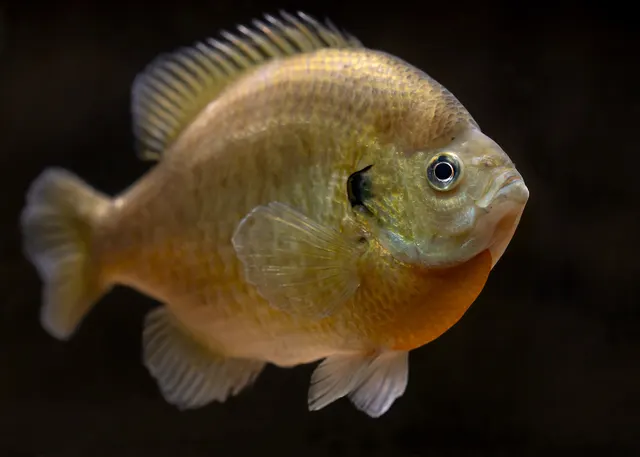 BluegillBoth are sunfish of the Centrarchidae, and the difference that matters is diet: crappie eat small fish and take jigs and minnows, bluegill pick invertebrates and do not.
- Gizzard shadYoung-of-year gizzard shad are a principal crappie prey through the warmer months, and the arrival of a strong shad year class changes crappie growth for a season.
How it is caught
Why the 3 connections on this page are here, and the sources
Similar and related fish
Backed by research — 2 connections
Supported by peer-reviewed research or fisheries science. The sources are listed and can be checked.
Bluegill
A comparison resting on shared family and differing feeding ecology, naming both binomials.
- FishBase: a global information system on fishes — Froese, R. and D. Pauly, eds. — FishBase Consortium (Scientific institute)Relied on for: That Pomoxis nigromaculatus and Lepomis macrochirus are both Centrarchidae, with the former taking a substantially piscivorous diet.States this directlyPassage read and verified
Gizzard shad
Recorded diet evidence identifies Dorosoma cepedianum as a food item of this predator at species level. The edge is written at that granularity and no further.
- FishBase: a global information system on fishes — Froese, R. and D. Pauly, eds. — FishBase Consortium (Scientific institute)Relied on for: Food items recorded for this predator, including Dorosoma cepedianum.States this directlyPassage read and verified
- FAO Species Identification Guides for Fishery Purposes and the FAO Species Catalogues — Food and Agriculture Organization of the United Nations (Scientific institute)Relied on for: Species account describing the diet of this predator in the region where Dorosoma cepedianum occurs.Background and mechanism onlyCitation checked — the work exists and is described correctly
How it is caught
What experienced anglers do — 1 connection
Widely and independently recommended by experienced anglers and specialist sources. This is real angling knowledge, not proof: controlled evidence for it is limited, and FishingHQ records it as convention rather than as a demonstrated effect.
Jigging
A practitioner claim about the dominant method for the species.
- General angling website restatements of established technique — Various (Credible secondary source)Relied on for: Widely restated practitioner accounts of jig fishing for crappie around structure and at located depths.Citation checked — the work exists and is described correctly
- Angling Times — Bauer Media (Specialist angling publication)Relied on for: Contemporary treatment of small jig and soft plastic technique.Citation checked — the work exists and is described correctly
Safety
Venomous and spined species — Can cause injury needing treatment
Sharp dorsal and anal spines on a small fish handled in numbers.
What reduces it: Hold the fish with the spines folded, wet hands, and use a disgorger rather than fingers. Clean any puncture properly.
Biosecurity and disease transfer — Can cause injury needing treatment
Crappie are widely introduced beyond their native range, and the movement of live fish and of live minnow bait spreads both species and pathogens.
What reduces it: Never move live fish or water between waters. Do not release unused live bait. Clean, drain, dry and check equipment between waters.